NGC 559 is a relatively bright open star cluster located in the northern constellation Cassiopeia. Popularly known as the Ghost’s Goblet, the cluster is visible in small telescopes. It is listed as Caldwell 8 in the Caldwell catalogue of deep sky objects accessible to amateur astronomers. It spans 9.7 arcminutes across and has an apparent visual magnitude of 9.5.
A Ghostly Goblet in Cassiopeia’s W
NGC 559 lies in the region of Cassiopeia’s W, one of the most familiar asterisms in the far northern sky. The cluster was discovered by William Herschel using an 18.7-inch reflector on November 9, 1787. Herschel listed it as VII 48 in his catalogue.
The cluster is one of the several deep sky objects in Cassiopeia listed in the Caldwell catalogue. The others include the open clusters NGC 663 and the Owl Cluster (NGC 457), the dwarf spheroidal galaxies NGC 147 and NGC 185, and the emission nebula NGC 7635 (the Bubble Nebula).
The Ghost’s Goblet is one of at least eight open clusters in the area near Segin and Ruchbah that can be picked out in binoculars or small telescopes. It has a mass of 1,949 Suns and contains around 40 stars that shine at magnitude 12 or brighter.
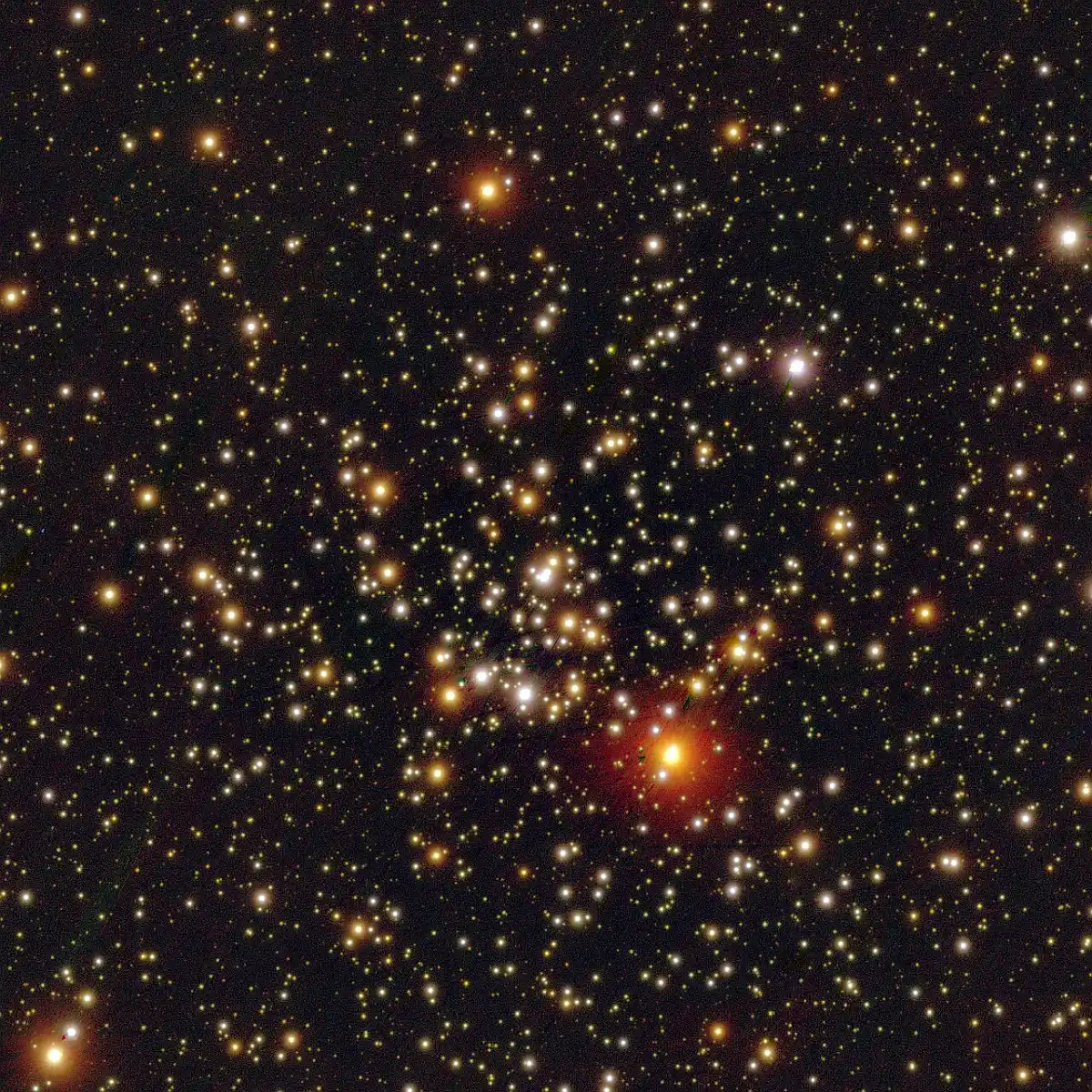
The Ghost’s Goblet Cluster (NGC 559), image credit: PanSTARRS & Melina Thévenot (CC BY-SA 4.0)
How the Ghost’s Goblet got its name
The cluster was nicknamed Ghost’s Goblet by astronomer Stephen J. O’Meara in his book The Caldwell Objects (2016). As he explained, “With imagination this central core takes on an eerie quality, that of a still photograph of a ghostly jeweled goblet in the act of vanishing. In a way, this metaphor reflects the cluster’s advanced age (1.8 billion years).”
A younger cluster than once thought
The cluster’s age has since been revised sharply downward. In 2020, Joshi et al identified 30 variable stars in cluster, including three slowly pulsating B-type stars, one Algol-type eclipsing binary system, two FK Comae Berenices variables, five rotational variables, and a candidate blue straggler. Based on photometric data, the researchers derived an age of 224 ± 25 million years for the cluster.
In 2023, Almeida et al. used Gaia DR3 data to determine the fundamental parameters of open clusters. They gave NGC 559 an age of around 570 million years and a distance of 7,674 light-years (2.353 ± 0.041 kpc). At that distance, the cluster’s angular size of 9.7 arcminutes corresponds to a physical radius of around 21,700 light-years. The two newer age estimates differ but both give the cluster a fraction of the age in O’Meara’s book.
How to find NGC 559 in the night sky
The Ghost’s Goblet Cluster lies close to the imaginary line running from Segin (Epsilon Cassiopeiae), the leftmost star in Cassiopeia’s W, to Caph (Beta Cassiopeiae), the rightmost star. It sits just over 3 degrees north of Ruchbah (Delta Cassiopeiae), the bottom left star of the asterism.
In good conditions, NGC 559 can be spotted in small binoculars. A small telescope will resolve its brightest members and turn the faint smudge into a scatter of individual stars.
At declination +63, the cluster is circumpolar for observers north of the latitude 27° N, which means that it never sets from those locations. From places south of 27° S, it never rises. For mid-northern observers, the cluster stays visible year-round.
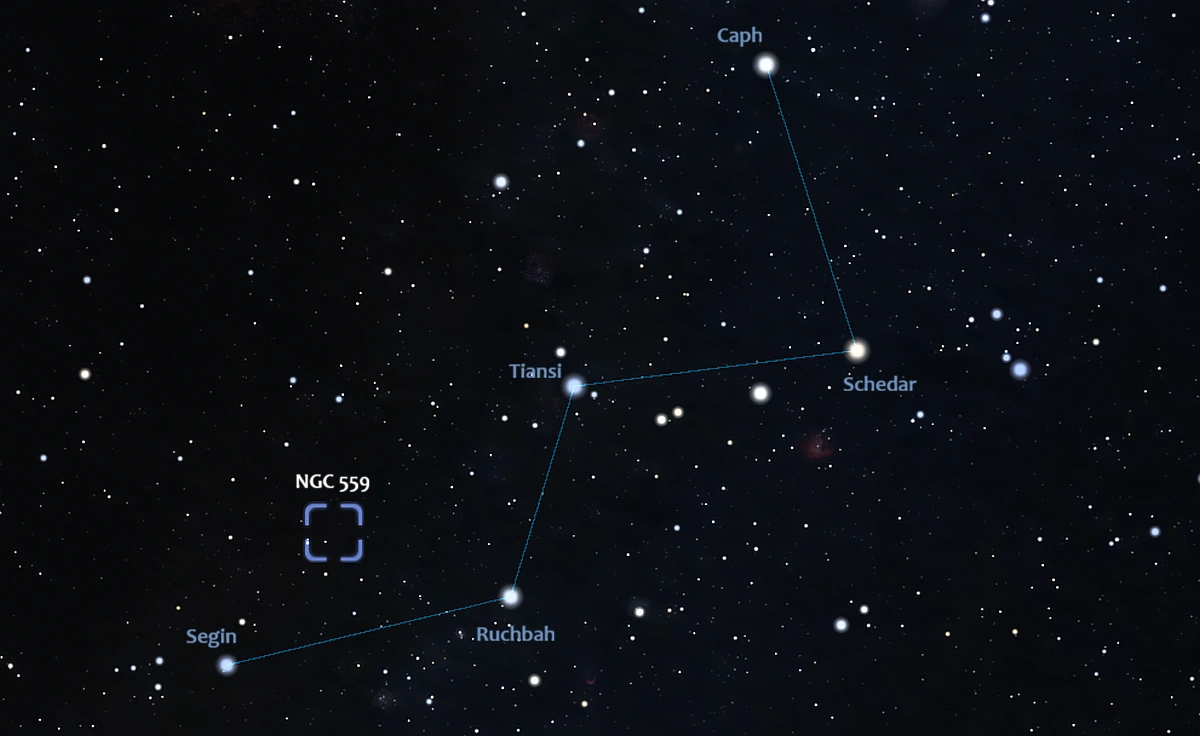
Location of NGC 559, image: Stellarium (annotated for this article)
Explore other deep sky objects in Cassiopeia:
- Tycho’s Supernova (SN 1572)
- Sailboat Cluster (NGC 225)
- Cassiopeia A
- Caroline’s Rose Cluster (NGC 7789)
- Pacman Nebula (NGC 281)
Ghost’s Goblet – NGC 559
| Constellation | Cassiopeia |
| Object type | Open cluster |
| Right ascension | 01h 29m 31.20s |
| Declination | +63° 18′ 07.2″ |
| Apparent magnitude | 9.5 |
| Apparent size | 9.7′ |
| Distance | 7,674 ± 134 light-years (2.353 ± 0.041 kpc) |
| Mass | 1949 ± 389 M☉ |
| Size | 21,700 ± 400 light-years (6.6 ± 0.1 pc) |
| Age | ~570 million years |
| Names and designations | NGC 559, Ghost’s Goblet Cluster, Caldwell 8, C8, Collinder 13, Cr 13, C 0126+630, OCl 322, OCISM 74, [KPS2012] MWSC 0122 |