Frederick’s Glory is a relatively bright asterism located in the constellation Andromeda. It is the remnant of the obsolete constellation Honores Friderici (Frederick’s Honour or Frederick’s Glory). The Y-shaped star pattern lies in northwestern Andromeda, near the border with Cassiopeia, and can be used to find the Blue Snowball Nebula (NGC 7662) and the bright open cluster NGC 7686.
The stars that form Frederick’s Glory are Lambda, Kappa, Iota, and Psi Andromedae. Together with the brighter Omicron Andromedae, they were the most prominent stars of the constellation Honores Friderici. With apparent magnitudes in the range from 3.8 to 4.95, they are visible from areas without too much light pollution.
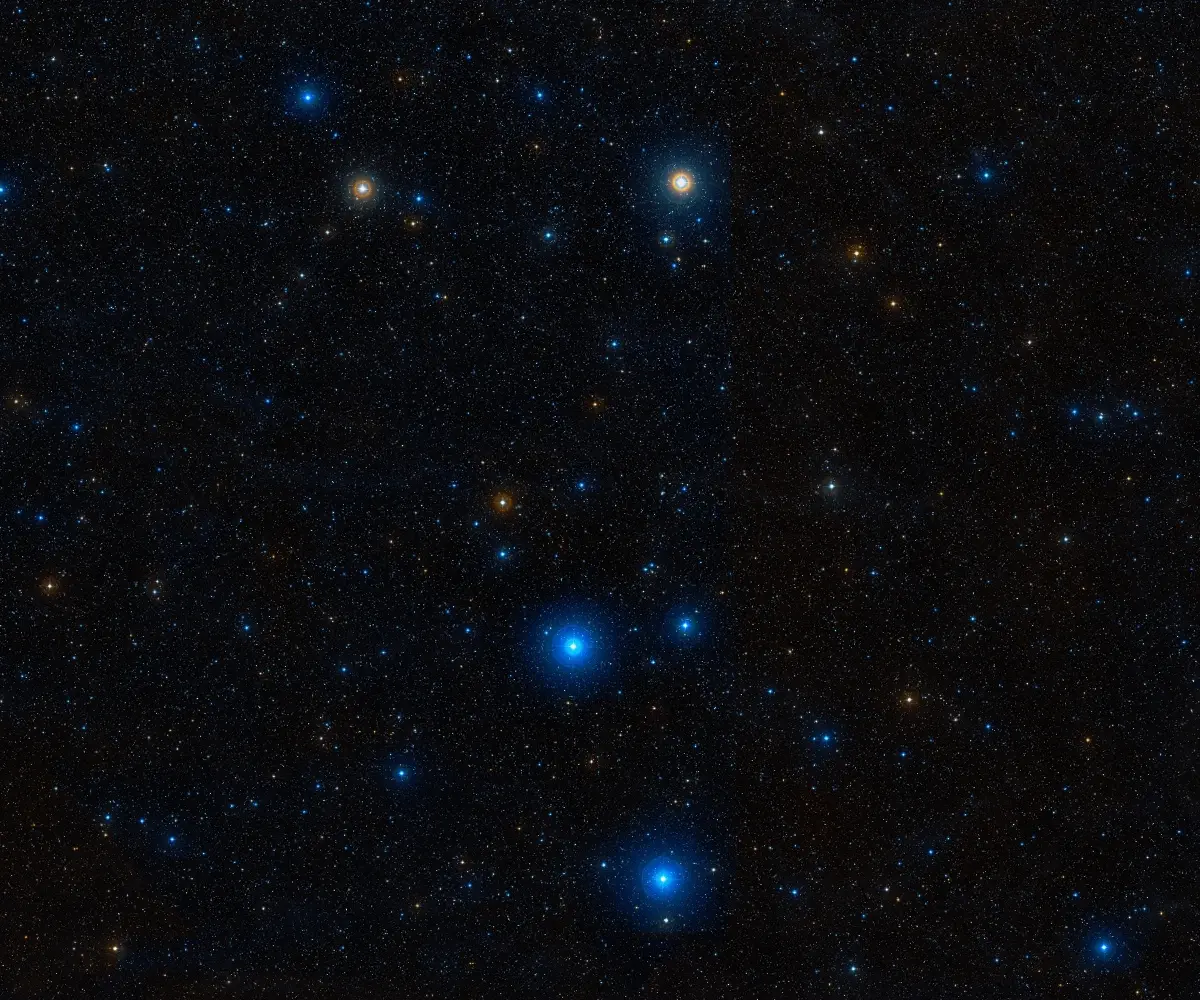
Frederick’s Glory, image credit: ESO/Digitized Sky Survey 2 (CC BY 4.0)
Quick facts
| Frederick’s Glory | |
| Constellation | |
| Best viewing season | Autumn |
| Number of stars | 4 (Lambda, Kappa, Iota and Psi Andromedae) |
| Magnitude range | 3.8 – 4.95 |
| Alternative names | Gloria Frederici, Gloria Frederica, Honores Friderici, Frederici Honores |
The lost constellation behind the asterism
The constellation Honores Friderici was created by the German astronomer Johann Elert Bode in 1787. Bode introduced the constellation as a tribute to Frederick the Great, the king of Prussia, who had passed away in 1786.
Honores Friderici was depicted as a crown on top of a sword, with a pen and an olive branch tied to the sword to celebrate Frederick’s wisdom, military successes, and peacemaking endeavours. The constellation’s original name, Friedrichs Ehre, was Latinized to Honores Friderici in Bode’s star atlas Uranographia of 1801. In 2025, the International Astronomical Union (IAU) named the star 7 Andromedae Honores to commemorate the former constellation.
Honores Friderici included 76 stars, mostly in Andromeda, but also in the neighbouring Lacerta, Cepheus, Pegasus, and Cassiopeia. The constellation’s brightest star was Omicron Andromedae (Alfarasalkamil), Andromeda’s sixth brightest star.
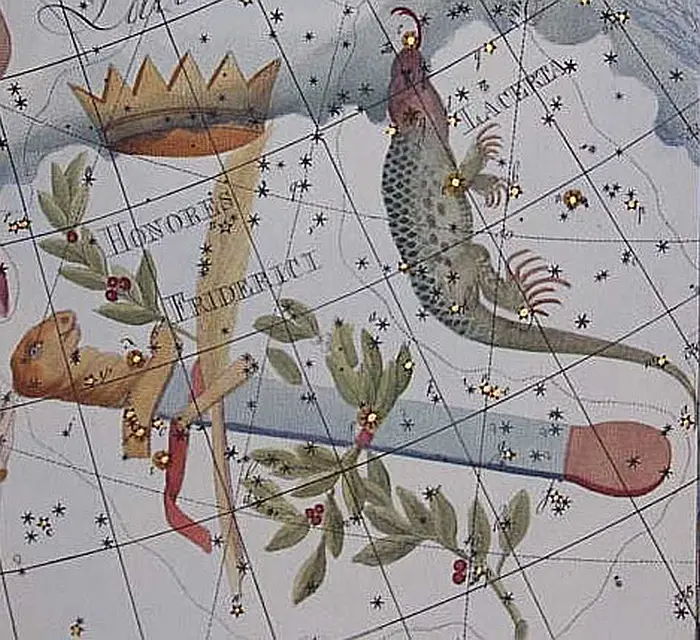
Honores Friderici depicted in Johann Bode’s Uranographia (1801)
The stars of Frederick’s Glory
The four stars that form Frederick’s Glory are all visible to the unaided eye on a clear, dark night. All four are larger, more massive, and more luminous than the Sun. They lie at very different distances and are not physically related to one another. Lambda and Psi Andromedae mark the upper part of the Y and Kappa and Iota form the base. Lambda and Psi are evolved yellow stars, while Kappa and Iota are white and blue-white main sequence stars.
| Star | Name | Vmag | Distance (ly) | Spectral type | Mass (M☉) | Radius (R☉) | Luminosity (L☉) |
| Lambda | Udkadua | 3.8 | 84.6 | G8 IV | 1.47 | 7.787 | 28.8 |
| Kappa | Kaffalmusalsala | 4.12 | 168 | A0 V | 2.768 | 2.303 | 62.60 |
| Iota | Rasalnaqa | 4.29 | 510 | B8 V | 3.1 | 4.6 | 638 |
| Psi | 4.95 | 2,000 | G5 Ib | 5.4 | 59 | 1049 |
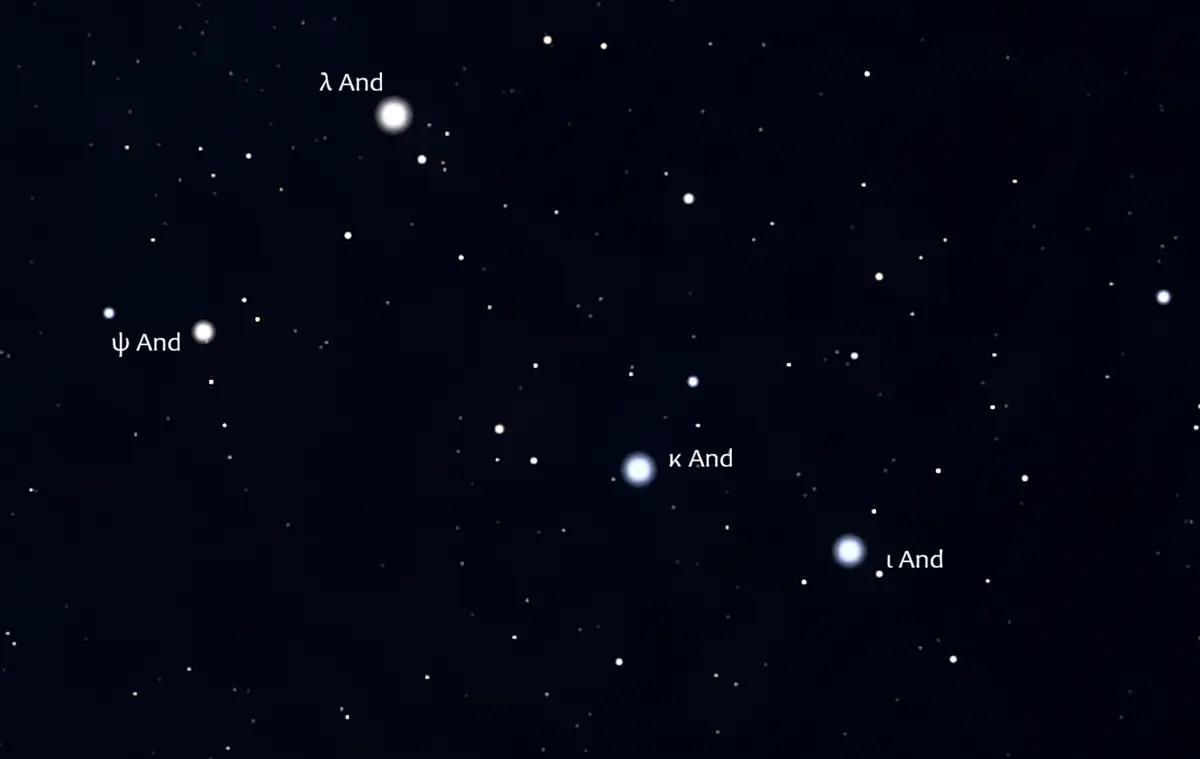
The stars of Frederick’s Glory: Lambda, Iota, Kappa, and Psi Andromedae, image: Stellarium (annotated for this article)
Lambda Andromedae (Udkadua): A yellow subgiant with an invisible companion
Lambda Andromedae (λ And) is the nearest and brightest of the four stars of Frederick’s Glory. It is a spectroscopic binary system composed of an evolved yellow subgiant and a low-mass companion believed to be a brown dwarf. The system lies 84.6 light-years away. The primary component has 1.47 times the Sun’s mass and 7.787 times its radius. It is 28.8 times more luminous than the Sun. The companion has a mass of only around 0.1 solar masses.
Lambda Andromedae is classified as an RS Canum Venaticorum variable, a type of close binary system that shows variations in brightness because of large stellar spots that come in and out of view as the two components orbit around a common centre of mass.
In ancient Sumerian astronomy, the star marked the heel of Udkadua (“the storm demon with the gaping mouth”), a constellation long lost to history. In 2025, the International Astronomical Union (IAU) approved the name Udkadua for the primary component.
Kappa Andromedae (Kaffalmusalsala): The star with a directly imaged companion
Kappa Andromedae (κ And) is a white main sequence star of spectral type A0V, the same as Vega, located approximately 168 light-years away. It is a young star, with an estimated age of around 47 million years, with a mass of 2.768 Suns and a luminosity 62.60 times the Sun’s. It spins close to its breakup velocity. The rapid rotation flattens the star at the poles and pushes out an equatorial bulge, giving it an oblate shape.
In 2012, astronomers reported the discovery of a substellar object orbiting the star. The companion, Kappa Andromedae b, was directly imaged with the Subaru Telescope. It was originally thought to be a superjovian-mass planet, but observations with the James Webb Space Telescope in 2025 refined its mass to 17.3 Jupiter masses, placing the object above the planet-brown dwarf boundary.
The star’s name, Kaffalmusalsala, comes from the Arabic Kaff al-Musalsala, meaning “the hand of the chained woman.” In traditional Arabic astronomy, it was the name of an asterism formed by Kappa, Lambda and Iota Andromedae.
Iota Andromedae (Rasalnaqa): The hot blue star at the tail
Iota Andromedae (ι And) is a hot, blue B-type main sequence star located approximately 510 light-years away. It has 3.1 times the Sun’s mass and is 638 times more luminous. With an estimated temperature of 12,620 K, it is the hottest of the four stars of Frederick’s Glory. It has an estimated age of 116 million years.
The name Rasalnaqa comes from the Arabic Ra’s al-Nāqa, “the head of the she-camel.” This was the other traditional Arabic name for the pattern formed by Iota, Kappa and Lambda Andromedae.
Psi Andromedae: The distant yellow supergiant
Psi Andromedae (ψ And) is the faintest and most distant of the Frederick’s Glory stars. It is also the only one without a formal name. It belongs to the rare class of yellow supergiants and is by far the most massive and most luminous of the four stars. It has a mass 5.4 times that of the Sun and shines with more than a thousand solar luminosities. The star’s intrinsic luminosity makes it visible to the unaided eye from a distance of 2,000 light-years.
Psi Andromedae forms a triple star system with a hot blue B-type star at a separation of 0.28 arcseconds and another companion at 0.14 arcseconds. The system’s orbital elements are uncertain.
How to find Frederick’s Glory
Frederick’s Glory lies in the region between the Great Square of Pegasus and Cassiopeia’s W. It can be found along the imaginary line extended from the midpoint between Schedar and Caph in Cassiopeia and Scheat in Pegasus. Alternatively, a line from Segin through Schedar also leads to the asterism.
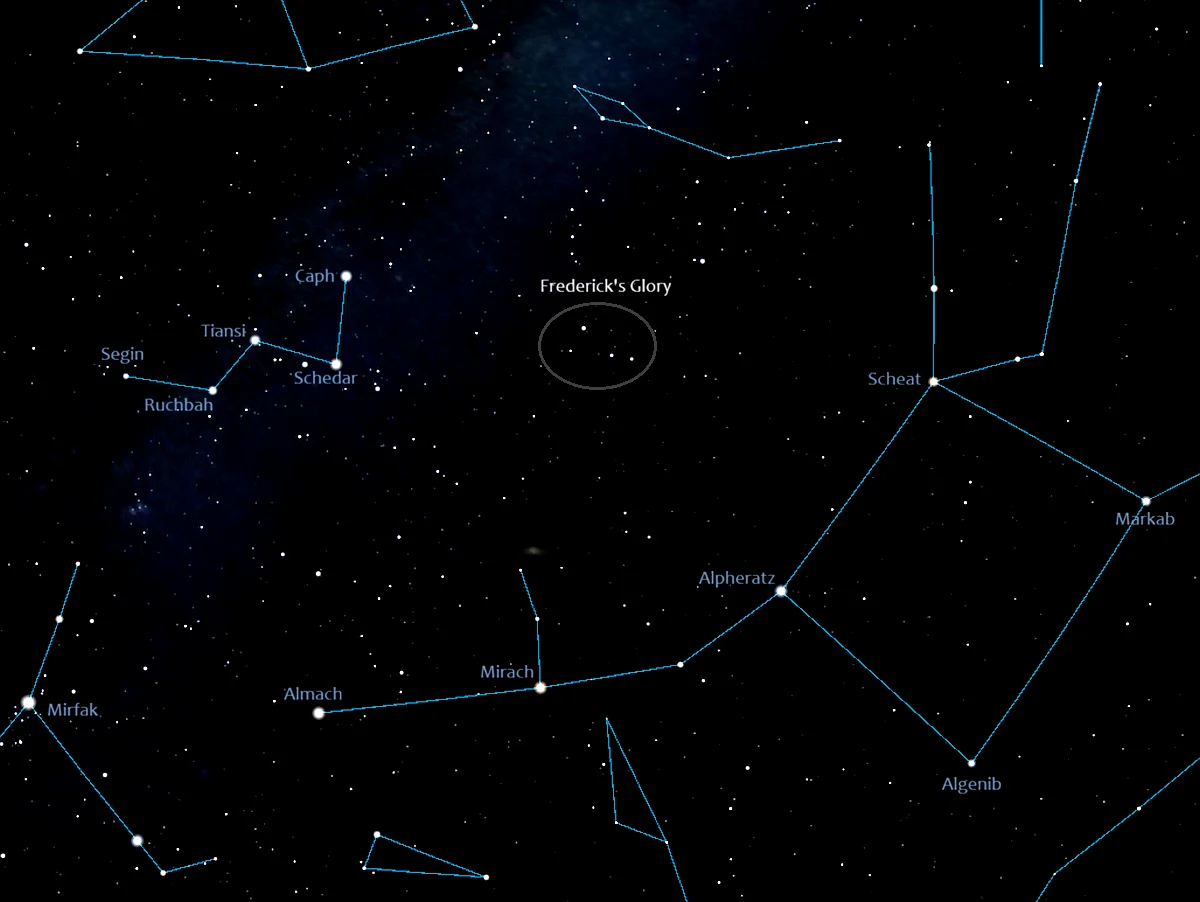
Location of Frederick’s Glory, image: Stellarium (annotated)
How and when to observe the asterism
Frederick’s Glory is visible without binoculars in good conditions. The best time to see the asterism is during the northern hemisphere autumn (southern spring), when Andromeda appears higher above the horizon in the early evening. The northernmost stars in the asterism, Lambda and Psi Andromedae, lie at declination 46° N, making Frederick’s Glory visible from all but the southernmost inhabited locations on Earth.
Deep sky objects near Frederick’s Glory
The stars of Frederick’s Glory can be used to find two relatively bright deep sky objects that lie in this region of the sky. The Blue Snowball Nebula (NGC 7662, Caldwell 22), a magnitude 8.2 planetary nebula, lies a little less than halfway from Scheat to Caph, just west-southwest of Iota Andromedae. It can be seen in small telescopes at high magnification.
The open cluster NGC 7686 shines at magnitude 5.6 and is visible in binoculars. It appears just west of the imaginary line extended from Kappa through Lambda Andromedae.
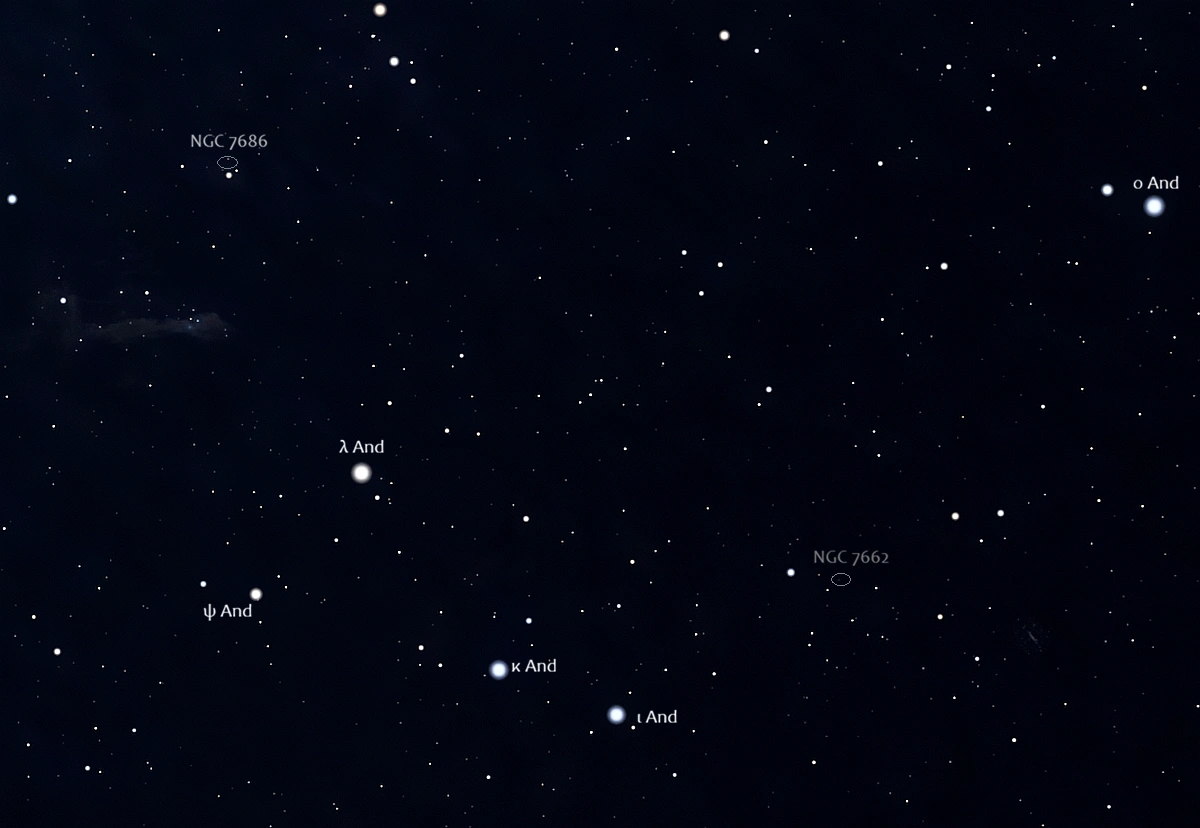
Frederick’s Glory, the Blue Snowball Nebula and NGC 7686, image: Stellarium (annotated)
Explore other autumn asterisms: