The Shaft of Aquila (or Family of Aquila) is a prominent asterism formed by Altair, Tarazed and Alshain in the equatorial constellation Aquila (the Eagle). These three bright stars form a nearly straight line that spans around four degrees and can be spotted high overhead in the evening throughout the northern hemisphere summer.
The Family of Aquila is the Eagle’s most widely recognized informal star pattern. The nickname comes from the shape itself, which evokes a spear shaft in flight. The short line of three stars sits in the region of the Eagle’s head and neck. Altair, the middle point of light, is the brightest star in Aquila and one of the brightest stars in the sky. It is flanked by the fainter Tarazed and Alshain.
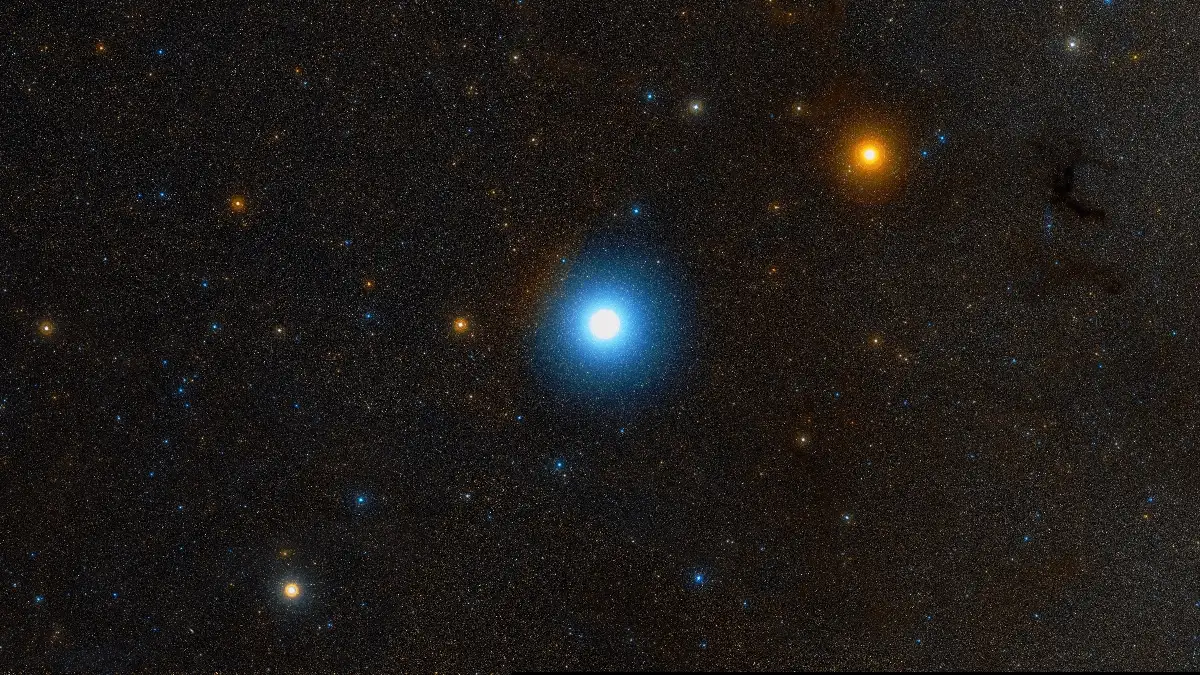
The Shaft of Aquila: Alshain, Altair and Tarazed, image credit: ESO/Digitized Sky Survey 2 (CC BY 4.0)
A family of stars at very different distances
Unlike the stars of Orion’s Belt and most stars of the Big Dipper, which lie at similar distances and share the same origin, the Family of Aquila is not really a family. Even though the three bright stars appear close to each other in the night sky, they are not physically related.
Altair is a young star in the Sun’s neighbourhood, while its less conspicuous companions are older, more evolved stars located much further away. Tarazed is an orange bright giant 395 light-years away, and Alshain is a yellow subgiant 44.36 light-years away.
All three stars are hotter, larger, and more massive than the Sun. Alshain, the least massive of the three, has 124% of the Sun’s mass. It is a G-type star like the Sun, but much further along its evolutionary path.
| SHAFT OF AQUILA STARS | |||||
| Name | Designation | Vmag | Distance | Spectral type | Mass |
| Altair | α Aql | 0.76 | 16.73 ly | A7Vn | 1.86 M☉ |
| Tarazed | γ Aql | 2.712 | 395 ly | K3II | 3.51 M☉ |
| Alshain | β Aql | 3.87 | 44.36 | G9.5 IV | 1.24 M☉ |
Altair: Aquila’s brightest light
Altair (Alpha Aquilae) is the lucida of Aquila and the 12th brightest star in the sky. Shining at magnitude 0.76, it is easily visible even from heavily light-polluted cities and makes the Shaft pattern findable.
Located only 16.7 light-years away, Altair is one of the closest bright stars to the Sun. It is the 65th nearest individual star to Earth and the 10th nearest visible star.
The Sun’s neighbour appear so bright both because it lies nearby and because it is intrinsically luminous. With a mass of 1.86 solar masses, it has an energy output 10.6 times that of the Sun.
Like Sirius and Vega, Altair is an A-type main sequence star. It has the spectral type A7Vn and an estimated age of 88 million years. It is a pulsating star classified as a Delta Scuti variable. The pulsations cause its brightness to vary very slightly, but the variations are imperceptible to the human eye.
Like Vega, Altair is an astonishingly fast spinner. Rotating at 242 km/s, it completes a spin in only 7.77 hours. The fast rotation speed has flattened the star into a noticeably oblate shape. Altair’s equatorial diameter is more than 20% greater than its polar diameter.
Tarazed: The distant orange giant
Tarazed (Gamma Aquilae) is Aquila’s second brightest star. At magnitude 2.712, it is on average the 112th brightest star in the sky. It is visible even from light-polluted areas, appearing as the reddish star just northwest of Altair.
Tarazed has the spectral class K3 II, indicating an orange bright giant. It has 3.51 times the Sun’s mass and a radius 91.81 times the Sun’s. It shines with a luminosity of 2,146 Suns.
Like Altair, Tarazed is much younger than the Sun. It has an estimated age of 270 million years. It has evolved faster than the Sun because it is much more massive and is now fusing helium into carbon in its core.
Alshain: The quiet companion
Alshain (Beta Aquilae) is the faintest, least massive and oldest of the three stars of the Shaft of Aquila. With an estimated age of 4.77 billion years, it is slightly older than the Sun. It has an apparent magnitude of 3.87 and lies 44.36 light-years away. Even though it has the Bayer designation Beta, it is only the seventh brightest star in Aquila.
The spectral class G9.5 IV indicates a yellow subgiant, a star that has burned through the supply of hydrogen in its core and begun to expand into a giant. Alshain has a mass of 1.24 solar masses and a radius just over three times that of the Sun. It is 6.18 times more luminous than our parent star and spins at 22.28 km/s.
Even though it appears as a single star to the unaided eye, Beta Aquilae is really a star system. The fainter companion is a red dwarf with an apparent magnitude of 12.0, well below unaided eye visibility. It appears too close to the primary component to be resolved visually, making Beta Aquilae a spectroscopic binary star.
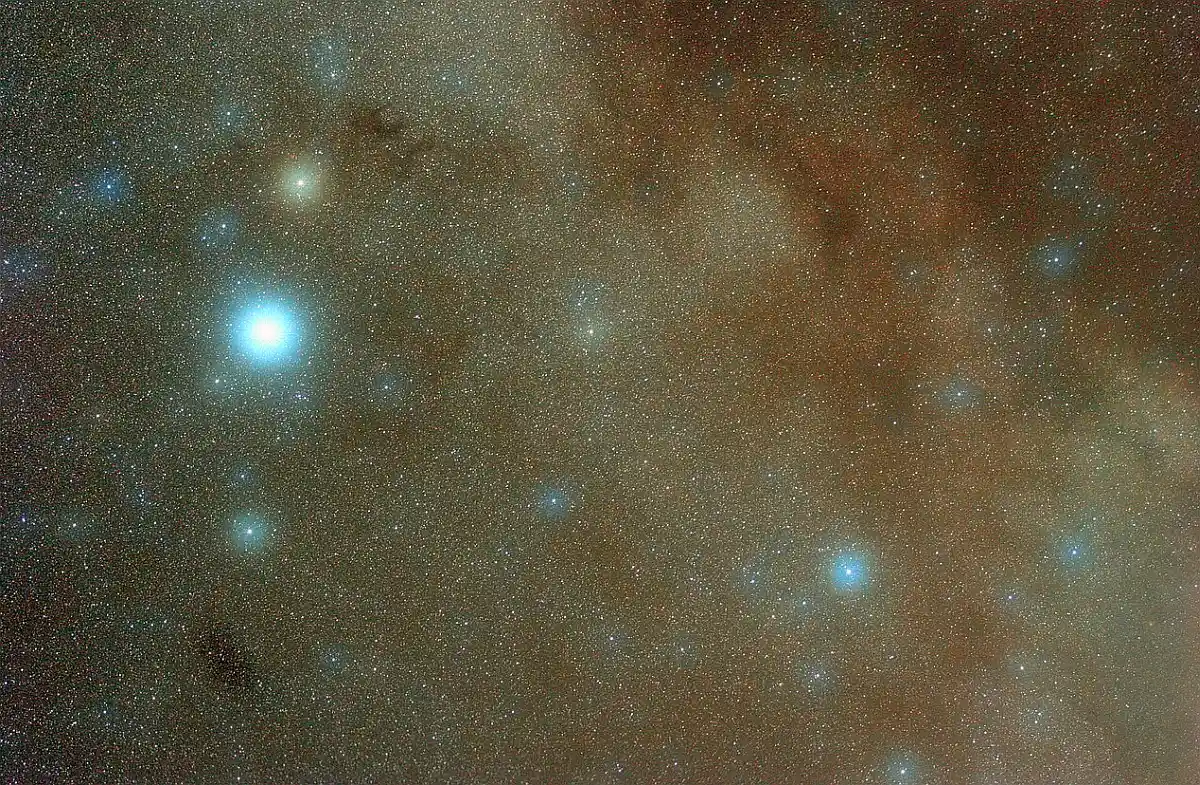
Altair (Alpha Aquilae), Tarazed (Gamma Aquilae) and Alshain (Beta Aquilae), image credit: J. Aleu (PDM 1.0)
Family of Aquila across cultures
Like other familiar star patterns in the sky, the Shaft of Aquila has accumulated many different names across different cultures. Anchored by the bright Altair and visible from virtually anywhere, the asterism has been seen as a bird in flight, a creator deity, and a military drum, among other interpretations.
In Greek mythology, the constellation Aquila is seen as the eagle that carried Zeus’ thunderbolts. In one story, the god sent the eagle to bring Ganymede, a young Trojan boy, to Mount Olympus to serve as cup bearer to the Olympian gods. Ganymede is represented by the zodiac constellation Aquarius.
The association of the bird-like constellation figure of Aquila and the Shaft asterism with an eagle predates the Greeks. It probably has its origins in Babylonian and Sumerian astronomy, where Altair was known as “the Eagle Star.”
The Flying Eagle
In early Arabic astronomy, the line of three stars represented a flying eagle or vulture. Altair was seen as the bird’s body and the two fainter stars as the wingtips. Altair’s own name comes from the Arabic phrase meaning “the flying eagle” (Al-Nasr Al-Ṭā’ir). The name originally applied both to the star and to the asterism.
In the constellation figure of Aquila, the three stars appear in the region of the Eagle’s neck. The 17th century Egyptian astronomer Al Achsasi Al Mouakket labelled Tarazed and Alshain as Menkib al Nesr (“the eagle’s shoulder”) and Unuk al Ghyrab (“the crow’s neck”).
China’s River Drum
In traditional Chinese astronomy, Altair, Tarazed and Alshain were called the River Drum (Hé Gǔ). The pattern was tied to the Milky Way, which was seen as a celestial river running nearby in Chinese tradition. The River Drum asterism represented military drums in the sky.
Cowherd and his children
In Chinese lore, Altair is better known as the Cowherd Star. It is linked with the legend of the Cowherd and the Weaver Girl (Niulang and Zhinü), star-crossed lovers who can only meet once a year, when magpies form a bridge across the Milky Way. The Weaver Girl is represented by the bright Vega, and Alshain and Tarazed represent their two children.
The Persian Scale Beam
The names Tarazed and Alshain are both derived from the Persian phrase shāhīn-i tarāzū, meaning “the balance” or “the scale beam.” The asterism they form with Altair was seen as a scale beam. The Persian names were medieval translations of the Arabic name for these stars, al-mizan (“the Balance”).
The Eagle and his black swan wives
Even in Indigenous Australian lore, Altair was associated with an eagle. The Koori people of Victoria saw Altair as Bunjil, the wedge-tailed eagle, and Alshain and Tarazed as his two black swan wives.
In Australian Aboriginal mythology, Bunjil is a creator deity. In local legend, after creating the mountains, rivers, animals and plants, the eagle asked Waang, the wind deity, for an increasingly strong wind. As Waang granted his request, Bunjil and his people were flung upwards into the heavens, where Bunjil became Altair and his wives became Tarazed and Alshain.
How to find the Shaft of Aquila
The Shaft of Aquila is best viewed from July to November and reaches its highest point in the sky on August evenings. It can be located using the brighter and larger Summer Triangle asterism, formed by Altair with Deneb in Cygnus and Vega in Lyra. The large, slightly elongated triangle dominates the sky overhead throughout the northern hemisphere summer, and Altair is the southernmost of its vertices.
Tazared and Alshain are easily visible in reasonably dark skies, and the line of three stars can be spotted even from areas with some light pollution. Located about eight degrees north of the celestial equator, the asterism can be seen from almost any location on Earth for at least part of the year.
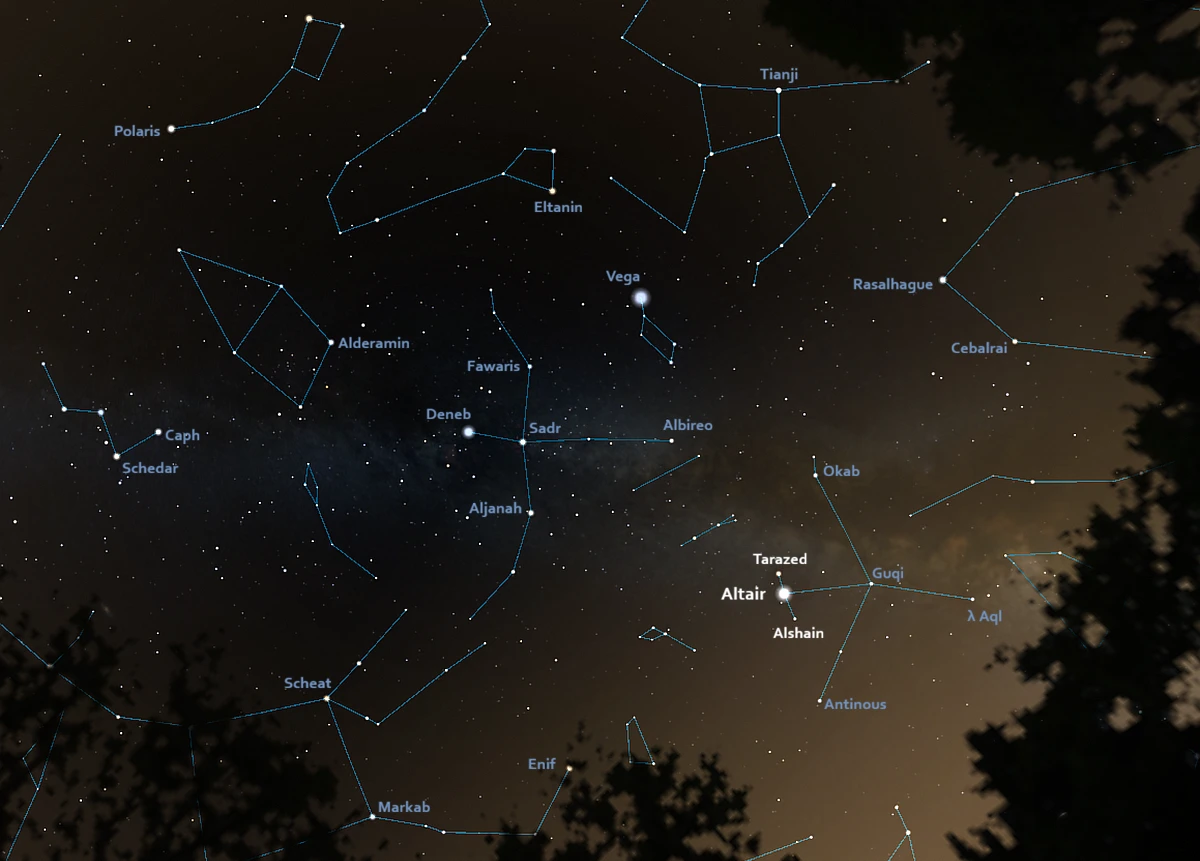
Shaft of Aquila location, image: Stellarium (annotated for this article)
Guide to the E Nebula
The Shaft of Aquila can be used to find the E Nebula, a pair of prominent dark nebulae that form the letter “E” in the sky. The two nebulae, catalogued as Barnard 142 and 143, appear near Tarazed. They span an area of 30 arcminutes, the same size as the full Moon, and lie approximately 2,000 light years away. They can be found 1.3 degrees west-northwest of Tarazed and spotted in binoculars and small telescopes at low magnification.
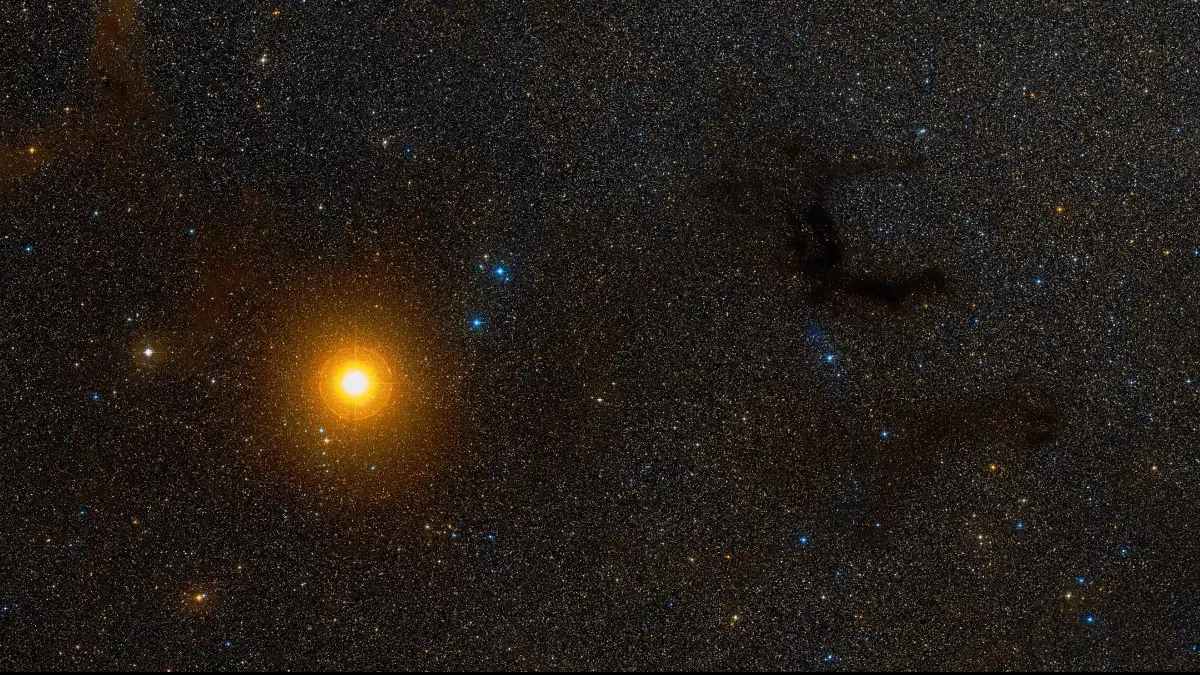
Tarazed and the E Nebula, image credit: ESO/Digitized Sky Survey 2 (CC BY 4.0)
Explore other constellation-based asterisms:
- The Teapot in Sagittarius
- The Big Dipper in Ursa Major
- The Southern Cross in Crux
- The Northern Cross in Cygnus
- The Fish Hook in Scorpius
- The Sickle of Leo
- The Keystone in Hercules
| Shaft of Aquila | |||
| Constellation | |||
| Object type | |||
| Coordinates | |||
| Stars | Altair | Tarazed | Alshain |
| Right ascension | 19h 50m 46.99855s | 19h 46m 15.58029s | 19h 55m 18.793s |
| Declination | +08° 52′ 05.9563″ | +10° 36′ 47.7408″ | +06° 24′ 24.35″ |