The E Nebula (or Barnard’s E Nebula) is a pair of prominent dark nebulae silhouetted against the Milky Way in the constellation Aquila. The two dark clouds of interstellar gas and dust appear in the region of the Eagle’s shoulder and cast a shadow on the Milky Way’s dense star fields. They absorb and block out the light of background stars.
Barnard’s E occupies just under a degree of the apparent sky, roughly the size of two full Moons, and is an easy target for binoculars and small telescopes in clear, dark skies. The cosmic ink blot is called Barnard’s E Nebula after the American astronomer Edward Emerson Barnard, who compiled the Barnard Catalogue of Dark Markings in the Sky, an astronomical catalogue of dark nebulae, in 1919. The Barnard catalogue lists the two “E” nebulae as Barnard 142 and Barnard 143.
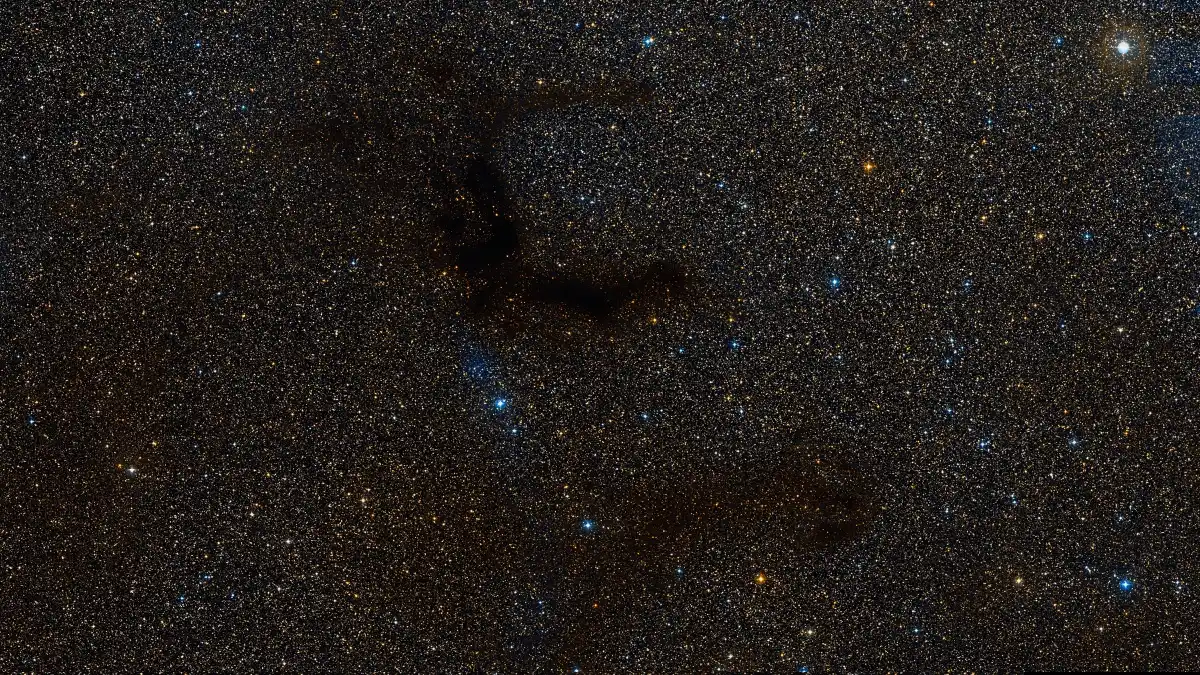
Barnard’s E Nebula (Barnard 142 and Barnard 143), image credit: ESO/Digitized Sky Survey 2 (CC BY 4.0)
Cosmic origins: Molecular clouds and stellar nurseries
The two dark nebulae that trace the letter E contain molecular hydrogen and are sites where new stars are forming. They are part of a giant molecular cloud, a cold, dense cloud of gas in which pockets of gas sometimes collapse under their own gravity and, over time, give birth to young stars. The E Nebula itself is believed to conceal protostars that are still shrouded in their birth clouds.
Structurally, Barnard 142 and Barnard 143 appear very different. Barnard 143 is the darker and better-defined nebula. It outlines a “C” shape that forms the northern part of the “E.” The less distinct Barnard 142 sits just to south and forms the bottom stroke of the “E.”

The E Nebula. A combination of two dark nebulae, Barnard 143 (top half of the ‘E’) and Barnard 142 (lower half). Captured by amateur astronomer Chuck Ayoub (CC0 1.0)
Part of the Great Rift
The E Nebula is a small piece of a much larger structure. It is part of the Aquila Rift (or Serpens-Aquila Rift), a sprawling complex of dark, dusty clouds that stretches across the constellations Aquila, Serpens Cauda, and eastern Ophiuchus.
The Aquila Rift is itself part of the larger Great Rift, a long dark lane of obscuring dust that runs across the middle of the Milky Way’s plane, appearing to split the Milky Way’s band into two.
While many popular astronomy sources quote a distance of 2,000 light-years (610 parsecs) for Barnard’s E, recent studies place Barnard 143 much closer, at an approximate distance of 650 light-years (200 parsecs). The estimates of the distance of the larger Aquila Rift range from 750 to 1,650 light-years (225 – 500 pc).

Thick dust clouds block our night-time view of the Milky Way, creating what is sometimes called the Dark Rift. Thick dust clouds also populate the galaxy. And while infrared telescopes can see them clearly, our eyes detect these dark clouds only as irregular patches where they dim or block the Milky Way’s faint glow. The most prominent dark lane stretches from the constellations Cygnus to Sagittarius and is often called the Great Rift, sometimes the Dark Rift. The Shaft of Aquila and the E Nebula appear just below the centre. Image credit: NASA (PD)
How to find the E Nebula
The E Nebula lies near the Shaft of Aquila, an asterism formed by the bright Altair, Aquila’s brightest star, with Tarazed and Alshain, the two stars flanking it. In the constellation figure of Aquila, the three stars mark the Eagle’s neck and shoulder.
The dark nebulae appear 1.3 degrees west-northwest of the orange giant Tarazed, the brighter of the two stars near Altair. In binoculars, the nebulae appear in the same wide field of view as the star.
The best time of the year to observe the E Nebula and other deep sky objects in Aquila is in the month of September, when the constellation is high overhead in the early evening. The Eagle is prominent in the evening sky throughout the northern hemisphere summer and early autumn. It flies opposite Cygnus (the Swan), and their luminaries, Altair and Deneb, form the Summer Triangle with the bright Vega in Lyra.

Location of the E Nebula, image: Stellarium (annotated for this article)

Tarazed (Gamma Aquilae) is an orange star, slightly smaller than our Sun. The E is instead a complex of opaque nebulae cataloged, from north to south, LDN 700, LDN 964 with a dense core [LM99] L694-2, LDN 688. The complex is usually referred to as Barnard 143. In the field there are also some cirrus clouds of interstellar dust, presumably the less dense part of the same molecular complex. Image credit: Giuseppe Donatiello (CC0 1.0)
- Manatee Nebula (Westerhout 50)
- Starfish Nebula (IRAS 19024+0044)
- Phantom Streak Nebula (NGC 6741)
- Snowglobe Nebula (NGC 6781)
- Glowing Eye Nebula (NGC 6751)
E Nebula – Barnard 142 and 143
| Constellation | Aquila | |
| Object type | A pair of dark nebulae | |
| Right ascension | 19h 40m 42s | |
| Declination | +10° 57′ | |
| Apparent size | <1° | |
| Distance | ~650 light-years (200 parsecs) | |
| Barnard 142 | Barnard 143 | |
| Names and designations | Barnard 142, B142, TGU H367, [DB2002b] G47.85-5.72 | Barnard 143, B143, LDN 694, TDS 202, [DB2002b] G48.37-5.83 |