NGC 6441 is a bright globular cluster located approximately 42,700 light-years away in the southern constellation Scorpius. Popularly known as the Silver Nugget Cluster, the ancient ball of stars appears in the region of the Scorpion’s stinger, next to the giant star G Scorpii.
With an estimated mass of 1.6 million Suns, NGC 6441 is one of our galaxy’s most massive and luminous globular clusters. It lies in the Milky Way’s bulge, around 13,000 light-years from the Galactic centre. Shining at magnitude 7.2, the cluster can be spotted in small telescopes. It has an apparent size of 9.6 arcminutes.
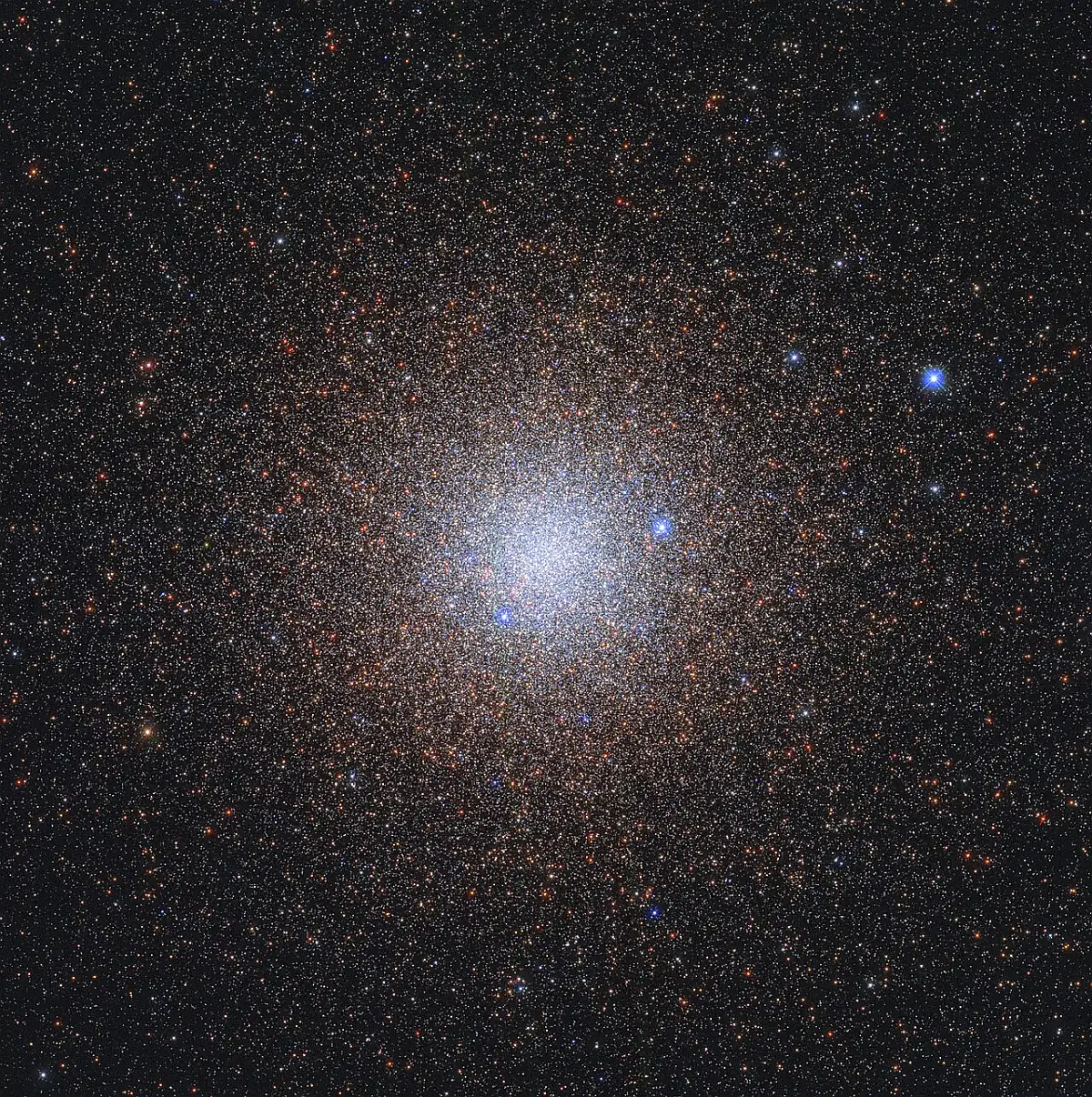
Almost like snowflakes, the stars of the globular cluster NGC 6441 sparkle peacefully in the night sky, about 13 000 light-years from the Milky Way’s galactic centre. Like snowflakes, the exact number of stars in such a cluster is difficult to discern. It is estimated that together the stars weigh 1.6 million times the mass of the Sun, making NGC 6441 one of the most massive and luminous globular clusters in the Milky Way. NGC 6441 is host to four pulsars that each complete a single rotation in a few milliseconds. Also hidden within this cluster is JaFu 2, a planetary nebula. Despite its name, this has little to do with planets. A phase in the evolution of intermediate-mass stars, planetary nebulae last for only a few tens of thousands of years, the blink of an eye on astronomical timescales. Image credit: ESA/Hubble & NASA, G. Piotto (CC BY 4.0)
NGC 6441 at a glance: The heavyweight of Milky Way’s globulars
The Silver Nugget Cluster is a very old and very dense globular cluster, a compact group of stars held together by gravity. It has half-light radius of 7.1 light-years and a tidal radius of 88.8 light-years. Its half-mass radius spans 0.64 arcminutes. While it is not quite as large as Omega Centauri and 47 Tucanae, the cluster is among the Milky Way’s most massive globulars.
NGC 6441 appears projected against the southwestern part of the Milky Way’s bulge, where the intervening dust dims its light by 0.5 magnitudes. In a clearer region of the sky, the cluster would almost be visible to unaided eye.
The Silver Nugget has a relatively dense concentration of stars towards the centre. It has the Shapley-Sawyer concentration III (on a scale of I to XII, I being the densest), the same as 47 Tucanae in Tucana, Messier 54 in Sagittarius, and NGC 6388 in Scorpius. The cluster’s strong inner core has an angular size of 0.11 arcminutes and a luminosity density of 5.25 L☉ pc−3.
Discovery of the Silver Nugget Cluster
NGC 6441 was discovered by James Dunlop from Australia on May 13, 1826. The Scottish astronomer described the object as a “small, well-defined rather bright nebula, about 20″ diameter; a very small star [is west of it], but is not involved; following [Gamma] Telescopii.”
Gamma Telescopii is the former designation of G Scorpii, which used to lie in the constellation Telescopium. Dunlop discovered the cluster hidden in the giant star’s glare using a 9-inch reflector from Parramatta, New South Wales. He listed it as object number 557 (Dunlop 557) in his catalogue.
The English astronomer John Herschel observed the cluster from the Cape of Good Hope, South Africa, on June 28, 1834. He included it in his catalogue as h 3705, noting, “Globular, bright, round, very gradually brighter in the middle, up to a blaze. In field with Gamma Telescopii, and nearly on the same parallel; with left eye I barely see it resolved into stars of 18th or 20th magnitude. The whole ground of the heavens, for an immense extent, is thickly sown with such stars. A beautiful object.”
An ancient relic: NGC 6441’s age and origins
NGC 6441 is one of the oldest known objects in the Milky Way, with an estimated age of 13 − 13.7 billion years. It formed when the universe itself was still in its infancy, not long after the Big Bang. It belongs to an exclusive group of the Milky Way’s roughly 150 known globular clusters, dense, spherical collections of stars that are among the most ancient structures in our galaxy.
Despite decades of study, the formation of globular clusters like NGC 6441 remains poorly understood. These objects are packed with hundreds of thousands of old, metal-poor stars, tightly bound by gravity into a compact, spherical shape. Their low metallicity is an indicator of their age. Stars that formed later are more enriched with heavier elements produced by older generations of stars, while metal-poor stars have an earlier origin.
Interestingly, some globular clusters are believed to be the stripped remnant cores of dwarf galaxies that were consumed by the Milky Way in ancient galactic mergers. This means that a cluster like NGC 6441 could be the last surviving remnant of a small galaxy that no longer exists.
A metal-rich oddball among ancient globulars
The Silver Nugget Cluster stands out as an anomaly among the Milky Way’s globulars. It has an unusually high abundance of elements heavier than helium. A 2008 study found a 1/3 solar abundance, which is high for a cluster that may be as old as the Milky Way itself.
One possible explanation is that NGC 6441 formed in the Milky Way’s bulge, where the proto-cluster gas had already been enriched by an earlier generation of massive AGB stars. This gave the cluster a head start in heavy element content that most old globulars lack.
In 2013, Hubble observations of NGC 6441’s stars on the red giant branch revealed that there were two or possibly three distinct populations of these stars in the cluster. The brighter and hotter ones mostly reside closer to the cluster’s centre. They may represent a second generation with a higher abundance of helium.
Astronomers suspect that second generations of stars in globular clusters form from gas that already contains helium and some heavier elements. The helium and metals come from material expelled from asymptotic giant branch stars or fast-spinning massive stars from the cluster’s first generation.
The RR Lyrae puzzle
The Silver Nugget Cluster hosts an unusually large number of RR Lyrae variables. These are old pulsating stars on the horizontal branch, commonly found in ancient globular clusters like NGC 6441. These stars typically retain only about half the Sun’s mass, having shed much of their initial mass while on the red giant branch. Most variable stars (around 80 percent) found in globular clusters are RR Lyrae variables.
In 2006, Corwin et al. identified 68 probable RR Lyrae candidates in NGC 6441. Curiously, these stars have longer pulsation periods than expected for their metal abundances. The discrepancy may be explained by them being more luminous than RR Lyrae variables typically found in other clusters.
NGC 6441 also contains several type II Cepheids, whose presence is also unusual considering the cluster’s high metallicity. These are typically old, low-mass, metal-poor stars whose luminosity is linked to their pulsation periods. Along with NGC 6388, NGC 6441 is one of the most metal-rich globulars known to host these stars. Like NGC 6441, NGC 6388 contains a substantial number of RR Lyrae stars with extraordinarily long periods. It also lies in the Scorpius constellation, south of the bright Sargas.
The Silver Nugget Cluster is also home to four known millisecond pulsars, fast-spinning remnants of stars similar to the Sun. Two of these fast-spinning neutron stars reside in binary systems.
JaFu 2: The planetary nebula hiding inside NGC 6441
The Silver Nugget Cluster harbours one of only a handful of planetary nebulae ever found in a globular cluster. The central stars of these nebulae are thought to be descended from merged or interacting binary systems. Single evolved stars in old globular clusters are believed to evolve too slowly to ionize their expelled outer layers before those layers disperse, which makes finding a planetary nebula in this kind of environment all the more unusual.
The nebula was discovered in 1997, when George H. Jacoby of the Kitt Peak National Observatory and L. Kellar Fullton of the Space Telescope Science Institute reported its detection in The Astronomical Journal. The astronomers found that the nebula, designated JaFu 2 (Jacoby – Fullton 2), shared a common velocity and extinction with NGC 6441 and appeared too close to the cluster’s centre to be a foreground object. They concluded that it was a true member of the cluster rather than a line-of-sight coincidence.
JaFu 2 has an elongated ring-like structure and is just under 5 arcseconds across, corresponding to a physical diameter of 0.75 light-years. Astronomers have also detected signs of a central torus of emission, a feature usually associated with binary interaction. They estimated a mass of 0.55 solar masses for the central star, at a distance of 9.1 kiloparsecs.
JaFu 2 is one of only four planetary nebulae ever detected in globular clusters. The others have been reported in Messier 15 in the constellation Pegasus, Messier 22 in Sagittarius, and Palomar 6 in Ophiuchus. However, the nebula JaFu 1 in Palomar 6 was found not to be a member of the cluster, leaving only three confirmed examples.
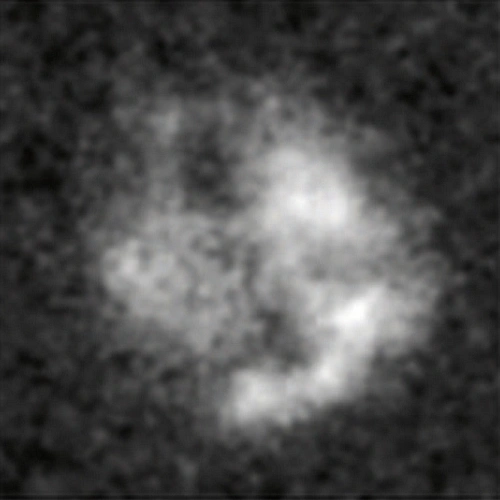
The planetary nebula JaFu 2 is shown in Hα, taken from Jacoby et al. (1997). North is up and east is to the left.
How to find the Silver Nugget Cluster
NGC 6441 appears only 5 arcminutes east-northeast of the magnitude 3.2 orange giant Fuyue (G Scorpii) and 6 degrees east of Shaula, in the direction of Eta Sagittarii in the neighbouring Sagittarius. The cluster can be spotted even in the smallest of telescopes but, because of its relatively small apparent size, it requires high magnification.
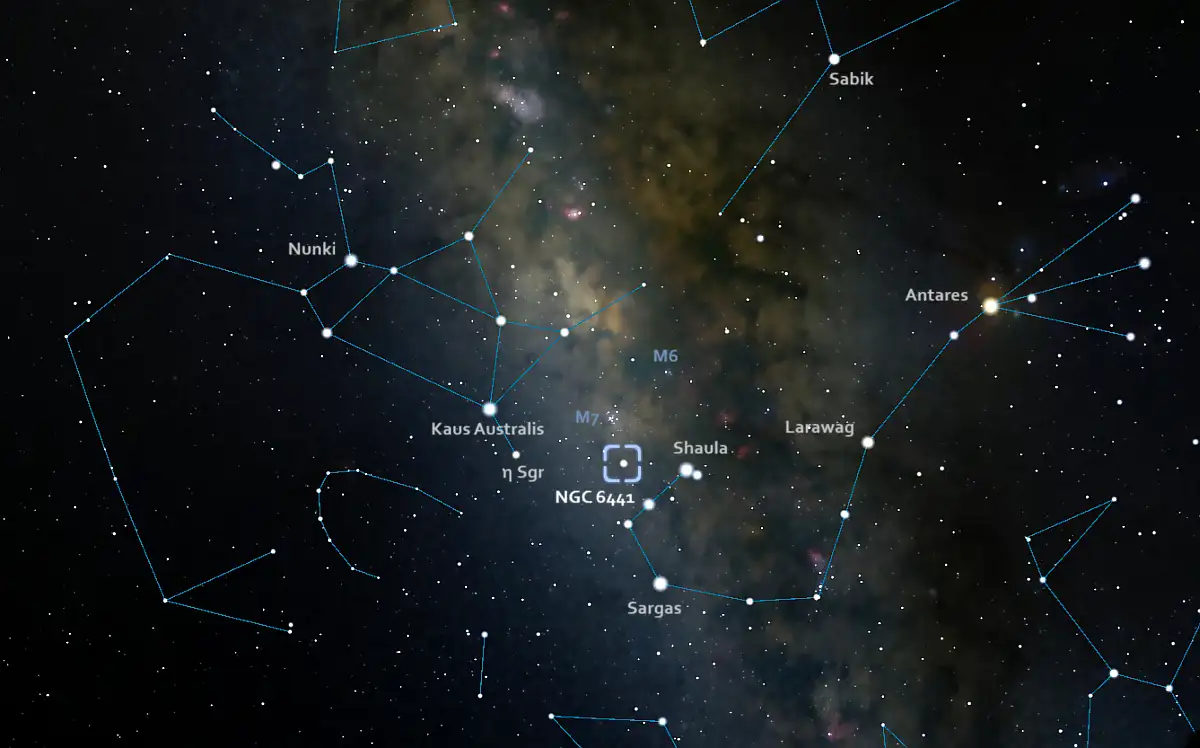
NGC 6441 location, image: Stellarium (annotated for this article)
NGC 6441 lies in the same area as several better-known clusters and nebulae. The bright open clusters Messier 7 (Ptolemy’s Cluster) and Messier 6 (the Butterfly Cluster) appear to the north and north-northwest. The large stellar nurseries NGC 6357 (the Lobster Nebula) and NGC 6334 (the Cat’s Paw Nebula) appear on the other side of the Scorpion’s stinger, marked by Shaula and the fainter Lesath.
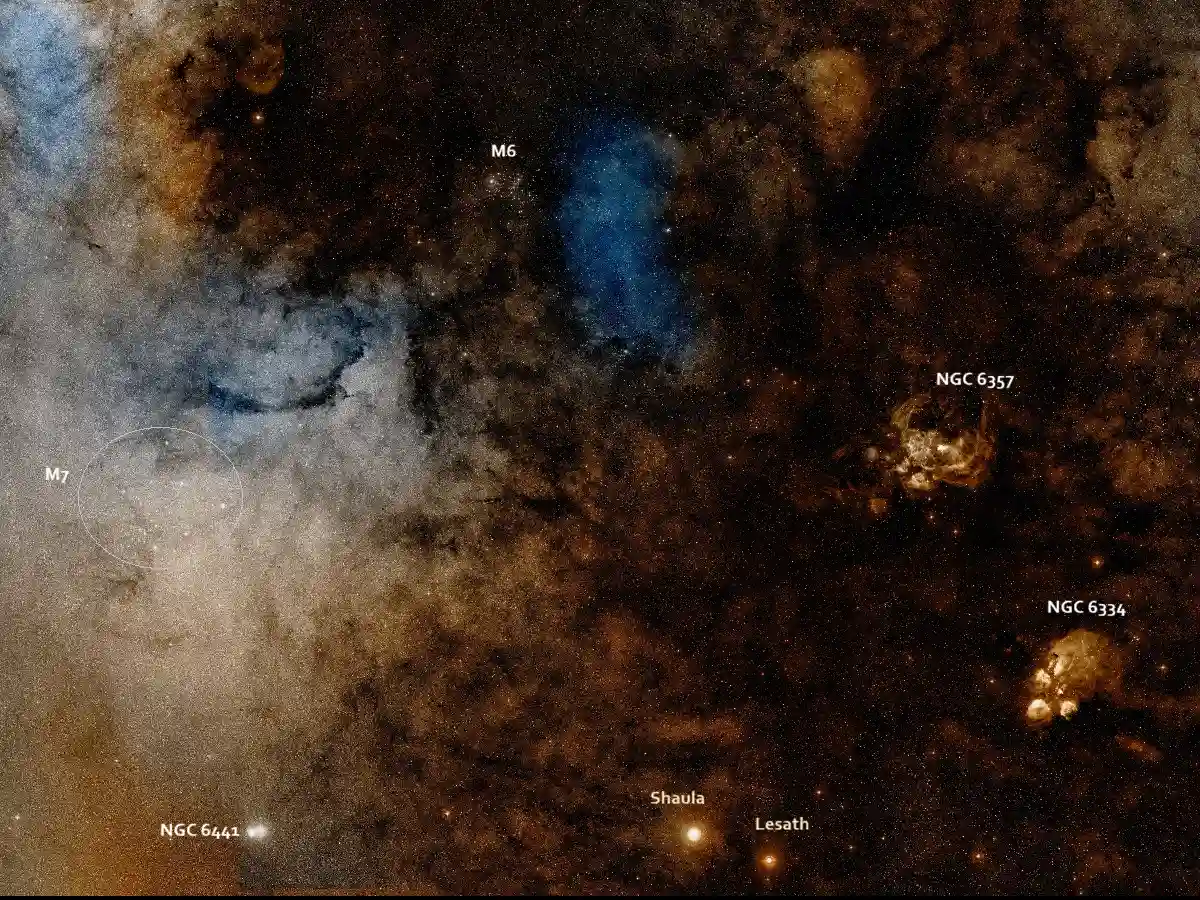
NGC 6441, Messier 6, Messier 7, Lobster Nebula and Cat’s Paw Nebula, image credit: ESO/Digitized Sky Survey 2 (CC BY 4.0)
The best time of the year to observe NGC 6441 and other deep sky objects in Scorpius is during the northern hemisphere summer, when the constellation appears higher in the sky in the early evening.
Explore other deep sky objects in Scorpius:
- Butterfly Nebula (NGC 6302)
- Prawn Nebula (IC 4628)
- Cheerio Nebula (NGC 6337)
- Cotton Candy Nebula (IRAS 17150-3224)
- Blue Horsehead Nebula (IC 4592)
- Fried Egg Nebula (Hen 3-1379)
Silver Nugget Cluster – NGC 6441
| Constellation | Scorpius |
| Object type | Globular cluster |
| Shapley-Sawyer concentration class | III |
| Right ascension | 17h 50m 13.06s |
| Declination | −37° 03′ 05.2″ |
| Apparent magnitude | 7.2 |
| Apparent size | 9.6′ |
| Distance | 42.7 ± 2.3 kilolight-years (13.1 ± 0.7 kiloparsecs) |
| Mass | 1.6 × 10⁶ M☉ |
| Half-light radius | 7.1 light-years (2.18 parsecs) |
| Tidal radius | 88.8 light-years (27.23 parsecs) |
| Metallicity | [Fe/H] = −0.53 dex |
| Age | 13 − 13.7 billion years |
| Names and designations | Silver Nugget Cluster, NGC 6441, GCl 78, Cl VDBH 248, C 1746-370, CD−37° 11916, CPC 18 9008, CPD−37° 7530, HD 161968 |