The Cheerio Nebula (or Ghostly Cheerio Nebula) is a small planetary nebula located approximately 5,500 light-years away in the constellation Scorpius. It is listed as NGC 6337 in the New General Catalogue. With an apparent magnitude of 12 and an apparent size of 0.783 arcminutes, the nebula can only be observed in larger amateur telescopes.
Discovered by the English astronomer John Herschel on June 28, 1834, the toroidal planetary nebula appears in the region of the Scorpion’s stinger, just south of the Cat’s Paw Nebula (NGC 6334). NGC 6337 is contained within the larger emission nebula Sh 2-5, but it is not part of it. Sh 2-5 is part of the Lobster Nebula (NGC 6357), a stellar nursery connected to the Cat’s Paw by a filamentary structure.
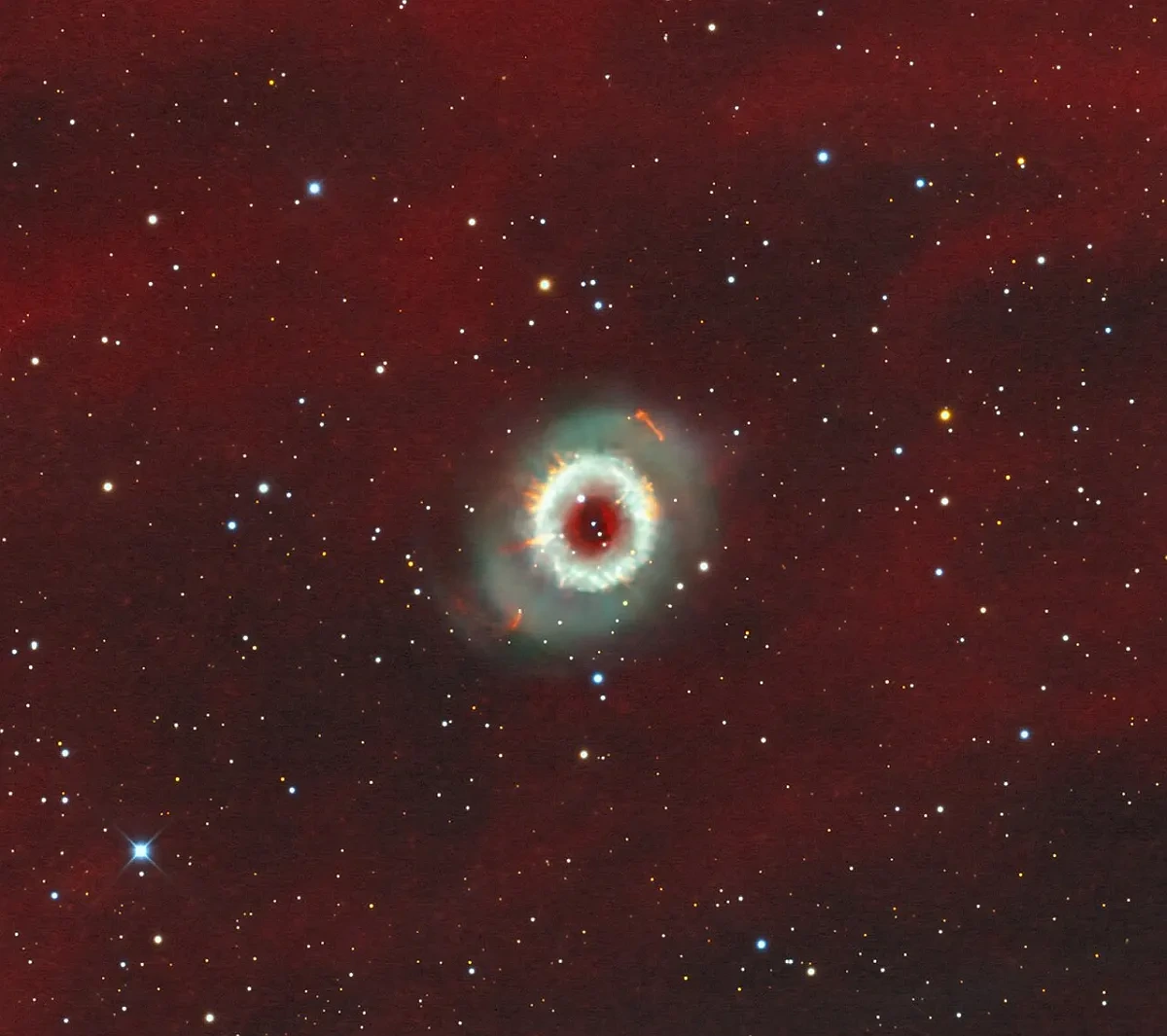
NGC 6337 (the Cheerio Nebula), image credit: Adam Block (CC BY-SA 4.0)
NGC 6337: A Ring of Stellar Debris
NGC 6337 was nicknamed the Ghostly Cheerio because its annular structure looks like the popular breakfast cereal. The small, bright inner ring is surrounded by a faint extended halo around 1.5 arcminutes long. Two fainter lobes extend beyond the halo.
The bright ring contains many cometary knots. These are globules of gas with glowing heads and trailing tails that form when gases of different densities and temperatures collide. These structures have also been found in the better-known Helix Nebula in the constellation Aquarius, the Dumbbell Nebula in Vulpecula, the Ring Nebula in Lyra, the Retina Nebula in Lupus, and NGC 2392 in Gemini.
A 2009 study found a kinematic age of 12,000 years for NGC 6337. The slow projected radial expansion of the thick ring indicates that the nebula appears almost face-on when seen from Earth.
The central binary system
The Ghostly Cheerio Nebula has a binary nucleus at its core, identified by Hillwig in 2004. The central star system has an orbital period of only 0.173 days, and the two components have masses of 0.6 and up to 0.3 solar masses. The physical separation between the stars is up to 1.26 solar radii, indicating that the system underwent a common envelope phase. This may have caused the formation of the thick inner ring.
The faint elliptical outer shell of NGC 6337 has a slight “S” shape, which is sometimes linked with bipolar envelopes. This envelope material is believed to be what is left of bipolar lobes expelled at an early stage of the nebula’s development.
A 2025 study provided an orbital period of 0.35 days for the central star system, identifying it as an eclipsing binary system.
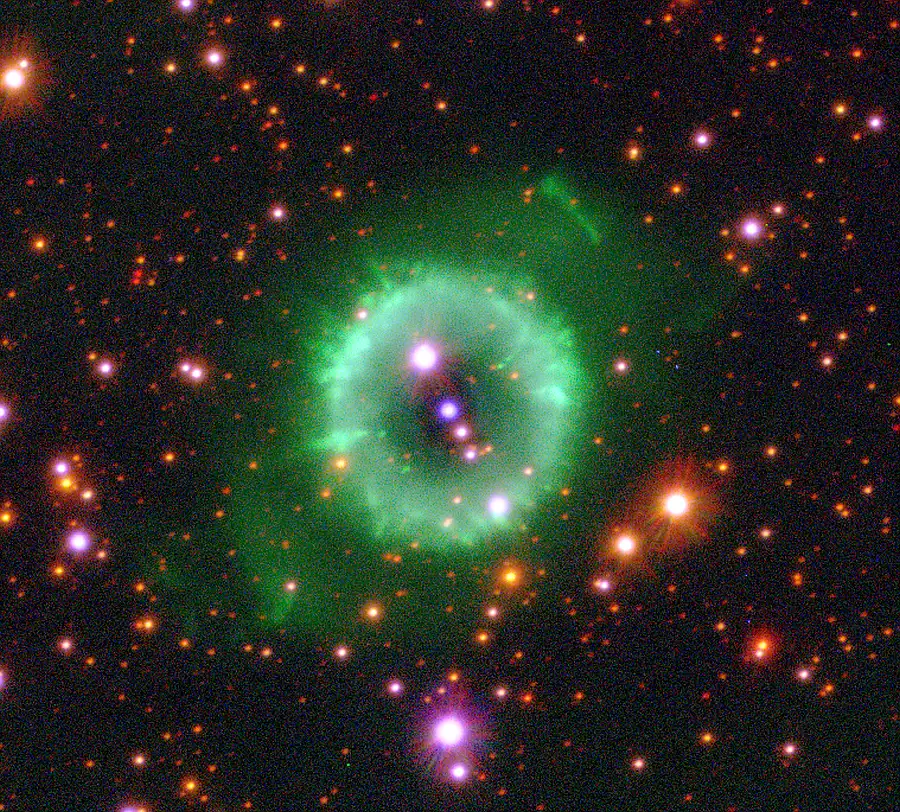
Planetary Nebula NGC 6337 with VST, image credit: Meli Thev (CC BY-SA 4.0)
How to find the Cheerio Nebula
NGC 6337 lies in the region of the Scorpion’s tail and stinger, about a third of the way and just north of the line drawn from Girtab (Kappa Scorpii) to Mu Scorpii (Pipirima and Xamidimura). Kappa and Mu Scorpii are part of the Fish Hook, a prominent asterism formed by the brightest star in Scorpius.
The ring-shaped nebula appears about 2 degrees southwest of Lesath (mag. 2.70), the fainter of the two stars marking the Scorpion’s stinger. The brighter Shaula shines at magnitude 1.63 and is the second brightest star in Scorpius, after Antares.
At declination -38° 29′, NGC 6337 never rises for observers north of the latitude 51° N and only appears low in the sky from the mid-northern latitudes. It can be seen in 12-inch and larger telescopes at high magnification. It is best observed with OIII filters.
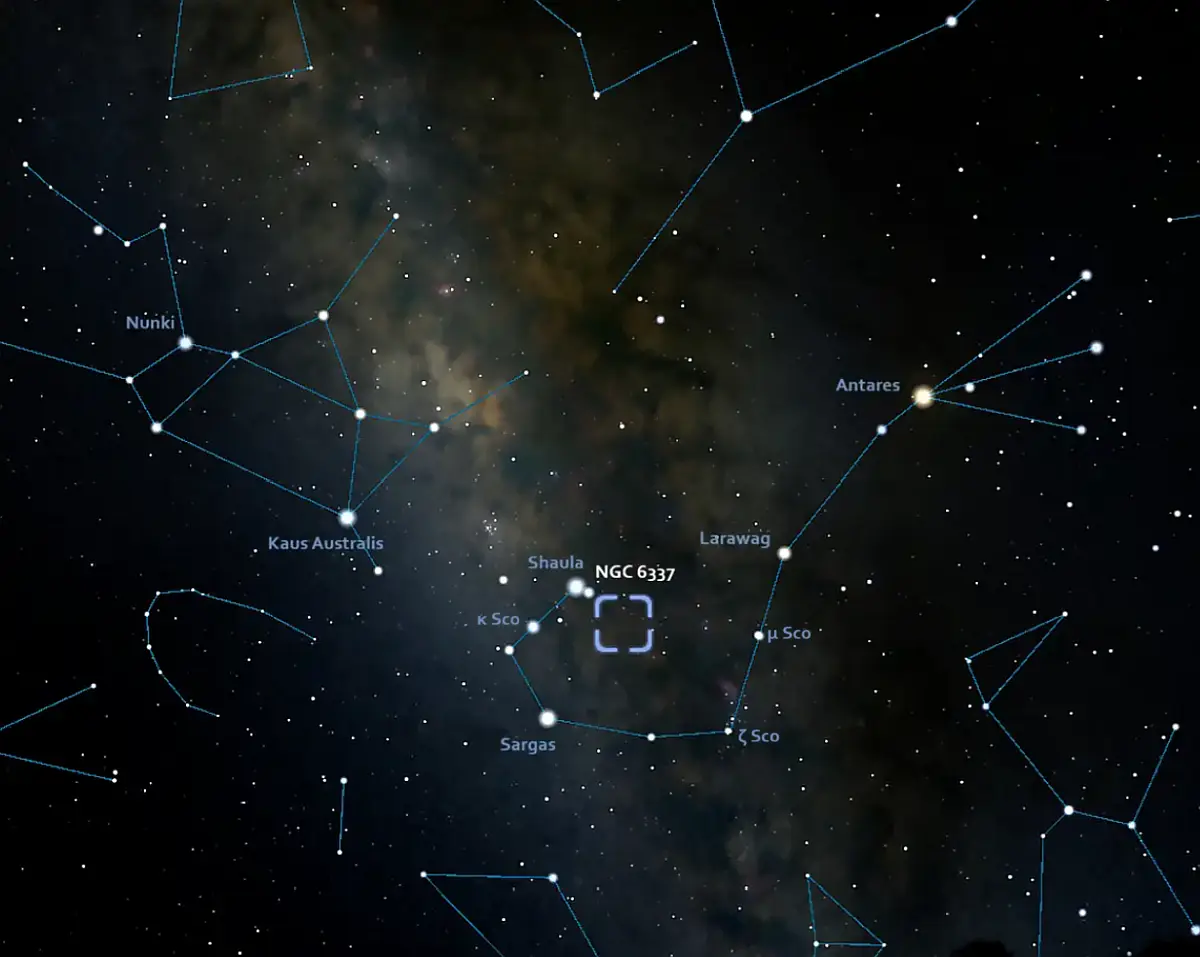
Location of the Cheerio Nebula (NGC 6337), image: Stellarium (annotated for this article)
The best time to observe the Ghostly Cheerio and other deep sky objects in Scorpius is during the month of July, when the constellation appears higher above the horizon in the early evening.
Explore other deep sky objects in Scorpius:
- Butterfly Nebula (NGC 6302)
- Prawn Nebula (IC 4628)
- Cotton Candy Nebula (IRAS 17150-3224)
- Northern Jewel Box Cluster (NGC 6231)
- Blue Horsehead Nebula (IC 4592)
- Fried Egg Nebula (Hen 3-1379)
Cheerio Nebula – NGC 6337
| Constellation | Scorpius |
| Object type | Planetary nebula |
| Right ascension | 17h 22m 15.6721413768s |
| Declination | −38° 29′ 01.735593252″ |
| Apparent magnitude | 12.0 |
| Apparent size | 0.783′ × 0.783′ |
| Distance | 5,479 ± 359 light-years (1,680 ± 110 parsecs) |
| Names and designations | Cheerio Nebula, Ghostly Cheerio Nebula, NGC 6337, ESO 333-5, Haro 2-10, Henize 2-215, Hen 2-215, PN G349.3-01.1, PN H 1-10, PK 349-01 1, PN VV’ 181, PN Sa 2-191, WRAY 16-267, IRAS 17188-3826, Gaia DR2 5972577055062637056, Gaia DR3 5972577055062637056 |