NGC 3285B is a barred spiral galaxy located 136.59 million light years away in the constellation Hydra. With an apparent magnitude of 13.86 and an apparent size of 1.5 by 1.1 arcminutes, it is a challenging target for amateur telescopes. The galaxy is a member of the NGC 3312 Group, which lies within the larger Hydra Cluster of galaxies.
Even though it is commonly referred to as NGC 3285B, the galaxy is not an NGC object. It was not included in the New General Catalogue, compiled by the Danish astronomer John Louis Emil Dreyer in 1888.
The earliest known mention of the galaxy was in the Reference Catalogue of Bright Galaxies (1964), written by French astronomers Antoinette de Vaucouleurs and Gérard de Vaucouleurs, and American astronomer Harlow Shapley.
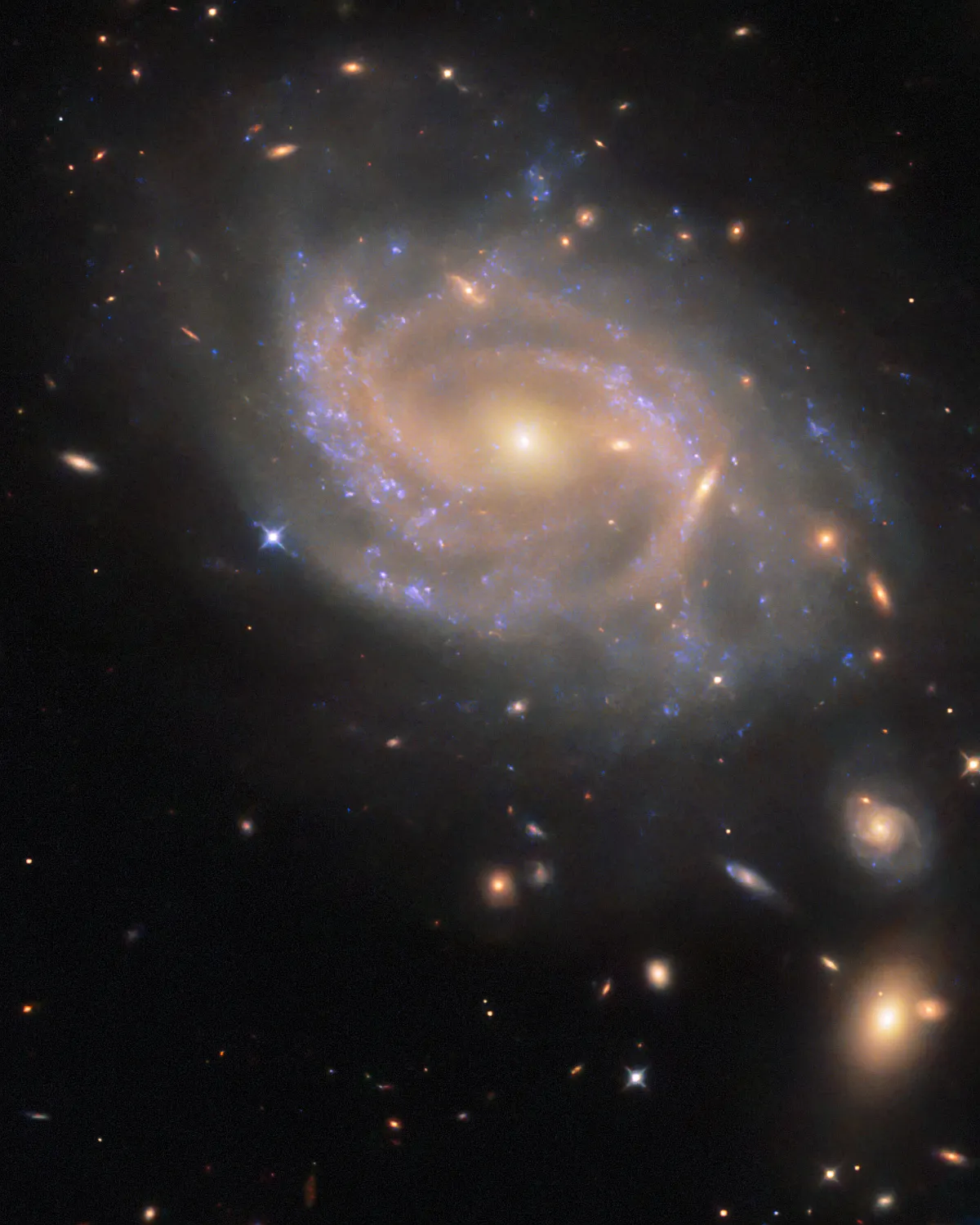
The swirling spiral galaxy in this NASA/ESA Hubble Space Telescope Picture of the Week is NGC 3285B, which resides 137 million light-years away in the constellation Hydra (The Water Snake). Hydra has the largest area of the 88 constellations that cover the entire sky in a celestial patchwork. It’s also the longest constellation, stretching 100 degrees across the sky. It would take nearly 200 full Moons, placed side by side, to reach from one side of the constellation to the other. NGC 3285B is a member of the Hydra I cluster, one of the largest galaxy clusters in the nearby Universe. Galaxy clusters are collections of hundreds to thousands of galaxies that are bound to one another by gravity. The Hydra I cluster is anchored by two giant elliptical galaxies at its centre. Each of these galaxies is about 150,000 light-years across, making them about 50% larger than our home galaxy, the Milky Way. NGC 3285B sits on the outskirts of its home cluster, far from the massive galaxies at the centre. This galaxy drew Hubble’s attention because it hosted a Type Ia supernova in 2023. Type Ia supernovae happen when a type of condensed stellar core called a white dwarf detonates, igniting a sudden burst of nuclear fusion that briefly shines about 5 billion times brighter than the Sun. The supernova, named SN 2023xqm, is visible here as a blue-ish dot on the left edge of the galaxy’s disc. Image credit: ESA/Hubble & NASA, R. J. Foley (UC Santa Cruz) (CC BY 4.0)
A barred spiral in the Hydra Cluster
NGC 3285B is a large barred spiral galaxy with the morphological class SB(rs)b or SAB. The class SB(rs)b indicates a transition galaxy between one with a ring-like structure and one without rings, while SAB indicates a weakly barred spiral.
With an estimated size of 100,800 light-years, NGC 3285B is larger than our own Milky Way (87,400 ly) but much smaller than Andromeda (152,000 ly).
The galaxy is a member of the Hydra Cluster (Hydra I, Abell 1060), a cluster of galaxies spanning 10 million light years and containing over 150 members. Hydra I is the dominant cluster within the larger Hydra-Centaurus Supercluster. Its largest members are the giant elliptical galaxy NGC 3309, the supergiant elliptical NGC 3311, and the large spiral NGC 3312.
Location within the Hydra Cluster
NGC 3285B lies on the outskirts of the Hydra Cluster. The brighter and larger elliptical galaxies NGC 3309 and NGC 3311 form a pair in the cluster’s centre. They appear east and a little north of NGC 3285. The bright spiral galaxy NGC 3312 and the overlapping pair catalogued as NGC 3314 appear east-southeast of the bright ellipticals.
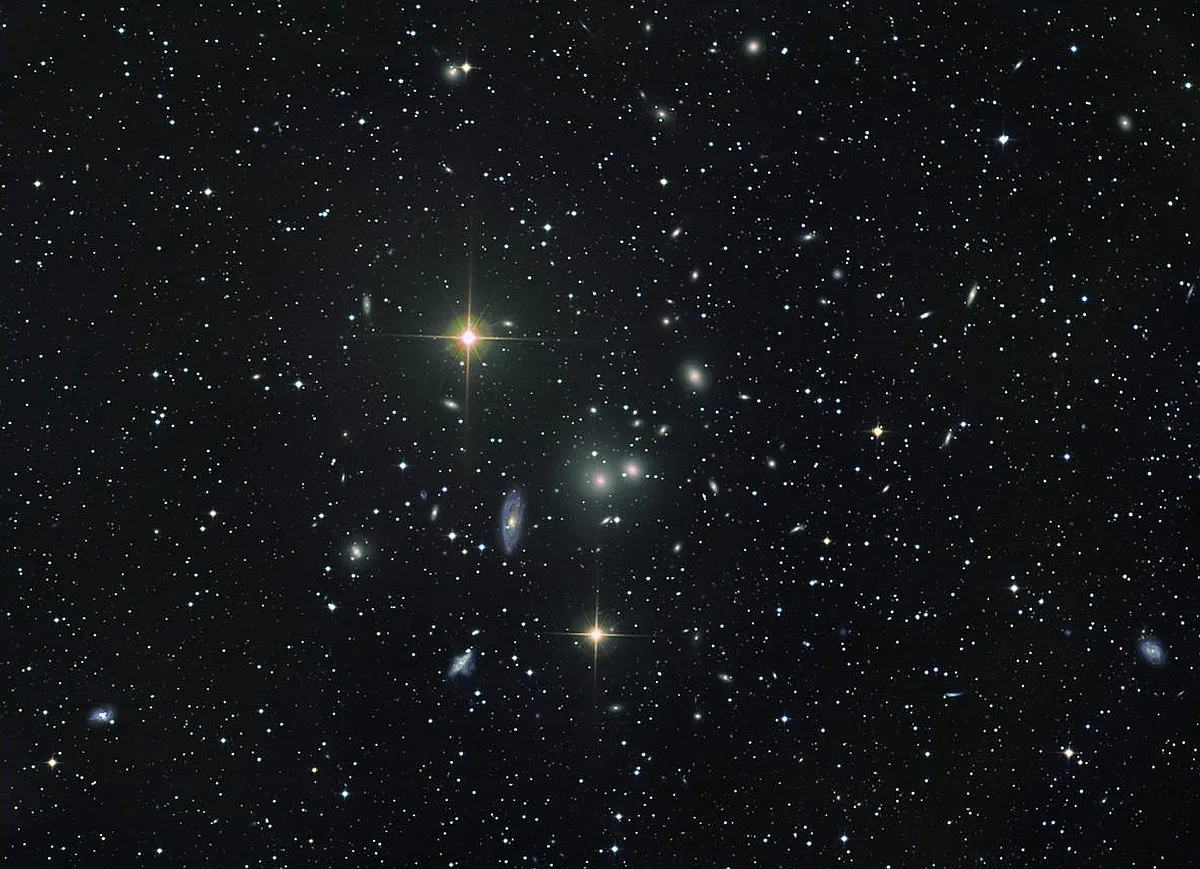
NGC 3285B (far right) in the Hydra Cluster, image: Capella Observatory/Wikisky (PD)
Member of the NGC 3312 group
NGC 3285B is a member of the NGC 3312 group of galaxies (LGG 210), which contains at least 11 members. Other members include NGC 3312, the largest spiral galaxy in the Hydra I cluster, the spiral galaxy NGC 3314A, the elliptical galaxies IC 2597 and LEDA 31444, the lenticular galaxies LEDA 31441 and LEDA 31515, and the radio galaxy LEDA 31504.
Supernova 2023xqm
NGC 3285B hosted a Type Ia supernova, SN 2023xqm, discovered by the Asteroid Terrestrial-impact Last Alert System (ATLAS) in November 2023. The supernova occurred at the edge of the galaxy. It had an apparent magnitude of 17.885 and was captured by the Hubble Space Telescope (HST) as part of an observing program that targeted 100 Type Ia supernovae in order to help refine cosmic distance measurements based on observations of these events.
Type Ia supernovae are triggered by carbon-oxygen white dwarfs that accrete too much material from their binary companions. When they reach the critical mass of 1.44 solar masses, white dwarfs reignite, which sometimes leads to a supernova event.
These supernovae produce a relatively consistent peak luminosity because the critical mass of the progenitor white dwarfs is always the same. For this reason, Type Ia supernovae can be used as standard candles to measure distances to their host galaxies.
How to find NGC 3285B
NGC 3285B lies in the faint portion of the sky in the constellation Hydra, near the border with Antlia. It appears about a quarter of the way from Alpha Antliae to Nu Hydrae, close to the imaginary line extended from Kraz through Alchiba in the Sail asterism in Corvus.
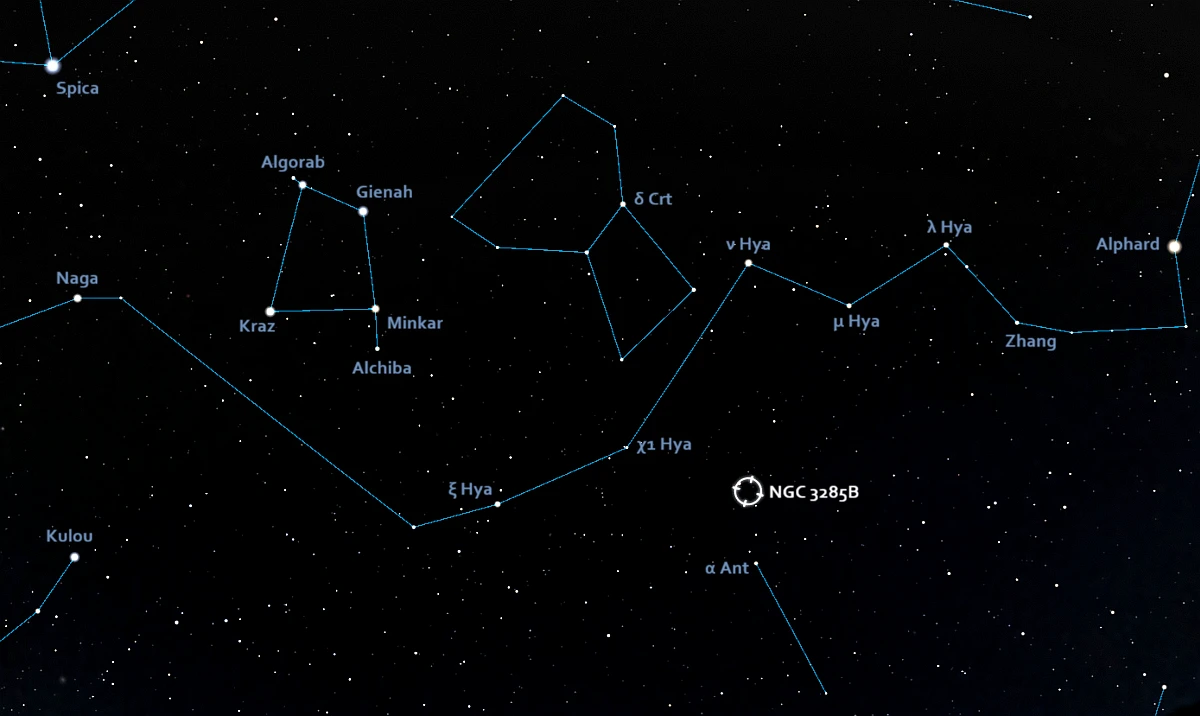
Location of NGC 3285B, image: Stellarium (annotated for this article)
When to observe the Hydra Cluster
The best time of the year to observe NGC 3285B and other galaxies in the Hydra Cluster is in April, when the Hydra constellation appears higher above the horizon in the early evening. From the northern hemisphere, Hydra is visible throughout the months of spring.
At declination -28°, NGC 3285B is best seen from the southern hemisphere. It never rises above the horizon for observers north of the latitude 62° N.
Explore other deep sky objects in Hydra:
- Southern Pinwheel Galaxy (Messier 83)
- NGC 3314: Overlapping Galaxies in Hydra
- Porpoise Galaxy (NGC 2936)
- Hickson 40: Five Galaxies on a Collision Course
- Ghost of Jupiter Nebula (NGC 3242)
- Southern Owl Nebula (ESO 378-1)
- Diamond Ring Nebula (Abell 33)
- Tombaugh’s Globular Cluster (NGC 5694)
NGC 3285B
| Constellation | Hydra |
| Object type | Barred spiral galaxy |
| Morphological type | SB(rs)b |
| Right ascension | 10h 34m 36.8767s |
| Declination | −27° 39′ 10.468″ |
| Apparent magnitude | 13.86 |
| Apparent size | 1.5′ × 1.1′ |
| Distance | 136.59 ± 2.83 million light-years (41.880 ± 0.867 megaparsecs) |
| Size | ~100,800 light-years (30.92 kiloparsecs) |
| Redshift | 0.009847 ± 0.0000033 |
| Heliocentric radial velocity | 2,952 ± 10 km/s |
| Names and designations | NGC 3285B, LEDA 31293, PGC 31293, ESO 501-18, SGC 103216-2723.7, IRAS 10322-2723, 2MASX J10343687-2739108, WALLABY J103436-273900, [RMH82] 13, ESO-LV 501-0180, MCG -04-25-022, [CHM2007] HDC 596 J103436.87-2739108, FLASH J103437.48-273908.2, [CHM2007] LDC 729 J103436.87-2739108, [R89b] 156, 6dFGS gJ103436.9-273911, NVSS J103437-273912, [CZ2003] 1060A-494 39, Gaia DR2 5468060651385181696, Gaia DR3 5468060651385181696 |