Hickson 40 (Hickson Compact Group 40) is a group of five merging galaxies located approximately 300 million light years away in the constellation Hydra. The compact galaxy group consists of three spiral galaxies, a lenticular galaxy, and an elliptical galaxy. The member galaxies are in an early stage of merger.
The five galaxies of HCG 40 form an exceptionally compact configuration and are one of the densest galaxy groups known. They occupy a region less than 200,000 light-years across. To put this in perspective, the Milky Way has a diameter of 87,400 light-years and the larger Andromeda Galaxy (Messier 31) is around 152,000 light-years across. Such dense groupings are typically found at the cores of large galaxy clusters.
Hickson 40 is catalogued as VV 116 in Boris Vorontsov-Velyaminov’s Atlas and Catalogue of Interacting Galaxies (1959) and Arp 321 in Halton Arp’s Atlas of Peculiar Galaxies (1966). It is one of the best-known interacting galaxy groups in the sky, along with Stephan’s Quintet (HCG 92) in the constellation Pegasus, Seyfert’s Sextet (HCG 97) in Serpens, and Copeland’s Septet (HCG 57) in Leo.
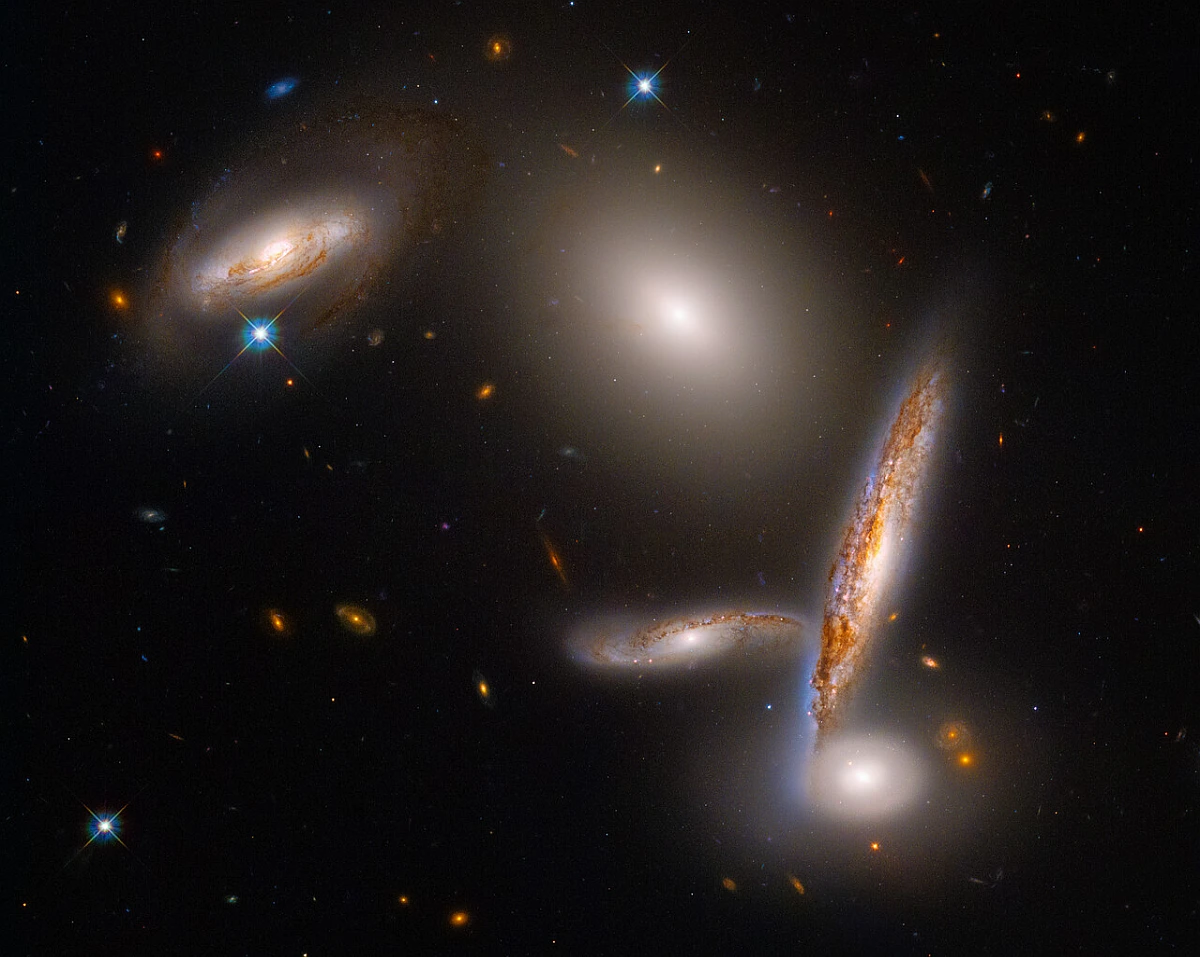
NASA is celebrating the Hubble Space Telescope’s 32nd birthday with a stunning look at an unusual close-knit collection of five galaxies, called The Hickson Compact Group 40. This menagerie includes three spiral-shaped galaxies, an elliptical galaxy, and a lenticular (lens-like) galaxy. Somehow, these different galaxies crossed paths in their evolution to create an exceptionally crowded and eclectic galaxy sampler. Caught in a leisurely gravitational dance, the whole group is so crowded that it could fit within a region of space that is less than twice the diameter of our Milky Way’s stellar disk. Image credit: NASA, ESA, STScI; Image processing: Alyssa Pagan (STScI) (PD)
Hickson 40 galaxies
Hickson 40 consists of the elliptical galaxy LEDA 27509 (HCG 40a), the lenticular galaxy LEDA 27513 (HCG 40b), the barred spiral galaxies LEDA 27508 (HCG 40c) and LEDA 27516 (HCG 40d), and the intermediate spiral galaxy LEDA 27515 (HCG 40e). The five overlapping galaxies will merge into a single giant elliptical galaxy in about a billion years.
Most members of HCG 40 contain dense radio sources in their cores, which may indicate the presence of supermassive black holes. The galaxies are undergoing a burst of star formation because of their close interaction.
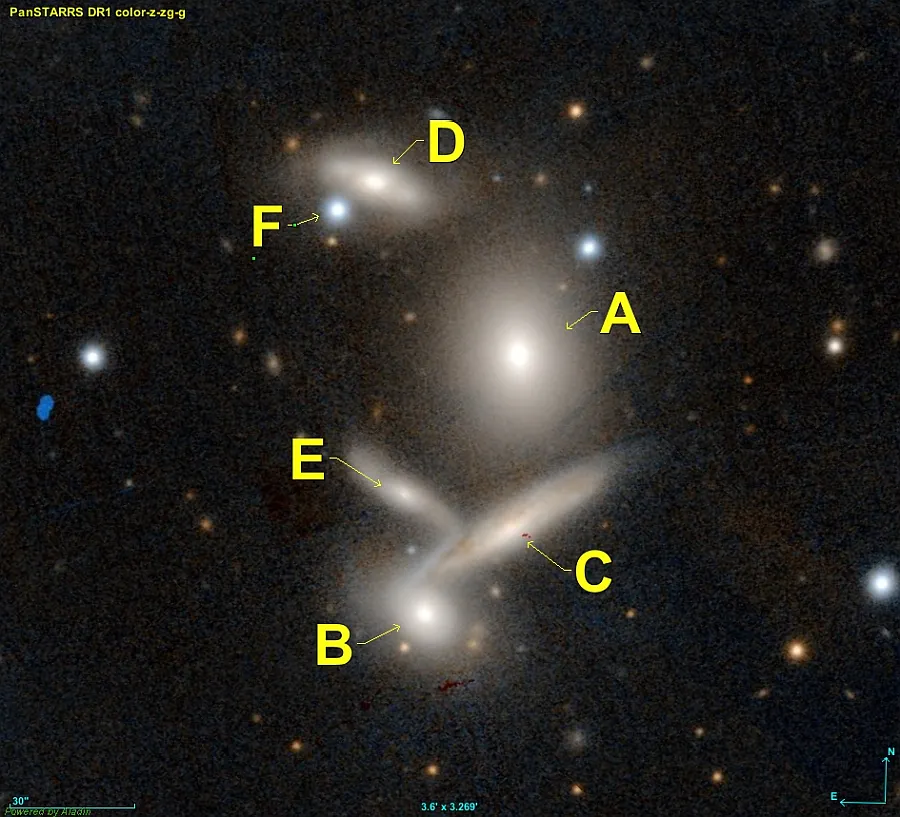
HCG designations of the various members of the Hickson 40 compact galaxy group (HCG 40), also known as Arp 321 in the Arp atlas. The members are initially designated HCG40 followed by a letter of the alphabet. Note that HCG40 F (F in the image) is not a galaxy, but a star located in the foreground. Image created using Aladin Sky Atlas software from the Strasbourg Astronomical Data Centre and data from the Pan-STARRS astronomical survey. Credit: Wikimedia Commons/GommeMagique (CC0 1.0)
Canadian astronomer Paul Hickson originally listed six members of the group in his 1982 paper on compact galaxy groups. However, the object labelled as HCG 40f (PGC 27517) appears as a foreground star in the Hubble images of the interacting quintet. The Simbad database lists it as an elliptical to lenticular galaxy.
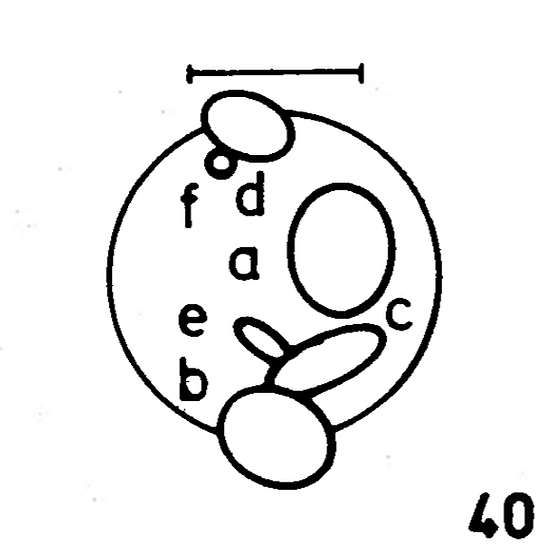
Illustration of Hickson 40 by Paul Hickson, 1982.
The five overlapping galaxies of Hickson 40 are known to be interacting because X-ray observations have revealed the presence of large amounts of hot gas among them, and infrared studies have shown increased star formation rates, which are common in interacting systems.
Astronomers have found that most of the H I gas in HCG 40 is associated with the spiral galaxies HCG 40c and HCG 40d. These galaxies appear very bright in the mid-infrared.
| Hickson Compact Group 40 | ||||
| Member | Type | Apparent magnitude | Apparent size (arcminutes) | Designations |
| HCG 40a | E | 12.8 | 1.53477 × 1.08508 | LEDA 27509, MCG-01-25-008, VV 116A |
| HCG 40b | SA(r)0-: pec | 14 | 1.50333 | LEDA 27513, MCG-01-25-012, VV 116e |
| HCG 40c | SB(rs)b pec sp | 14.9 | 1.47639 × 0.367916 | LEDA 27508, MCG-01-25-009, VV 116c |
| HCG 40d | SB(s)0/a pec | 14.2 | 0.989017 × 0.453563 | LEDA 27516, MCG-01-25-010 |
| HCG 40e | SAB(s)a pec | 17.3 | 0.710683 × 0.220951 | LEDA 27515, MCG-01-25-011, VV 116d |
Supernovae in HCG 40
Two supernovae were discovered in Hickson 40 in recent decades. In 2003, the Type Ia supernova SN 2003D shone at magnitude 17.5. It was spotted by Tim Puckett and Alex Langoussis on January 6, 2003. The supernova was discovered 1.6 arcseconds east and 10.2 arcseconds south of the galactic nucleus of HCG 40a (MCG-01-25-008). It was triggered by a white dwarf that accreted too much material from a binary companion.
In 2026, the Gravitational-wave Optical Transient Observer (GOTO) robotic telescope array detected the supernova SN 2026dwm. At discovery, the transient shone at magnitude 19.97 and was classified as a Type IIb supernova, triggered by the core collapse of a massive star.
How to find Hickson 40
HCG 40 lies in the faint constellation Hydra, near the border with Sextans. The galaxies appear in the region between Alphard (Alpha Hydrae) and Ukdah (Iota Hydrae). Alphard, Hydra’s brightest star, is the only bright star southwest of Regulus in Leo.
With an apparent size of only 1.74 arcminutes, the compact galaxy group is a challenging target for amateur telescopes. Located only 5 degrees south of the celestial equator, it is visible from virtually any location in Earth.
The best time of the year to see Hickson 40 and other deep sky objects in Hydra is during the northern hemisphere spring, when the constellation appears higher in the sky in the early evening.
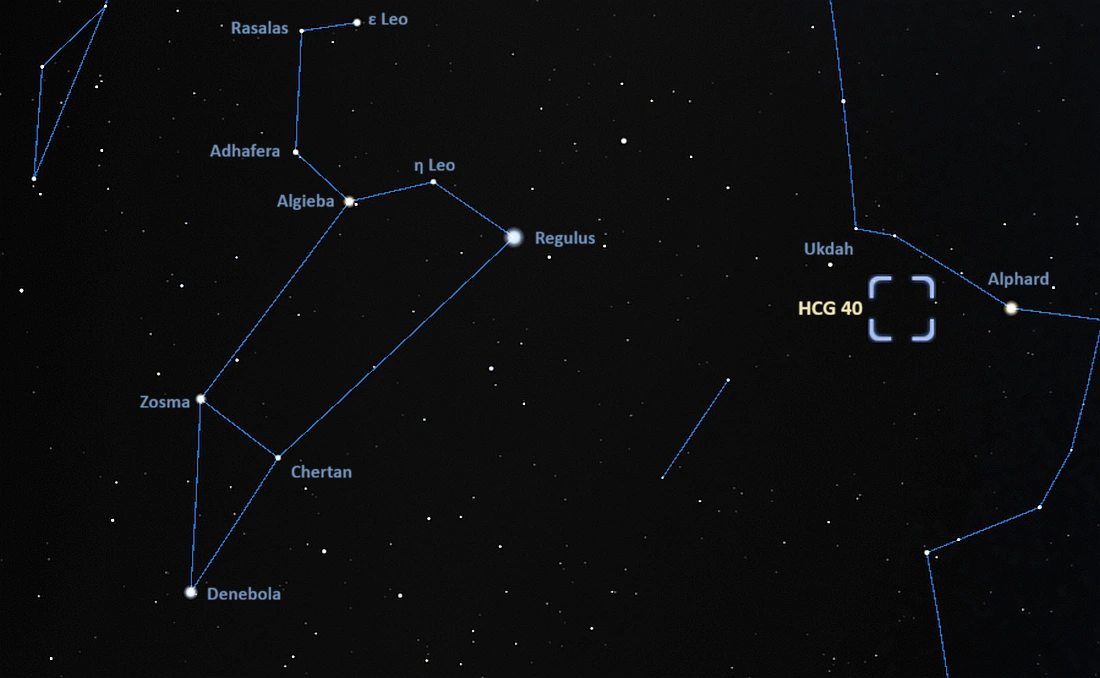
Location of the Hickson Compact Group 40, image: Stellarium (annotated for this article)
Explore other deep sky objects in Hydra:
- Southern Pinwheel Galaxy (Messier 83)
- Ghost of Jupiter Nebula (NGC 3242)
- Southern Owl Nebula (ESO 378-1)
- Porpoise Galaxy (NGC 2936)
- Diamond Ring Nebula (Abell 33)
- NGC 3314: Overlapping Galaxies in Hydra
- Tombaugh’s Globular Cluster (NGC 5694)
Hickson Compact Group 40 (Arp 321)
| Constellation | Hydra |
| Object type | Compact galaxy group |
| Right ascension | 09h 38m 54s |
| Declination | -04° 51.1′ |
| Apparent size | 1′.74 |
| Distance | 300 million light-years (92 megaparsecs) |
| Names and designations | Hickson Compact Group 40, Hickson 40, HCG 40, Arp 321, APG 321, VV 116, [DMP2012] 34 |