NGC 5694 is a relatively bright globular cluster located approximately 114,100 light-years away in the constellation Hydra. With an apparent magnitude of 10.2 and an apparent size of 3.6 arcminutes, the dense collection of stars can be observed in larger amateur telescopes. It is listed as Caldwell 66 (C66) in the Caldwell catalogue and also known as Tombaugh’s Globular Cluster.
The metal-poor cluster is one of the oldest and most remote globular clusters in the Milky Way galaxy. It has an estimated age of 13.44 billion years. It lies in the outer Galactic halo.
NGC 5694 has a physical diameter of 120 light years and contains around 250,000 stars. Its brightest members shine at magnitude 15.5. The cluster has the Shapley-Sawyer concentration class VII, indicating an intermediate concentration toward its core.
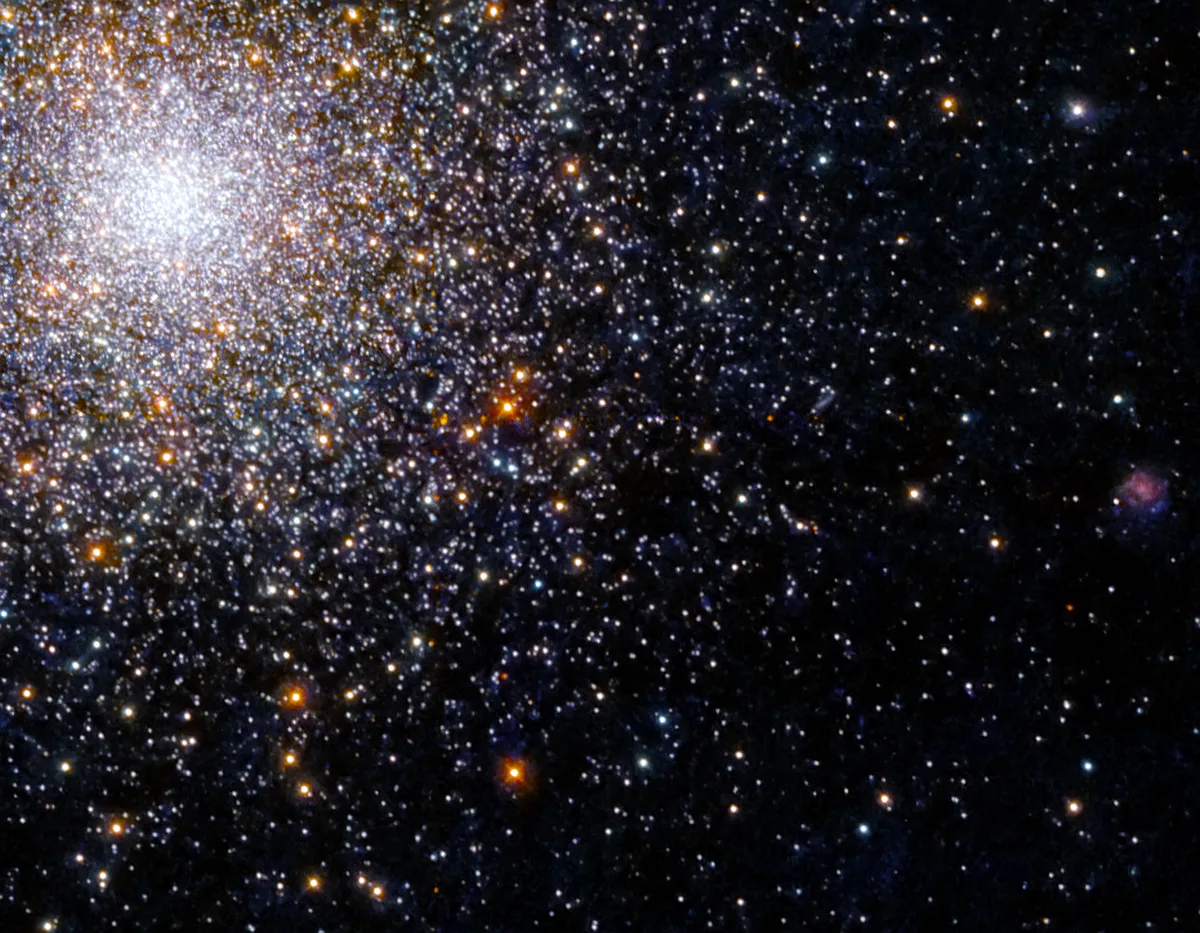
Caldwell 66, also known as NGC 5694, was discovered by William Herschel in 1784 and is one of the oldest, most remote globular clusters in our galaxy. Located roughly 100,000 light-years from Earth in the constellation Hydra, this collection of stars appears very faint in the sky with an apparent magnitude of 10.2. A small telescope is needed to spot the distant cluster. It can be seen best from southern locations in the northern hemisphere in the late spring and from the southern hemisphere in the autumn. Most globular clusters reside on the outskirts of a galaxy and are gravitationally bound to their galaxy. This means that the clusters will remain in orbit around the galaxy’s gravitational center. However, astronomers suspect that Caldwell 66 is traveling on an unbound, hyperbolic (or U-shaped) path around our Milky Way galaxy. The cluster is located far enough away from the galactic center that it is only loosely bound by gravity, and it is traveling through space so quickly that it will likely escape from our galaxy’s gravitational grip. This image of Caldwell 66 is a composite of observations made in visible and ultraviolet light by Hubble’s Wide Field and Planetary Camera 2. The observations were taken to help astronomers better understand the evolution of globular clusters and to more precisely determine the age of the cluster. A faint background galaxy appears near the right edge of the image. Credit: NASA, ESA, G. Fahlman (Dominion Astrophysical Observatory), R. Ibata (Université de Strasbourg), and F. Ferraro (Università di Bologna); Processing: Gladys Kober (NASA/Catholic University of America) (CC BY 2.0)
Discovery and early observations
NGC 5694 was discovered by the German-born British astronomer William Herschel on May 22, 1784. Herschel was unable to resolve the cluster’s individual stars and described the object as a faint nebula. He listed it as II 196 in his catalogue of deep sky objects.
American astronomers Carl Lampland and Clyde Tombaugh were the first to recognize NGC 5694 as a globular star cluster in 1932. Tombaugh identified the object as a globular after examining a pair of photographic plates centred on Pi Hydrae taken at Lowell Observatory in May 1931. Even though the cluster was listed in the New General Catalogue (1888), its true nature was previously unknown.
Tombaugh reported his discovery to his colleague Lampland, who then photographed the object using a 42-inch reflector. The image revealed NGC 5694 to be a globular cluster.
Extragalactic interloper
NGC 5694 lies in the Milky Way’s halo, roughly 96,000 from the Galactic centre. Astronomers believe that the cluster did not originate in our galaxy. It has a highly unusual chemical composition and was likely captured by the Milky Way in the distant past. The cluster’s birthplace is still unknown.
The extragalactic origin of NGC 5694 was originally proposed by Harris & Hesser in 1976 based on the cluster’s large distance and radial velocity. In 2006, Lee et al. supported the hypothesis after analyzing the chemical composition of a single giant star at the tip of the red giant branch (RGB) in the cluster.
In 2013, Mucciarelli et al. confirmed that NGC 5694 did not form in the Milky Way. The astronomers obtained accurate abundances for many elements and found that six observed stars had the same anomalous chemical composition. The researchers based their findings on data obtained with the FLAMES multi-object high resolution spectrograph on the Very Large Telescope (VLT). The team compared the observations with archival data for NGC 6397 (C86) in the constellation Ara, a globular cluster with similar iron content.
The analysis also revealed that the average abundance of alpha elements in the cluster (except silicon) was very similar to the Sun and different from that seen in globular clusters with similar metallicity and stars in the Milky Way’s halo. The findings fully confirmed that NGC 5694 is an interloper in the Galactic halo.
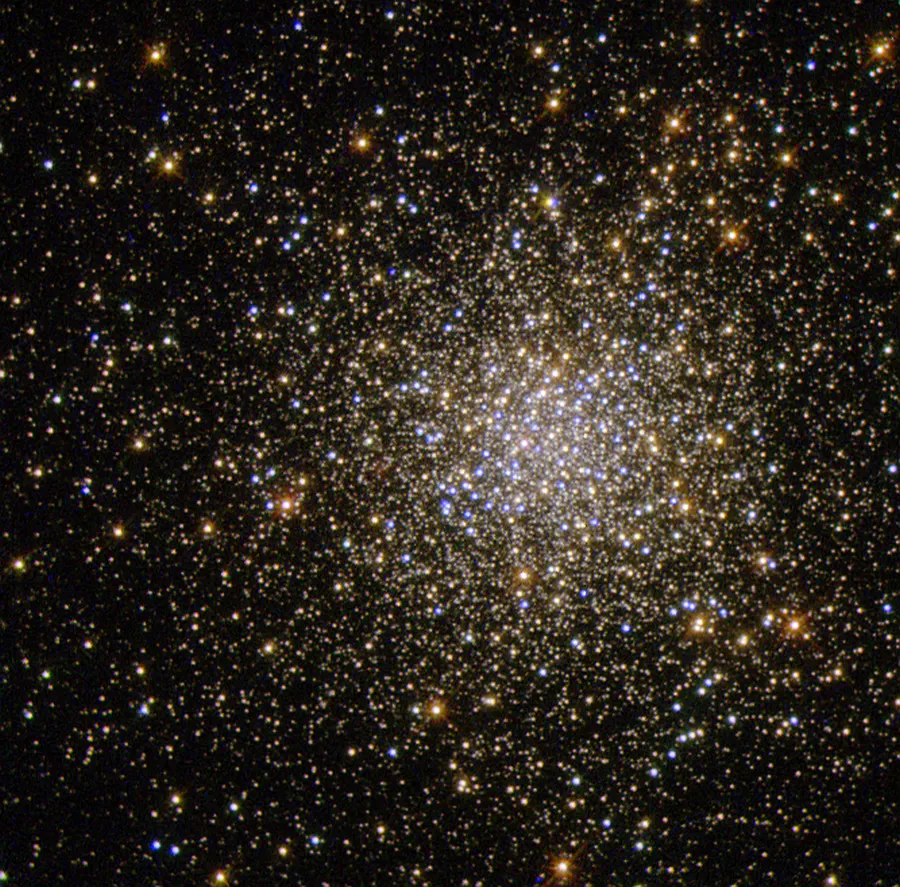
NGC 5694 (Tombaugh’s Globular Cluster), image credit: Judy Schmidt (CC BY 2.0)
A search for possible relatives
A search for globular clusters with similar properties ruled out the origin in the Large Magellanic Cloud (LMC), as well as in the Sagittarius Dwarf Spheroidal Galaxy, where several clusters with similar metallicity were born, including Messier 54, Arp 2, and Terzan 8. NGC 5694 has chemical anomalies that these clusters do not share.
Astronomers ruled out the hypothesis that the cluster formed in a system that was chemically similar to the present-day dwarf spheroidal galaxies. They noted that stars with similar abundances have been observed in ultra faint dwarf galaxies like Canes Venatici II (CVn II) in the constellation Canes Venatici and Leo IV in Leo.
The chemical anomalies found in NGC 5694 have also been observed in the globular cluster Ruprecht 106 in the constellation Centaurus, which has a similar galactocentric distance and radial velocity. Ruprecht 106 is a couple of billion years younger than NGC 5694 and more metal-rich, but the two clusters may share a common origin.
Extended halo
In 2011, Correnti et al. discovered an extended stellar halo around NGC 5694. The stars extend out to 9 arcminutes from the cluster centre, corresponding to a distance of 93 parsecs, far beyond the cluster’s tidal radius.
The stars in the halo may have escaped the cluster through tidal stripping, but the origin of the extended structure remains uncertain. The researchers have proposed that the cluster may be the remnant of a disrupted dwarf satellite of the Milky Way.
Variable stars in NGC 5694
In 2012, Rodrigues de Andrade et al. reported the discovery of the first 15 variable star candidates in NGC 5694, including several RR Lyrae variables, semiregular variables and long period variables, as well as a short-period type II Cepheid variable (BL Herculis star).
RR Lyrae stars are pulsating periodic variables. These are evolved stars on the horizontal branch with masses around half that of the Sun. They are commonly found in globular clusters like NGC 5694. However, the cluster does not contain many of these stars compared to other globulars.
How to find NGC 5694
NGC 5694 appears in the easternmost part of the large but faint constellation of Hydra, near the border with Libra. It can be found using the brighter stars of Libra and Scorpius. A line drawn from Dschubba (Delta Scorpii), the middle bright star of the Scorpion’s claws, through Brachium (Sigma Librae) in Libra points in the direction of the cluster.
Tombaugh’s Globular lies below what used to be the tail of the former constellation Turdus Solitarius (the Solitary Thrush), later known as Noctua (the Owl), near the K-type giant Solitaire (E Hydrae).
The cluster can be spotted in medium and larger telescopes, but it is a difficult object to resolve because of its distance. In small telescopes, it appears as a small, fuzzy patch of light. In 10-inch instruments, the brighter central region becomes visible. In good conditions, the cluster can be resolved in 20-inch instruments.
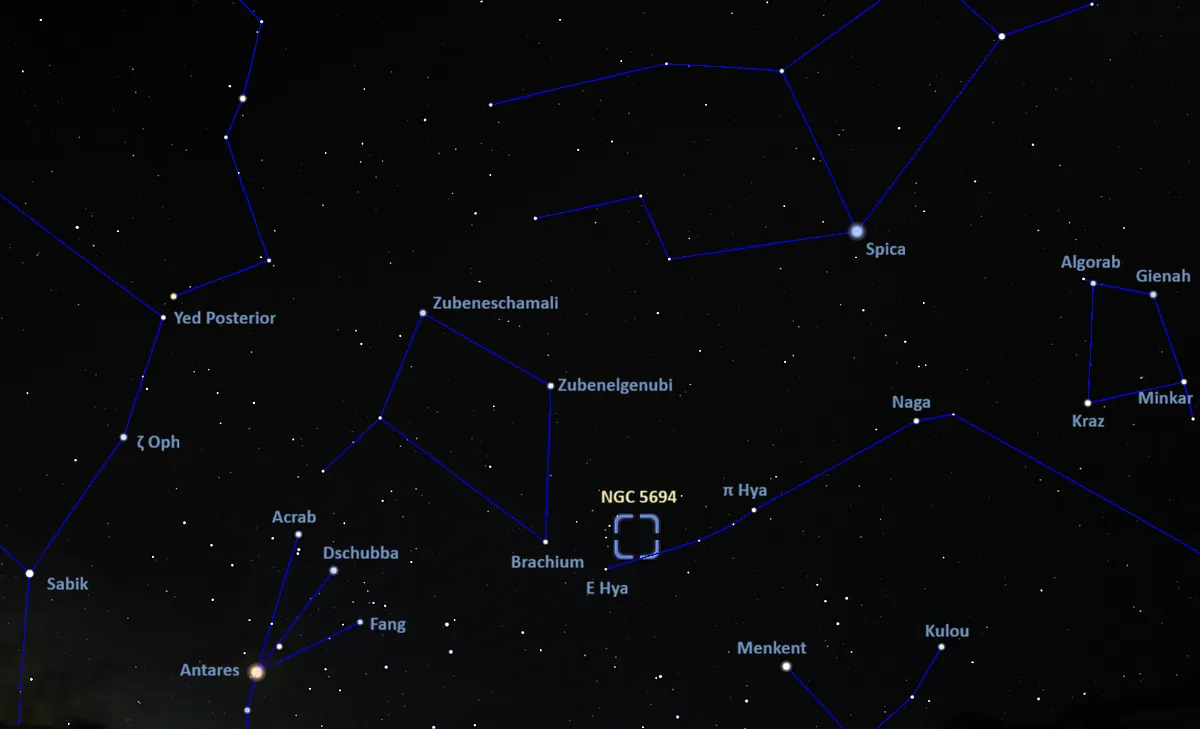
Location of NGC 5694, image: Stellarium (annotated for this article)
At declination -27°, NGC 5694 is best seen from the southern hemisphere. It is visible from locations south of the latitude 63° N. It never climbs very high above the horizon for observers in the mid-northern latitudes.
The best time of the year to observe NGC 5694 and other deep sky objects in Hydra is in May and June, when the constellation appears higher in the sky in the early evening.
Explore other deep sky objects in Hydra:
- Southern Pinwheel Galaxy (Messier 83)
- Ghost of Jupiter Nebula (NGC 3242)
- Southern Owl Nebula (ESO 378-1)
- Porpoise Galaxy (NGC 2936)
- Diamond Ring Nebula (Abell 33)
NGC 5694
| Constellation | Hydra |
| Object type | Globular cluster |
| Class | VII |
| Right ascension | 14h 39m 36.52s |
| Declination | −26° 32′ 18.0″ |
| Apparent magnitude | 10.2 |
| Apparent size | 3.6′ |
| Distance | 114,100 light-years (34,983 parsecs) |
| Size (diameter) | 120 light-years |
| Age | 13.44 billion years |
| Metallicity | [Fe/H] = -1.74 |
| Names and designations | NGC 5694, Caldwell 66, C66, Tombaugh’s Globular Cluster, GCl 29, C 1436-263 |