NGC 3314 is a striking pair of overlapping spiral galaxies located in the southern constellation Hydra. The two galaxies, catalogued as NGC 3314A and NGC 3314B, lie in the same line of sight when seen from Earth but are not physically related. They are separated by tens of millions of light years. Both are members of the Hydra Cluster.
Even though they look like they are interacting, the galaxies lie at very different distances. The smaller foreground galaxy NGC 3314A lies 154 million light-years away and the larger and more distant NGC 3314B lies 239.8 million light-years away. With an apparent magnitude of 13.11 and an apparent size of 2.6 by 1.7 arcminutes, the galaxies are a challenging target for backyard telescopes.
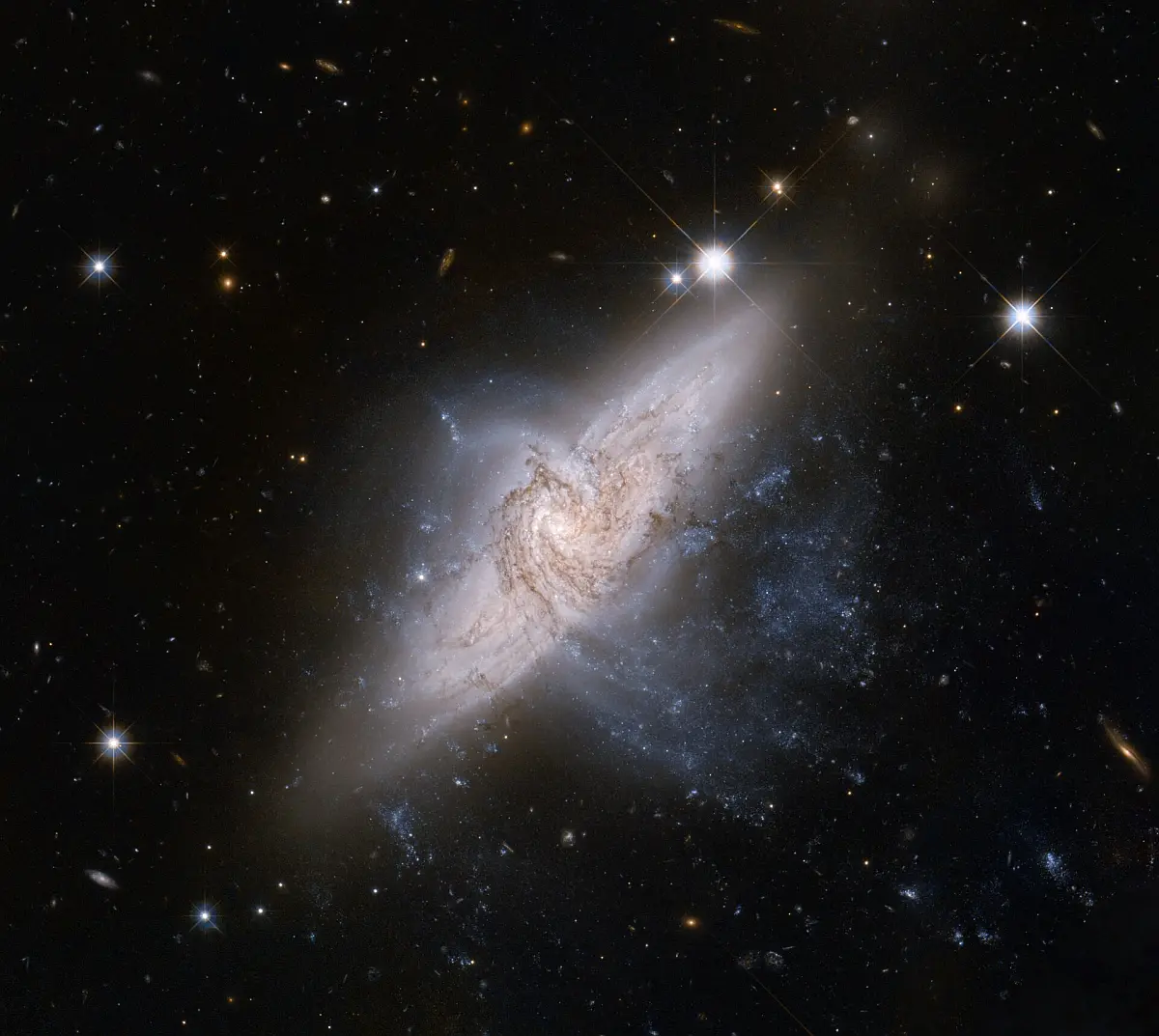
The NASA/ESA Hubble Space Telescope has produced an incredibly detailed image of a pair of overlapping galaxies called NGC 3314. While the two galaxies look as if they are in the midst of a collision, this is in fact a trick of perspective: the two are in chance alignment from our vantage point. NGC 3314A and B might look like they are in the midst of a galactic pile-up, but they are in fact separated by tens of millions of light years of void. Their apparent proximity is simply a trick of perspective. How do we know this? The biggest hint as to whether galaxies are interacting is usually their shapes. The immense gravitational forces involved in galactic mergers are enough to pull a galaxy out of shape long before it actually collides. Deforming a galaxy like this does not just warp its structure, but it can trigger new episodes of star formation, usually visible as bright blue stars and glowing nebulae. This mosaic image covers a large field of view (several times the size of an individual exposure from Hubble’s Advanced Camera for Surveys). Thanks to a long exposure time of more than an hour in total exposure time for every frame, the image shows not only NGC 3314, but also many other more distant galaxies in the background. Image credit: NASA, ESA, the Hubble Heritage (STScI/AURA)-ESA/Hubble Collaboration, and W. Keel (University of Alabama) (PD)
Discovery and observations
NGC 3314 was discovered by the British astronomer John Herschel on March 24, 1835. Herschel listed the object as JH 3283 in his Catalogue of nebulae and clusters of stars of 1864. He did not realize that he was looking at two overlapping objects, and he simply noted, “8th of 9.” The other eight “nebulae” he was referring to were NGC 3285, NGC 3305, NGC 3307, NGC 3308, NGC 3309, NGC 3311, NGC 3312, and NGC 3316. He discovered all these galaxies in the same week.
NGC 3314 was believed to be a single object for well over a century after its discovery. The first person to suggest the possibility of a superposition of two galaxies was Gérard de Vaucouleurs in 1964. Known for his extensive study of galaxies, the French astronomer classified the galaxy as SB0(s)pec (a peculiar barred lenticular galaxy) but proposed that it may in fact be two galaxies in strong interaction. In 1983, Richter and Huchtmeier found direct evidence for the superposition.
The nuclei of the overlapping galaxies are separated by only 2.36 arcseconds. The unique alignment allows astronomers to study the properties of dust in NGC 3314A and extinction in NGC 3314B. The clouds of gas and dust like those seen in NGC 3314A can usually only be seen in star forming regions of other galaxies, where they are heated and lit by the intense energy of young stars.
In NGC 3314A, these dusty regions are juxtaposed against the stars of the background galaxy. They stand out because they absorb the light of the background stars. At the same time, the stars in NGC 3314B are considerably reddened and dimmed by the intervening dust.
NGC 3314A has a prominent dust tail, the result of ram pressure stripping as they galaxy speeds through the dense intracluster medium of the Hydra Cluster. The galaxy is showing signs of interaction with other members of the cluster but not with NGC 3314B. It has a mildly distorted appearance and stretched out spiral arms.
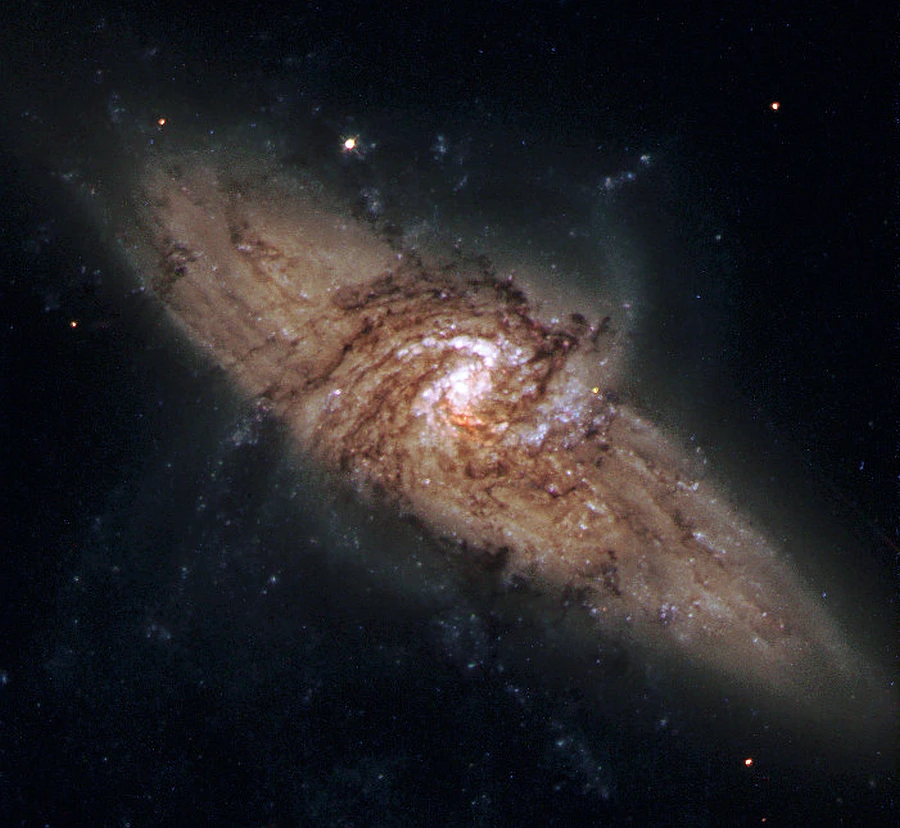
Through an extraordinary chance alignment, the Hubble telescope has captured a view of a face-on spiral galaxy lying precisely in front of another larger spiral. The unique pair is called NGC 3314. This line-up provides astronomers with the rare chance to see the dark material within the foreground galaxy, seen only because it is silhouetted against the light from the object behind it. Image: NASA/ESA and The Hubble Heritage Team (STScI/AURA) (CC BY 4.0)
Hydra Cluster
Both NGC 3314A and NGC 3314B are members of the Hydra Cluster of galaxies. The Hydra Cluster (Abell 1060) is a large galaxy cluster about 10 million light years across. Its brightest and largest members are the supergiant elliptical galaxy NGC 3311 and the giant elliptical NGC 3309.
The galaxy cluster is part of the larger Laniakea Supercluster, which also contains the Local Group, the home of the Milky Way and Andromeda galaxies.
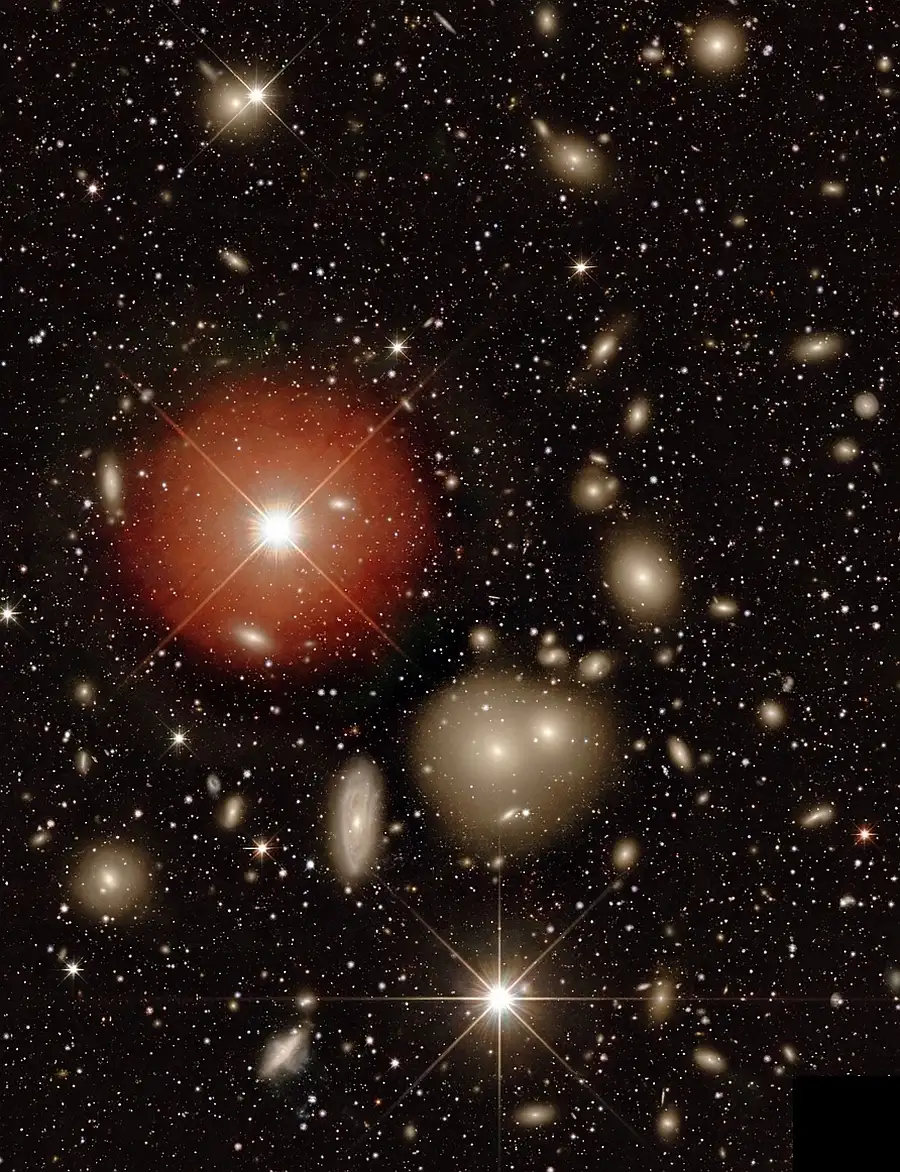
Center of Hydra I galaxy cluster (ACO 1060) with many NGC galaxies. Image credit: Legacy Surveys / D. Lang (Perimeter Institute), NERSC; artefacts removed with Gemini (CC BY-SA 4.0)
How to find NGC 3314
NGC 3314 lies in a faint area of the sky in the southern part of Hydra. It appears about a quarter of the way from Alpha Antliae in the constellation Antlia to Alkes in Crater.
At declination -28°, the overlapping pair is best seen from the southern hemisphere. It never rises above the horizon for observers north of the latitude 62° N.
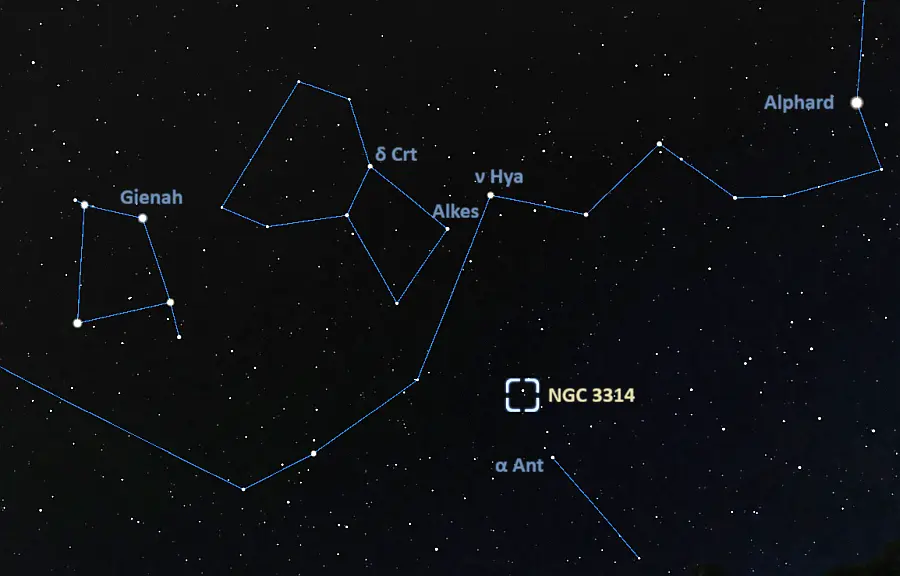
Location of NGC 3314 in Hydra, image: Stellarium (annotated for this article)
Explore other deep sky objects in Hydra:
- Southern Pinwheel Galaxy (Messier 83)
- Ghost of Jupiter Nebula (NGC 3242)
- Southern Owl Nebula (ESO 378-1)
- Porpoise Galaxy (NGC 2936)
- Diamond Ring Nebula (Abell 33)
- NGC 3285B
NGC 3314
| Constellation | Hydra |
| Object type | Spiral galaxies |
| Right ascension | 10h 37m 13.2s |
| Declination | -27° 41′ 04.0″ |
| Apparent magnitude | 13.11 |
| Apparent size | 2′.6 × 1′.7 |
| Names and designations | NGC 3314, MCG-04-25-041, ESO 501-46, ESO-LV 501-0460, AM 1034-272, SGC 103452-2725.5, ACO 1060 62, ACO 1060-3, IRAS 10348-2725, IRAS F10348-2725, 2MASX J10371285-2741021, PRC D-48, NVSS J103712-274103, XMMU J103712.8-274102, PSCz Q10348-2725, 6dFGS gJ103712.9-274102, Gaia DR2 5468002029381065344, Gaia DR3 5468002033672171392 |
NGC 3314A
| Morphological type | SBbc |
| Distance | 154.0 ± 10.9 million light-years (47.23 ± 3.33 megaparsecs) |
| Redshift | 0.009537 |
| Names and designations | NGC 3314A, LEDA 31531, PGC 31531, ESO 501-IG 046 NED01, ESO 103452-2725.5 NED01, WISEA J103712.91-274102.1, 2MASX J10371285-2741021 |
NGC 3314B
| Morphological type | SAab |
| Distance | 239.8 ± 16.8 Mly (73.52 ± 5.16 Mpc) |
| Redshift | 0.015481 |
| Names and designations | NGC 3314B, LEDA 31532, PGC 31532, ESO 501-IG 046 NED02, ESO 103452-2725.5 NED02, SGC 103452-2725.5 NED02, PGC1 0031478 NED012 |
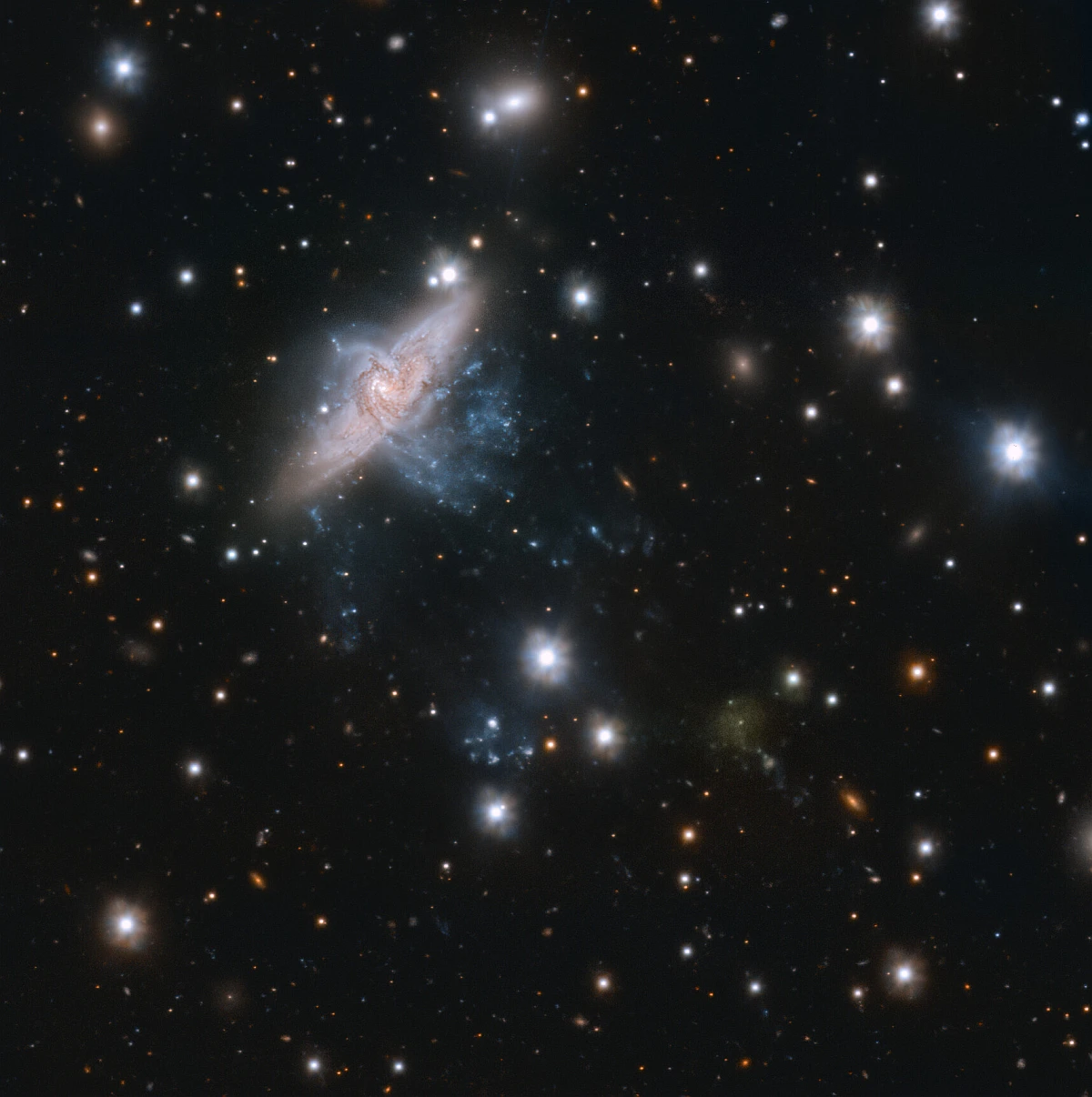
The image shows a pair of overlapping spiral galaxies, NGC 3314a and b, in the top left, caught in a majestic cosmic dance — captured by ESO’s VLT Survey Telescope (VST).But don’t let the perspective fool you! They are, in fact, not interacting at all. The two galaxies, located between 117 and 140 million light-years away in the constellation of Hydra, are actually physically unrelated and only appear to overlap when viewed from Earth. This unique alignment gives astronomers the opportunity to measure many properties of the galaxies, such as how dust absorbs starlight, and hence gain insight into their composition and evolution.There is another hidden secret in this picture if you look closely at the lower right region: beyond this stunning cosmic dance you will find a faint yellowish smudge, the signature of an ultra-diffuse galaxy (UDG). UDGs are objects as large as the Milky Way but with 100 – 1000 times fewer stars. These galaxies are extremely faint and lack star-forming gas, which makes them appear almost like a smudge in the night sky. This UDG, named UDG 32, is one of the faintest and most spread out galaxies in the Hydra I cluster. Image credit: ESO/Iodice et al. (CC BY 4.0)