NGC 5728 is a barred spiral galaxy located 145.8 million light-years away in the constellation Libra. With an apparent magnitude of 13.40 and an apparent size of 3.02 by 1.78 arcminutes, it is a challenging object for amateur telescopes. It is classified as an active galaxy and contains a supermassive black hole at its centre.
NGC 5728 was discovered by William Herschel on May 7, 1787. The galaxy spans about 97,400 light-years across, making it slightly larger than the Milky Way, and contains a mass of 72 billion Suns. It is one of the more scientifically studied barred spirals in the southern sky, serving as a window into the physics of active galactic nuclei.
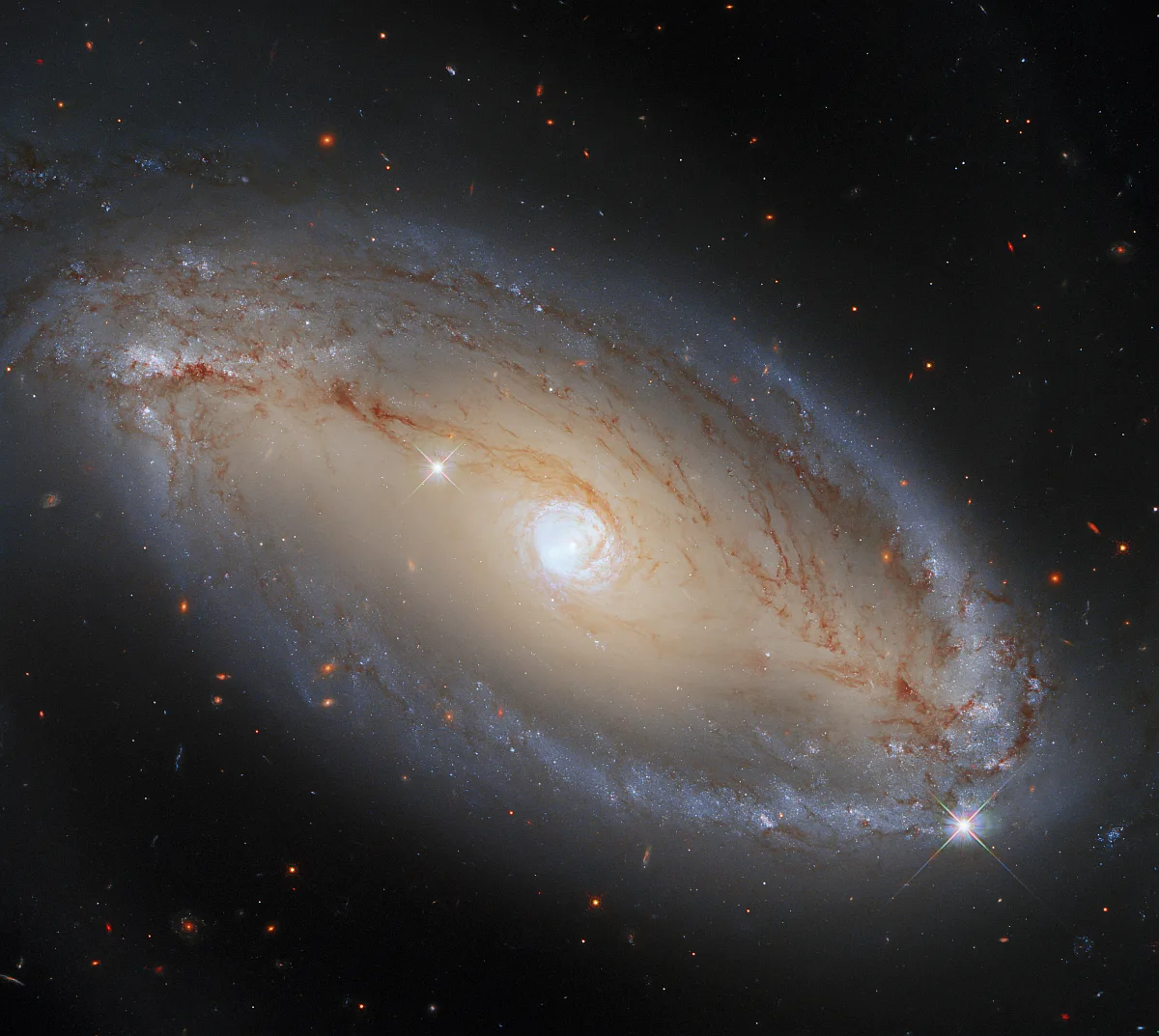
Meet NGC 5728, a spiral galaxy around 130 million light-years from Earth. This image was captured using Hubble’s Wide Field Camera 3 (WFC3), which is extremely sensitive to visible and infrared light. Therefore, this image beautifully captures the regions of NGC 5728 that are emitting visible and infrared light. However, there are many other types of light that galaxies such as NGC 5728 can emit, which WFC3 cannot see. In this image, NCG 5728 appears to be an elegant, luminous, barred spiral galaxy. What this image does not show, however, is that NGC 5728 is also a monumentally energetic type of galaxy, known as a Seyfert galaxy. This extremely energetic class of galaxies are powered by their active cores, which are known as active galactic nuclei (AGNs). There are many different types of AGNs, and only some of them power Seyfert galaxies. NGC 5728, like all Seyfert galaxies, is distinguished from other galaxies with AGNs because the galaxy itself can be seen clearly. Other types of AGNs, such as quasars, emit so much radiation that it is almost impossible to observe the galaxy that houses them. As this image shows, NGC 5728 is clearly observable, and at optical and infrared wavelengths it looks quite normal. It is fascinating to know that the galaxy’s centre is emitting vast amounts of light in parts of the electromagnetic spectrum that WFC3 just isn’t sensitive to! Just to complicate things, the AGN at NGC 5728’s core might actually be emitting some visible and infrared light — but it may be blocked by the dust surrounding the galaxy’s core. Image credit: ESA/Hubble, A. Riess et al., J. Greene (CC BY 4.0)
A closer look at the structure of NGC 5728
NGC 5728 is classified as a barred spiral galaxy, which means that it has a bar-shaped structure of stars that stretches across its central region. The central bar is believed to have formed as a result of a density wave emanating from the galactic centre and gradually reshaping the orbits of the stars in the galaxy’s inner region.
NGC 5728 has the morphological class SAB(r)a?, which indicates a spiral galaxy with a weak bar, a ring structure (r) and possible tightly wound spiral arms (a?).
The galaxy contains the main bar and a smaller counter-rotating nuclear bar within 10 arcseconds of the galactic centre. The nuclear bar is positioned at an angle of 60 degrees from the main bar. Counter-rotating features like this are relatively rare and hint at a complex formation history.
Observations with the Spitzer Space Telescope have revealed further structural layers: a nuclear ring, an inner pseudo-ring, and a closed outer ring with trailing spiral arms. The region between the galactic nucleus and the outer ring is relatively smooth but contains some dust rings and lanes. These play an important role in funnelling material towards the galactic centre.
The galaxy has a complex nuclear structure, containing a star-forming ring stretching 2 kiloparsecs (roughly 6,500 light-years) across and a radio jet that affects the surrounding interstellar medium up to 200 parsecs (650 ly) from the nucleus. In 1999, Prada and Gutiérrez found the galactic core to be counter-rotating with respect to the galaxy’s main body.
A star-forming ring around the nucleus
The star-forming ring in the inner region of NGC 5728 is an area of intense activity. It contains stars that are less than 10 million years old. In 2018, astronomers estimated a stellar age of 7.4 to 8.4 million years and a star formation rate of 3.5 solar masses per year for the nuclear region.
The circumnuclear ring also contains a string of emission features with similar luminosities, thought to be supernova remnants. These were produced by massive stars that formed and evolved rapidly due to their high mass. Two dark dust lanes emerge from the region just outside the ring and appear parallel to the galaxy’s primary bar. The dust lanes and spiralling filaments act as channels that feed gas and dust inwards, sustaining the active nucleus.
Observations in the 1980s and 1990s revealed two blue rings in the galaxy showing evidence of recent star formation, one concentrated in the core region and another near the ends of the primary bar. The second ring indicates that star formation is not limited to the innermost region.
The supermassive black hole within
One of the more interesting features of NGC 5728 is its active galactic nucleus (AGN). The galaxy is classified as a Seyfert 2 galaxy, a category of galaxies that contain very luminous cores with supermassive black holes at their centres. Seyfert galaxies are powered by supermassive black holes actively consuming the surrounding material.
Observations of NGC 5728 across multiple wavelengths have revealed a highly active and luminous core hidden behind dense clouds of dust and gas. The active galactic nucleus is concealed by a dust bar with up to 19 magnitudes of extinction, which means that only a very small fraction of the light from the nucleus reaches us at visible wavelengths. The dust bar has an estimated size of 64 by 28 parsecs (208 by 91 ly).
The central black hole of NGC 5728 has an estimated mass of 3.4×10⁷ solar masses. It is surrounded by an accretion disk of infalling material which emits strongly in the ultraviolet. The luminosity of the galactic core is comparable to that of the entire Milky Way.
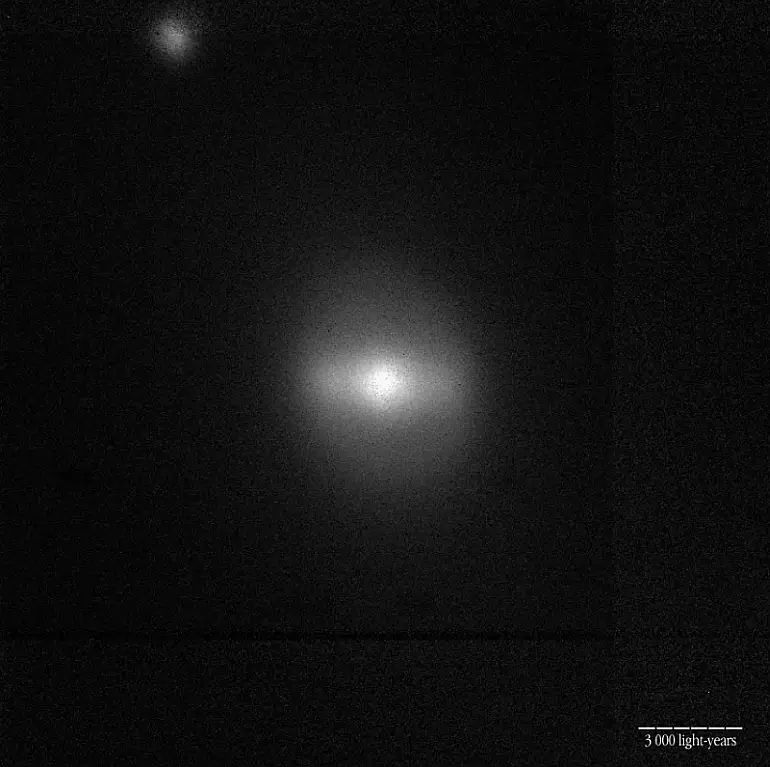
Tmage of the central region of NGC 5728 was obtained at the 3.5-m Canada-France-Hawaii Telescope (CFHT) and the Adaptive-Optics PUEO instrument; the K-band (2.3 µm) exposure lasted 60 sec and the field measures 38 X 38 arcsec 2. North is up and East is left. Image credit: ESO (CC BY 4.0)
Giant ionization cones of light and gas
Even though the galactic nucleus of NGC 5728 is obscured, astronomers have observed large cones of ionized gas that extend outward from the galaxy’s core. These ionization cones are oriented across our line of sight. They stretch over 2,500 parsecs (8,154 ly) from the galactic nucleus.
The ionization cones are AGN-driven outflows created when visible and ultraviolet light escapes along the relatively clear path of the dusty material around the black hole. The dense ring of gas shapes the light into two cones.
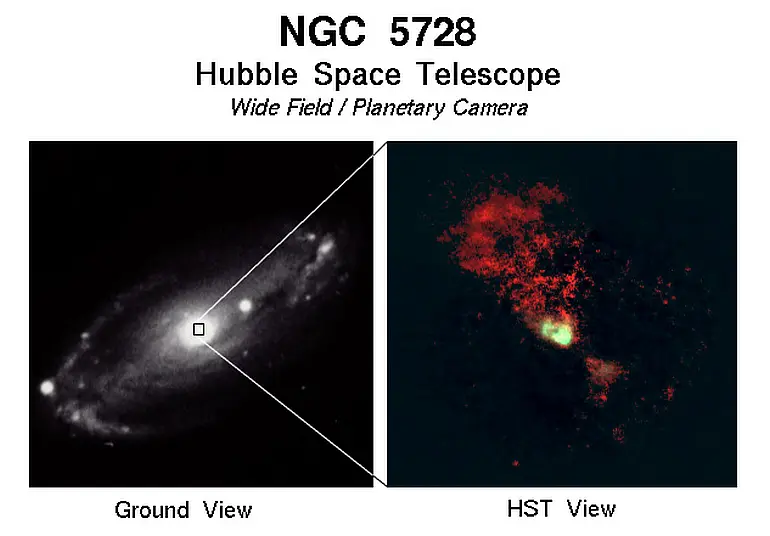
A NASA Hubble Space Telescope (HST) view of the core of the barred spiral Seyfert galaxy NGC 5728 reveals a spectacular bi-conical beam of light that is ionizing the gas in the central region of the galaxy. The image was made September 4, 1992 with the Wide Field and Planetary Camera (WFPC) in PC mode. Exposures were obtained in the light of doubly-ionized oxygen and neutral hydrogen. Credit – Right: Andrew S. Wilson (STScI)/NASA Right Co-investigators: James A. Braatz (Univ. Of Maryland), Timothy M. Heckman (STScI), Julian H. Krolik (JHU), and George K. Miley (Leiden Observatory). Left Courtesy of: Allan Sandage, Carnegie Observatories (CC BY 4.0)
Evidence of a turbulent past
In 2002, a team of astronomers reported an asymmetric distribution of carbon monoxide gas in the nuclear region of NGC 5728, based on observations with the Owens Valley Radio Observatory Millimeter Array. The off-centre CO emission may be evidence for a past merger with a smaller galaxy.
The merger would have been a minor one, as no tidal tails have been detected around NGC 5728. The merger scenario may also explain the counter-rotating core. The material accreted during a merger may have arrived with a different spin direction than the larger galaxy.
Supernova 2009Y
NGC 5728 hosted a Type Ia supernova, SN 2009Y, observed in February 2009. The supernova occurred 24.7 arcseconds north and 9.3 arcseconds east of the galactic centre. It was discovered by Ralph Martin on February 1, 2009. The Lick Observatory Supernova Search (LOSS) detected it the following day.
SN 2009Y was triggered by a white dwarf that accreted too much mass from a binary companion and reignited. It reached a peak apparent magnitude of 16.0.
How to find NGC 5728 in the night sky
NGC 5728 is relatively easy to find because it appears just southwest of Zubenelgenubi (Alpha2 Librae), the second brightest star in Libra. Zubenelgenubi is the middle of the three relatively bright stars that appear as the extension of the Scorpion’s claws. The brighter Zubeneschamali (Beta Librae) appears to the north and the fainter Brachium (Sigma Librae) to the south. Zubenelgenubi lies just north of the imaginary line connecting Antares in Scorpius and Spica in Virgo.
At declination -17°, NGC 5728 lies close enough to the celestial equator to be visible from all but the northernmost locations.
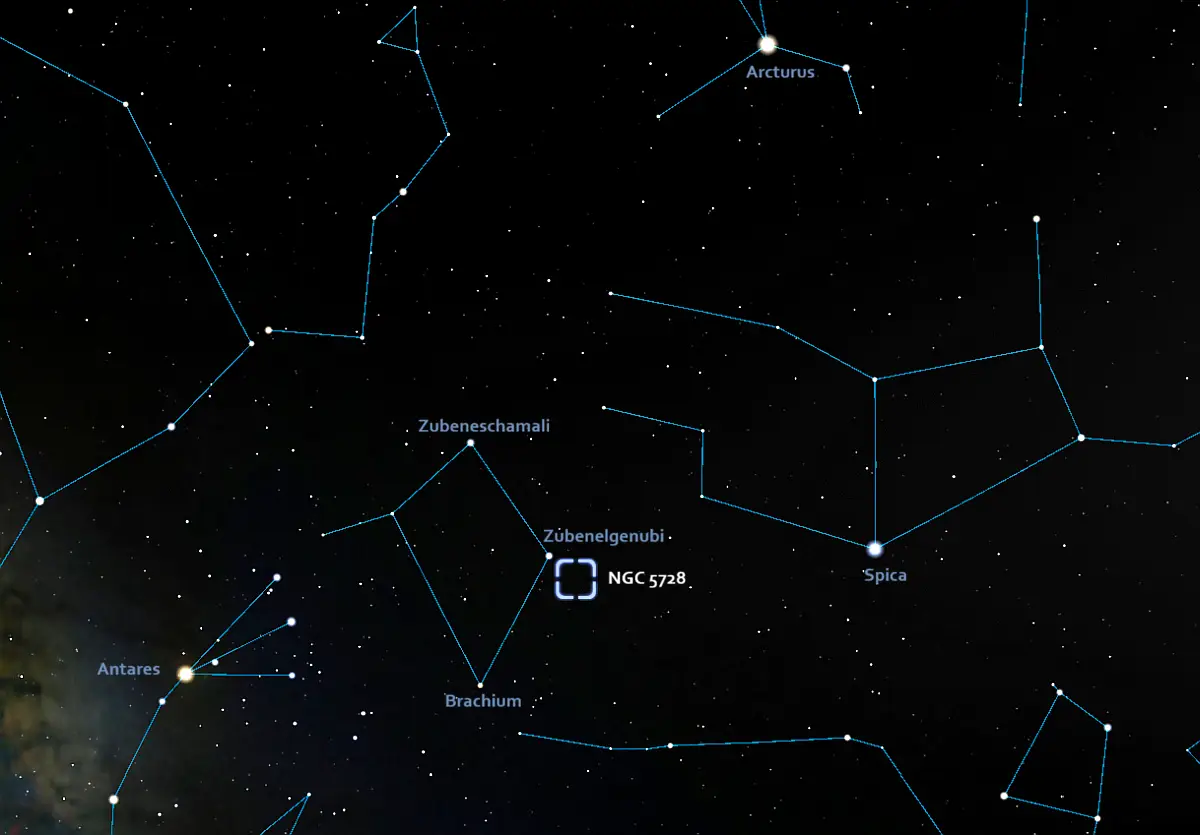
NGC 5728 location, image: Stellarium (annotated for this article)
With an apparent magnitude of 13.40, NGC 5728 requires at least a medium-aperture telescope of 10 inches, which will reveal a faint, elongated smudge of light in good observing conditions.
The best time of the year to observe deep sky objects in Libra is in the month of June, when the constellation appears higher above the horizon in the early evening.
Explore other barred spiral galaxies:
- Pinwheel Galaxy (Messier 101) in Ursa Major
- Southern Pinwheel Galaxy (Messier 83) in Hydra
- NGC 1365: The Great Barred Spiral Galaxy in Fornax
- NGC 4519: A Distorted Spiral in Virgo
- Amatha Galaxy (NGC 925) in Triangulum
- Godzilla Galaxy (UGC 2885) in Perseus
- Hockey Stick Galaxy (NGC 4656/4657) in Canes Venatici
NGC 5728
| Constellation | Libra |
| Object type | Barred spiral galaxy |
| Morphological type | SBa or SAB(r)a |
| Right ascension | 14h 42m 23.8918506576s |
| Declination | −17° 15′ 11.240783784″ |
| Apparent magnitude | 13.40 |
| Absolute magnitude | -18.3 |
| Apparent size | 3.02′ × 1.78′ |
| Distance | 145.8 ± 10.3 million light-years (44.70 ± 3.15 megaparsecs) |
| Redshift | 0.01032112 ± 0.0005 |
| Heliocentric radial velocity | 3,078 ± 150 km/s |
| Size | 97,400 light-years (29,860 parsecs) |
| Mass | 7.2 × 10¹⁰ M☉ |
| Names and designations | NGC 5728, LEDA 52521, PGC 52521, MCG-03-37-005, AGC 540121, PBC J1442.4-1714, WISE J144223.87-171510.7, WISEA J144223.87-171510.8, GSC 06158-01021, SGC 143937-1702.4, NVSS J144223-171510, IRAS 14396-1702, IRAS F14396-1702, 2MASX J14422392-1715114, AKARI-IRC-V1 J1442239-171511, PSCz Q14396-1702, WISH B1439.6-1702, GLEAM J144223-171510, TGSSADR J144223.5-171508, SWIFT J1442.4-1713, SWIFT J1442.6-1713, SWIFT J1442.5-1715, [HSN2016] J220.59-17.25, 6dFGS gJ144223.9-171511, 1E 1439.6-1702, SRGA J144223.1-171505, [NLB95] f651g001, [VV2000c] J144223.9-171511, [VV2003c] J144223.9-171511, [VV2006c] J144223.9-171511, [VV2010c] J144223.9-171511, [VV98c] J144223.9-171511, [HB91] 1439-170, [BAG2012] 220.6846-17.225, [CHM2007] LDC 1073 J144223.92-1715114, [DML87] 689, Gaia DR3 6285466045335849984 |