NGC 4519 is a barred spiral galaxy located approximately 72.56 million light years away in the equatorial constellation Virgo. It is a member of the Virgo Cluster of galaxies. The twisted spiral has an apparent magnitude of 12.9 and an apparent size of 2.69 by 1.75 arcminutes.
NGC 4519 was discovered by the German-born British astronomer William Herschel on April 15, 1784. The galaxy, along with its companion NGC 4519A and other Virgo Cluster galaxies in this region were among the first targets of the NSF–DOE Vera C. Rubin Observatory in 2025.
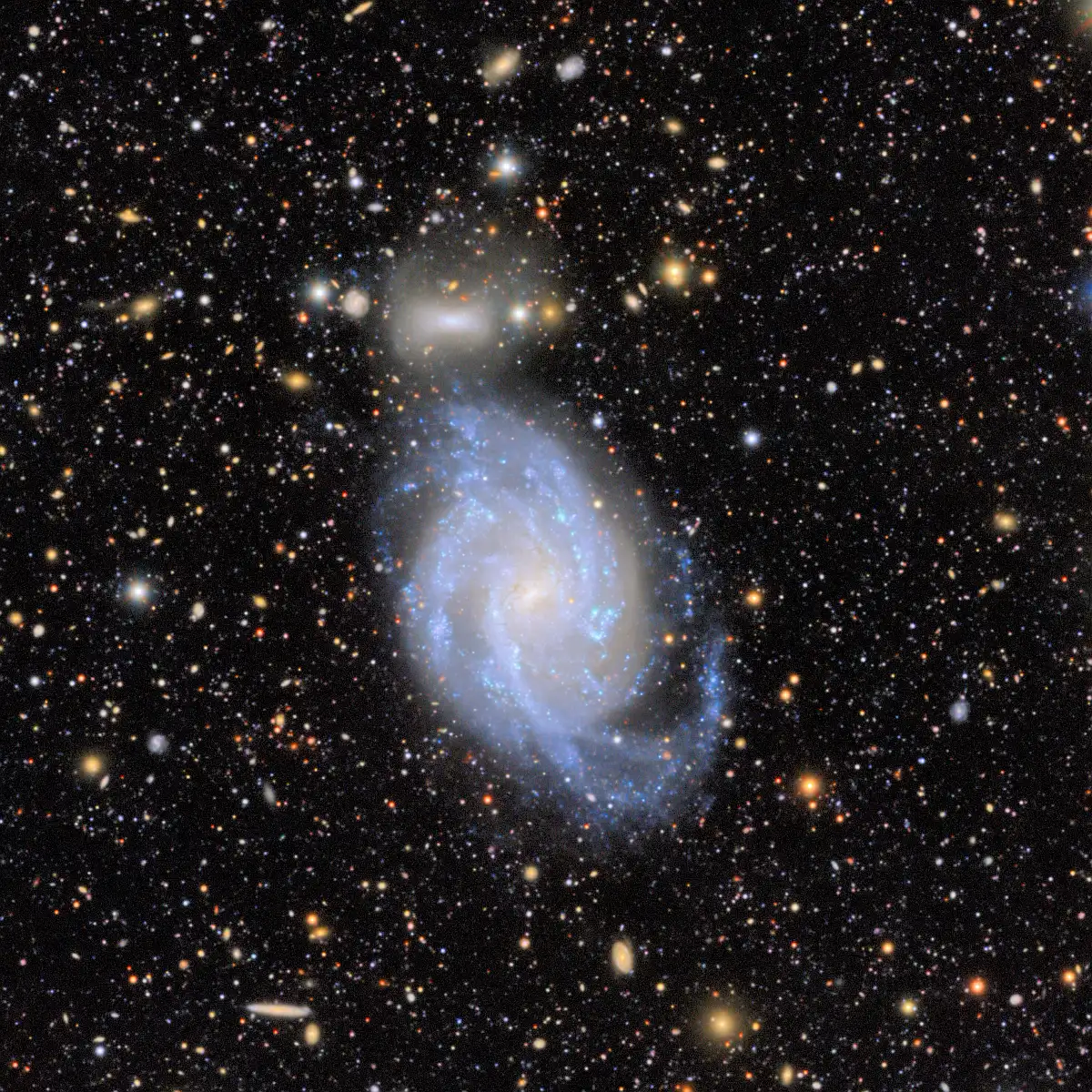
The barred spiral galaxy NGC 4519 appears in this excerpt from a First Look image captured by NSF–DOE Vera C. Rubin Observatory. The galaxy’s companion, a lenticular galaxy known as PGC 41706, can be seen directly above NGC 4519. Image credit: RubinObs/NOIRLab/SLAC/NSF/DOE/AURA (CC BY 4.0)
A lopsided barred spiral
NGC 4519 has a well-defined bar and knotty, open spiral arms. It has an asymmetrical structure, affected by the interaction with the dense medium of the Virgo Cluster. More recent studies place the galaxy 48.27 (Urrejola-Mora et al, 2022) or 19.60 megaparsecs (Soria et al, 2022) away.
NGC 4519 has misaligned photometric and kinematical major axes. Astronomers have also detected a disturbance in the distribution of the galaxy’s neutral atomic hydrogen (H I), which extends to the northwest, in the direction of the smaller companion galaxy NGC 4519A.
The disturbance may be caused by tidal forces of the smaller galaxy or by ram pressure stripping, the galaxy’s cold gas being stripped away by the drag force as the galaxy moves through the hot, dense intracluster medium at a high velocity.
The companion, NGC 4519A, is a dwarf lenticular galaxy also catalogued as LEDA 41706 (PGC 41706). The smaller galaxy is separated by 159 kiloparsecs (518,589 light-years) from its larger companion.
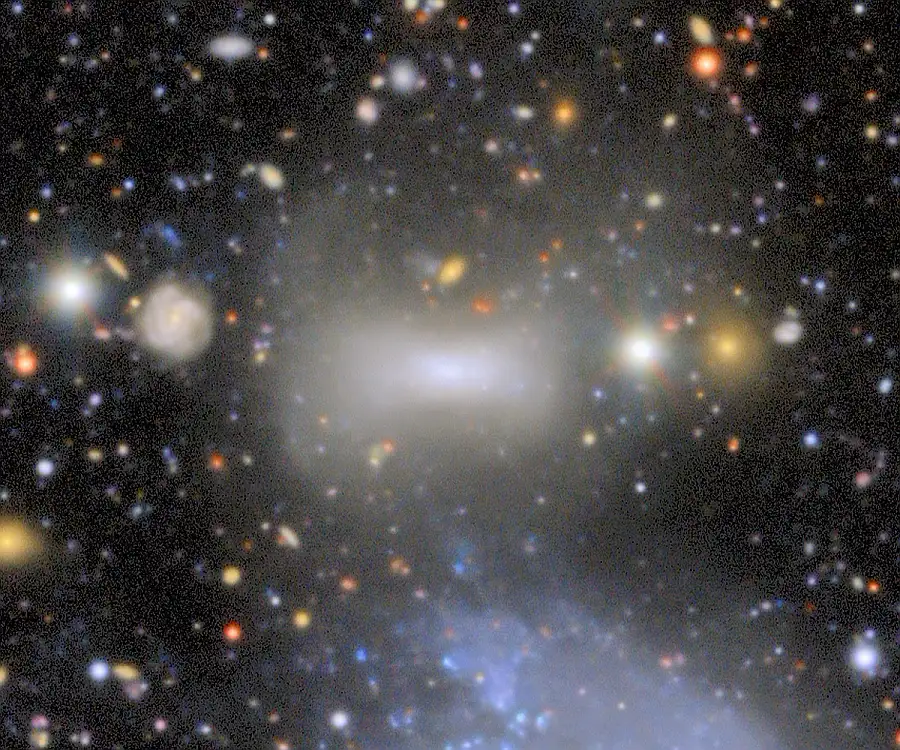
NGC 4519A imaged by the Vera C. Rubin Observatory, image credit: RubinObs/NOIRLab/SLAC/NSF/DOE/AURA (CC BY 4.0)
Possible association with ALFALFA Virgo 7 cloud complex
In 2024, Jones et al. proposed NGC 4519 as a possible progenitor of the ALFALFA Virgo 7 complex (the Kent Complex), an enormous cloud of over a billion solar masses of H I gas. The cloud complex is considered one of the largest “dark” structures in the local universe.
Discovered by Kent et al. in 2007, the complex of atomic gas clouds stretches 190 kiloparsecs (619,697 light-years) across. It is associated with an ultra-faint stellar counterpart designated Blue Candidate 6 (BC6).
BC6 is one of the most gas-rich systems known. It actively forms stars despite being isolated in intergalactic space. Other possible progenitors of BC6 include the edge-on spiral galaxies NGC 4522 and NGC 4445.
A galaxy hidden in the Virgo Cluster
NGC 4519 is a member of the Virgo Cluster, the nearest massive galaxy cluster to the Local Group. The cluster stretches across 8 degrees of the sky. Its centre appears roughly halfway between Vindemiatrix in Virgo and Denebola in Leo. In good conditions, around 160 cluster members can be spotted in a 6-inch telescope.
The brightest members of the Virgo Cluster are the giant elliptical galaxies Messier 49 (Virgo B, mag. 9.3) and Messier 87 (Virgo A, mag. 9.6). The subcluster centred on M87 appears almost exactly halfway between Denebola and Vindemiatrix, and the one centred on M49 appears to the south.
NGC 4519 lies in the same region as M49.
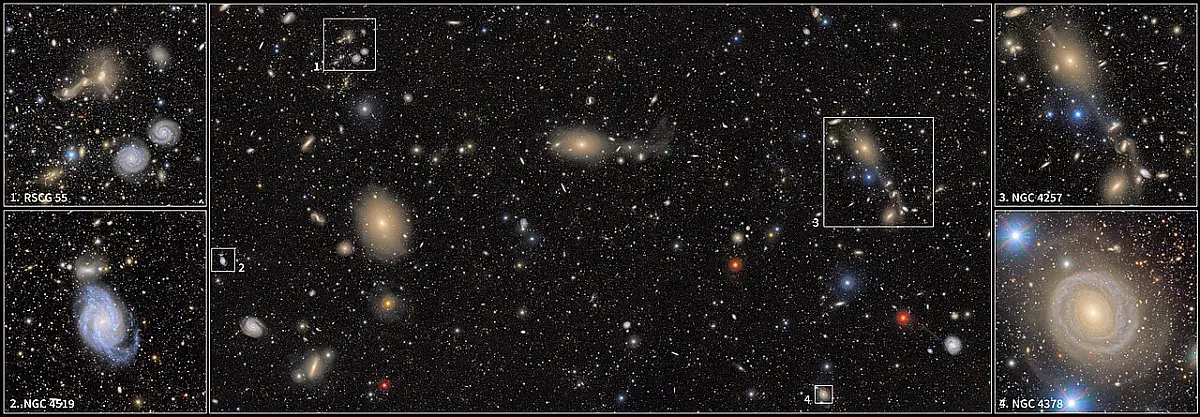
This image offers a closer look at the region surrounding the Virgo Cluster, as seen in a First Look image captured by NSF–DOE Vera C. Rubin Observatory. At the upper-left is RSCG 55, a group of interacting galaxies with trails of material between them. They can be seen above a pair of whirling spiral galaxies. Beneath that is the barred spiral galaxy NGC 4519. On the right is the region around spiral galaxy NGC 4257. Finally, at the bottom lies the single-armed spiral galaxy NGC 4378. Image credit: RubinObs/NOIRLab/SLAC/NSF/DOE/AURA (CC BY 4.0)
Galaxies near NGC 4519
Several relatively bright galaxies appear in the same region as NGC 4519. Nicknamed the Lost Galaxy, the barred spiral galaxy NGC 4535 lies southeast of NGC 4519, and the dusty edge-on lenticular galaxy NGC 4526 appears further south.
The dwarf barred lenticular galaxy NGC 4483 and the edge-on spiral NGC 4469 lie to the west and a little north of NGC 4519, and the peculiar lenticular galaxy NGC 4488 lies to the southwest. The background spiral galaxy NGC 4492 appears in the same area, between NGC 4519 and M49, but it is not a member of the Virgo Cluster.
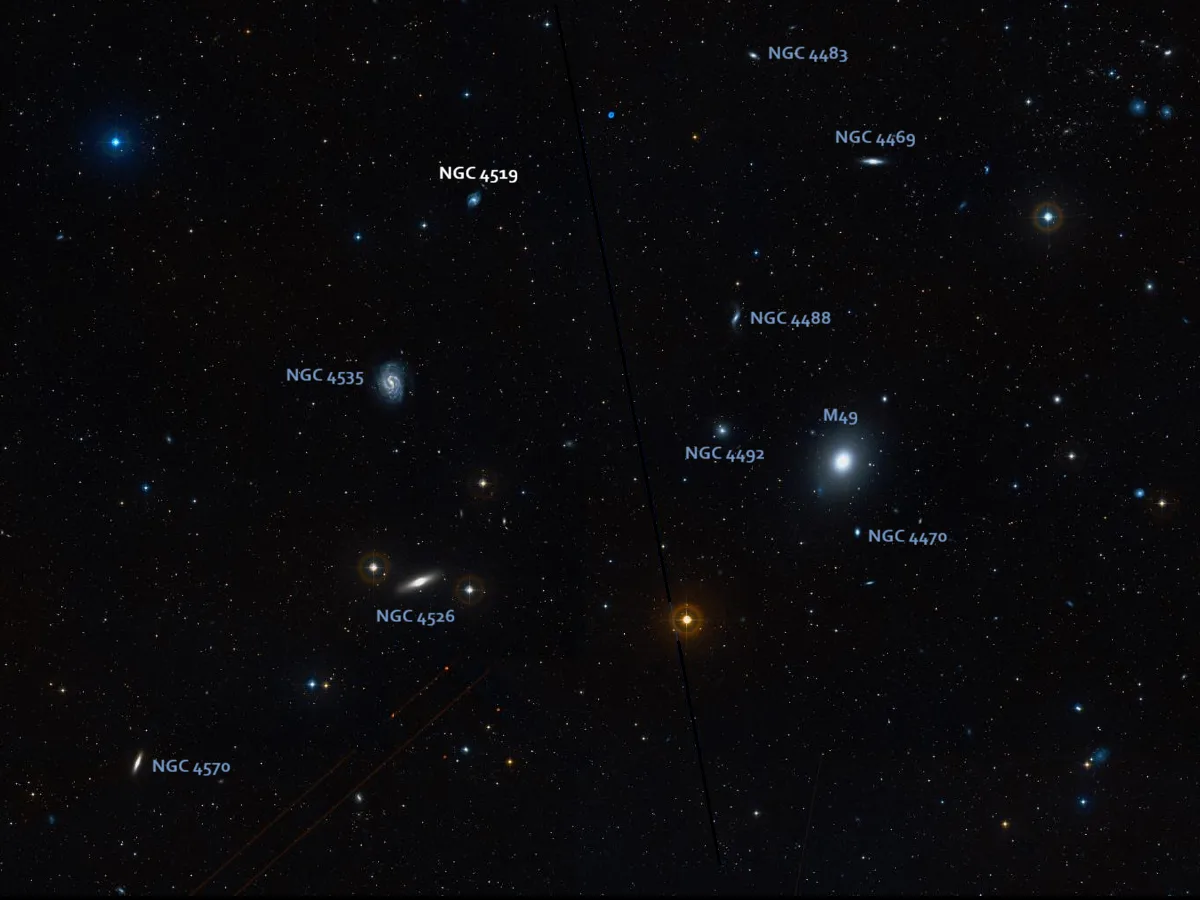
NGC 4519 in the Virgo Cluster, image credit: ESO/Digitized Sky Survey 2 (CC BY 4.0)
How to find NGC 4519
NGC 4519 lies just outside the Bowl of Virgo, a prominent spring asterism formed by Vindemiatrix (Epsilon Virginis), Minelauva (Delta Virginis), Porrima (Gamma Virginis), Zaniah (Eta Virginis), and Zavijava (Beta Virginis). It appears northeast of the bright elliptical galaxy M49, which lies about 4.5 degrees from the centre of the Virgo Cluster.
NGC 4519 can be found about a third of the way from Vindemiatrix to Zavijava, just north of the imaginary line connecting the two bright stars.
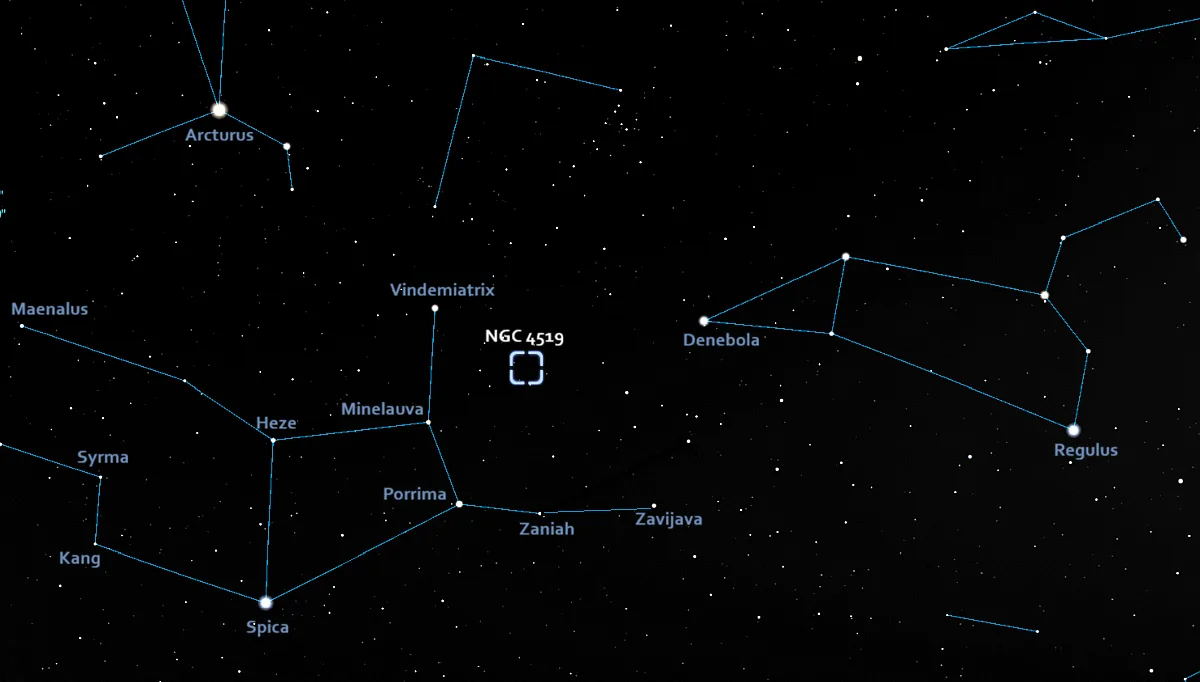
NGC 4519 location, image: Stellarium (annotated for this article)
Best time of year to observe Virgo Cluster galaxies
The best time of the year to observe NGC 4519 and other galaxies in the Virgo Cluster is during the month of May, when Virgo appears higher above the horizon in the early evening. The constellation is prominent in the evening sky throughout the northern hemisphere spring.
At declination +08° 39′, NGC 4519 is visible from virtually any location for at least part of the year.
Explore other deep sky objects in Virgo:
- Sombrero Galaxy (Messier 104)
- Arp 271 (NGC 5426 and NGC 5427)
- IC 1101
- Eyes Galaxies (NGC 4435 and NGC 4438)
- Butterfly Galaxies (NGC 4567 and NGC 4568)
NGC 4519
| Constellation | Virgo |
| Object type | Barred spiral galaxy |
| Morphological type | SB(rs)d |
| Right ascension | 12h 33m 30.2419s |
| Declination | +08° 39′ 17.334″ |
| Apparent magnitude | 12.9 |
| Apparent size | 2.31247′ × 1.74337′ |
| Distance | 72.56 ± 6.03 million light-years (22.248 ± 1.850 megaparsecs) or 48.27 Mly (14.8 Mpc), or 63.93 Mly (19.60 ± 8.48 Mpc) |
| Size | ~80,200 ly (24,590 parsecs) |
| Redshift | 0.004098 ± 0.000010 |
| Heliocentric radial velocity | 1226 ± 3 km/s |
| Names and designations | NGC 4519, LEDA 41719, PGC 41719, UGC 7709, MCG +02-32-135, CGCG 70-167, VCC 1508, IRAS 12308+0856, IRAS F12309+0855, 2MASX J12333027+0839160, ALFALFA 3-306, EVCC 869, VCC 1508, NVSS B123058+085543, PCCS1 857 G289.13+71.03, PCCS1 545 G289.12+71.03, PSCz Q12308+0856, SDSS J123330.25+083917, UZC J123330.3+083917, WVFSCC J123334+083802, Z 1231.0+0855, Z 70-167 |