Arp 271 is a pair of interacting galaxies located 127 million light years away in the constellation Virgo. The interacting pair has an apparent magnitude of 11.4 and an apparent size of 2.5 arcminutes. The two spiral galaxies are listed as NGC 5426 and NGC 5427 in the New General Catalogue.
Arp 271 was discovered by the German-born British astronomer William Herschel on March 5, 1785. Herschel listed the galaxies as II 309 (NGC 5427) and II 310 (NGC 5426) in is catalogue, describing them as “faint nebulae.”
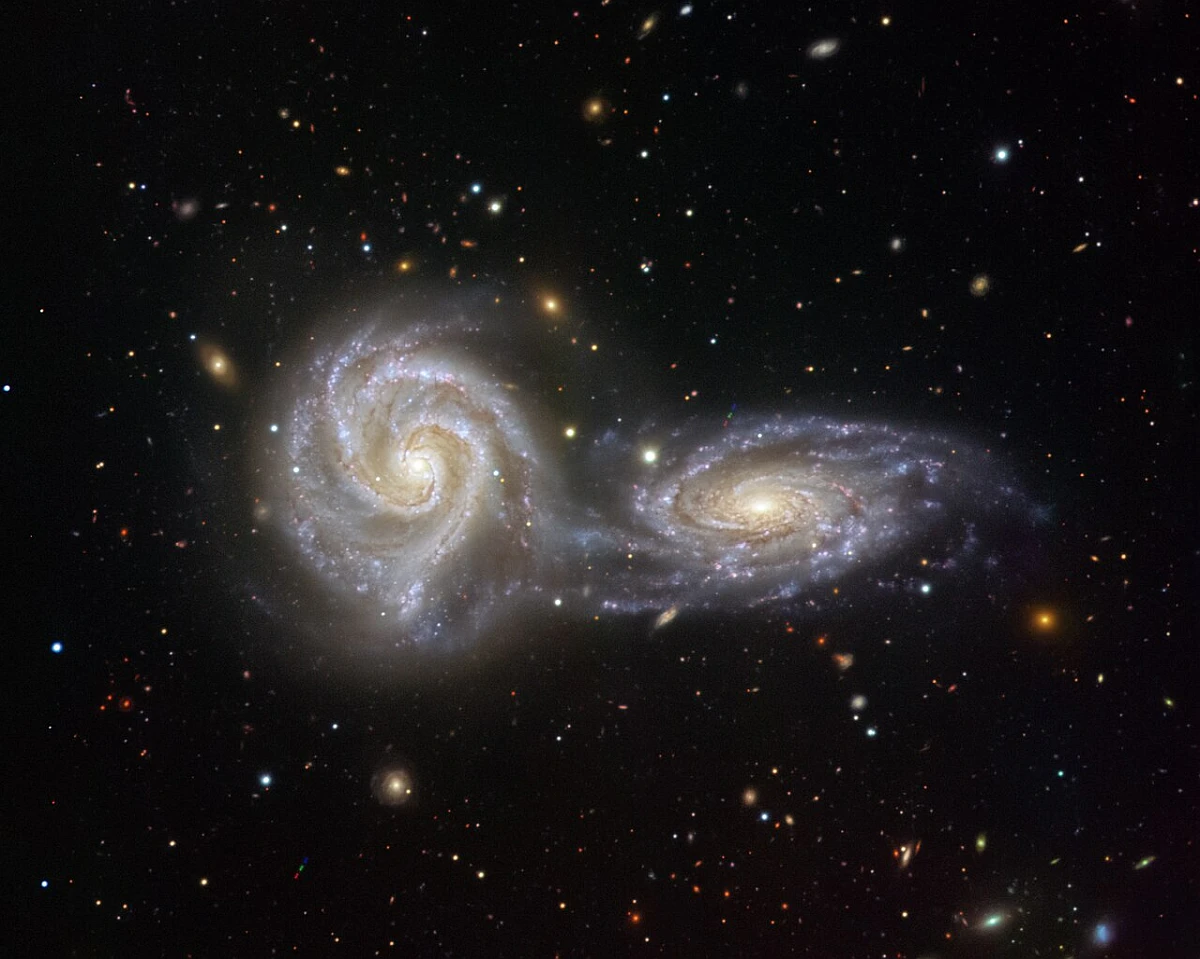
Two spiral galaxies are locked in a spellbinding, swirling dance in this image from the VIMOS instrument on ESO’s Very Large Telescope (VLT). The two interacting galaxies — NGC 5426 and NGC 5427 — together form an intriguing astronomical object named Arp 271, the subject of this, the final image captured by VIMOS before it was decommissioned on 24 March 2018. Arp 271 is framed against a backdrop of distant galaxies in this view, and wisps of bluish gas, dust and young stars can be seen bridging the gap between the two galaxies — a result of their mutual gravitational interaction. Like many astronomical observations, this image looks back in time. Thanks to the vast gulf of space separating the Earth and Arp 271, this image shows how the galaxies looked over 110 million years ago: the amount of time it has taken their light to reach us. This kind of collision and merger is also thought to be the eventual fate of the Milky Way, which scientists believe will undergo a similar interaction with our neighbouring galaxy Andromeda. Image credit: ESO/Juan Carlos Muñoz (CC BY 4.0)
Two galaxies on a collision course
The galaxies NGC 5426 and NGC 5427 are interacting with each other, and they may or may not ultimately collide to form a single larger galaxy. They are currently in a slow gravitational tango rather than a head-on smash, and tidal forces are visibly distorting their spiral arms. The interaction is triggering bursts of star formation in both galactic disks.
The galaxies are separated by about 20 kiloparsecs (65,231 light-years) and connected by a bridge of stars. They will continue their gravitational dance for at least tens of millions of years, and their tidal forces will continue to pull out tails of stars and gas and create new star forming regions.
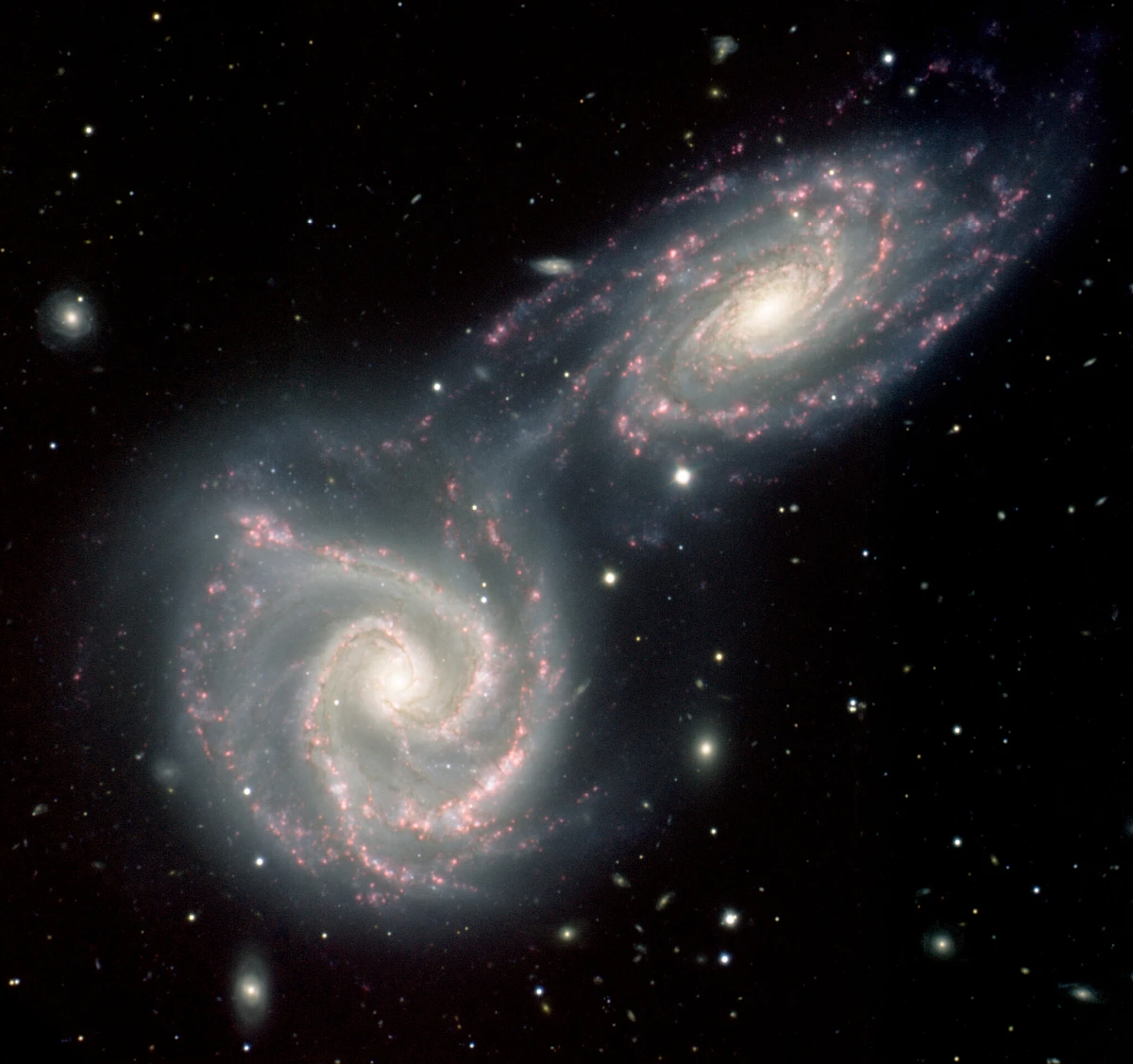
Gemini South image of NGC 5426-27 (Arp 271) as imaged by the Gemini Multi-Object Spectrograph. Image: International Gemini Observatory/NOIRLab/NSF/AURA (CC BY 4.0)
Meet the players: NGC 5426 and NGC 5427
NGC 5426 and NGC 5427 are spiral galaxies with similar spiral structure and size. Both have well-defined spiral arms that have been disrupted by mutual gravitational forces and show tidal distortion.
NGC 5427 is a giant grand design spiral galaxy with an active Seyfert 2 nucleus. It has a central supermassive black hole with an estimated mass of 5 × 10⁷ solar masses.
The galaxy is seen nearly face-on. It contains a nuclear ring or pseudo-ring and several nuclear dust spirals in its central region. The ring of star forming H II regions is separated by 1 kiloparsec from the galactic nucleus.
NGC 5426 is the more massive of the two galaxies within the optical radius. A 2004 study found a total dynamical mass of 6.72-11.2 × 10¹⁰ solar masses for NGC 5426 and 4.5–7.5 × 10¹⁰ solar masses for NGC 5427 within the isophotal radius.
In 2011, Font et al. detected hydrogen from NGC 5426 falling onto NGC 5427. The researchers concluded that the gas was pulled out from the galaxy during its passage close to NGC 5427. The infalling gas is contributing to an enhanced star formation rate across the disk of NGC 5427.
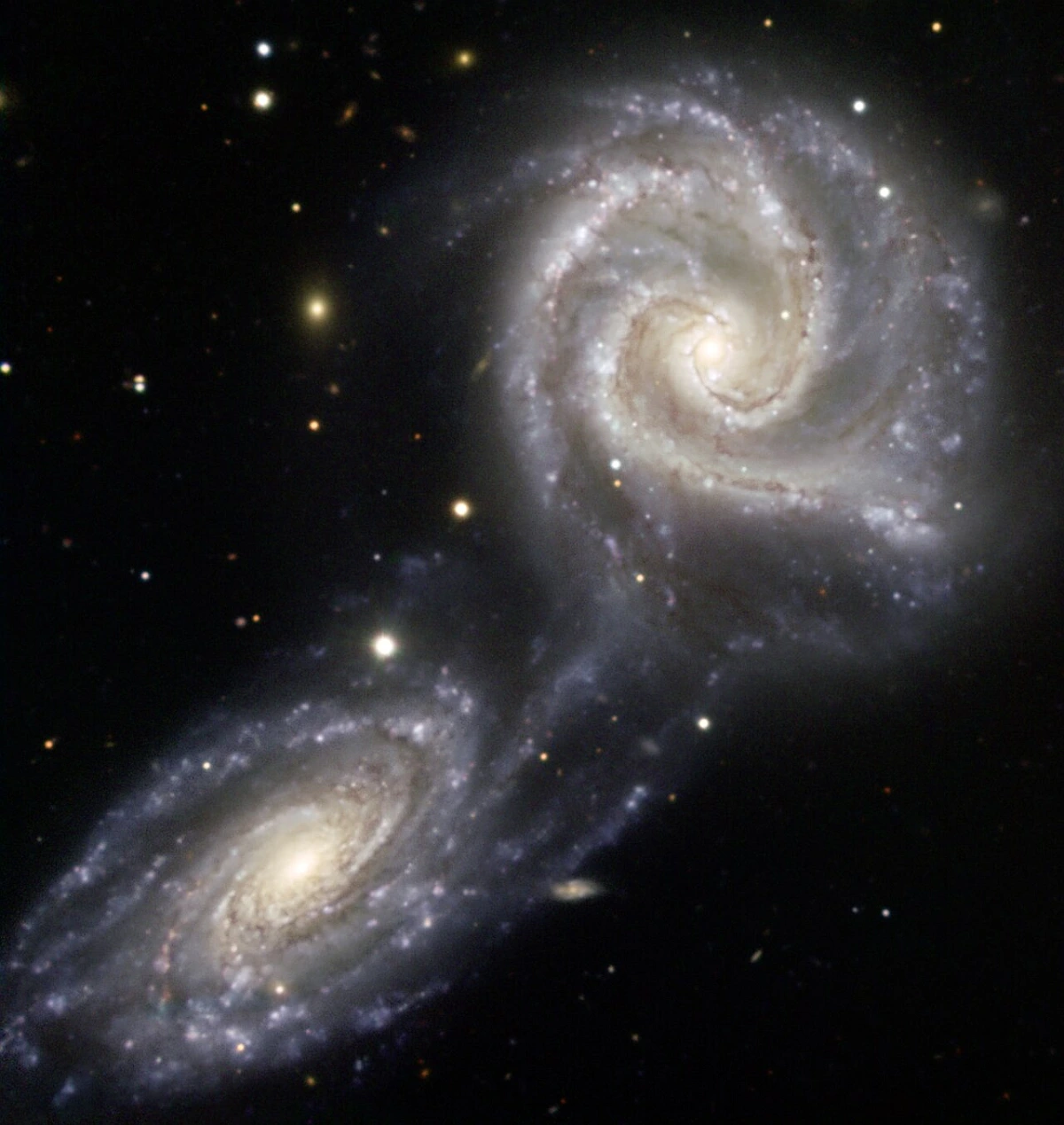
This image was taken with the EFOSC instrument, attached to the 3.58-metre New Technology Telescope at ESO’s La Silla Observatory in Chile. The data was acquired through three different filters (B, V, and R) for a total exposure time of 4440 seconds. The field of view is about 4 arcminutes. Image credit: ESO (CC BY 4.0)
A preview of the Milky Way’s collision with the Andromeda Galaxy
The galaxies of Arp 271 may be showing us what the future interactions and collision between our own Milky Way and the larger Andromeda Galaxy will look like when the galaxies collide in about 5 billion years. Andromeda is approaching our galaxy at around 110 km/s and is expected to ultimately merge with the Milky Way into a single larger elliptical galaxy.
However, a 2024 study brought the certainty of the Milky Way – Andromeda collision into question because the orbit of the Large Magellanic Cloud makes the merger less likely. The study authors found that the probability of the two galaxies colliding in the next 10 billion years was close to 50 percent.
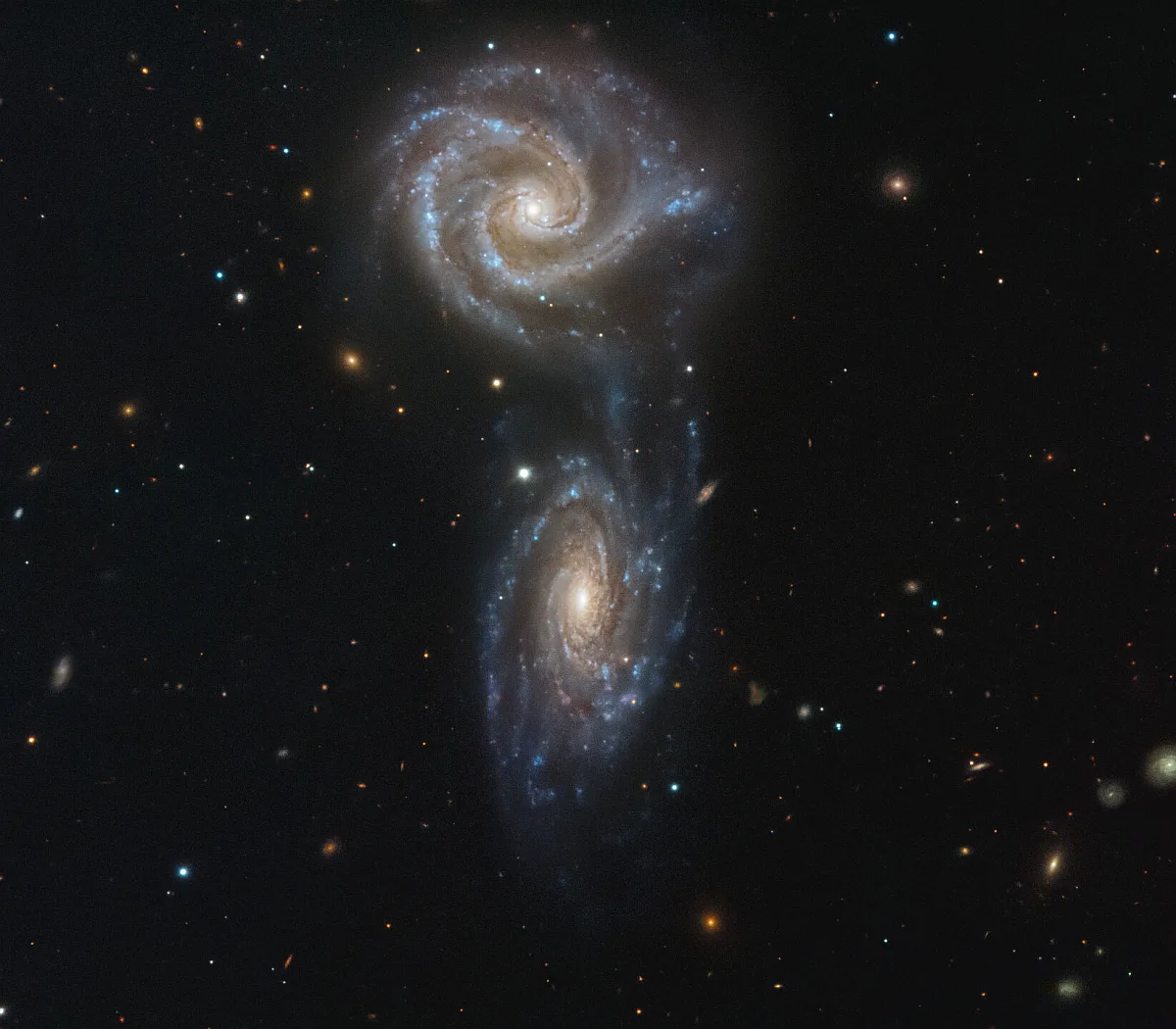
This image shows a pair of interacting galaxies known as Arp 271. Individually, these galaxies are named NGC 5426 and NGC 5427; both are spirals, and both are roughly the same size. Some astronomers believe that these galaxies are in the process of merging to form a single entity. This interaction will create increasing numbers of new stars over the next few million years, some of which can be seen within the “bridge” of gas connecting the two galaxies. Image credit: ESO (CC BY 4.0)
Supernovae in Arp 271
Arp 271 has hosted four supernovae in the last five decades. The Type Ia supernovae SN 1991B and SN 2009mz were detected in NGC 5426 in 1991 and 2009. They shone at magnitudes 16 and 15.1.
NGC 5427 also hosted two Type Ia supernovae. SN 1976D had an apparent magnitude of 14.5 and was discovered in August 1976. The more recent SN 2021pfs was detected in June 2021 and shone at magnitude 19.43.
Where does the name Arp come from?
NGC 5426 and NGC 5427 were listed as Arp 271 in American astronomer Halton Arp’s Atlas of Peculiar Galaxies (1966). Arp’s Atlas included 338 galaxies, galactic pairs and groups that served as examples of different structures detected among galaxies. It was published by the California Institute of Technology.
Arp included NGC 5426 and NGC 5427 among the double galaxies with connected arms, noting “Arms linked. Note bifurcation in arm of N spiral.”
Finding Arp 271 in the night sky
Arp 271 appears in the eastern part of Virgo, in the region of the celestial Maiden’s legs. It lies almost directly west of Syrma (Iota Virginis), the star that marks the edge of Virgo’s garment. It can be found slightly south of the imaginary line connecting Spica (Alpha Virginis) and Maenalus (109 Virginis). The galaxies lie close to the line extended from Mu Virginis through Syrma.
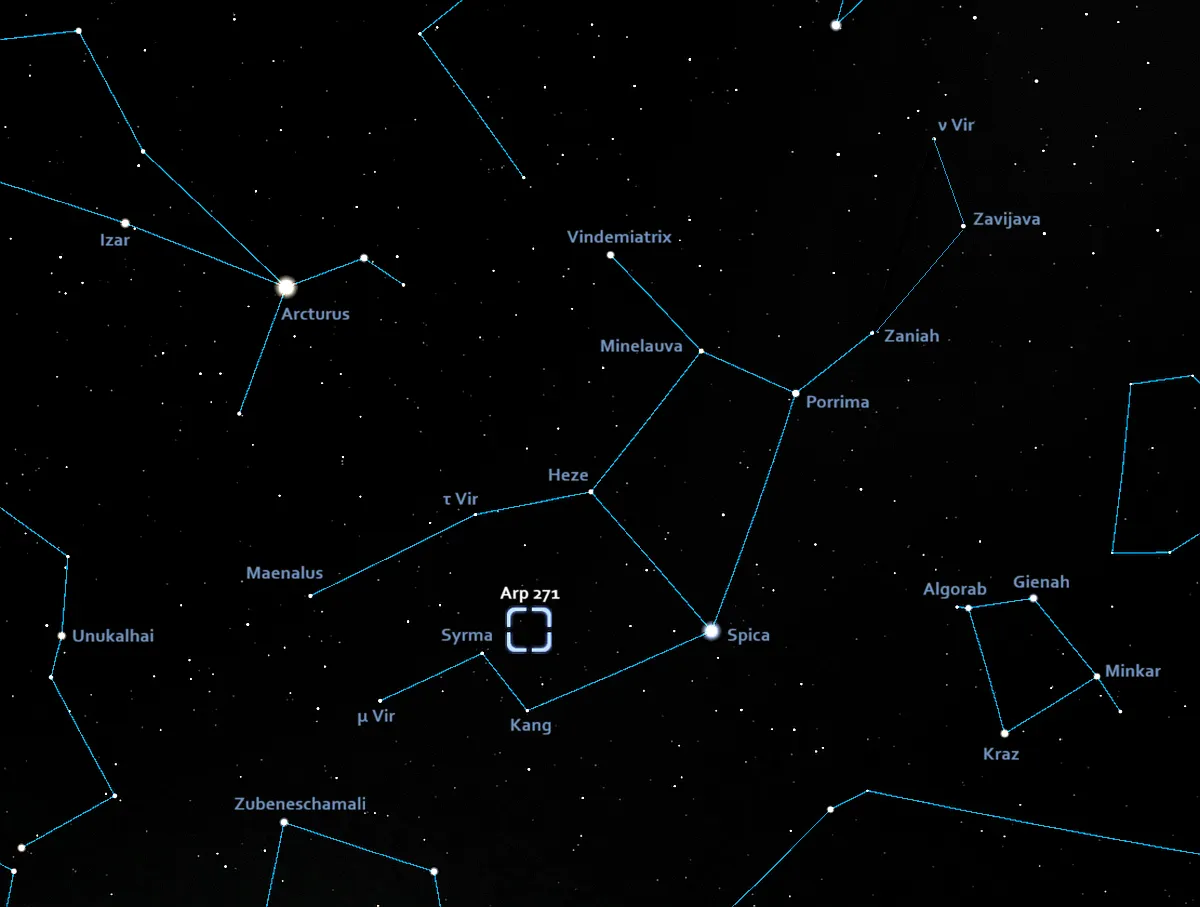
Arp 271 location, image: Stellarium (annotated for this article)
Best time to observe Arp 271
At declination -6°, Arp 271 is close enough to the celestial equator to be visible from virtually anywhere for at least part of the year. The best time to observe the interacting galaxies is in May, when Virgo appears higher above the horizon in the early evening.
Explore other deep sky objects in Virgo:
- Sombrero Galaxy (Messier 104)
- IC 1101
- Eyes Galaxies (NGC 4435 and NGC 4438)
- Butterfly Galaxies (NGC 4567 and NGC 4568)
Arp 271
| Constellation | Virgo |
| Object type | Interacting spiral galaxies |
| Right ascension | 14h 03m 25.45s |
| Declination | -06° 02′ 59.9″ |
| Distance | 127 million light-years (39 megaparsecs) |
| Names and designations | Arp 271, APG 271, VV 21, [TKK2018] 5087, [TKT2016] 3448 |
NGC 5426
| Object type | Spiral galaxy |
| Morphological type | SA(s)c pec or Sc |
| Right ascension | 14h 03m 24.8484884640s |
| Declination | -06° 04′ 08.186632788″ |
| Apparent magnitude | 12.1 |
| Apparent size | 3.16′ × 1.48′ |
| Redshift | 0.008834 |
| Heliocentric radial velocity | 2636.8 km/s |
| Names and designations | NGC 5426, LEDA 50083, MCG-01-36-004, UGCA 380, SINGG HIPASS J1403-06 S1, VV 21b, [CHM2007] HDC 850 J140324.85-0604087, AGC 540004, 2MASX J14032485-0604087, TC 833, [CHM2007] LDC 1026 J140324.85-0604087, 6dFGS gJ140324.9-060408, Gaia DR3 3643550606943932288, HIPASS J1403-06, SINGG HIPASS J1403-06 |
NGC 5427
| Object type | Spiral galaxy |
| Morphological type | SA(s)c pec or Sbc |
| Right ascension | 14h 03m 26.0408044536s |
| Declination | -06° 01′ 50.682790236″ |
| Apparent magnitude | 11.4 |
| Apparent size | 2.49456′ × 2.12362′ |
| Redshift | 0.00911 |
| Heliocentric radial velocity | 2719 km/s |
| Names and designations | NGC 5427, LEDA 50084, MCG-01-36-003, UGCA 381, VV 21a, [CHM2007] HDC 850 J140326.04-0601509, [VV2010c] J140325.9-060150, AGC 540006, NVSS J140326-060149, [CHM2007] LDC 1026 J140326.04-0601509, [VV98c] J140325.9-060150, 6dFGS gJ140326.1-060151, PSCz Q14008-0547, [HB91] 1400-057, Gaia DR2 3643739791663392128, IRAS 14008-0547, SINGG HIPASS J1403-06 S2, [VV2000c] J140325.9-060150, Gaia DR3 3643739791663537920, [VV2003c] J140325.9-060150, 2MASX J14032604-0601509, [VV2006c] J140325.9-060150 |