The Garden Sprinkler Nebula (Henize 3-1475, IRAS 17423-1755) is a protoplanetary nebula located approximately 18,900 light-years away in the constellation Sagittarius. It was produced by an evolved star near the end of its asymptotic giant branch (AGB) phase as it expelled material in a twisting S-shape, much like a lawn sprinkler.
The Garden Sprinkler caught in the act
Henize 3-1475 is a young bipolar nebula composed of material ejected from an aging star as it came to the end of its life. The central star has not yet expelled its entire gaseous envelope and is not hot enough to fully ionize the expanding shell.
This means that much of the nebula’s visible light is reflected starlight rather than emission produced by ionized gas. When the star blows away the rest of its shell, it will increase in temperature, and the cosmic Garden Sprinkler will become a fully-fledged planetary nebula.
Hen 3-1475 has highly collimated bipolar outflows that produce its striking S-shaped structure. The nebula’s curved jets – the long outflows of material moving away from the star at high velocities – have puzzled astronomers for decades.
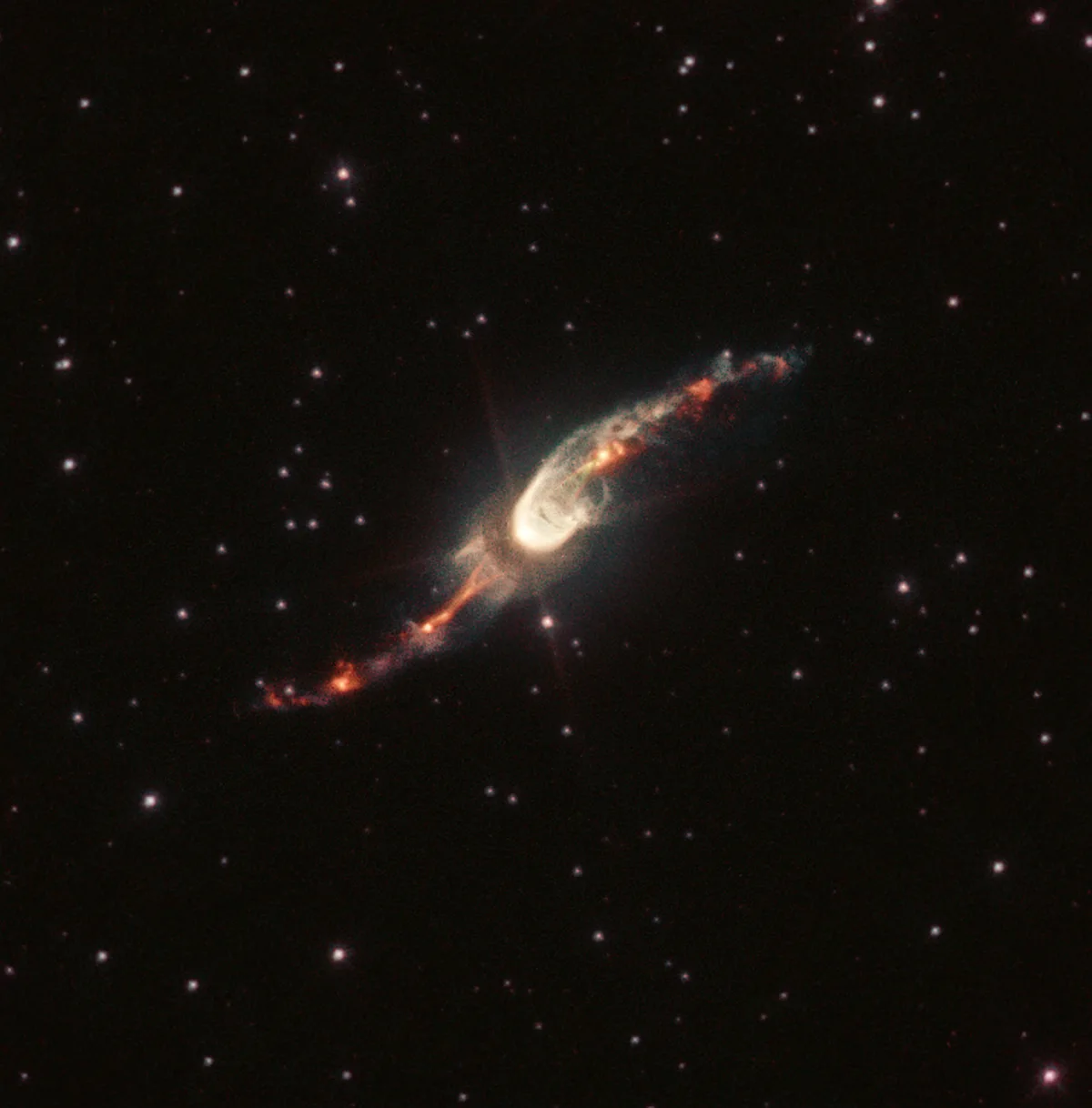
Garden Sprinkler Nebula (Henize 3-1475), image credit: Judy Schmidt (CC BY 2.0)
The short-lived stage between red giant and planetary nebula
Protoplanetary nebulae like the Garden Sprinkler are rare objects. They last only a few thousand years, which is why astronomers seldom catch them in this phase. These objects represent the short-lived episode between evolved red giants on the late asymptotic giant branch (LAGB) and planetary nebulae, the final phase in the lives of intermediate-mass stars like the Sun.
Preplanetary nebulae are primarily reflection nebulae because their central stars have not yet reached a temperature of around 30,000 K, required to ionize the rapidly expanding expelled material and turn it into an emission nebula. Once the stars are sufficiently hot, the surrounding nebulae begin to emit their own light and become planetary nebulae. The transition from preplanetary to planetary nebulae typically takes only a few thousand years.
A cosmic sprinkler that slowly changes direction
The nebula’s elongated bipolar shape was produced by wide jets emanating from the central star’s poles, that evolve into collimated outflows.
Astronomers found that the central star’s wind has two main components, a fast wind moving at 150 – 1,200 km s-1 and an ultrafast wind flowing with velocities of up to 2,300 km s-1. The ultrafast wind is highly collimated and close to the nebula’s central star.
Researchers have suggested that the S-shaped jets may be the product of a central star that undergoes a full precession every 1,500 years, all the while ejecting streams of material in opposite directions. Precession is the gradual change in the orientation of a star’s rotational axis. In Hen 3-1475, this changing orientation of the outflow axis could cause the outflows to trace the S-shaped pattern.
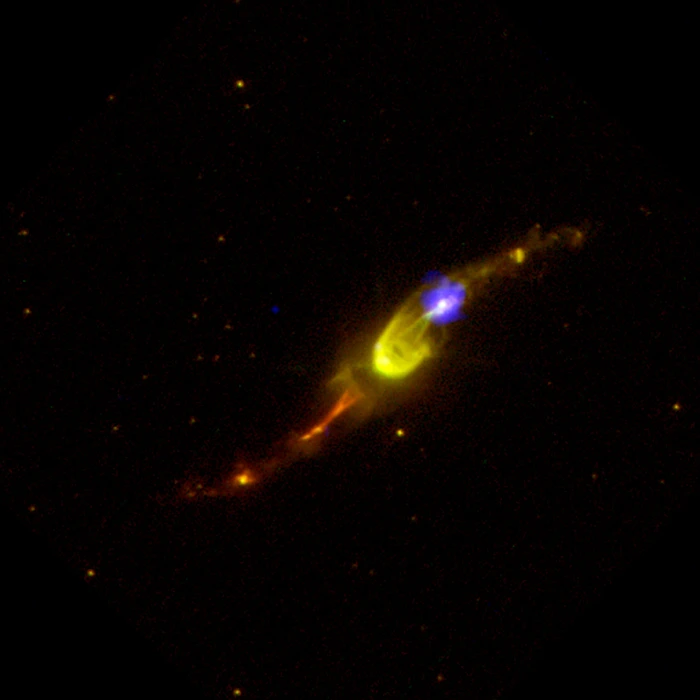
Chandra & HST Images of Hen 3-1475 Chandra’s image of Hen 3-1475 shows X-rays from this young planetary nebula that is about 18,000 light years from Earth. Image credit: Chandra X-ray Observatory (PD)
The star at the heart of the Sprinkler
The central star of the Garden Sprinkler Nebula has a luminosity 12,000 times that of the Sun. It is surrounded by a thick dust ring.
In 2011, Manteiga et al. found the dusty material around the star to be oxygen-rich based on observations with the Spitzer Space Telescope. The team also found evidence that the star may just be beginning to ionize the surrounding gas.
The discovery places Hen 3-1475 at the brief evolutionary transition from a giant star experiencing high mass loss toward a glowing planetary nebula. The study authors proposed that the central star is a relatively massive, oxygen-rich post-AGB star that serves as an evolutionary bridge between OH/IR stars with strong outflows and strongly bipolar planetary nebulae. The observations also revealed water ice associated with the dust.
OH/IR stars are highly evolved AGB stars that lose mass at an accelerated rate through a super-wind. As the expelled gas speeds away from the star, it cools and condenses, forming silicate dust and molecules, including water.
Is a hidden companion shaping the nebula?
Astronomers suspect that bipolar protoplanetary nebulae are generally produced by central stars in binary systems, and the Garden Sprinkler Nebula’s collimated jets make its central star a strong binary candidate.
In binary systems, a companion can create the conditions needed for the bipolar structure by redirecting the expelled material into bipolar lobes. Additionally, common-envelope evolution is linked to a substantial fraction of bipolar planetary and protoplanetary nebulae.
However, while binary interaction is the leading explanation for the two-lobed morphology, it has not been established as the only possible cause. The central stars of protoplanetary nebulae can be difficult to observe directly and their dimmer companions are hard to detect. To date, astronomers have not identified a companion to the Garden Sprinkler Nebula’s central star.
A 2026 study led by Ana Valeria Beltrán-Sánchez of the Institute of Astronomy at the National Autonomous University of Mexico found no evidence of the radial-velocity variations expected from stars in a close binary orbit. The researchers compared observations from 2006 and 2024 and found essentially the same radial velocity in both datasets. However, they could not rule out a binary system viewed in an orbit close to the plane of the sky.
The comparison led to an interesting discovery. It revealed that a new jet may have emerged from the central region, providing scientists with a rare look into an actively evolving young nebula.
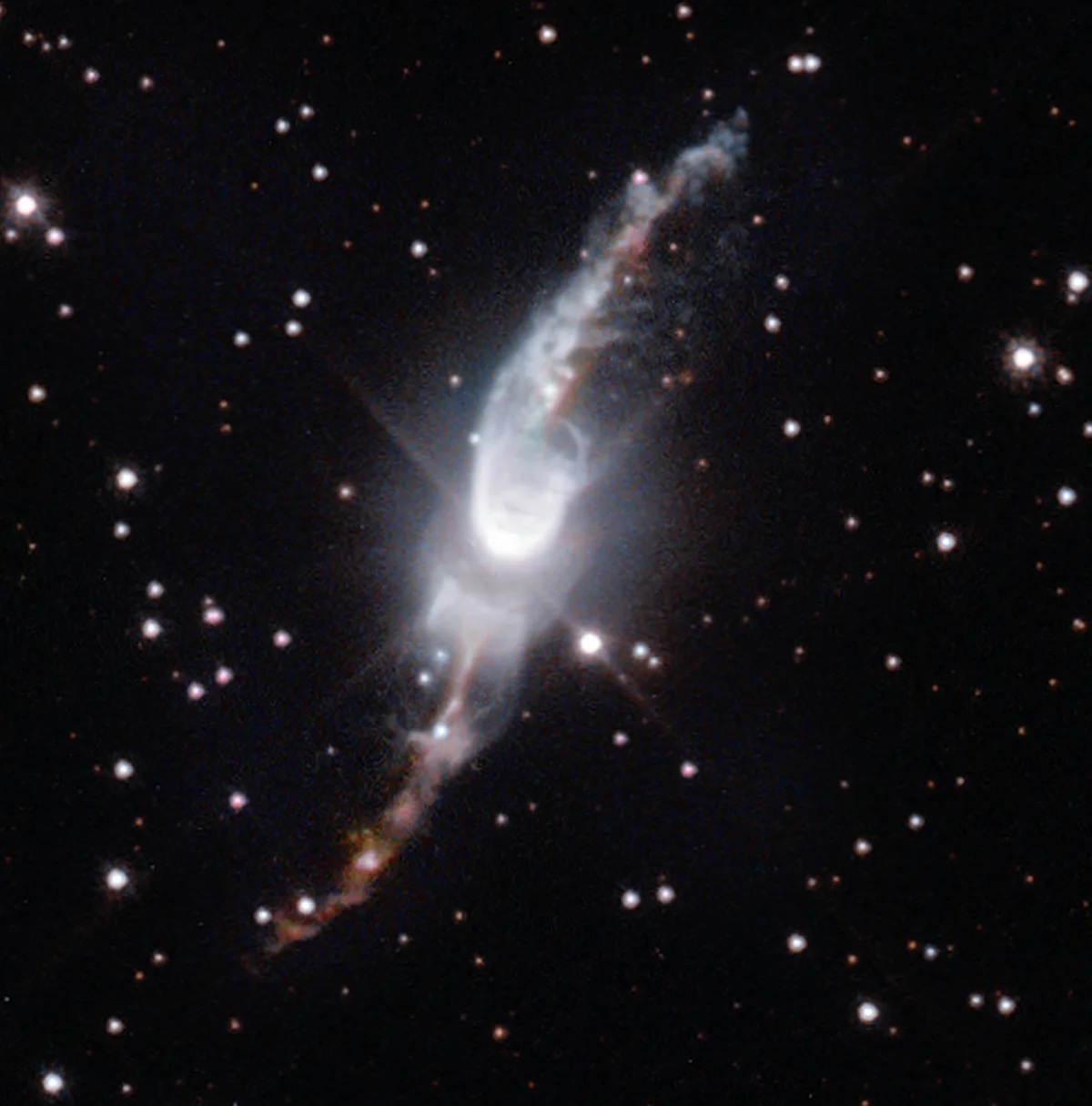
Hen 3-1475 is located in the constellation of Sagittarius around 18 000 light-years away from us. The central star is more than 12 000 times as luminous as our Sun. Its most characteristic feature is a thick torus of dust around the central star and two S-shaped jets that are emerging from the pole regions of the central star. These jets are long outflows of fast-moving gas travelling at hundreds of kilometres per second. The formation of these bipolar jets has puzzled astronomers for a long time. How can a spherical star form these complex structures? Recent studies suggest that the object’s characteristic shape and the large velocity outflow is created by a central source that ejects streams of gas in opposite directions and precesses once every thousand years. It is like an enormous, slowly rotating garden sprinkler in the middle of the sky. No wonder astronomers also have nicknamed this object the “Garden-sprinkler Nebula”. This picture was taken with Hubble’s Wide Field Camera 3. Image credit: ESA/Hubble & NASA (CC BY 3.0)
From discovery to Hubble
Hen 3-1475 was catalogued by American astronomer Karl Gordon Henize in April 1976. Henize identified the object as a star showing Hα emission on photographic plates taken with the Mount Wilson 10-inch camera at the Lamont-Hussey Observatory in South Africa in the period from 1949 to 1951. He described the object as an emission line B star.
In 1989, Parthasarathy & Pottasch were the first to identify Hen 3-1475 as a transition object on the asymptotic giant branch. The bipolar outflows were reported by a team led by A. Riera of the Universitat Politècnica de Catalunya, Spain, in 1995.
Because of its small apparent size, the Garden Sprinkler Nebula was a difficult target for researchers until the arrival of the Hubble Space Telescope.
Based on Hubble imaging in the early 1990s, astronomers reported that Hen 3-1475 was a very asymmetric nebula with an apparent size of around 1.3 by 1.7 arcseconds. At the time, the nebula was believed to lie much closer to us, at an estimated distance of 2.5 kiloparsecs (8,154 light-years). The asymmetry was attributed to interaction of the moving nebula with the interstellar medium.
Distance to the Garden Sprinkler Nebula
The currently accepted distance to Henize 3-1475 is 5.8 ± 0.9 kpc (about 18,900 light-years), based on kinematic and proper-motion analysis of its high-velocity jet features (Riera et al. 2003). This value has also been adopted in recent work, including a 2025 ALMA study of obscured post-AGB stars.
While 5.8 kpc is the preferred value in recent studies, the distance to the Garden Sprinkler Nebula carries significant uncertainty, and studies have reported values ranging from 3.7 to 8.3 kpc.
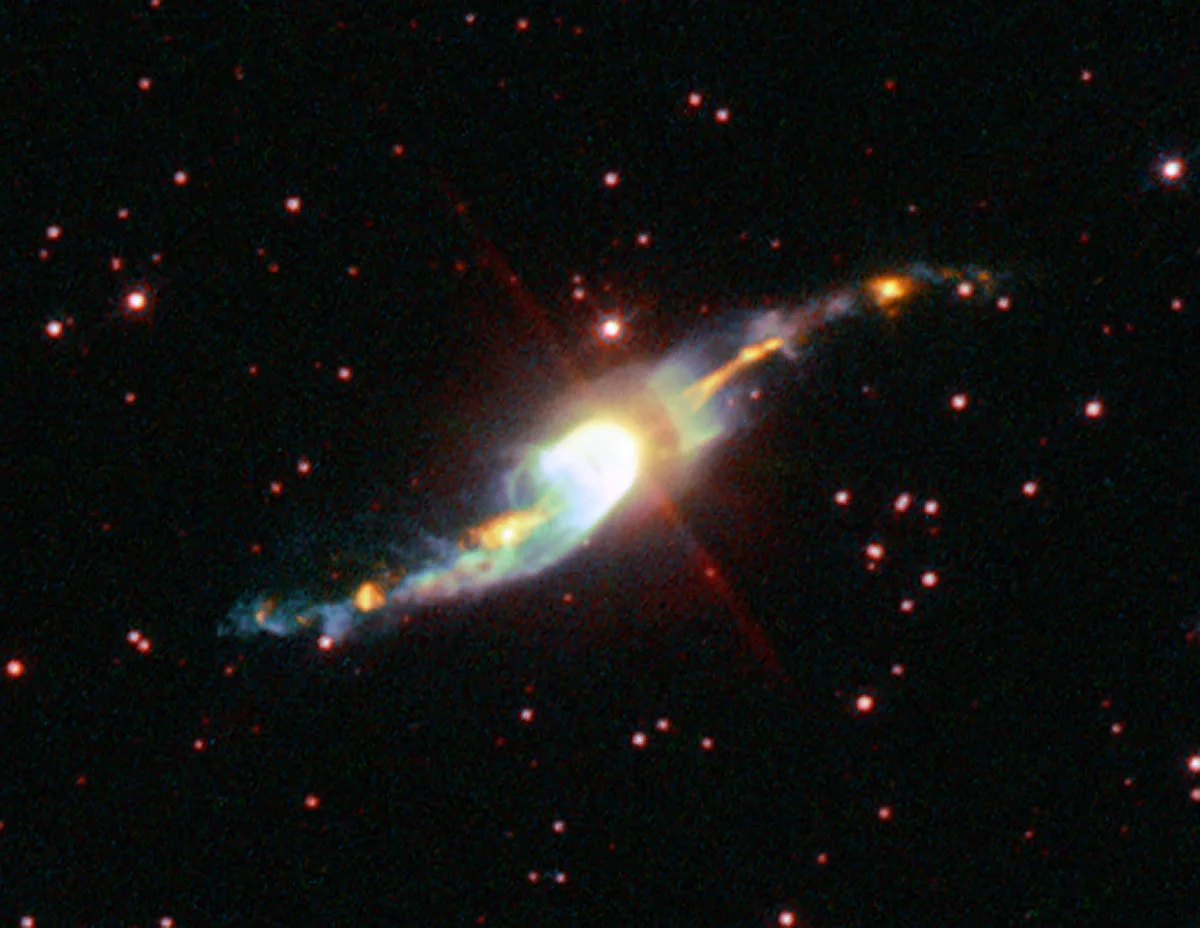
A Hubble Space Telescope photo of the planetary nebula Henize 3-1475. It is located about 18,000 light years away from Earth in the Sagittarius constellation. Astronomers have nicknamed it the ‘Garden-sprinkler’ Nebula due to its appearance. Image credit: European Space Agency, A. Riera (Universitat Politecnica de Catalunya, Spain) and P. Garcia-Lario (European Space Agency ISO Data Centre, Spain). (PD)
NGC 4361: The other Garden Sprinkler Nebula
Henize 3-1475 shares its nickname, the Garden Sprinkler or Lawn Sprinkler Nebula, with the planetary nebula NGC 4361 in the constellation Corvus. The brighter NGC 4361 is included in the Herschel 400 catalogue and can be observed in amateur telescopes, while Hen 3-1475 is a target for Hubble and other large space and ground-based telescopes.
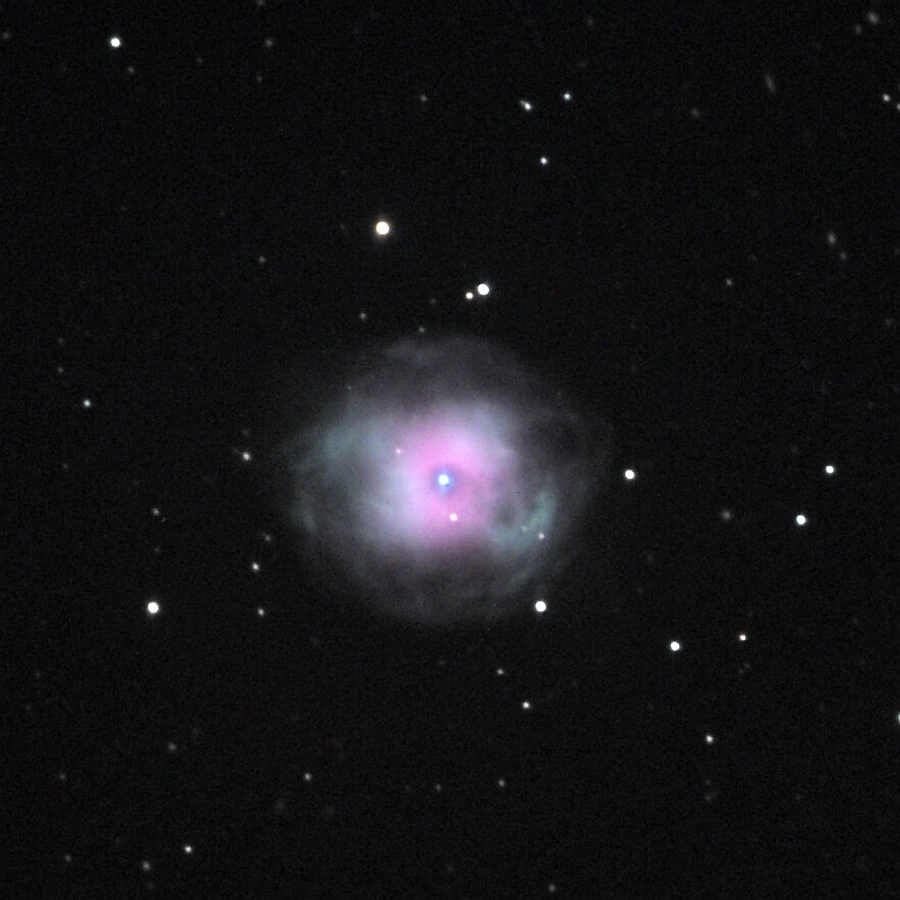
NGC 4361, image credit: KPNO/NOIRLab/NSF/AURA/Elliot Gellman and Duke Creighton/Adam Block (CC BY 4.0)
Where is Hen 3-1475?
The Garden Sprinkler Nebula lies in the southern constellation Sagittarius, close to the border with Ophiuchus. It appears roughly northeast of the midpoint between Polis in Sagittarius and Sabik in Ophiuchus.
The nebula’s tiny apparent size and faintness make it a challenging target for amateur observers and well beyond the reach of typical backyard telescopes.
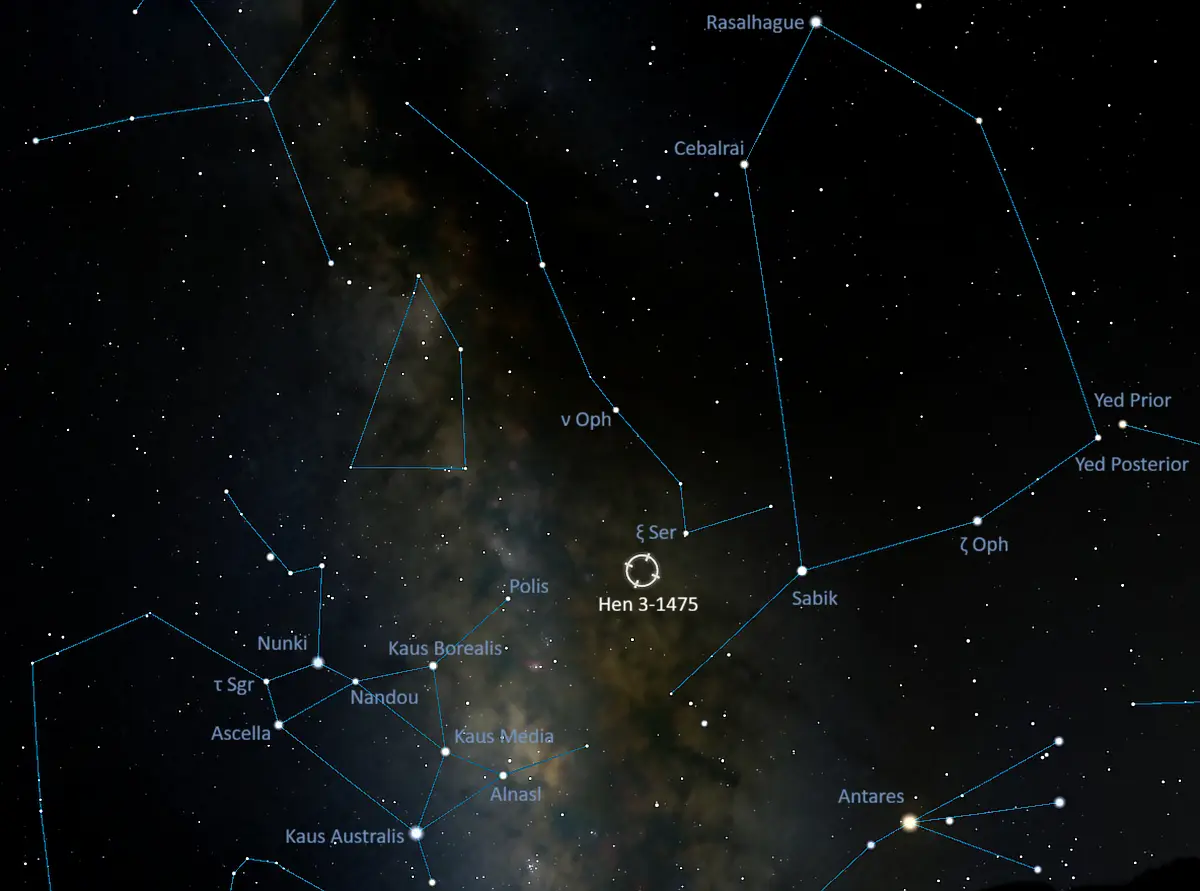
Location of the Garden Sprinkler Nebula, image: Stellarium (annotated for this article)
Explore other deep sky objects in Sagittarius:
- Trifid Nebula (Messier 20)
- Lagoon Nebula (Messier 8)
- Omega Nebula (Messier 17)
- Little Gem Nebula (NGC 6818)
- Chinese Dragon Nebula (NGC 6559)
- Red Spider Nebula (NGC 6537)
- Chandelier Cluster (NGC 6723)
Garden Sprinkler Nebula – Hen 3-1475
| Constellation | Sagittarius |
| Object type | Protoplanetary nebula |
| Right ascension | 17h 45m 14.1819342984s |
| Declination | -17° 56′ 46.778166204″ |
| Apparent magnitude | 12.87 |
| Distance | 18,900 light-years (5.8 ± 0.9 kpc) |
| Names and designations | Garden Sprinkler Nebula, Henize 3-1475, Hen 3-1475, PN G009.3+05.7, PK 009+05 1, IRAS 17423-1755, 2MASS J17451419-1756469, AKARI-IRC-V1 J1745141-175646, GLMP 632, DENIS J174514.1-175646, PDS 465, GSC2 S2202023288, GSC 06253-02182, MSX6C G009.3628+05.7782, TIC 419297075, WISE J174514.16-175646.7, UCAC4 361-114042, Gaia DR2 4120637086125583360, Gaia DR3 4120637086125583360 |