The Flaming Skull Nebula is a planetary nebula located approximately 1,142 light-years away in the equatorial constellation Serpens. Catalogued as Sharpless 2-68 (Sh 2-68), the faint, expanding remnant of a Sun-like star lies in the eastern part of the constellation, in the Serpent’s Tail (Serpens Cauda). With an apparent magnitude of 16.5 and an apparent size of 8 arcminutes, the nebula can only be observed in large telescopes.
How a Sun-like star came to be the Flaming Skull
The Flaming Skull Nebula has an estimated age of 30,000 to 45,000 years, which is more than the average lifespan of a planetary nebula. These relatively short-lived objects form when low to intermediate-mass stars like the Sun reach the end of their evolutionary cycles and expel their outer gaseous layers into space. As the expelled material speeds away from the central star, it is ionized by the hot exposed stellar core and appears as a glowing nebula.
Planetary nebulae eventually disperse into the surrounding interstellar medium. The central white dwarfs decrease in temperature until they are no longer hot enough to ionize their ejected envelopes. On average, these nebulae last only about 10,000 years.
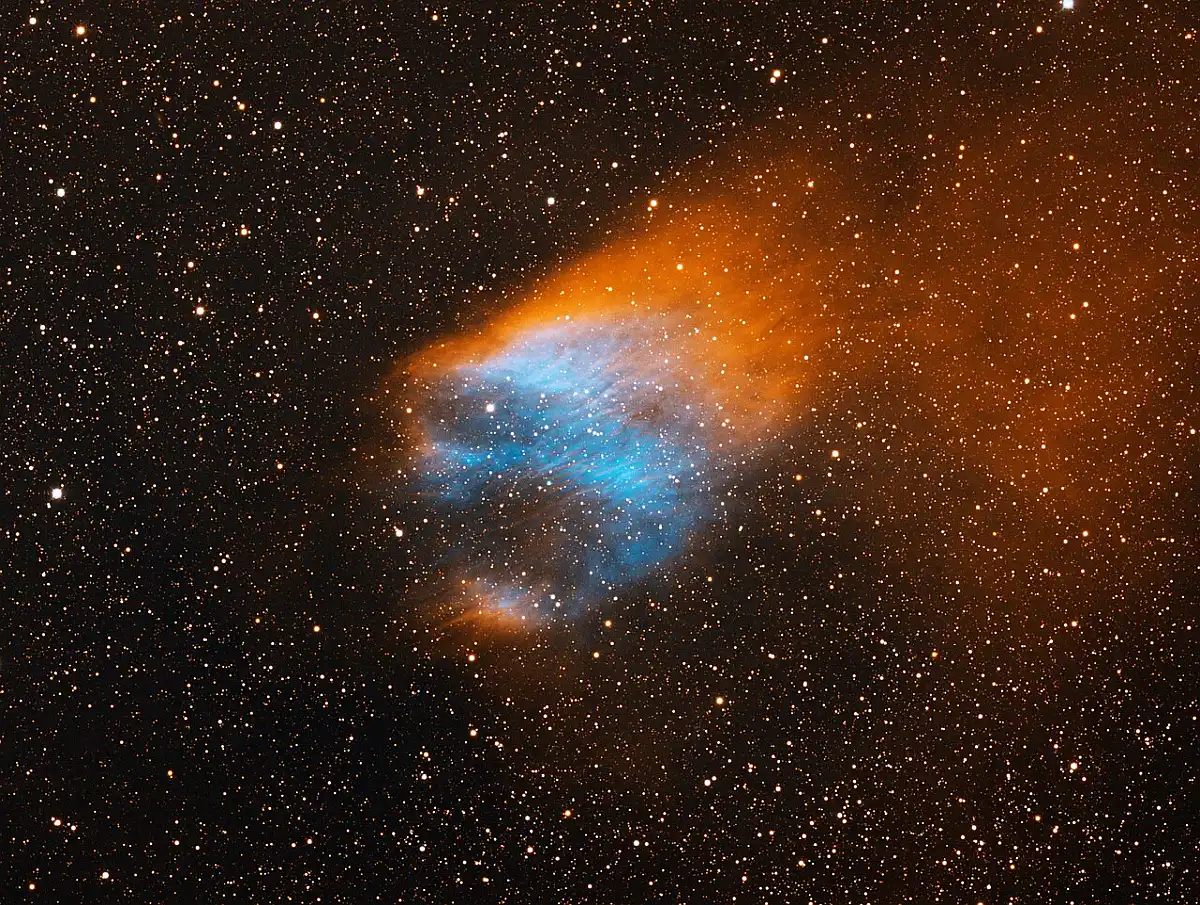
This image was obtained with the wide-field view of the Mosaic camera on the Mayall 4-meter telescope at Kitt Peak National Observatory. Sh2-68 is an ancient planetary nebula that is estimated to be at least 45,000 years old. The diffuse orange emission to the upper right is the result of the planetary nebula’s motion through the disk of our galaxy. The bluish interior is from energized oxygen atoms. The progenitor star is the very blue star at the center of the bluish gas. The image was generated with observations in the Hydrogen alpha (red) and Oxygen [OIII] (blue) filters. In this image, North is right, East is up. Image credit: T.A. Rector (University of Alaska Anchorage) and H. Schweiker (WIYN and NOIRLab/NSF/AURA) (CC BY 4.0)
Meet the central star: WD 1822+008
The central star of the Flaming Skull Nebula is catalogued as WD 1822+0808. It has the spectral type DAOZ.6, indicating prominent absorption lines of hydrogen and helium. The star appears offset from the nebula’s centre and is racing through the galaxy at high velocity.
In 2001, Kerber et al. reported the discovery of the star’s high proper motion, 53.2 ± 5.5 mas yr-1. At the time, this was the highest proper motion ever found for a planetary nebula from ground-based observations.
The Skull on the run: A planetary nebula with a tail
The Flaming Skull Nebula is notable for its cometary-like tail, produced by the interaction between the nebula and the interstellar medium. The tail is aligned with the central star’s proper motion and extends at least 30 arcminutes from the nebula’s main body. It was first detected by Xilouris et al. in 1996. The astronomers reported an extended halo in the form of a cometary tail surrounding the main nebula.
The interaction of planetary nebulae with the interstellar medium is an important process in the late phase of planetary nebula evolution. It is commonly seen in old planetary nebulae.
Young planetary nebulae are denser than the interstellar medium and expand freely. As they age and keep expanding, they become less dense and their expansion upstream is slowed down by the pressure from the surrounding medium. As a result, the nebulae first become deformed and then disrupted while the central stars move away from their geometrical centres and ultimately abandon them. The interaction disconnects the motion of the nebula from that of its central star.
The Valentine Rose Nebula (Sh2-174) in the constellation Cepheus is an example of a planetary nebula abandoned by its central star.
The distance estimates for the presumed central star of the Flaming Skull and the nebula itself have raised doubts regarding these objects being related at all, also questioning Flaming Skull’s status as a planetary nebula. If it is not the remnant of a Sun-like star, the nebula may be even more curious than it looks.
Why astronomers call Sh 2-68 a “rebrightened” planetary nebula
The most common effect of the interaction between planetary nebulae and the surrounding medium is a rebrightening effect that occurs when the expanding shell slams into a bow shock structure formed during an earlier phase of the central star’s evolution. The interaction compresses the nebula’s gas and reignites its glow.
Rebrightening is a rare phenomenon and Sh 2-68 is one of only a handful known examples. Others include the Shrimp Nebula (Sharpless 2-188) in the constellation Cassiopeia and Sharpless 2-216 in Perseus. Both show the same telltale signs of a planetary nebula colliding with the interstellar medium.
Other Flaming Skulls in the sky
Sharpless 2-68 shares its popular nickname with the Rosette Nebula (NGC 2237) in the constellation Monoceros and the Question Mark Nebula (NGC 7822) in Cepheus. While both these nebulae look distinctly skull-like in certain images, they are better-known by their other monikers.
While the Flaming Skull Nebula (Sh 2-68) marks the final stage of a single star’s life, the Rosette and Question Mark nebulae are much larger emission nebulae in which young stars are being born. Both stellar nurseries are over a hundred light years across and associated with young open star clusters.
Sharpless 2-68 should also not be mistaken for the better-known Skull Nebula (NGC 246) in the constellation Cetus, a much younger and brighter planetary nebula listed as Caldwell 56 in the Caldwell catalogue.
Another eerie skull, the Skull and Crossbones Nebula (NGC 2467), lies in the southern constellation Puppis. Like the Rosette and the Question Mark nebulae, it is a large star-forming region and not a stellar remnant.
Location of the Flaming Skull Nebula
The Flaming Skull Nebula lies in the faint region between the bird-like constellation figure of Aquila (the Eagle) and the large polygon formed by the brightest stars of Ophiuchus. It appears northwest of the faint star 59 Serpentis, which lies roughly halfway between Lambda Aquilae in Aquila and Cebalrai in Ophiuchus. The brighter Eta Serpentis lies just to the south.
The nebula appears in the same region as Poniatowski’s Bull, a V-shaped asterism near Cebalrai that was once a constellation separate from Ophiuchus.
The best time of the year to observe deep sky objects in Serpens is during the northern hemisphere summer, when the constellation appears higher in the sky in the early evening.
Located less than a degree north of the celestial equator, the cosmic Flaming Skull is theoretically visible from any location on Earth. However, with an apparent visual magnitude of 16.5, it is out of reach for most amateur telescopes and is best seen photographically.
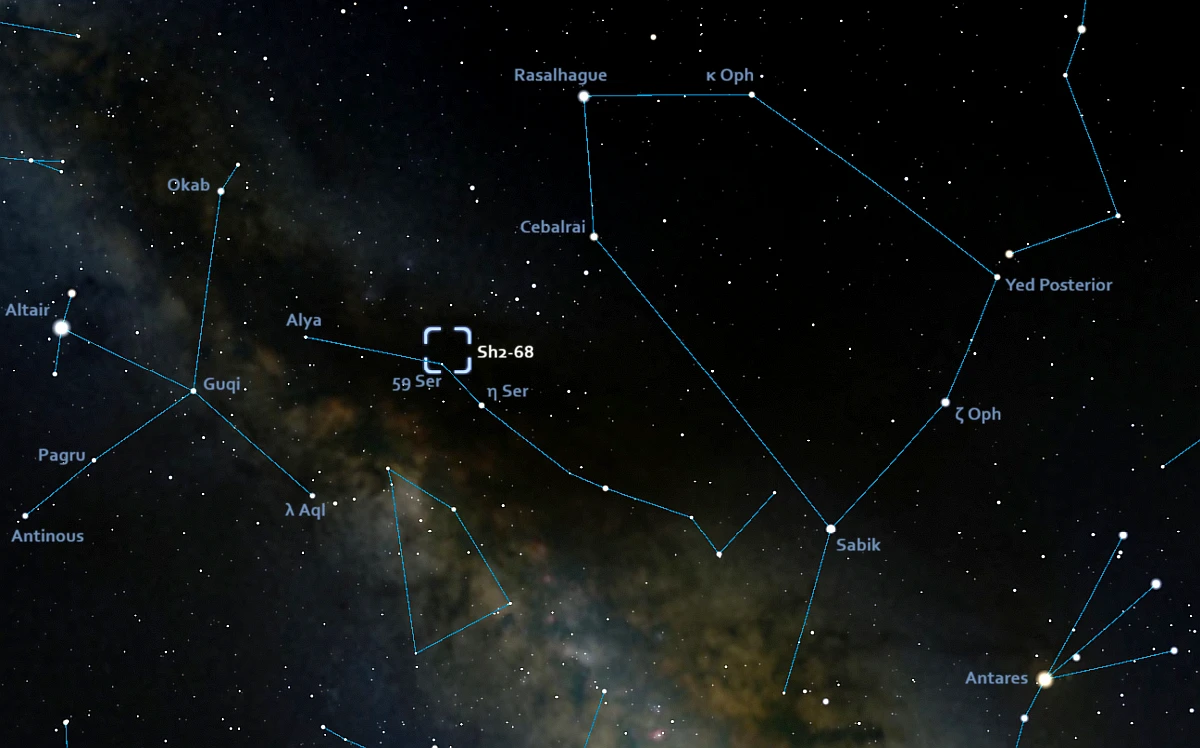
Flaming Skull Nebula (Sh2-68) location, image: Stellarium (annotated for this article)
Explore other deep sky objects in Serpens:
Flaming Skull Nebula – Sh2-68
| Constellation | Serpens |
| Object type | Planetary nebula |
| Right ascension | 18h 24m 58.43s |
| Declination | +00° 51′ 36.0″ |
| Apparent magnitude | 16.5 |
| Apparent size | 8′ |
| Distance | 1,142 light-years (350 parsecs) |
| Names and designations | Flaming Skull Nebula, Sharpless 2-68, Sh 2-68, LBN 93, LBN 030.63+06.37, PN G030.6+06.2, PK 030+06 1, DG 152, PN HDW 9, PN YM 15, GSC2 N020012315205, TIC 169602040, 2MASS J18245841+0051359, WD 1822+008, Gaia DR2 4276328581046447104, Gaia DR3 4276328581046447104 |