The Cosmic Caterpillar (IRAS 20324+4057) is a protostar surrounded by an interstellar cloud of gas and dust located approximately 4,600 light-years away in the constellation Cygnus (the Swan). The gaseous knot is about 1 light-year long and lies within the larger Cygnus OB2 association, one of Milky Way’s most massive stellar families.
While most stars are born in quieter stellar nurseries, IRAS 20324+4057 is being born in a storm. Embedded in one of our galaxy’s most violent stellar neighbourhoods, the newborn star is slowly being stripped of its birth cloud by the hot, massive members of Cygnus OB2.
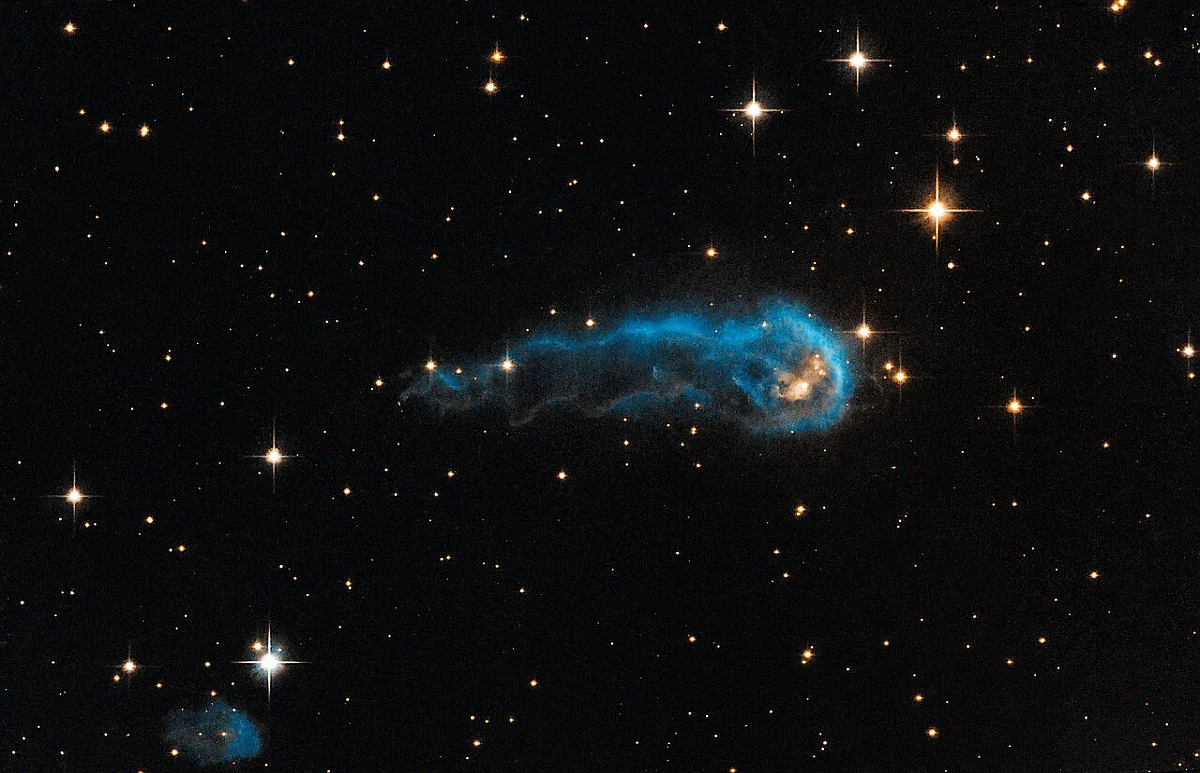
This light-year-long knot of interstellar gas and dust resembles a caterpillar on its way to a feast. But the meat of the story is not only what this cosmic caterpillar eats for lunch, but also what’s eating it. Harsh winds from extremely bright stars are blasting ultraviolet radiation at this “wanna-be” star and sculpting the gas and dust into its long shape. The culprits are 65 of the hottest, brightest known stars, classified as O-type stars, located 15 light-years away from the knot, towards the right edge of the image. These stars, along with 500 less bright, but still highly luminous, B-type stars make up what is called the Cygnus OB2 association. Collectively, the association is thought to have a mass more than 30 000 times that of our Sun. This image of IRAS 20324+4057 is a composite of Hubble Advanced Camera for Surveys (ACS) data taken in green and infrared light in 2006, and ground-based hydrogen data from the Isaac Newton Telescope in 2003, as part of the IPHAS H-alpha survey. Image credit: NASA, ESA, the Hubble Heritage Team (STScI/AURA), and IPHAS (CC BY 4.0)
What is the Cosmic Caterpillar?
The Cosmic Caterpillar is a dense knot of gas and dust associated with a very young star that is still accreting material from its birth cloud. It belongs to a class of tadpole-shaped objects found in the massive stellar nursery of the Cygnus OB2 region. Like all tadpoles, it has a bright, ionized “head” facing the massive stars of Cygnus OB2 and a long tail streaming away from them.
The young forming star lies in the Cosmic Caterpillar’s head. Because it faces the massive O- and B-type stars of Cygnus OB2, the head is shaped by these stars’ powerful winds and UV light. It gets heated and ionized, forming a bright rim. As the gas evaporates off the surface and is pushed away, it forms a cometary tail on the opposite side of the massive stars, producing the tadpole or caterpillar shape.
The Cosmic Caterpillar is not alone. It and five other infrared sources, all within 16 arcminutes of one another, lie close to the centre of Cygnus OB2, embedded in a CO cloud. All six are believed to be massive young stellar objects. They share the same east-west head-tail orientation. Astronomers have nicknamed two of these objects the Goldfish and the Wriggler. Both are much smaller than the Caterpillar. The Wriggler is visible in the Hubble image, and the Goldfish is out of view, to the bottom right.
The Cosmic Caterpillar’s own star, IRAS 20324+4057, is a protostar in an early phase of evolution, still fed by gas from the surrounding cloud. However, the young star’s birth cocoon is under attack from its massive neighbours, which have been steadily eroding for several million years. Whether the protostar can finish growing before its birth cocoon disappears remains uncertain.
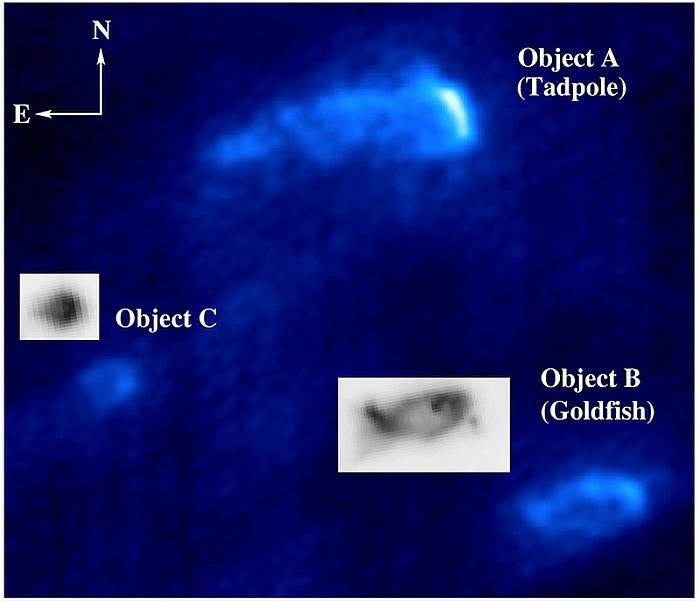
The Caterpillar (Tadpole), the Wriggler, and the Goldfish, image credit: Sahai et al. (2012)
A tough neighbourhood: Cygnus OB2
IRAS 20324+4057 is part of the Cygnus OB2 association, a family that includes some of the Milky Way’s most massive and luminous stars, among them the blue hypergiant Cygnus OB2#12 and the red hypergiant NML Cygni.
An OB association is a loose group of hot, young, massive stars that formed together from the same molecular cloud. Cygnus OB2 is one of the richest in our galaxy, with an estimated age of 1 to 7 million years. This is very young by stellar standards, but old enough for its brightest stars to have evolved away from the main sequence and spent a long time clearing the material from the stellar nursery.
For a newborn star, this is a harsh place to grow up because its growth is happening under constant bombardment. The ultraviolet light and powerful stellar winds from its massive neighbours heat, ionize and slowly strip away the gas and dust around it. How it has survived this long and what exactly its surrounding cloud is, are the questions astronomers have been trying to settle.
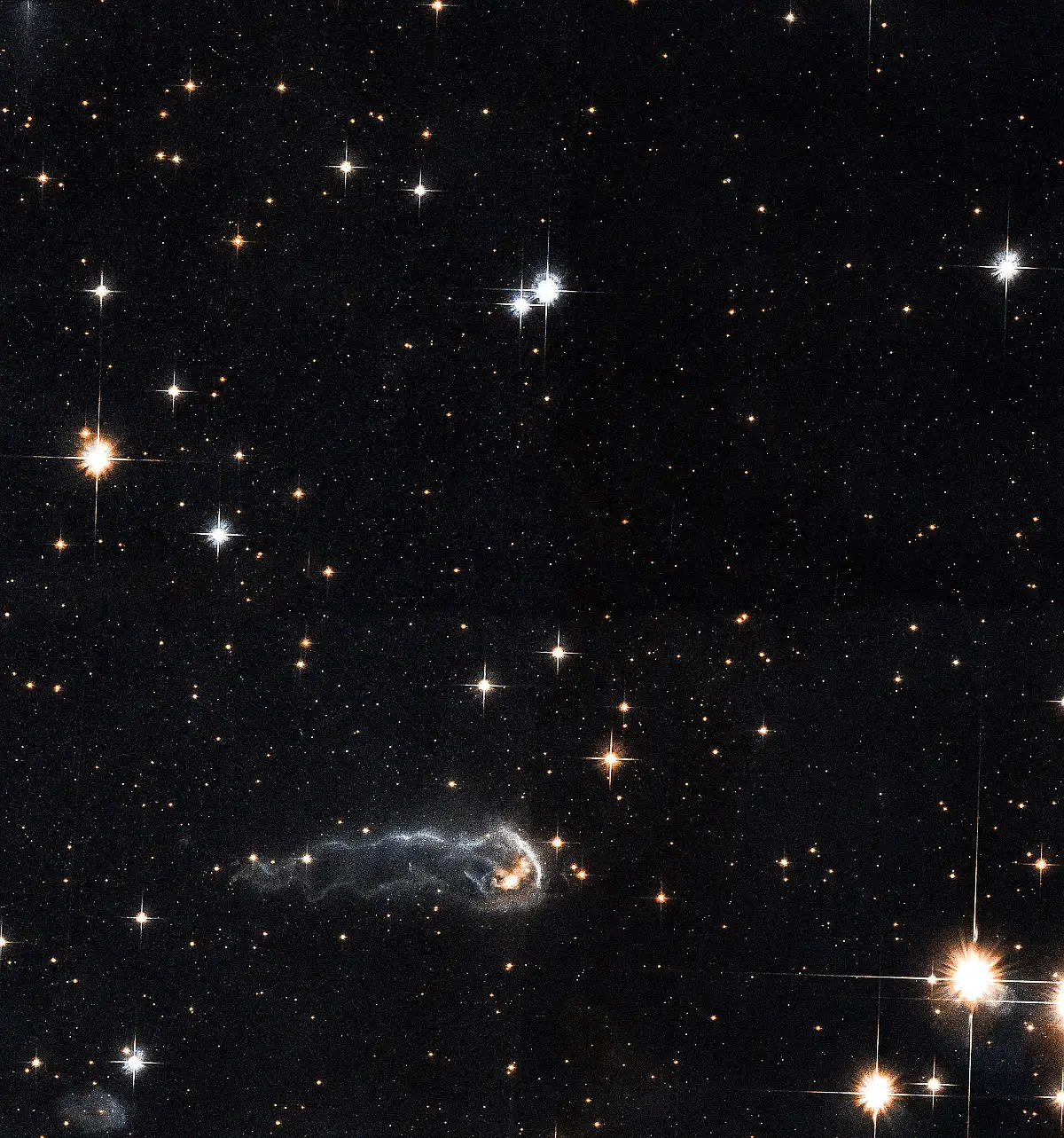
The Cosmic Caterpillar, image credit: NASA/ESA/Hubble Team/Raghvendra Sahai/Kevin M. Gill (CC BY 2.0)
Proplyd or EGG? The debate over the Cosmic Caterpillar’s nature
The main scientific debate about the Cosmic Caterpillar concerns the nature of its surrounding cloud of gas and dust. The cloud has been described as both a proplyd (an ionized protoplanetary disk) and an evaporating gaseous globule (EGG). Astronomers have also disagreed about the star inside, suggesting either a massive star with an H II region or a G-type T Tauri star with a photoevaporating disk, surrounded by a molecular envelope.
Proplyds vs. EGGs: What is the difference?
Both proplyds and EGGs are small, dense objects being blasted by radiation of nearby massive stars, but they are not the same thing. Proplyds are baby stars with protoplanetary disks where planets may eventually form, while EGGs are denser knots of gas and that may or may not contain protostars with circumstellar disks.
Because of their density, EGGs can survive UV light longer. They tend to look like fingers, and the best-known examples are found at the tips of the Pillars of Creation in the Eagle Nebula. Their denser pockets of gas withstand the harsh environment of a massive stellar nursery, protecting the gas directly behind them.
Proplyds, by contrast, are small disks immediately surrounding protostars, and they leave those stars much more exposed. The same radiation that sculpts them into tadpole shapes also erodes the material around the star.
Two competing interpretations in 2012
In 2012, Wright et al. classified the Cosmic Caterpillar as a proplyd-like feature. Based on multiwavelength images of 10 proplyd-like objects in Cygnus OB2, the researchers found that their tadpole-like shapes are oriented toward the central OB association.
That same year, a different team led by R. Sahai of the Jet Propulsion Laboratory, California Institute of Technology, named the object Tadpole and proposed that it was a free-floating EGG. The team measured its length at 54.7 arcseconds, with a maximum width of 14.1 arcseconds, corresponding to a physical length of 77,000 astronomical units (AU) and a width of up to 20,000 AU. They estimated that the central star could have a mass of up to 5 solar masses.
The 2025 study: A cloud on borrowed time
In 2025, Schneider et al. analyzed data from the upGREAT spectrometer on board the SOFIA telescope and from the IRAM 30-meter radio telescope. They concluded that the nature of the Cosmic Caterpillar remains uncertain.
The researchers proposed that the irradiation from the nearby OB stars has affected the object only moderately. The cloud around the young star has been exposed to UV radiation for around 4.5 million years and has persisted. However, it is unlikely to survive much longer or host further star formation because the massive stars are blowing it apart faster than gravity can pull it together to form more stars.
The astronomers expect the UV light from the massive stars to strip most of the gas in the Cosmic Caterpillar within 160,000 years. Meanwhile, even if nothing disturbed it, it would take around 520,000 years for the gas in the clump to collapse under its own gravity to create additional stars. While the Cosmic Caterpillar may already have one or more embedded protostars, it is unlikely to produce many more before it is destroyed.
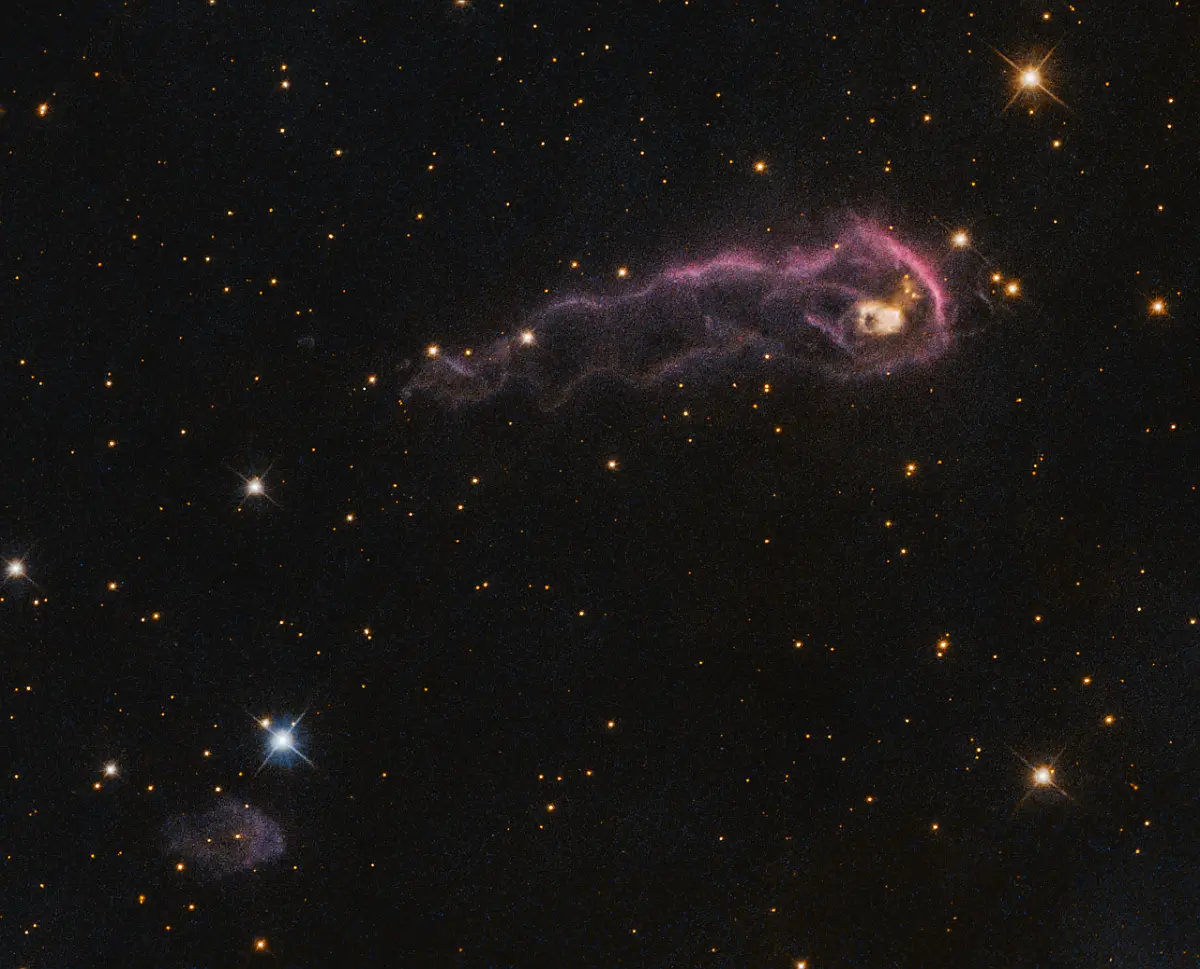
The Cosmic Caterpillar, image: Judy Schmidt (CC BY 2.0)
Can the protostar ever finish growing?
Located in the stellar battleground of Cygnus OB2, the growing baby star inside the Cosmic Caterpillar may or may not mature into a star. In simple terms, the nearby massive, luminous stars are blowing away its food supply while it is still eating, and they may destroy its birth cocoon before the star can finish growing. Depending on how much material survives, the young star’s final mass may be reduced.
Location of IRAS 20324+4057
The Cosmic Caterpillar lies in the northern constellation Cygnus, in the region of the Swan’s chest, marked by the bright Sadr. Sadr marks the centre of the Northern Cross, one of the most recognizable asterisms in the northern sky, and IRAS 20324+4057 lies east-northeast of the supergiant.
The Caterpillar itself is beyond the visual reach of amateur telescopes. It is a dense, dusty cocoon heavily obscured at visible wavelengths, and it has been studied mainly through infrared and radio observations.
The surrounding field can still be rewarding for backyard observers. Binoculars and small telescopes show the rich star fields of the Milky Way and open clusters such as NGC 6910 and M29 in the Gamma Cygni region, while the faint glow of its nebulosity is primarily a target for wide-field astrophotography and narrowband imaging rather than direct visual observation.
The stars of Cygnus OB2 are dimmed by the dust of the Cygnus Rift, but the brightest members can be spotted in small telescopes.
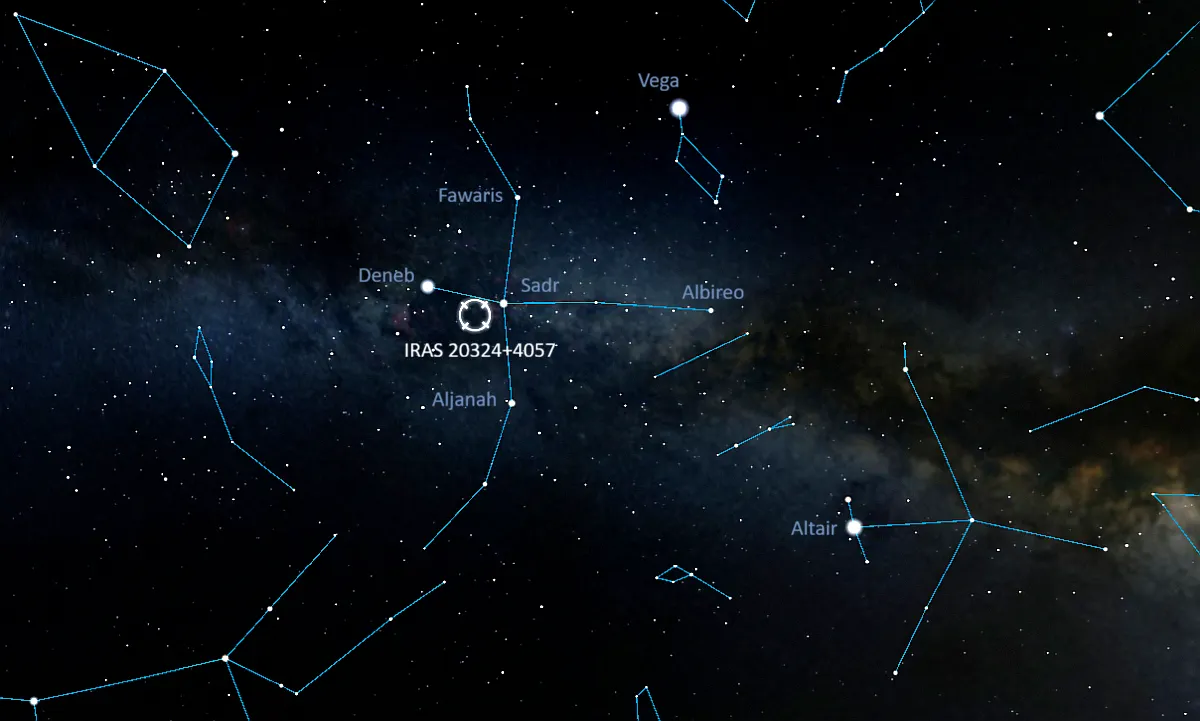
Location of the Cosmic Caterpillar, image: Stellarium (annotated for this article)
Explore other deep sky objects in Cygnus:
- Crescent Nebula (NGC 6888)
- Blinking Planetary Nebula (NGC 6826)
- Egg Nebula
- Cocoon Nebula (IC 5146)
- Jewel Bug Nebula (NGC 7027)
- Methuselah Nebula (MWP 1)
- Footprint Nebula (M1-92)
Cosmic Caterpillar – IRAS 20324+4057
| Constellation | Cygnus |
| Object type | Young stellar object |
| Right ascension | 20h 34m 13.25177s |
| Declination | +41° 08′ 13.8973″ |
| Apparent size | 1.47′ × 2.00′ |
| Distance | 4,600 light-years (1,40 parsecs) |
| Size | 1 light-year |
| Names and designations | Cosmic Caterpillar, Tadpole Nebula, IRAS 20324+4057, 2MASS J20341326+4108140, AKARI-IRC-V1 J2034133+410813, TIC 63459755, AP J20341326+4108140, BLAST J203414+410808, GLMP 1000, IPHASX J203413.3+410814, WSRTGP 2032+4057, MSX6C G080.1909+00.5353, WISE J203413.25+410814.1, WISEA J203413.26+410814.1, Gaia DR2 2067766757181346560, Gaia DR3 2067766757181346560 |