SN 1006 is a supernova remnant located 7,200 light-years away in the southern constellation Lupus (the Wolf). The supernova that produced it reached an apparent visual magnitude of -7.5 and was visible in the daytime. It was the brightest supernova ever recorded.
SN 1006 was observed in the year 1006 and documented as a “guest star” by observers in Europe, Japan, China, and Egypt. The faint expanding remnant was discovered by radio astronomers in Australia in the 1960s.
SN 1006 first appeared in the southern sky on April 30 or May 1, 1006. It was around 16 times brighter than Venus. It was well over a magnitude brighter than the Crab Supernova (SN 1054), the event that produced the famous Crab Nebula (Messier 1) half a century later.
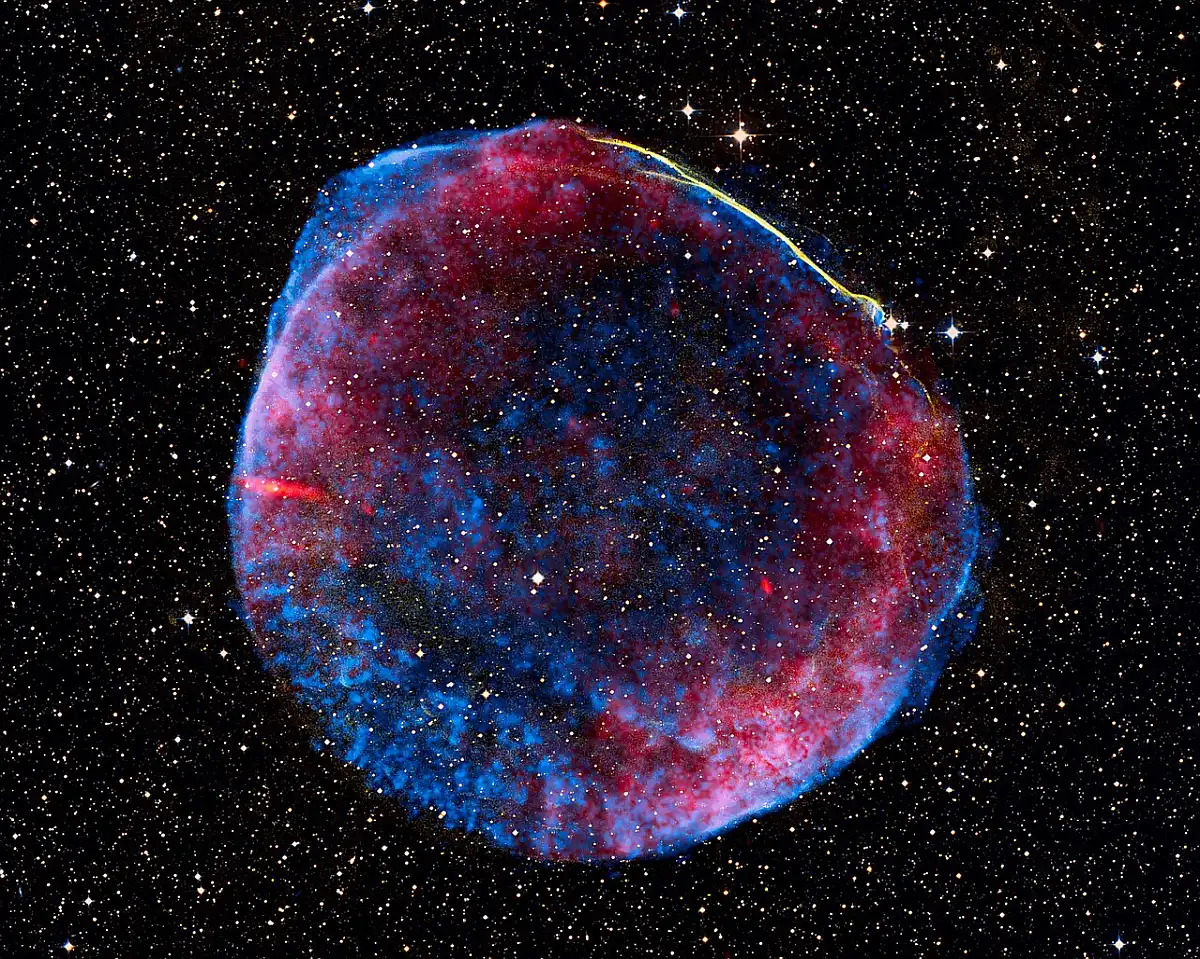
This image is a composite of visible (or optical), radio, and X-ray data of the full shell of the supernova remnant from SN 1006. The radio data show much of the extent that the X-ray image shows. In contrast, only a small linear filament in the northwest corner of the shell is visible in the optical data. The object has an angular size of roughly 30 arcminutes (0.5 degree, or about the size of the full moon), and a physical size of 60 light-years (18 parsecs) based on its distance of nearly 7,000 light-years. The small green box along the bright filament at the top of the image corresponds to the dimensions of the Hubble release image. Image credit – Radio: NRAO/AUI/NSF/GBT/VLA/Dyer, Maddalena & Cornwell, X-ray: Chandra X-ray Observatory; NASA/CXC/Rutgers/G. Cassam-Chenaï, J. Hughes et al., Visible light: 0.9-metre Curtis Schmidt optical telescope; NOAO/AURA/NSF/CTIO/Middlebury College/F. Winkler and Digitized Sky Survey (CC BY 4.0)
The guest star that shook the medieval world
On a spring night in the year 1006, medieval observers were shocked to find a new star blazing into existence, as if a smaller second moon had lit the sky above the southern horizon. The guest star shone brighter than Venus and the crescent Moon and was visible in broad daylight.
In ancient and medieval times, the term “guest star” was commonly used to describe novae and supernovae. These objects were known to be different from comets and planets because they stayed in the same place relative to other stars. However, their true nature remained unknown until the early 20th century.
From the mid-northern latitudes, the supernova SN 1006 would have been visible very low in the sky, southwest of the bright Antares and the Scorpion’s claws.
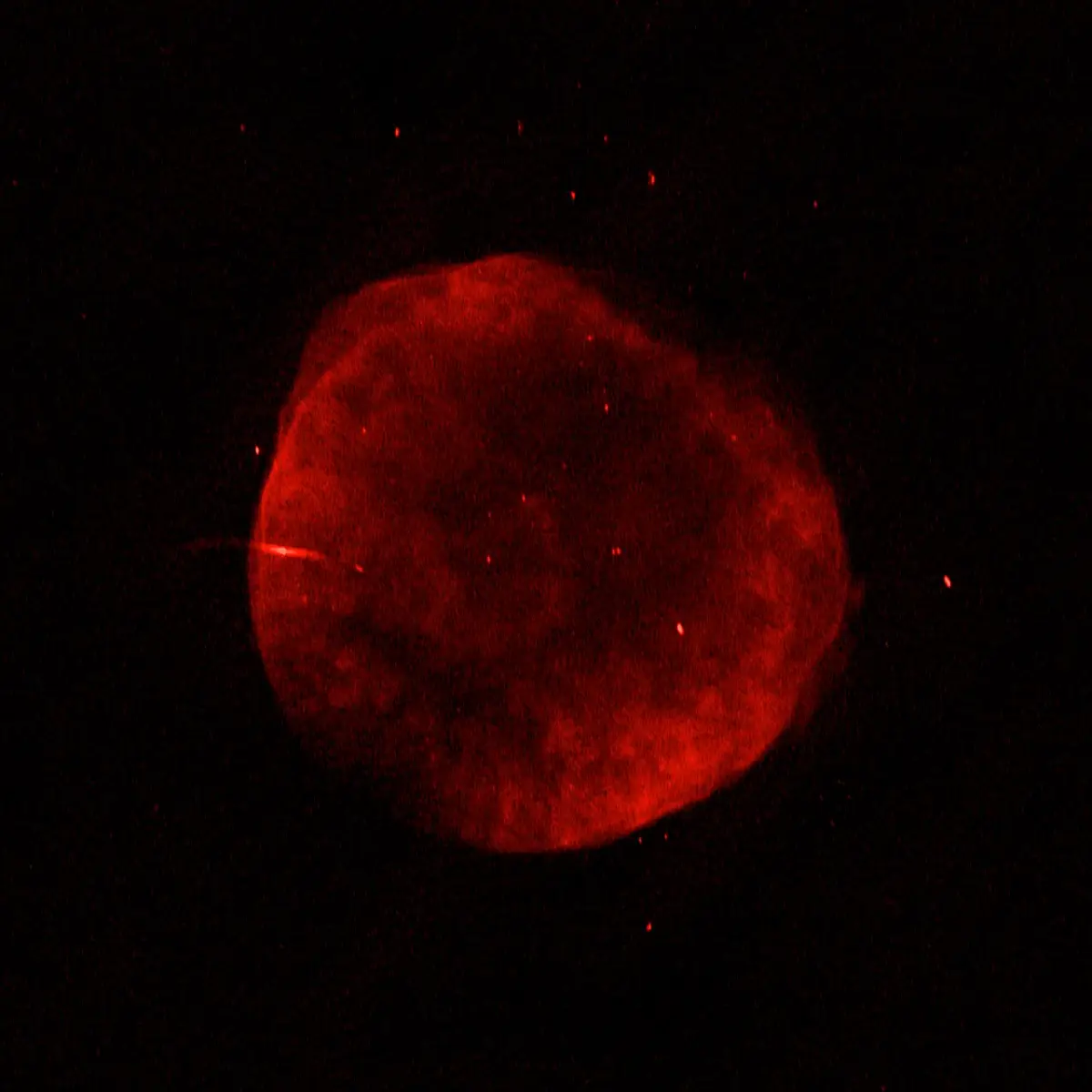
The radio image of SN 1006 shows much of the extent that the X-ray image shows. The visible light stems primarily from a small delicate filament along the northwest rim of the shell. Credit: NRAO/AUI/NSF/GBT/VLA/Dyer, Maddalena & Cornwell (PD)
Historical records of SN 1006
The supernova SN 1006 was documented by observers across Europe, Egypt, Japan, China and the Middle East. It was the first widely recorded supernova in history.
Egyptian astronomer Ali ibn Ridwan (c. 988 – c. 1061) provided the most detailed description of the supernova in an autobiographical footnote to Ptolemy’s Tetrabiblos, which he was editing. He observed the supernova from Cairo and used the term nayzak to describe it. The word typically denotes a very bright comet, but the astronomer noted that it remained stationary relative to nearby stars while the Sun moved into Virgo.
He wrote, “It was a large nayzak, round in shape and its size two and a half or three times the size of Venus. Its light illuminated the horizon and it twinkled a great deal. It was a little more than a quarter of the brightness of the Moon.”
The astronomer included the exact positions of the planets on the day of his first sighting of the supernova. Based on these positions, modern researchers pinpointed the date: April 30, 1006.
Several Chinese sources wrote that the supernova was bright enough to cast shadows. Observers in China and Japan placed the guest star on the border between the modern western constellations Lupus and Centaurus.
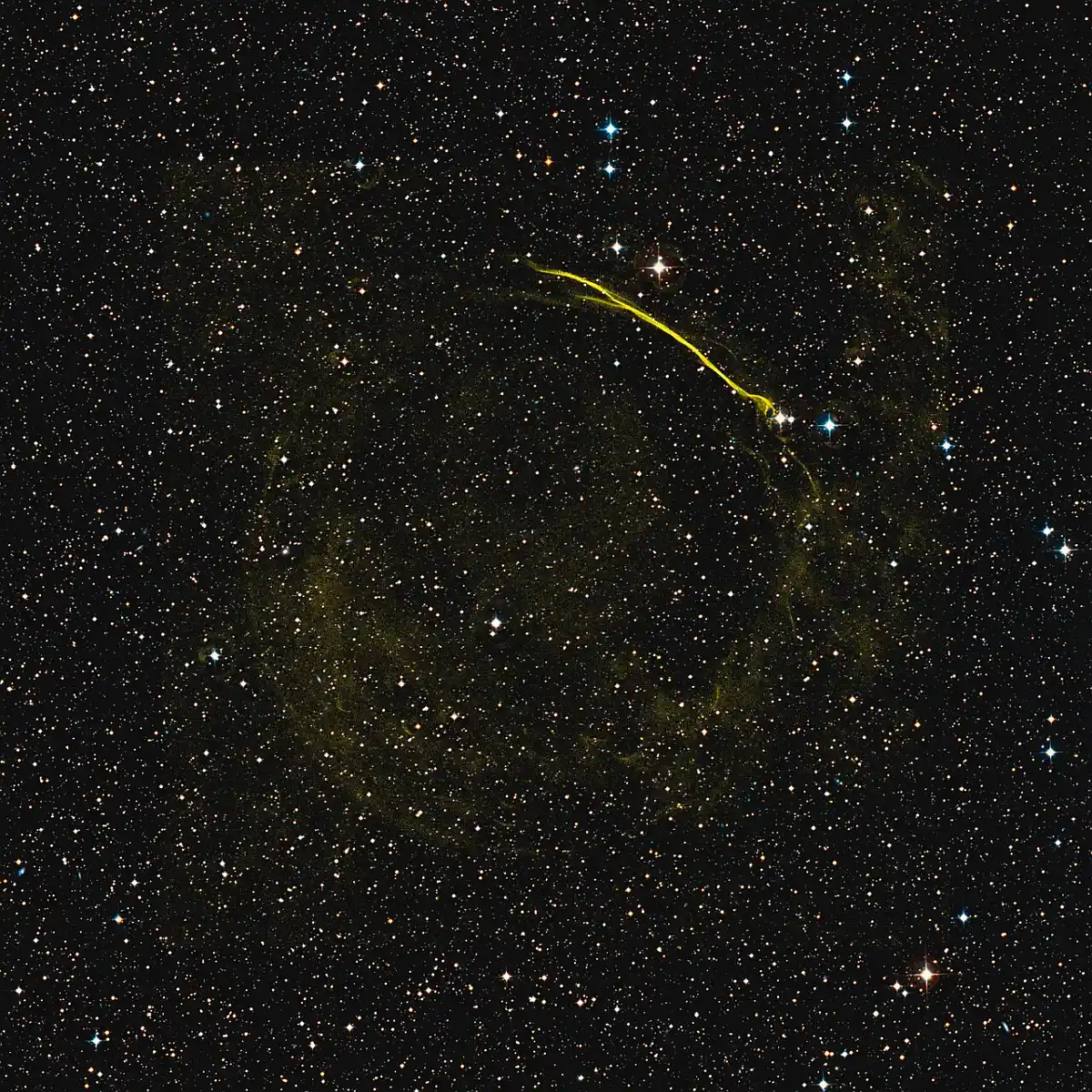
An optical image of the faint supernova remnant SNR 1006. The visible light stems primarily from a small delicate filament along the northwest rim of the shell. Credit: Middlebury College/F.Winkler, NOAO/AURA/NSF/CTIO Schmidt & DSS (PD)
The most important European record of the event comes from Hepidannus, a monk at the Abbey of Saint Gall in Switzerland. St. Gall is at latitude 47.5° N, making this the most northerly sighting of SN 1006. The supernova was recorded in the Annales Sangallenses maiores (Greater Annals of St. Gall):
“A new star of unusual size appeared, flashing brilliantly and striking the eyes—a sight not without terror. It varied remarkably, at times contracting and at others expanding, and occasionally even seemed to vanish. It was visible for three months in the deepest southern reaches of the sky, beyond all the constellations seen in the sky.”
Hepidannus’ description provided evidence that SN 1006 was a Type Ia supernova.
SN 1006 may have been depicted on a petroglyph by Native Americans in modern-day Arizona. The rock carving was discovered in White Tanks Regional Park near Phoenix, where the Hohokam lived from 500 to 1100 CE. It shows a symbol of a scorpion and a star-like object. The discovery was announced in 2006, a full millennium after the supernova lit up the skies. However, the interpretation of the carving is speculative and there is no evidence that ancient Americans saw the stars of Scorpius as a scorpion.
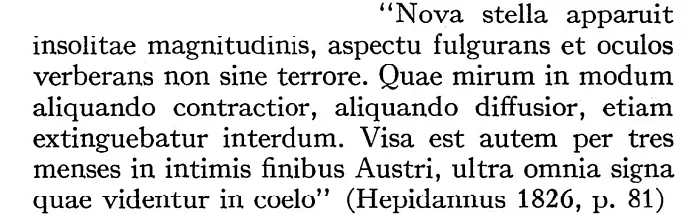
Hepidannus’ description of the supernova SN 1006.
Brightest historical supernova
SN 1006 is one of only eight visible supernovae in recorded history. It was the brightest of the eight. The others were SN 185 on the border between Circinus and Centaurus, SN 393 in Scorpius, the Crab Supernova (SN 1054) in Taurus, SN 1181 and Tycho’s Supernova (SN 1572) in Cassiopeia, Kepler’s Supernova (SN 1604) in Ophiuchus, and SN 1987A in the Large Magellanic Cloud in Dorado.
The better-known Crab Supernova peaked at magnitude -6, Tycho’s Supernova at magnitude -4, and Kepler’s Supernova at magnitude -2.5.
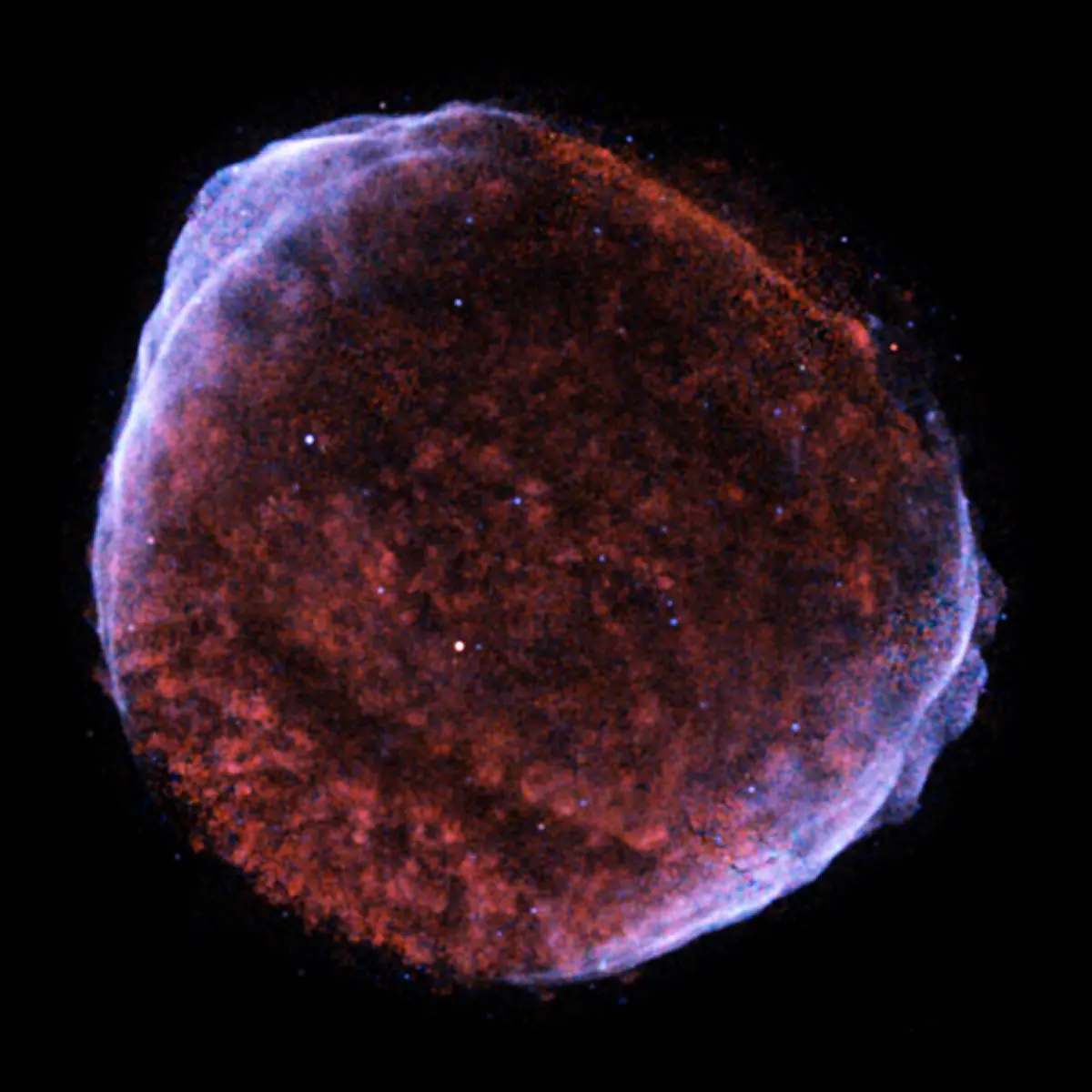
Chandra’s false-color image of SN 1006 shows X-rays from multimillion degree gas (red/green) and high-energy electrons (blue). In the year 1006 a “new star” appeared in the sky and in just a few days it became brighter than the planet Venus. We now know that the event heralded not the appearance of a new star, but the dramatic end of an old one. It was likely a white dwarf star that had been pulling matter off an orbiting companion star. When the white dwarf mass exceeded the stability limit (known as the Chandrasekhar limit), it went out as a luminous supernova. Material ejected in the supernova produced tremendous shock waves that heated gas to millions of degrees and accelerated electrons to very high energies. Image credit: Smithsonian Institution, NASA/CXC/Rutgers/J.Hughes et al. (PD)
The century-long hunt for the supernova remnant
The remnant of the historic supernova was identified in 1965. Astronomers Doug Milne and Frank Gardner of the Commonwealth Scientific and Industrial Research Organisation (CSIRO) in Australia used the 64 m CSIRO Parkes Radio Telescope at Parkes Observatory to make observations near the suggested location of SN 1006. They identified the polarized extended radio source PKS 1459−41 as the probable supernova remnant.
The remnant has a circular shell 30 arcminutes in diameter, the same size as the full Moon. At a distance of 7,200 light-years, this corresponds to a linear diameter of 65 light years.
SNR 1006 took a millennium to expand to its current size. It is still expanding at around 6 million miles (9.66 million km) per hour. Astronomers reported discovering X-ray and optical emission, and very-high-energy gamma-ray emission was detected with the H.E.S.S. gamma-ray observatory in 2010.
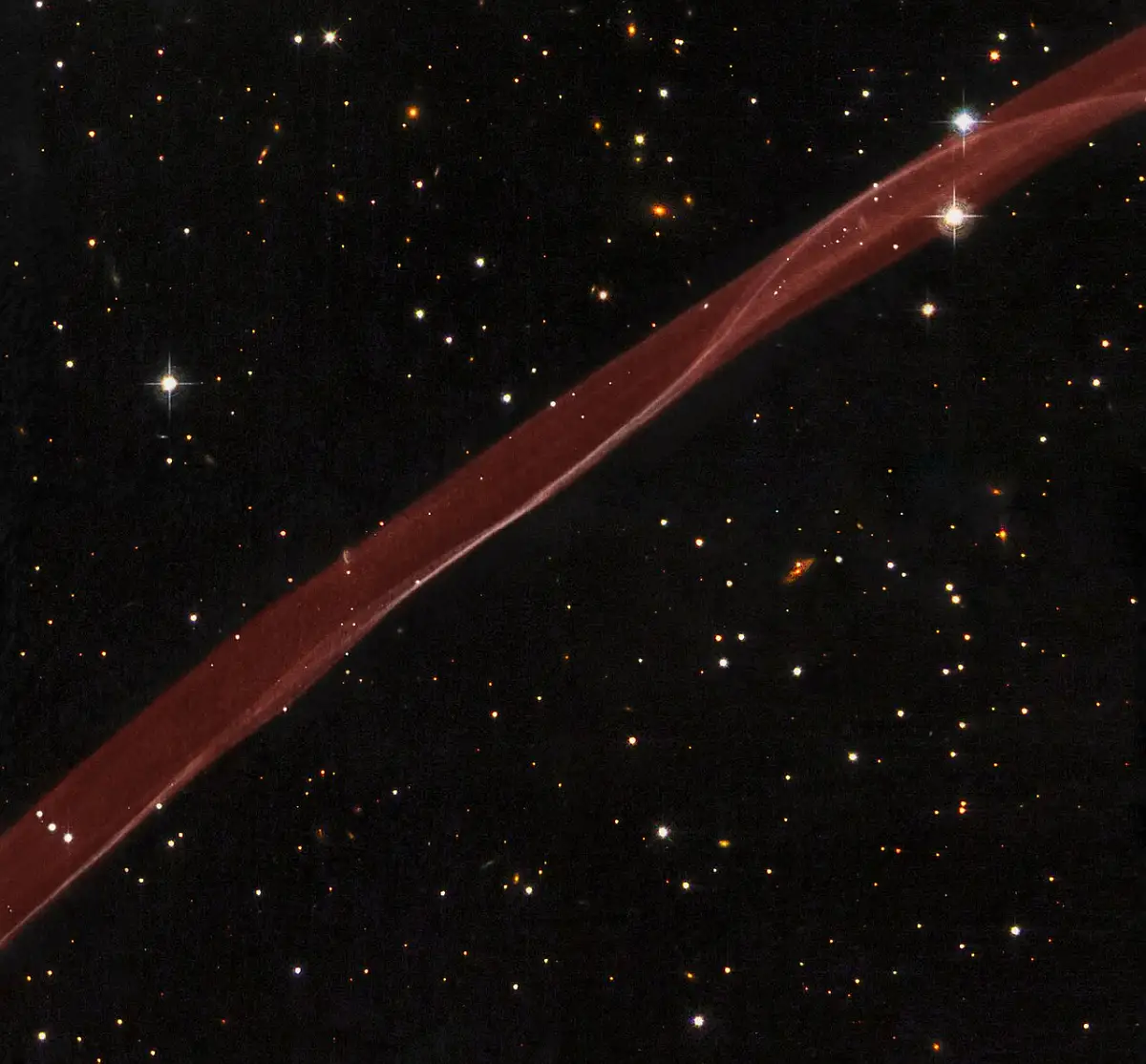
These columns that resemble stalagmites protruding from the floor of a cavern columns are in fact cool interstellar hydrogen gas and dust that act as incubators for new stars. Inside them and on their surface astronomers have found knots or globules of denser gas. These are called EGGs (acronym for “Evaporating Gaseous Globules”). Inside at least some of the EGGs stars being formed. A delicate ribbon of gas floats eerily in our galaxy. A contrail from an alien spaceship? A jet from a black hole? Actually this image, taken by the NASA/ESA Hubble Space Telescope, is a very thin section of the remnant of a supernova that occurred more than 1,000 years ago. On or around 1 May 1006 A.D., observers from Africa to Europe to the Far East witnessed and recorded the arrival of light from what is now called SN 1006, a tremendous supernova event caused by a white dwarf star nearly 7,000 light-years away. The supernova was probably the brightest star ever seen by humans, and surpassed Venus as the brightest object in the night time sky, only to be surpassed by the Moon. It was visible even during the day for weeks, and remained visible to the unaided eye for at least two and a half years before fading away. SN 1006 resides within our Milky Way galaxy. Located more than 14 degrees off the plane of the galaxy’s disk, there is relatively little confusion with other foreground and background objects in the field when trying to study this object. In the Hubble image, many background galaxies (orange extended objects) far off in the distant universe can be seen dotting the image. Most of the white dots are foreground or background stars in our Milky Way galaxy. This image is a composite of hydrogen-light observations taken with Hubble’s Advanced Camera for Surveys in February 2006 and Wide Field Planetary Camera 2 observations in blue, yellow-green, and near-infrared light taken in April 2008. The supernova remnant, visible only in the hydrogen-light filter was assigned a red hue in the Heritage colour image. Image credit: NASA, ESA, and the Hubble Heritage Team (STScI/AURA) Acknowledgment: W. Blair (Johns Hopkins University) (PD)
Progenitor of SN 1006
SN 1006 was classified as a Type Ia supernova, an event triggered by a white dwarf star that accretes too much material from a binary companion or merges with another white dwarf. These supernovae do not leave behind neutron stars or black holes. Unlike those produced by massive stars, Type Ia events completely disrupt the progenitors.
The binary white dwarf scenario is the most likely for SN 1006 because, despite extensive search, no companion star has ever been found. This type of supernova is triggered by two white dwarfs whose combined mass is over the Chandrasekhar limit after merging. As a white dwarf approaches this critical mass of 1.44 solar masses, its core reaches ignition temperature to start fusing carbon. Once the fusion begins, a runaway reaction unbinds the star in a supernova event within seconds.
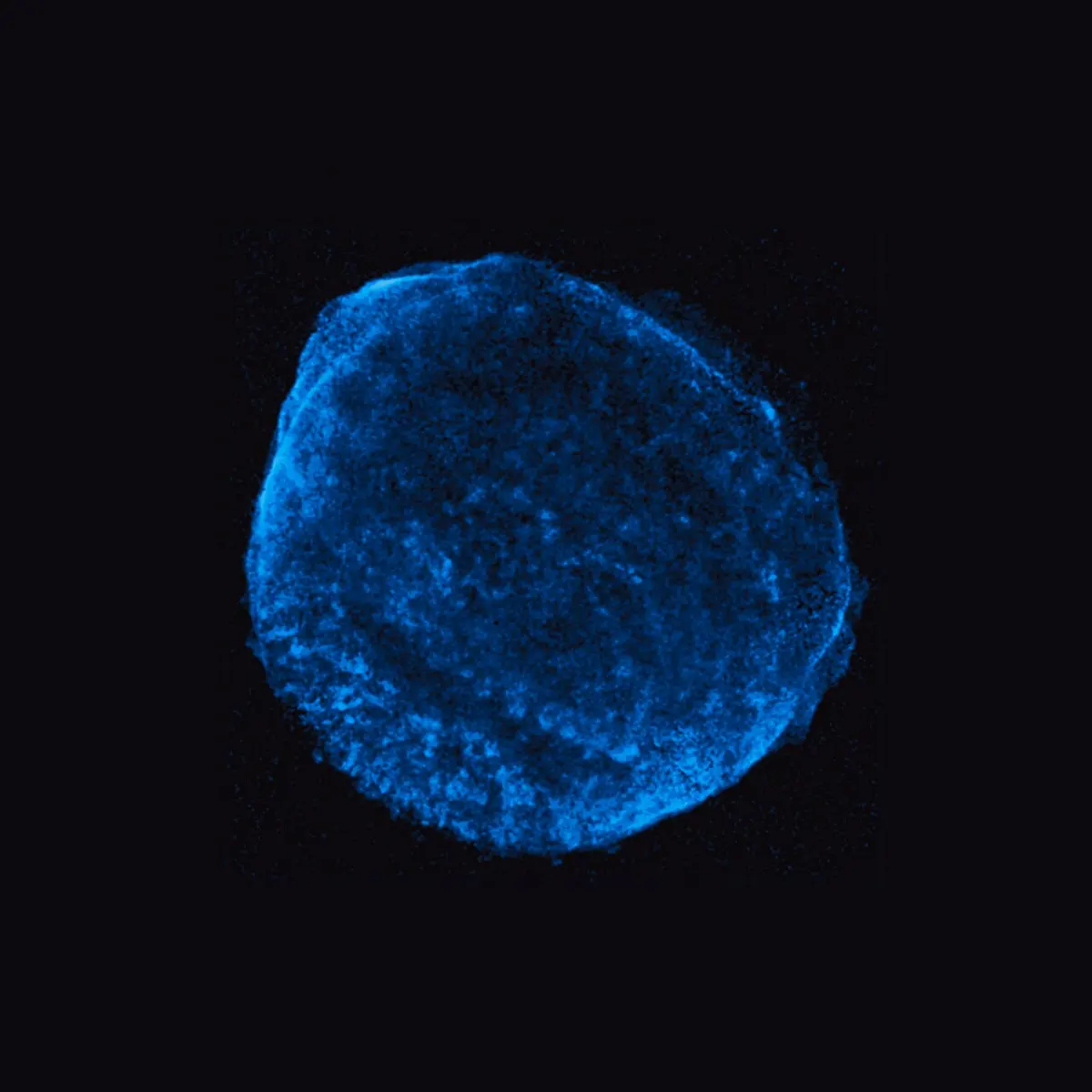
An X-ray image of SN 1006. The X-ray data were acquired from the Chandra X-ray Observatory’s AXAF CCD Imaging Spectrometer (ACIS) at 0.5-3keV, and were provided by J. Hughes (Rutgers University) et al. Image: NASA/CXC/Rutgers/G.Cassam-Chenai, J.Hughes et al. (PD)
Location of SN 1006
The remnant of the Supernova 1006 lies in the southern constellation of Lupus, on the border with Centaurus. It appears close to the massive triple star system Kappa Centauri and the blue giant Beta Lupi.
At declination -42°, SNR 1006 never rises above the horizon for observers north of the latitude 48° N. It is very faint and out of reach for amateur telescopes.
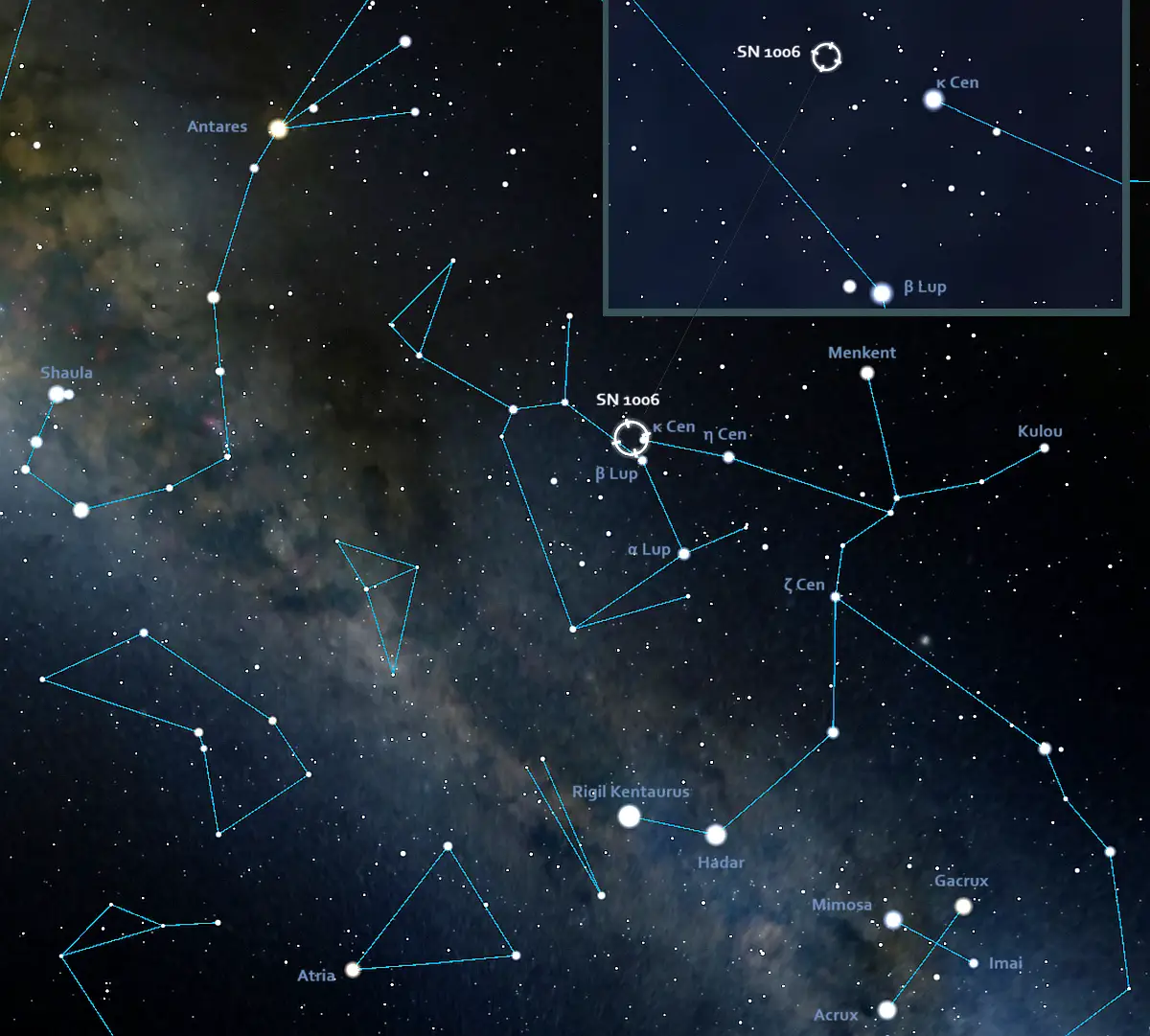
Location of SN 1006, image: Stellarium (annotated for this article)
Explore other supernova remnants:
- Supernova 1987A
- Medulla Nebula (CTB 1)
- Manatee Nebula (W50)
- Cassiopeia A
- Spaghetti Nebula
- Vela Supernova Remnant
- Jellyfish Nebula (IC 443)
SN 1006
| Constellation | Lupus |
| Object type | Supernova remnant |
| Supernova type | Type Ia |
| Right ascension | 15h 02m 08s |
| Declination | -41° 57′ |
| Peak apparent magnitude | -7.5 |
| Apparent size | 30′ |
| Distance | 7,200 light-years (2,200 parsecs) |
| Names and designations | SN 1006, SN 1006A, Lupus Supernova, Lupus SN, SNR G327.6+14.5, SNR G327.6+14.6, PKS 1459-419, PKS J1502-4205, PKS 1459-41, AJG 37, KOHX 1, TeV J1502-419, H 1506-42, 1E 1459.6-4146, 1M 1457-416, 2U 1440-39, 1ES 1500-41.5, MRC 1459-417, 3U 1439-39, GRS G327.60 +14.60, MSH 14-4-15, SN 1006A, 4U 1458-41, 1H 1458-416, SN 1016, XSS J15031-4149 |