The Pumpkin Nebula (Sharpless 2-232) is a vast, diffuse emission nebula located in the northern constellation Auriga. In infrared light, the cloud of gas and dust looks like a hollowed-out Halloween pumpkin. It is also known as the Halloween Nebula, the Jack-o’-lantern Nebula, and the Great Pumpkin Nebula. NASA’s Spitzer Space Telescope famously imaged it in 2019, just a few months before the telescope was retired.
The star that carved the cosmic Pumpkin
The cosmic Pumpkin owes its shape to a single star, HD 37737, a hot, luminous blue O-type star with a mass approximately 15-20 times that of the Sun. The star’s powerful stellar winds and intense radiation have pushed the nebula’s dust and gas outward, carving the cavity that gives Sh2-232 its jack-o’-lantern look.
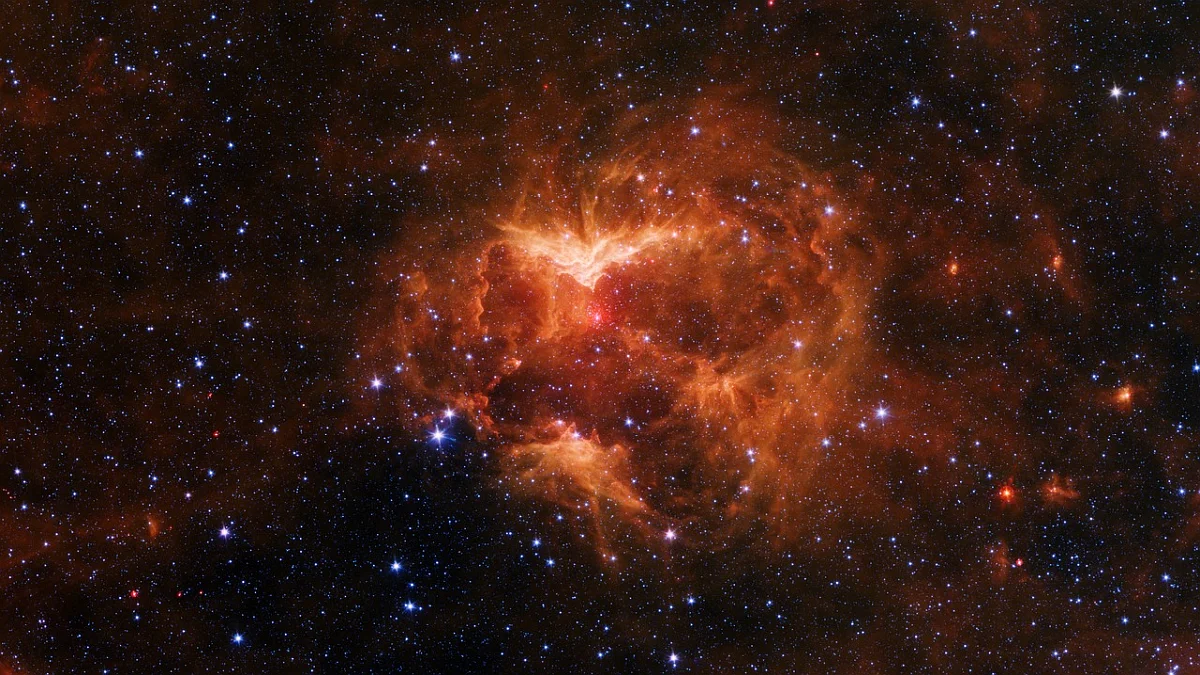
This carved-out cloud of gas and dust has been nicknamed the “Jack-o’-lantern Nebula” because it looks like a cosmic hollowed-out pumpkin. Powerful outflows of radiation and particles from a massive star known as an O-type star and about 15 to 20 times heavier than the Sun has likely swept the surrounding dust and gas outward, creating deep gouges in the cloud. The image shows infrared light (which is invisible to the human eye) captured by NASA’s Spitzer Space Telescope.
This image is a high-contrast version in which the red wavelength is more pronounced. Together, the red and green wavelengths create an orange hue. The picture highlights contours in the dust as well as the densest regions of the nebula, which appear brightest. Image credit: NASA/JPL-Caltech (PD)
A crowded stellar neighbourhood
The Pumpkin Nebula is not alone. It appears in the same area as three other regions of ionized hydrogen listed in the Sharpless catalogue: Sh2-231, Sh2-233, and Sh2-235. The four nebulae are part of the G173 Complex, one of the largest star-forming regions in the outer Milky Way.
The G173 Complex lies in the Perseus Arm, the same spiral arm of our galaxy that hosts Auriga’s bright star clusters Messier 36, Messier 37, and Messier 38, as well as the Double Cluster in Perseus. The complex lies at the core of the Auriga OB1 association, a family of exceptionally hot, blue O- and B-type stars, many of which will end their lives as luminous supernovae. Most sources place the complex approximately 5,870 light-years (1.8 kiloparsecs) away.
How far away is the Pumpkin Nebula?
The Pumpkin Nebula itself lies approximately 5,587 light-years (1.713 ± 171 kpc) away. The distance comes from a 2020 study of molecular cloud distances. Within the uncertainty, it agrees with the direct measurement of 1.68 ± 0.04 kpc, based on a parallax of the methanol maser source G173.48+2.44, measured by Sakai et al. (2019).
With an apparent diameter of 45.6 arcminutes (according to Simbad), the distance gives the nebula a physical diameter of around 74 light-years (23 pc).
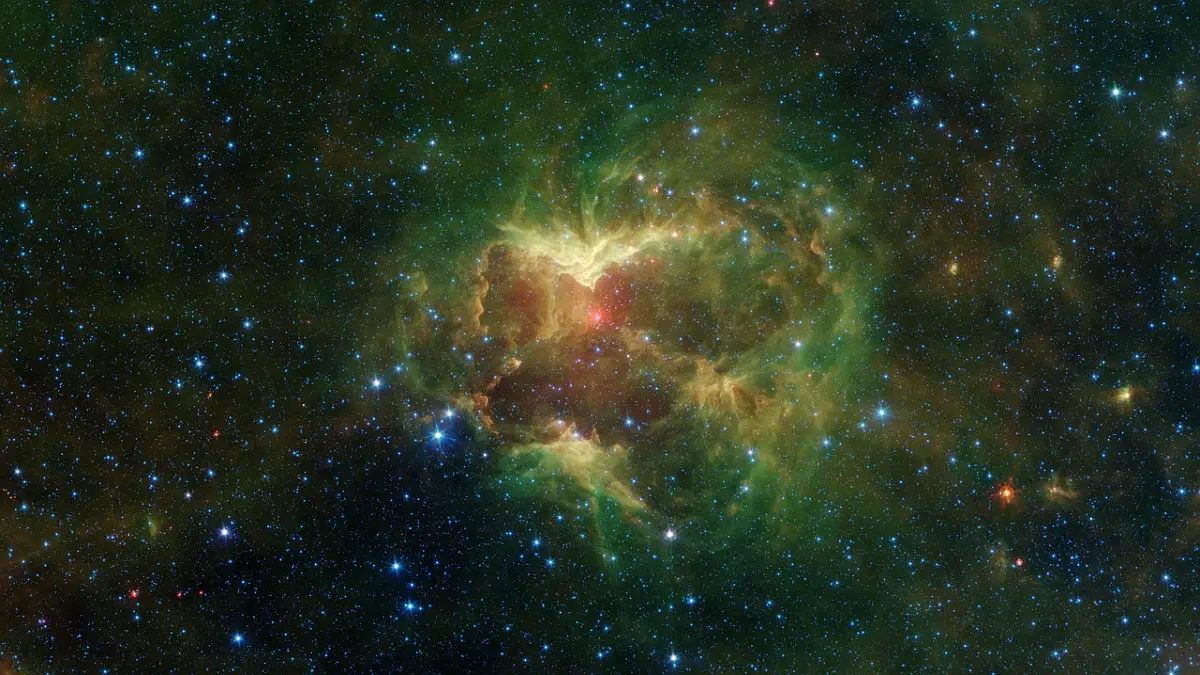
The Pumpkin Nebula, image credit: NASA/JPL-Caltech (PD)
A faint planetary nebula behind the Pumpkin
A planetary nebula designated PN G173.5+03.2 (PK 173+03 1, Pu 2) appears near the centre of the Great Pumpkin. It lies behind the nebula, forming a chance alignment. The stellar remnant was discovered by Austrian astronomer Alois Purgathofer in 1980. With an apparent magnitude of 20.5, it is an exceptionally faint object.
How to find the Pumpkin Nebula in Auriga
Sharpless 2-232 lies within Auriga’s Hexagon, in the same area as the bright Pinwheel Cluster (Messier 36). It appears near Mahasim (Theta Aurigae), close to the point where the imaginary line connecting Mahasim and Hassaleh (Iota Aurigae) crosses the line connecting Menkalinan (Beta Aurigae) and Elnath (Beta Tauri).
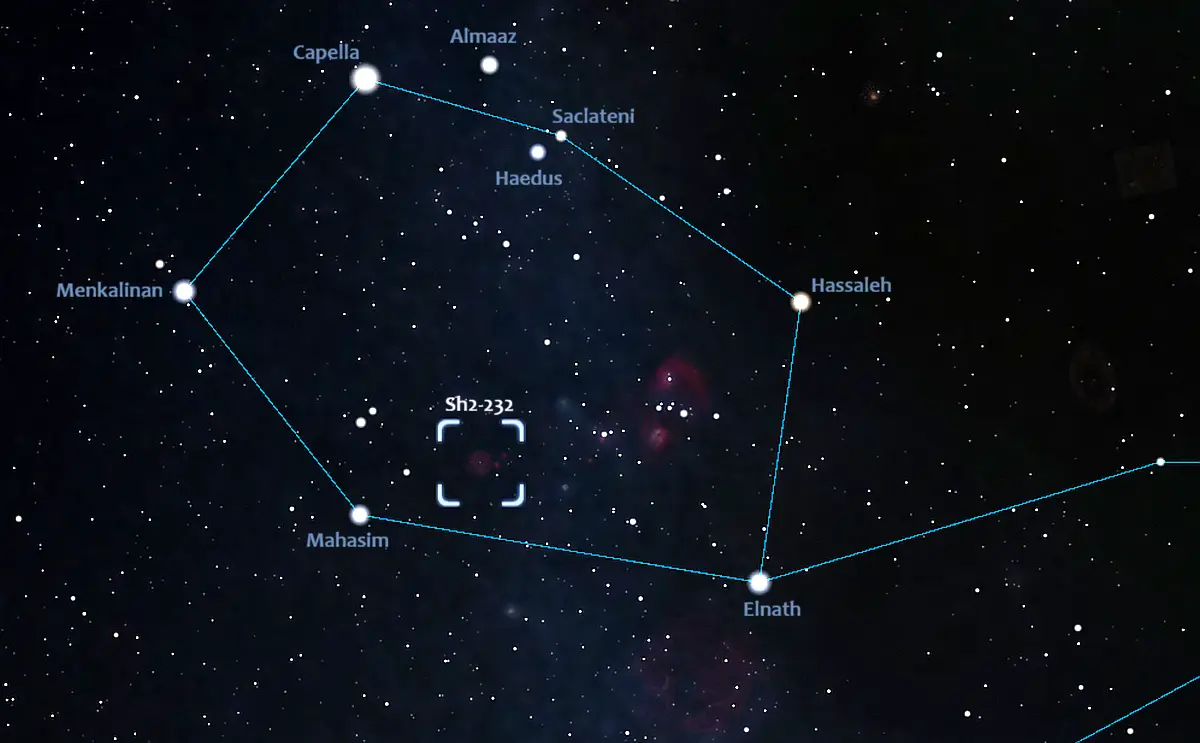
Location of the Great Pumpkin Nebula (Sharpless 232), image: Stellarium (annotated for this article)
Can you see the Pumpkin Nebula through a telescope?
The Pumpkin Nebula is far too faint for visual observing and is best captured photographically, with a hydrogen-alpha filter to help bring out its glowing gas.
Several brighter deep sky objects also occupy the region between Mahasim and Hassaleh: the open clusters Messier 36 and Messier 38, the Flaming Star Nebula (IC 405) around AE Aurigae, the Spider Nebula (IC 417), the Fly Nebula (NGC 1931), and the Tadpole Nebula (IC 410).
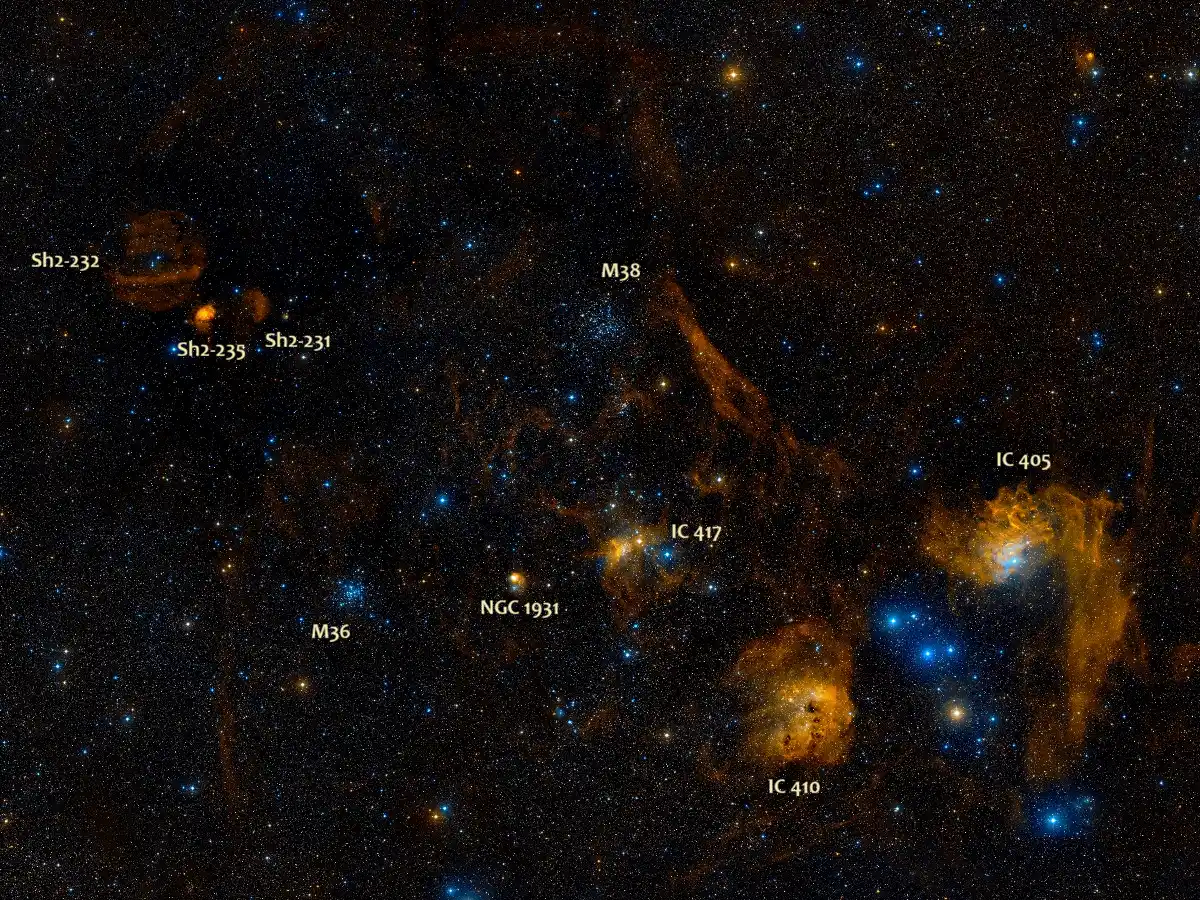
The Pumpkin Nebula, Tadpole Nebula, Flaming Star Nebula, and Spider and Fly nebulae, image credit: ESO/Digitized Sky Survey 2 (CC BY 4.0)
Auriga is prominent in the evening sky throughout the northern hemisphere winter. The best time to observe deep sky objects in the constellation is in February, when the Charioteer stands higher above the horizon in the early evening.
Explore the asterisms and deep sky objects in Auriga:
- Flaming Star Nebula (IC 405)
- Tadpole Nebula (IC 410)
- Westbrook Nebula (IRAS 04395+3601)
- Auriga’s Hexagon
Pumpkin Nebula – Sh2-232
| Constellation | Auriga |
| Object type | Diffuse nebula |
| Right ascension | 05h 42m 28.3s |
| Declination | +36° 11′ 24″ |
| Apparent size | 45.6′ × 45.6′ |
| Distance | 5,587 light-years (1.713 kpc) |
| Names and designations | Great Pumpkin Nebula, Jack-o’-lantern Nebula, Halloween Nebula, Sharpless 232, Sh2-232, LBN 173.48+03.24, LBN 805, GCRV 2197 E, [ABB2014] WISE G173.468+03.230 |