NGC 7727 is a peculiar spiral galaxy located 89 million light-years away in the constellation Aquarius. With an apparent magnitude of 11.5 and an apparent size of 3.48 by 2.95 arcminutes, it can be observed in medium-sized telescopes. It is included in the Herschel 400 catalogue of deep sky objects accessible to backyard astronomers.
The galaxy’s striking appearance is a remnant of a dramatic past. Astronomers believe that NGC 7727 formed when two spiral galaxies merged around 1 billion years ago, leaving behind a tangled structure of tidal tails and irregular streams extending far beyond the galaxy’s main body. In 2021, researchers confirmed that NGC 7727 contains a pair of supermassive black holes on a collision course. The black holes are among the nearest known pairs to Earth.
NGC 7727 was discovered by the German-born British astronomer William Herschel on November 27, 1785. The galaxy’s unusual structure has earned it a place in Halton Arp’s Atlas of Peculiar Galaxies (1966) as Arp 222. The American astronomer listed NGC 7727 as an example of a “galaxy with amorphous spiral arms.” The “amorphous” arms are now understood to be tidal tails.
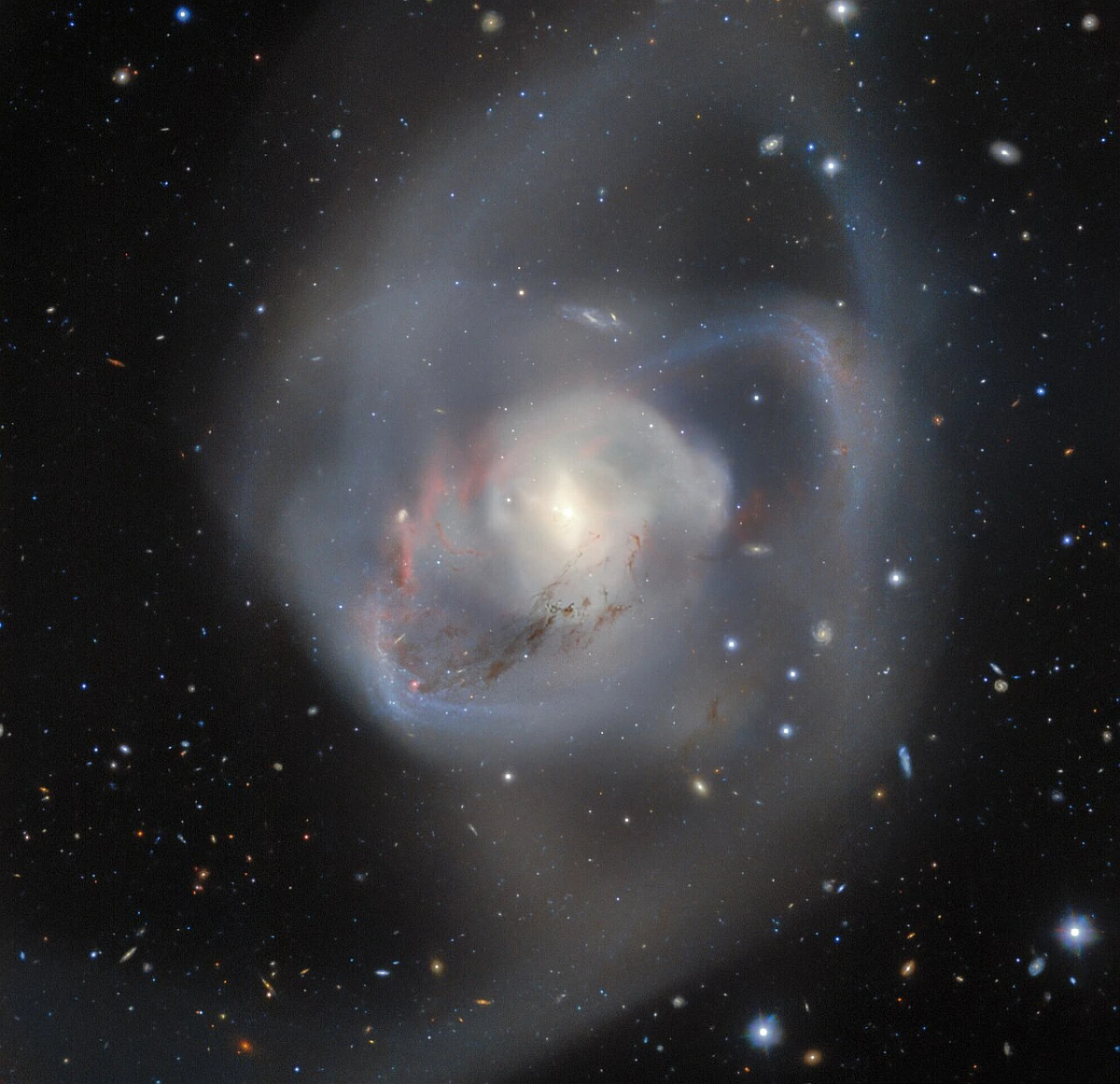
Gemini South, one half of the International Gemini Observatory operated by NSF’s NOIRLab, captures the billion-year-old aftermath of a double spiral galaxy collision. At the heart of this chaotic interaction, entwined and caught in the midst of the chaos, is a pair of supermassive black holes — the closest such pair ever recorded from Earth. Image credit: International Gemini Observatory/NOIRLab/NSF/AURA Image processing: T.A. Rector (University of Alaska Anchorage/NSF’s NOIRLab), J. Miller (International Gemini Observatory/NSF’s NOIRLab), M. Rodriguez (International Gemini Observatory/NSF’s NOIRLab), M. Zamani (NSF’s NOIRLab) (CC BY 4.0)
A spiral galaxy torn apart: The merger behind NGC 7727
NGC 7727 is a disturbed spiral galaxy that has been classified as an intermediate spiral, SAB(s)a pec, or barred spiral galaxy, SBa. Its irregular spiral structure and prominent tidal streams of material pulled out during the collision mark it as a merger remnant at an advanced phase. The streams and plumes are the remains of the disks of the two galaxies that merged.
The ages of the star clusters formed in the collision provide clues to the galaxy’s merger history. In 1994, astronomers identified 23 young candidate globular clusters whose colours indicated ages of around 1 billion years. Their ages support the theory that the galaxy formed from a merger that began roughly a billion years ago.
A cosmic sibling: NGC 7727 and the Atoms for Peace Galaxy
NGC 7727 looks similar to the Atoms for Peace Galaxy (NGC 7252), another merger remnant in Aquarius. Both galaxies have unusual loop-like structures, plumes, streams and shells resulting from galactic mergers, and both host a population of young clusters. However, NGC 7252 has much more molecular hydrogen and neutral hydrogen gas.
Two supermassive black holes closing in
NGC 7727 has a dual active galactic nucleus – a pair of supermassive black holes – at its centre. The black holes are separated by only 1,600 light-years (500 parsecs) and are expected to merge within the next couple of hundred million years. The angular separation between them is 3.8 arcseconds.
The more massive black hole has a mass of 1.54 × 10⁸ M⊙ and lies at the galaxy’s centre. The less massive one is offset from the centre by 500 pc and has a mass of 6.33 × 10⁶ M⊙. They are close enough to gravitationally affect each other, but the smaller black hole is not yet bound in orbit around the main black hole.
From foreground star to black hole pair: How the discovery unfolded
Many astronomers previously mistook the second nucleus in NGC 7727 for a Milky Way foreground star. The first to point out that the object was highly peculiar was A. Sandage in 1994. Sandage compared it to NGC 7252, proposing that the presence of the second nucleus indicated that NGC 7727 was also a merger remnant.
Schweizer et al. followed up in 2018 with observations from Hubble’s Wide Field and Planetary Camera 2 (WFPC2) and the Clay telescope in Chile. The team reported that the two bright nuclei were separated by 480 pc (1,566 ly) and had almost identical redshifts, which meant that the second nucleus was not a foreground or background object.
The two supermassive black holes in NGC 7727 were confirmed by Voggel et al. in 2021. Observations with the MUSE spectrograph on the Very Large Telescope (VLT) yielded black hole masses of 154 and 6.33 million solar masses. This confirmed the second nucleus to be the surviving nuclear star cluster of a galaxy that collided with NGC 7727.
The astronomers also detected optical emission lines in the second nucleus and reported that it was a low-luminosity Seyfert active galactic nucleus (AGN). They only confirmed the black hole in the second nucleus to be actively accreting material.
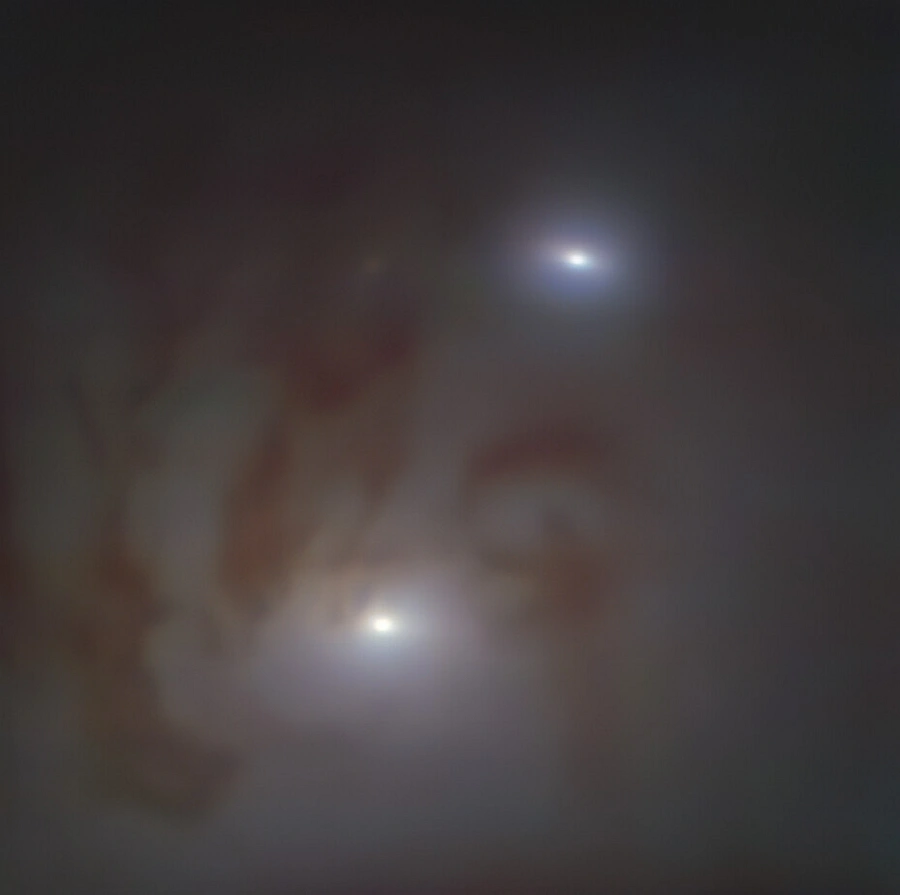
Close-up view of the two bright galactic nuclei, each housing a supermassive black hole, in NGC 7727, a galaxy located 89 million light-years away from Earth in the constellation Aquarius. Each nucleus consists of a dense group of stars with a supermassive black hole at its centre. The two black holes are on a collision course and form the closest pair of supermassive black holes found to date. It is also the pair with the smallest separation between two supermassive black holes — observed just 1600 light-years apart in the sky. The image was taken with theMUSE instrument on ESO’s Very Large Telescope (VLT) at the Paranal Observatory in Chile. Credit: ESO/Voggel et al. (CC BY 4.0)
What happens when the two black holes merge?
A 2025 study estimated a total merging time of 130 ± 10 million years for the black holes. Previous estimates were around 250 million years. The astronomers proposed that the black holes would take around 60 million years to become gravitationally bound.
As the smaller black hole keeps spiralling inward, the two will get closer and orbit each other more rapidly. Their orbital motion disturbs the fabric of space and time, and those disturbances spread outward as gravitational waves, ripples in spacetime that carry away energy. This causes the black holes to spiral together even faster as they get closer. Once they are very close, they will orbit each other exceptionally fast and ultimately merge in a fraction of a second.
The result will be one larger black hole with a mass slightly less than the sum of the two, because some energy will escape as gravitational waves. The galaxy’s two nuclei will gradually settle into one and the galaxy itself will become a more elliptical-looking remnant. As an elliptical galaxy, it will host very little star formation and contain little interstellar dust.
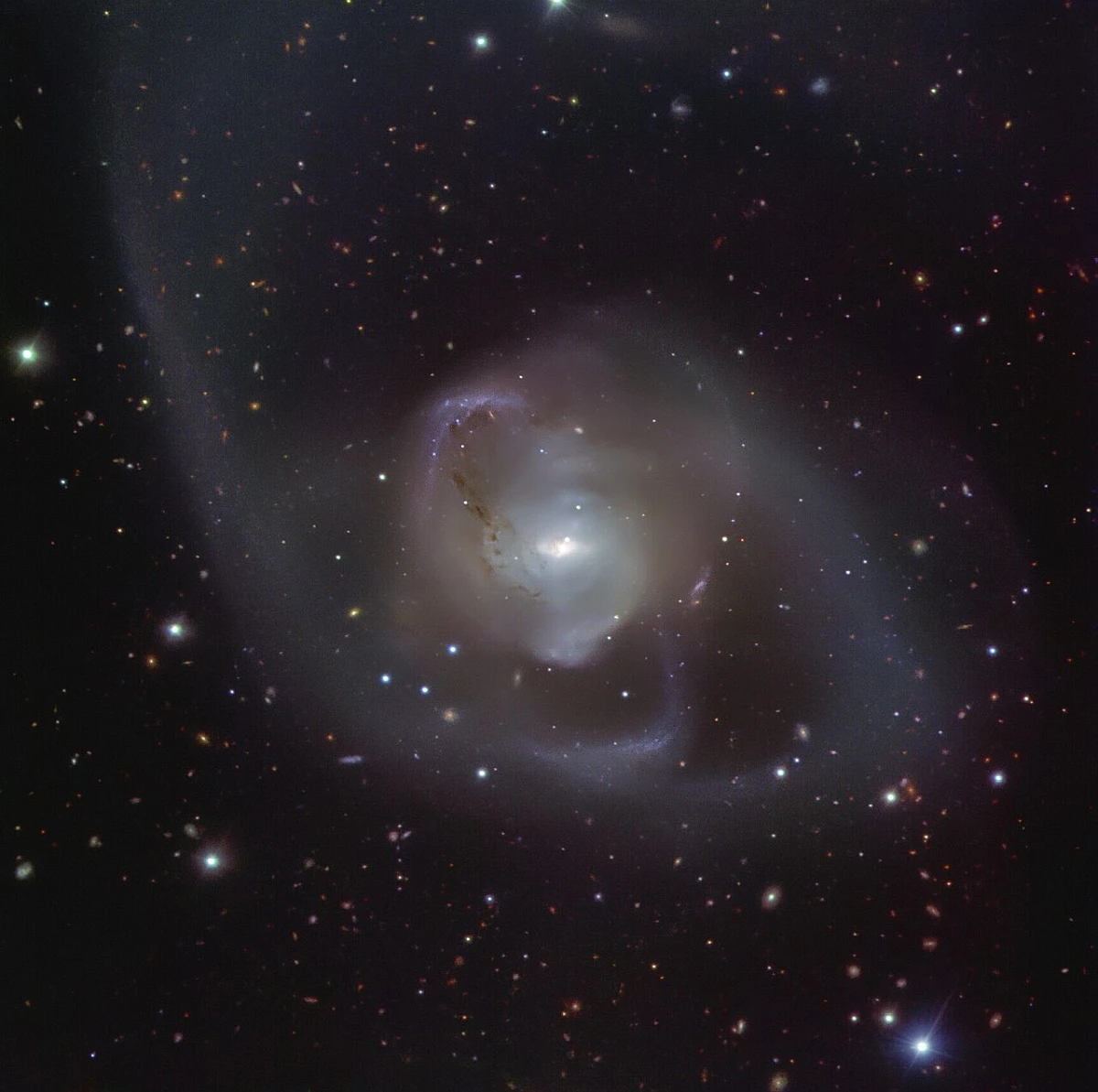
The galaxy NGC 7727 was born from the merger of two galaxies that started around a billion years ago. The cosmic dance of the two galaxies has resulted in the spectacular wispy shape of NGC 7727. At the heart of the galaxy, two supermassive black holes are spiralling closer to each other, expected to merge within 250 million years, the blink of an eye in astronomical time. This image of NGC 7727 was captured by the FOcal Reducer and low dispersion Spectrograph 2 (FORS2) instrument at ESO’s Very Large Telescope (VLT). Image credit: ESO (CC BY 4.0)
Brightest member of the NGC 7727 Group
NGC 7727 is the most prominent member of the NGC 7727 Group of galaxies, also known as the LGG 480 Group. The group contains at least five known members, including the relatively bright barred spiral galaxies NGC 7723 and NGC 7724 and the fainter MCG 2-60-7 and MCG 2-60-10.
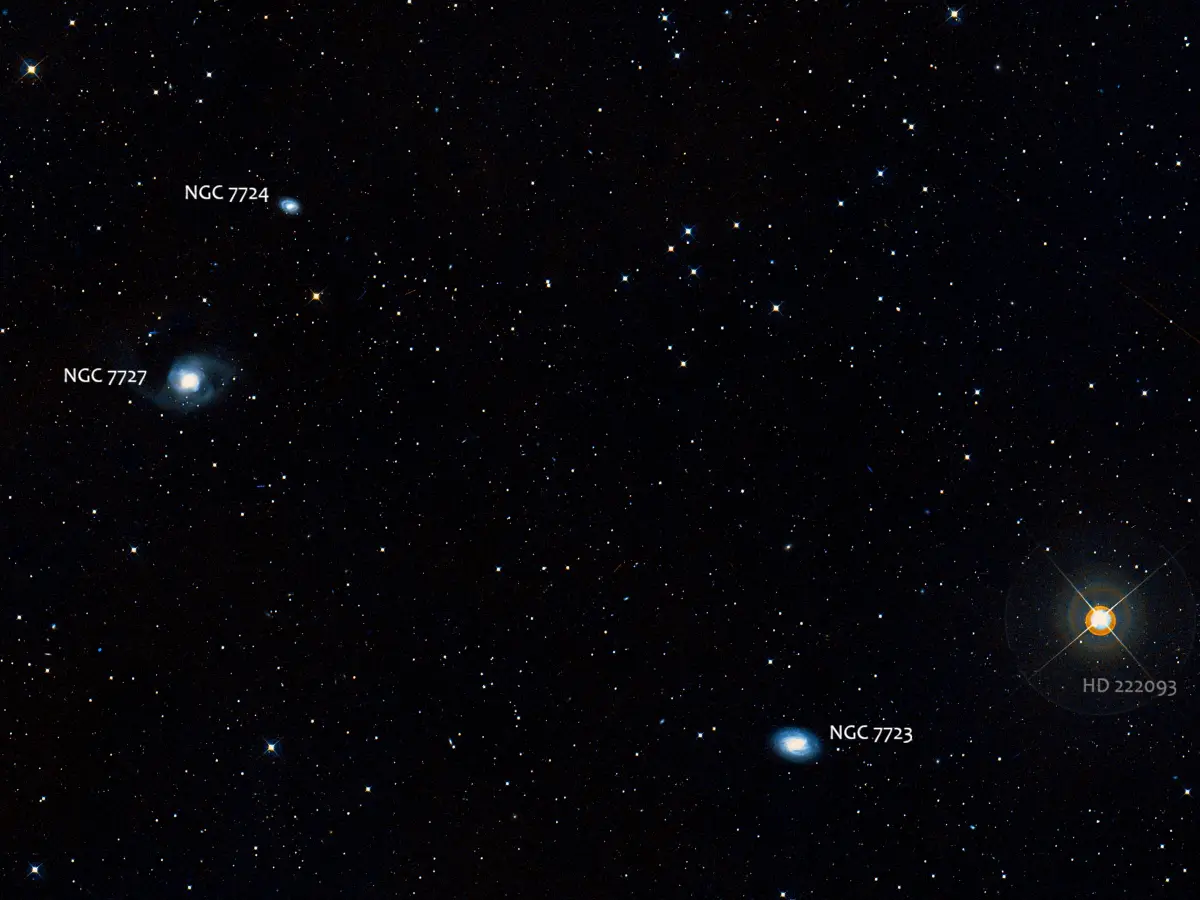
NGC 7727, NGC 7724 and NGC 7723, image credit: ESO/Digitized Sky Survey 2 (CC BY 4.0)
Where to find NGC 7727 in Aquarius
NGC 7727 lies in the faint southern part of Aquarius, about 2 degrees north and a little west of the magnitude 4.5 star Omega2 Aquarii. It can be found close to the imaginary line connecting the bright Diphda in the constellation Cetus and the three star systems that share the designation Psi Aquarii, about a quarter of the way from Psi Aquarii to Diphda.
Psi and Omega Aquarii are part of the stream of water flowing from the Water Jar in the direction of Fomalhaut, the bright star that marks the mouth of Piscis Austrinus (the Southern Fish). Psi Aquarii lies roughly on the line drawn from Diphda to Sadalmelik, the nearest bright star to the Water Jar. Diphda can be found close to the imaginary line drawn through the eastern side of the Great Square of Pegasus, from Alpheratz through Algenib, across the sky.
In 8-inch telescopes, NGC 7727 appears as a small elongated patch with a brighter core. Larger instruments will reveal its halo and irregular appearance on a clear night.
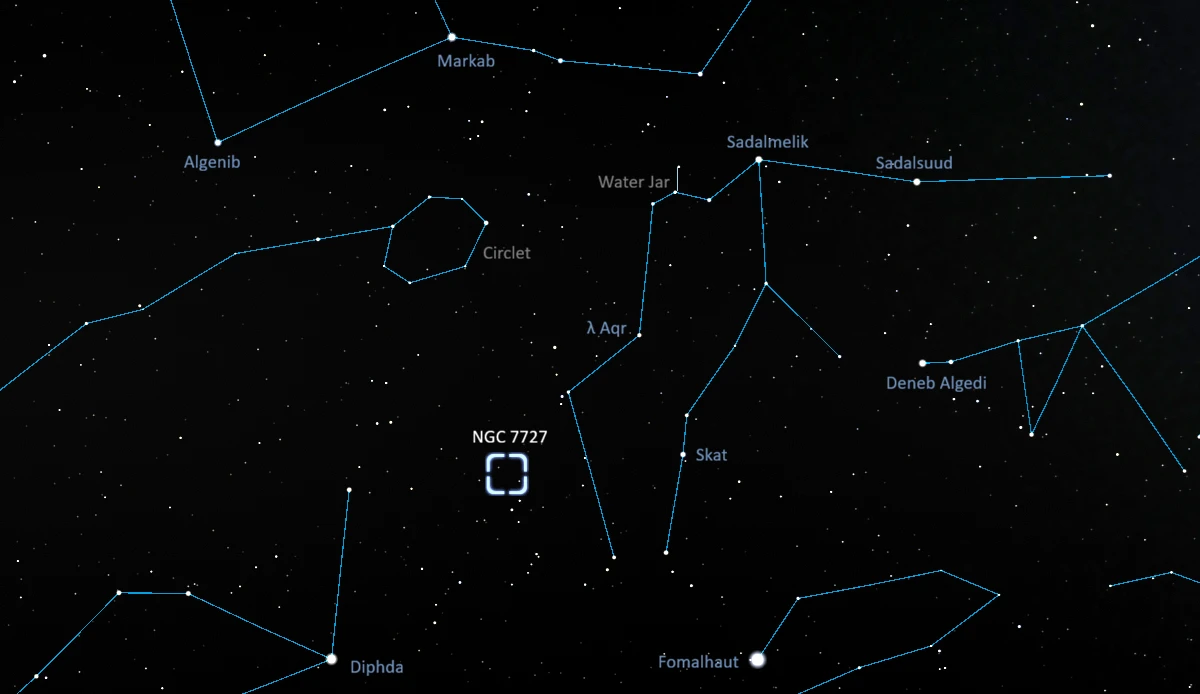
The location of NGC 7727 in the constellation Aquarius, image: Stellarium (annotated for this article)
The best time to observe NGC 7727 and other deep sky objects in Aquarius is in October, when the constellation appears higher above the horizon in the early evening. At declination -12°, the galaxy is visible from any inhabited location on Earth.
Explore other deep sky objects in Aquarius:
NGC 7727
| Constellation | Aquarius |
| Object type | Peculiar spiral galaxy |
| Morphological type | SAB(s)a pec |
| Right ascension | 23h 39.9m |
| Declination | -12° 17′ 34″ |
| Apparent magnitude | 11.5 |
| Apparent size | 3.48015′ × 2.95256′ |
| Distance | 89 million light-years (27 megaparsecs) |
| Redshift | 0.006131 ± 0.000073 |
| Heliocentric radial velocity | 1832 ± 22 km/s |
| Names and designations | NGC 7727, Arp 222, APG 222, LEDA 72060, PGC 72060, 2MASX J23395386-1217348, MCG-02-60-008 |