NGC 6397 (the Ara Globular Cluster) is a bright globular cluster located 7,800 light-years away in the southern constellation Ara. It is listed as Caldwell 86 (C86) in the Caldwell catalogue of objects visible in amateur telescopes. It is the second nearest globular cluster to the Sun, after Messier 4.
With an apparent magnitude of 6.68 and an apparent size of 32 arcminutes, the cluster can be seen with binoculars from southern locations. In exceptionally good conditions, it is visible to the unaided eye.
NGC 6397 has undergone a core collapse and contracted into an exceptionally dense ball of stars. It packs several hundred thousand members into an area with a radius of only 36 light years.
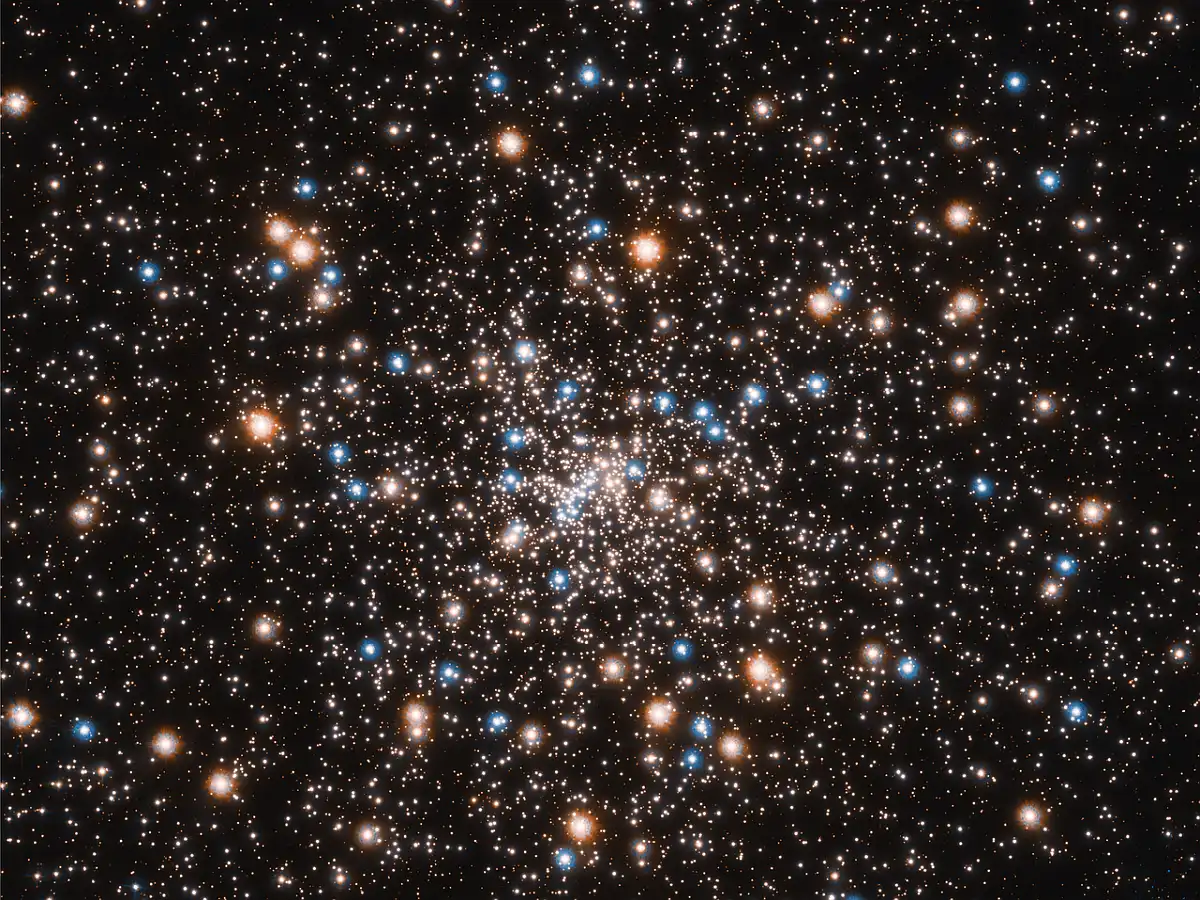
This ancient stellar jewelry box, a globular cluster called NGC 6397, glitters with the light from hundreds of thousands of stars. Astronomers used the Hubble Space Telescope to gauge the distance to this brilliant stellar grouping, obtaining the first precise measurement ever made to an ancient globular cluster. The measurement sets the cluster’s distance at 7,800 light-years away, with just a 3 percent margin of error. NGC 6397 is one of the closest globular clusters to Earth. By measuring an accurate distance to NGC 6397, astronomers then calculated a precise age for the cluster. The cluster is 13.4 billion years old, which means it was born shortly after the big bang. NGC 6397 is one of about 150 globular clusters that orbit outside of our Milky Way galaxy’s comparatively younger starry disk. These spherical, densely packed swarms of hundreds of thousands of stars are our galaxy’s first homesteaders. The cluster’s blue stars are near the end of their lives. These stars have used up their hydrogen fuel that makes them shine. Now they are converting helium to energy in their cores, which fuses at a higher temperature and appears blue. The reddish glow is from red giant stars that have consumed their hydrogen fuel and have expanded in size. The myriad small white objects include stars like our Sun. Image credit: NASA, ESA, and T. Brown and S. Casertano (STScI); Acknowledgement: NASA, ESA, and J. Anderson (STScI) (CC BY 4.0)
Stars of NGC 6397
NGC 6397 contains around 400,000 stars. The core region of the cluster hosts an abundant population of stellar remnants, mainly white dwarfs. These are dense, compact objects that contribute excess mass to the cluster’s centre. They are remnants of intermediate-mass stars like the Sun.
The cluster’s core is dominated by hundreds of white dwarfs, while black holes (remnants of more massive stars) have almost all been ejected as a result of repeated dynamical interactions in the cluster’s crowded central region.
The Ara Globular Cluster has a double main sequence population, reported by Milone in 2012. About 30% of main sequence stars in the cluster belong to a primordial population, while the second generation has enhanced sodium, nitrogen, and helium and depleted carbon and oxygen.
The bright globular clusters NGC 2808 in the constellation Carina and Messier 4 near Antares in Scorpius have similar main sequence splits. Messier 4, the only globular cluster closer to us than NGC 6397, lies 6,000 light-years away, while NGC 2808 lies 31,300 light-years away.
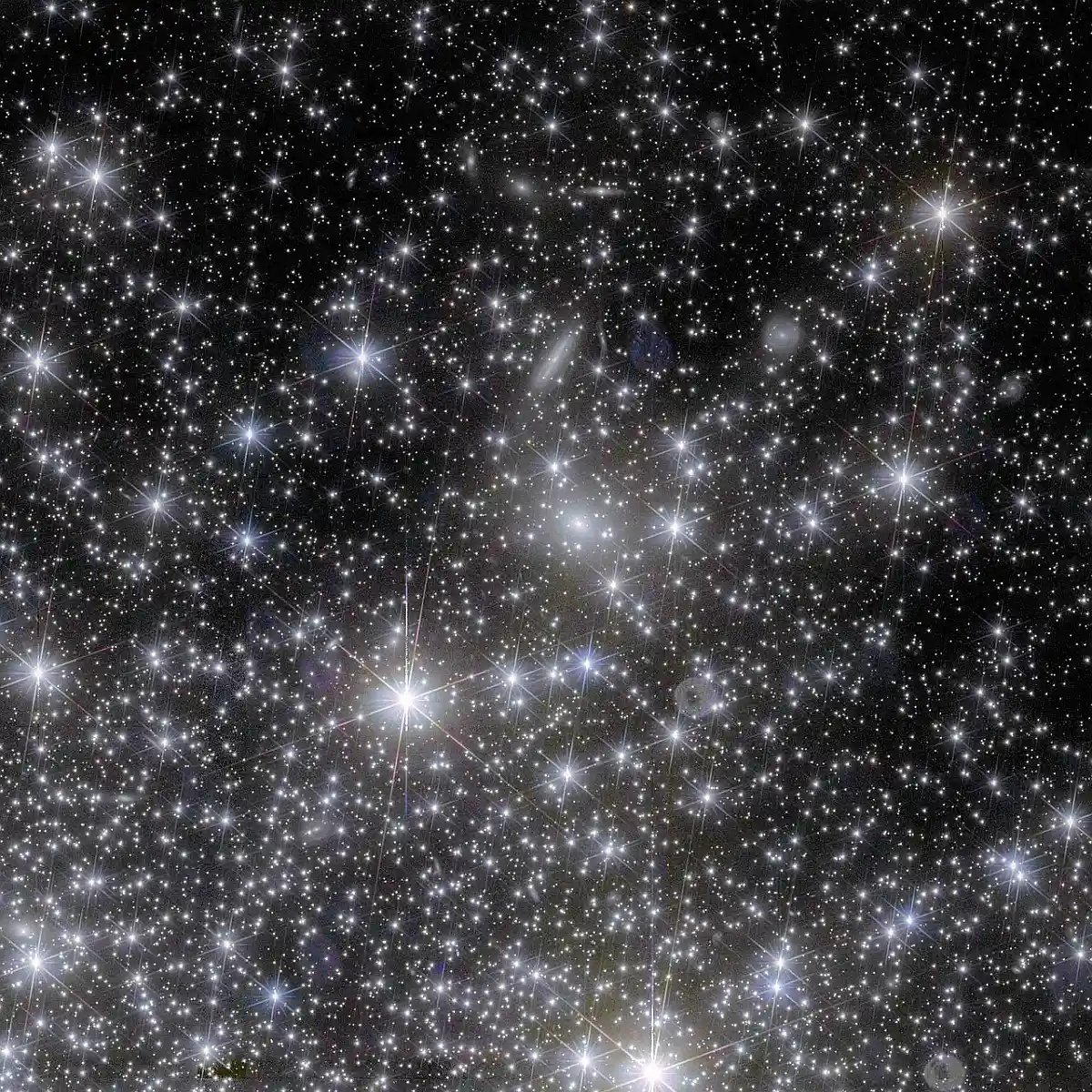
This cutout from Euclid’s full view of NGC 6397 is at the high resolution of the VIS instrument. This is nine times better than the definition of NISP that was selected for the full view; this was done for the practical reason of limiting the format of the full image to a manageable size for downloading. The cutout fully showcases the power of Euclid in obtaining exceptionally sharp images over a large region of the sky in one single pointing. Image credit: ESA/Euclid/Euclid Consortium/NASA image processing by J.-C. Cuillandre (CEA Paris-Saclay) G. Anselmi (CC BY-SA 3.0 IGO)
Blue stragglers
The Ara Globular Cluster hosts a large population of blue stragglers. These are unusually luminous blue stars that appear much hotter and younger than other stars in the cluster.
Since blue stragglers are commonly found in the densely packed cores of their host clusters, astronomers believe that they form in collisions between stars that come too close to each other. These newly formed objects have a higher mass and temperature, and they therefore appear bluer and much younger than other cluster members.
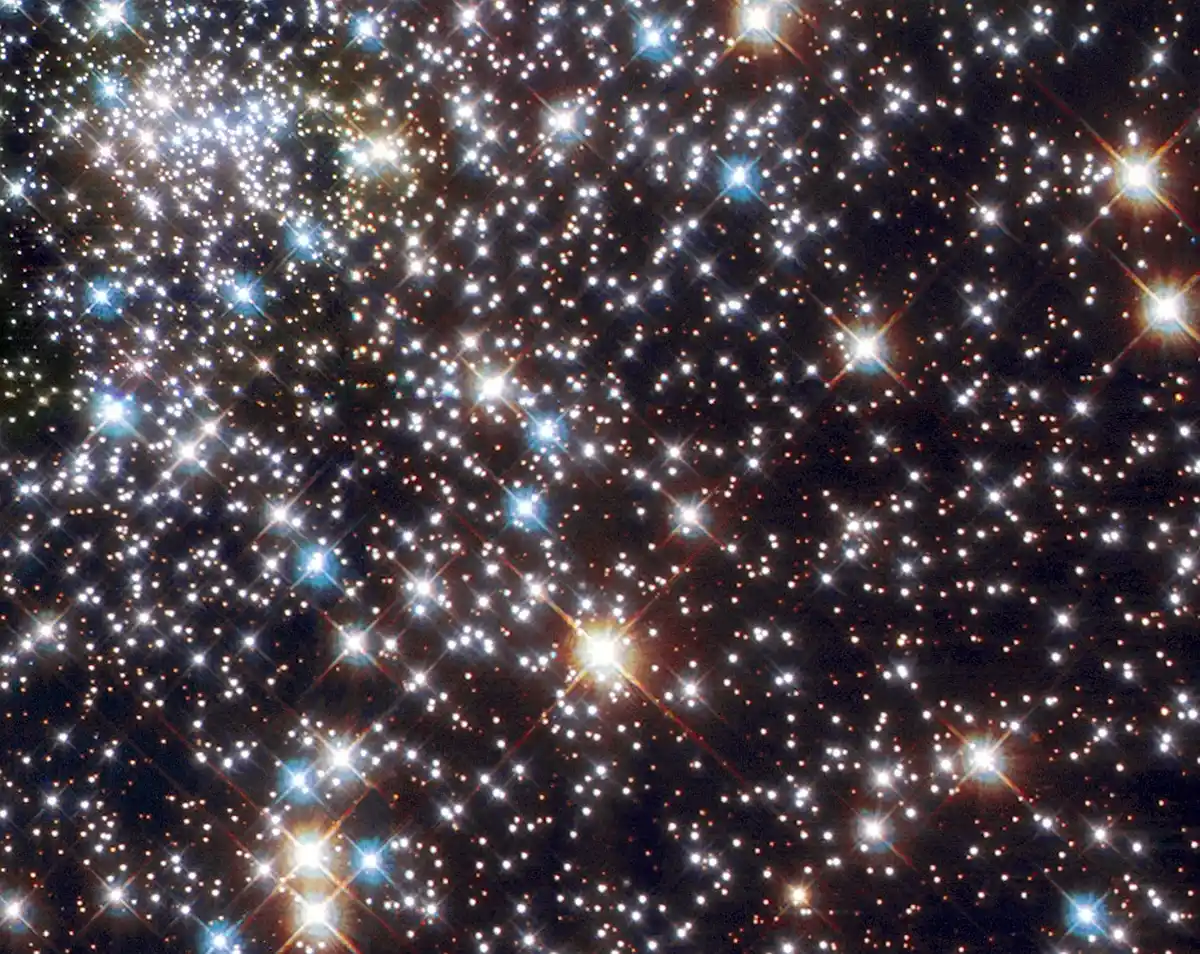
Image of NGC 6397 taken by the Hubble Space Telescope, with evidence of a number of blue stragglers. Image credit: Francesco Ferraro (Bologna Observatory), ESA, NASA (CC BY 4.0)
Indicator of the Milky Way’s age
Globular clusters are some of the oldest objects in the known universe. They provide astronomers with key insights into the formation, structure and evolution of galaxies.
The Ara Globular Cluster has been used as a stellar clock to determine the age of the Milky Way. In 2004, a team of astronomers led by Luca Pasquini of the European Southern Observatory (ESO) measured beryllium content of two member stars using the UV-Visual Echelle Spectrograph of the Very Large Telescope (VLT) in Chile. This was the first time beryllium content was measured in a globular cluster.
Beryllium is one of the lightest elements. The only lighter elements – hydrogen, helium, and lithium – were produced in the Big Bang. However, the most common stable isotope of beryllium can only be formed from the impact of cosmic rays, which originate in supernova events.
The UVES spectrometer made it possible for scientists to determine beryllium abundance in two cluster members. The measurement allowed them to determine the time between the formation of the first stars in the Milky Way and the formation of the first members NGC 6397. When this time is added to the age estimate of the cluster, it gives the Milky Way an estimated age of 13.6 billion years, close to the age of the universe itself (13.8 billion years).
The team found an age of 13.4 ± 0.8 billion years for NGC 6397.
In 2018, Correnti et al. gave an age estimate of 12.6 ± 0.7 billion years for the cluster using high-precision infrared (IR) colour–magnitude diagrams based on observations with the infrared channel of Hubble’s Wide Field Camera 3.
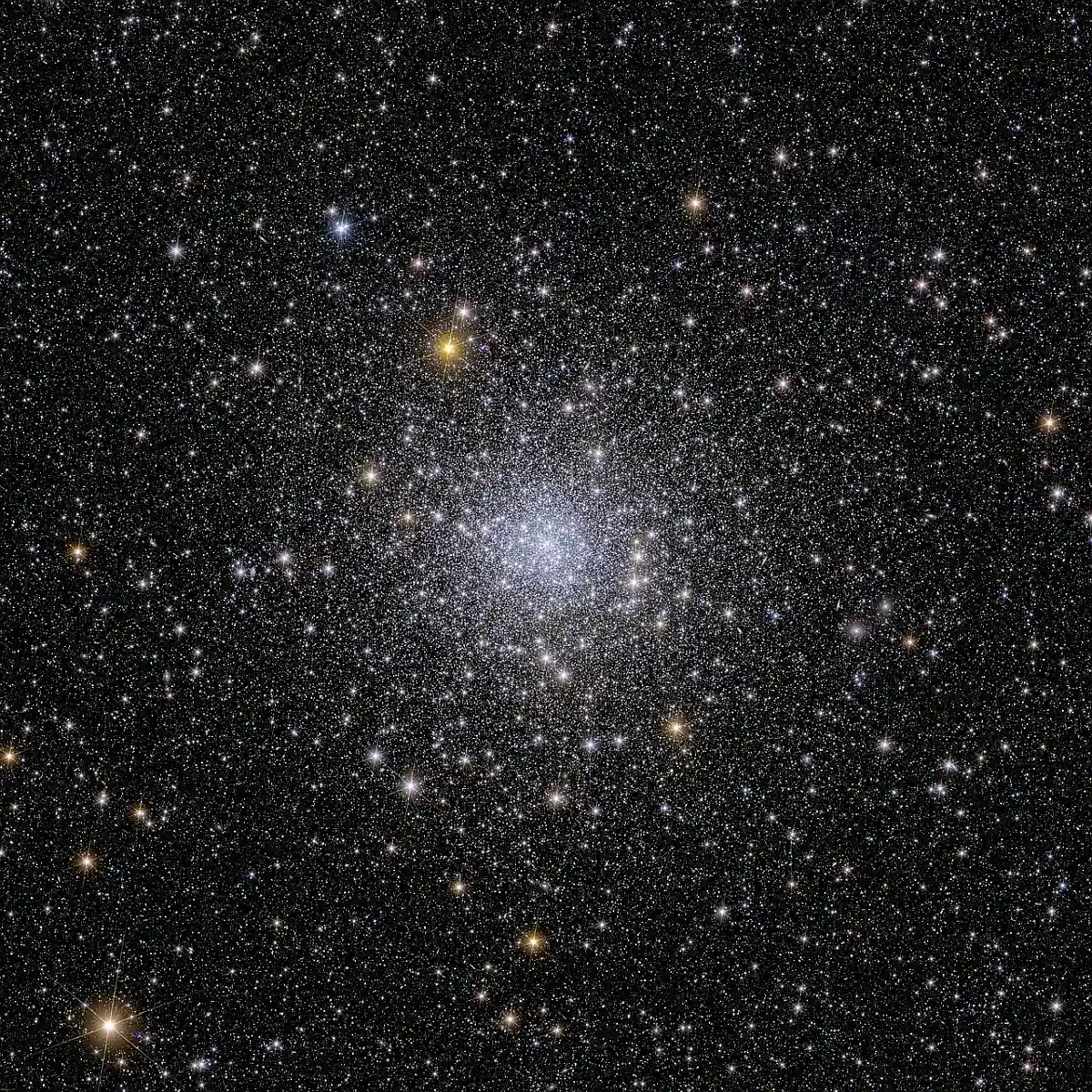
This sparkly image shows Euclid’s view on a globular cluster called NGC 6397. Globular clusters are collections of hundreds of thousands of stars held together by gravity. Located about 7800 light-years from Earth, NGC 6397 is the second-closest globular cluster to us. Together with other globular clusters it orbits in the disc of the Milky Way, where the majority of stars are located. Globular clusters are some of the oldest objects in the Universe. That’s why they contain a lot of clues about the history and evolution of their host galaxies, like this one for the Milky Way. The challenge is that it is typically difficult to observe an entire globular cluster in just one sitting. Their centres contain lots of stars, so many that the brightest ‘drown out’ the fainter ones. Their outer regions extend a long way out and contain mostly low-mass, faint stars. It is the faint stars that can tell us about previous interactions with the Milky Way. Image credit: ESA/Euclid/Euclid Consortium/NASA image processing by J.-C. Cuillandre (CEA Paris-Saclay) G. Anselmi (CC BY-SA 3.0 IGO)
Connection to the Northern Jewel Box (NGC 6231)?
The Ara Globular Cluster may have played a part in the formation of the luminous young cluster NGC 6231, popularly known as the Northern Jewel Box. Located near Zeta Scorpii, in the same area as the Prawn Nebula, the bright star cluster appears in the spot where the massive Ara cluster plunged through the Milky Way’s disk around 4.5 million years ago.
In 1996, astrophysicist John Wallin of the George Mason University in Virginia proposed that when globular clusters passed through the galactic disk in a region where there were molecular clouds, the gravity of these massive clusters would trigger the clouds’ collapse, leading to a burst of star formation. Such transits of globular clusters happen once every million years or so and could set off intense star forming activity.
In 2004, astronomers Richard Rees of Westfield State College and Kyle Cudworth of Yerkes Observatory provided an example to support this theory when they traced back the motion of NGC 6397 to the spot where the cluster had moved through the Milky Way’s disk. The impact point corresponds to the location of NGC 6231.
The Northern Jewel Box Cluster has an estimated age of 2 – 7 million years, which makes this scenario possible. The young cluster is part of the False Comet asterism in Scorpius. Shining at magnitude 2.6, it is visible to the unaided eye on a clear night. It lies approximately 5,600 light-years away. The hypergiant Zeta1 Scorpii may be a member.
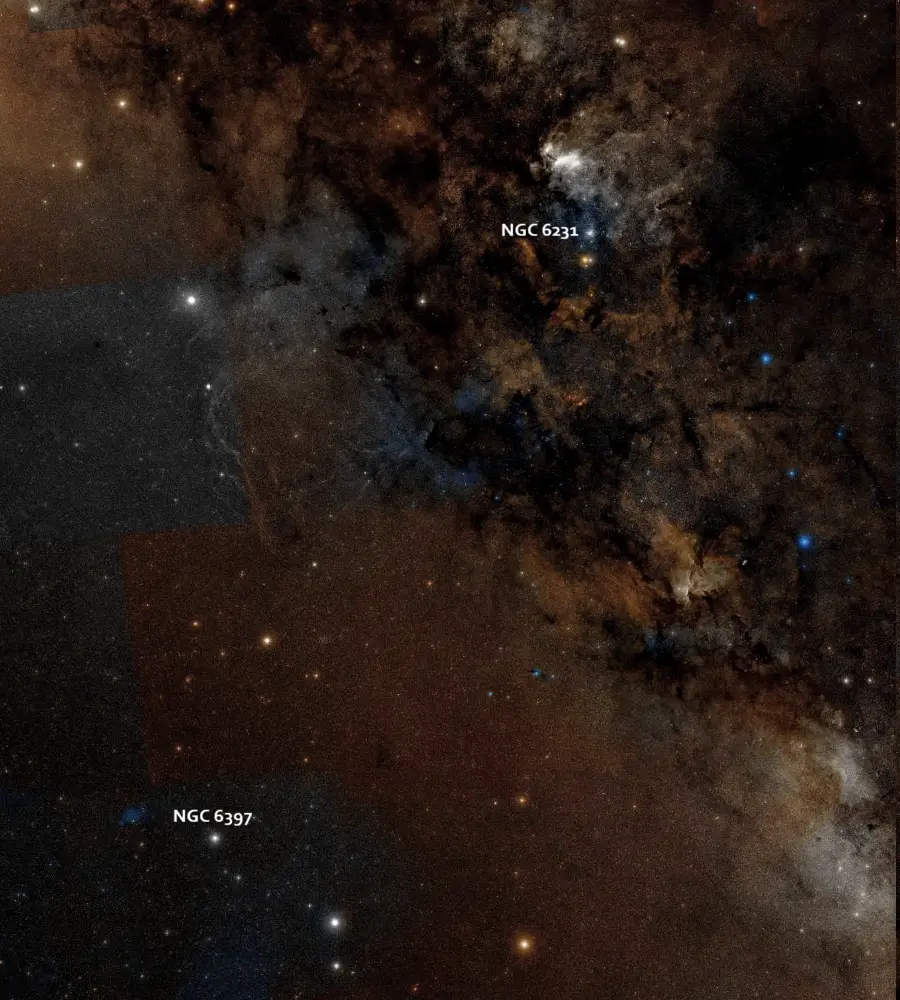
The Ara Globular Cluster (NGC 6397) and the Northern Jewel Box (NGC 6231), image credit: ESO/Digitized Sky Survey 2 (CC BY 4.0)
Discovery of the Ara Globular Cluster
NGC 6397 was discovered by the French astronomer Nicolas Louis de Lacaille with a ½-inch telescope from the Cape of Good Hope in South Africa in 1751. The cluster is listed as Lacaille III.11 in his catalogue. The astronomer described it as a “small star involved in a nebulosity.”
In June 1825, the Scottish astronomer James Dunlop spotted the cluster from Australia in a 9-inch reflector and added it as object number 366 in his catalogue, describing it as a nebula “resolvable into stars.”
English astronomer John Herschel observed the cluster from South Africa in July 1834 and catalogued it as h 3692, noting “Globular cluster; fine; large; bright; round; gradually brighter to the middle; not very compressed.”
How to find NGC 6397
The Ara Globular Cluster lies in the relatively bright constellation Ara, south of the Fish Hook of Scorpius. It can be found using Shaula and Sargas, the brightest stars in the Scorpion’s tail. A line drawn from Shaula in the Scorpion’s stinger through Sargas in the curve of the Scorpion’s tail points in the direction of the cluster.
NGC 6397 appears just northeast of the orange supergiant Beta Arae (mag. 2.84), the brightest star in Ara. Beta and the slightly fainter Alpha Arae appear along the line extended from Kappa Scorpii through Sargas.
At declination -54°, NGC 6397 is best seen from the southern hemisphere. It never rises above the horizon for observers north of the latitude 36° N.
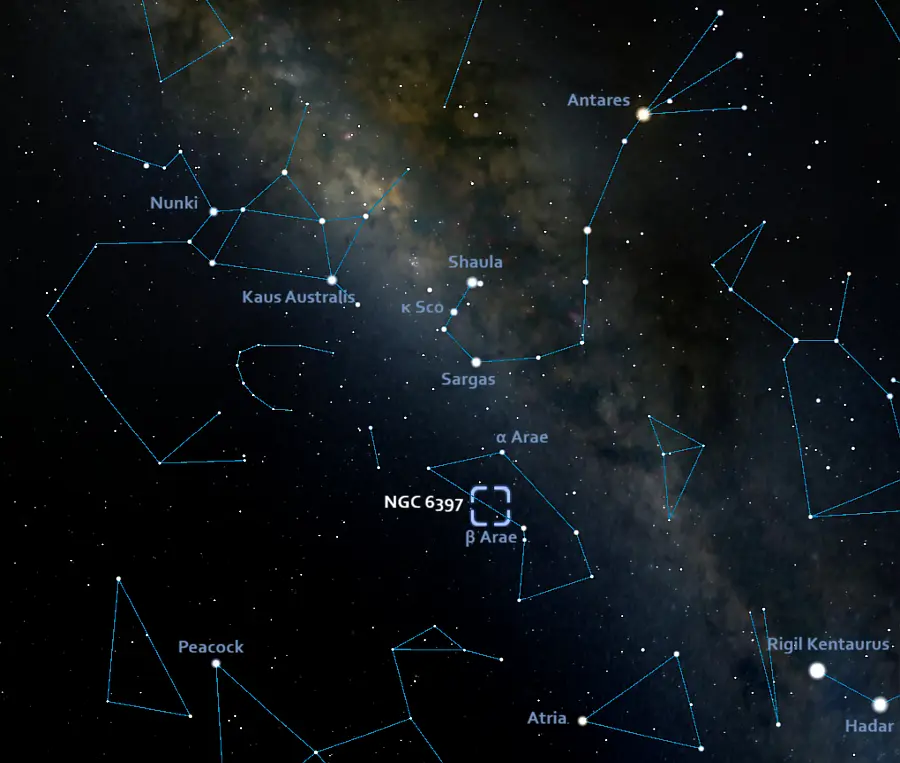
Location of NGC 6397 (the Ara Globular Cluster), image: Stellarium (annotated for this article)
Explore other bright globular clusters:
- Omega Centauri (NGC 5139) in Centaurus
- 47 Tucanae (NGC 104) in Tucana
- Great Peacock Globular (NGC 6752) in Pavo
- Tombaugh’s Globular Cluster (NGC 5694) in Hydra
- Chandelier Cluster (NGC 6723) in Sagittarius
- Intergalactic Wanderer (NGC 2419) in Lynx
- NGC 6101 in Apus
Ara Globular Cluster – NGC 6397
| Constellation | Ara |
| Object type | Globular cluster |
| Shapley-Sawyer concentration class | IX |
| Right ascension | 17h 40m 42.09s |
| Declination | -53° 40′ 27.6″ |
| Apparent magnitude | 6.68 |
| Apparent size | 32.0′ |
| Distance | 7,800 light-years (2,400 parsecs) |
| Radius | 36 light years |
| Mass | 1.14×10⁵ M☉ |
| Age | 12.6 ± 0.7 billion years |
| Names and designations | Ara Globular Cluster, NGC 6397, Caldwell 86, C86, GCl 74, Lacaille III.11, Bennett 98, Dunlop 366, C 1736-536, [KPS2012] MWSC 2662 |
Images
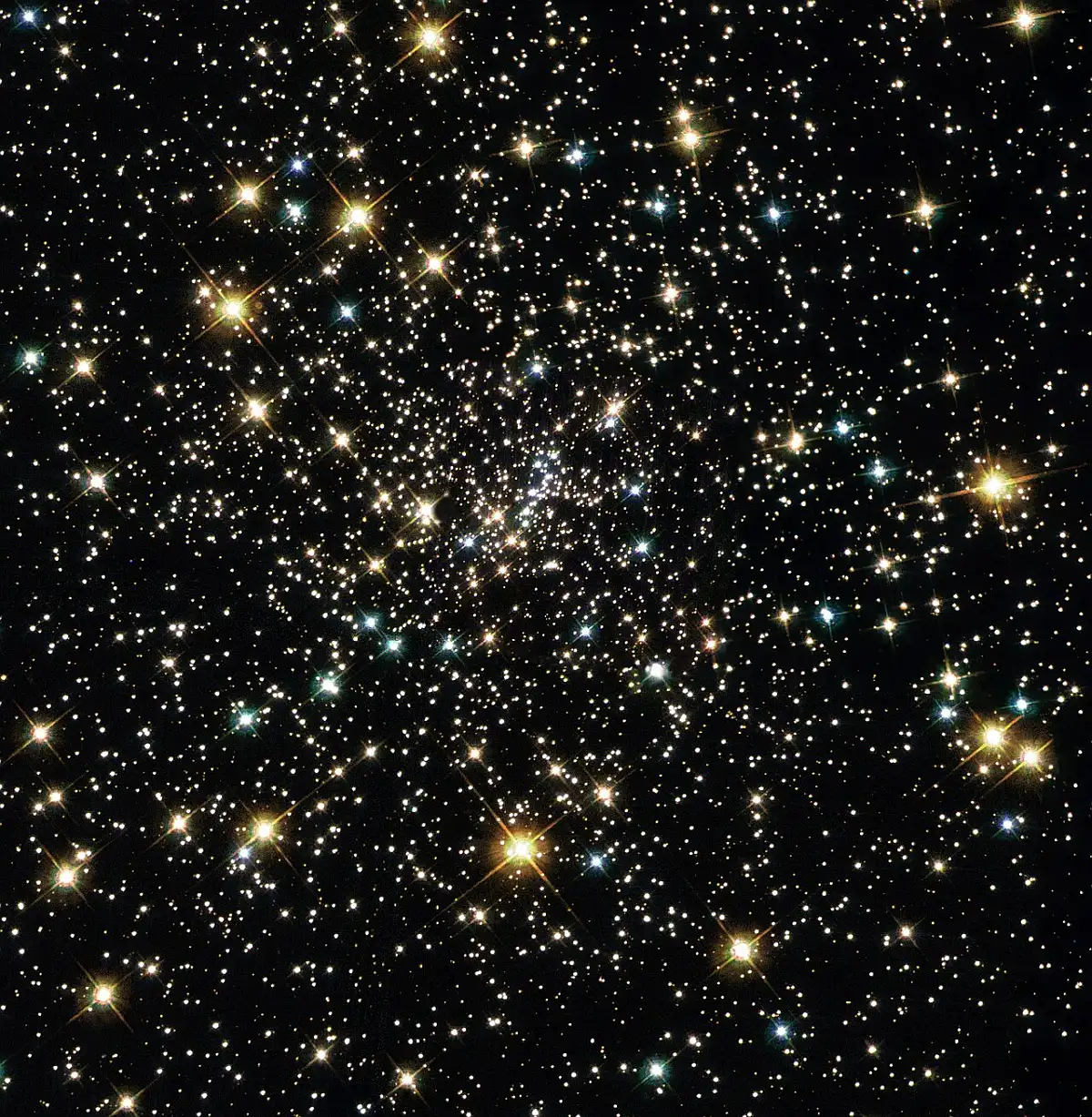
This Hubble Space Telescope view of the core of one of the nearest globular star clusters, called NGC 6397, resembles a treasure chest of glittering jewels. Here, the stars are jam-packed together. The stellar density is about a million times greater than in our Sun’s stellar neighborhood. The stars are only a few light-weeks apart, while the nearest star to our Sun is over four light-years away. Image credit: NASA/ESA and the Hubble Heritage Team (AURA/STScI) (PD)
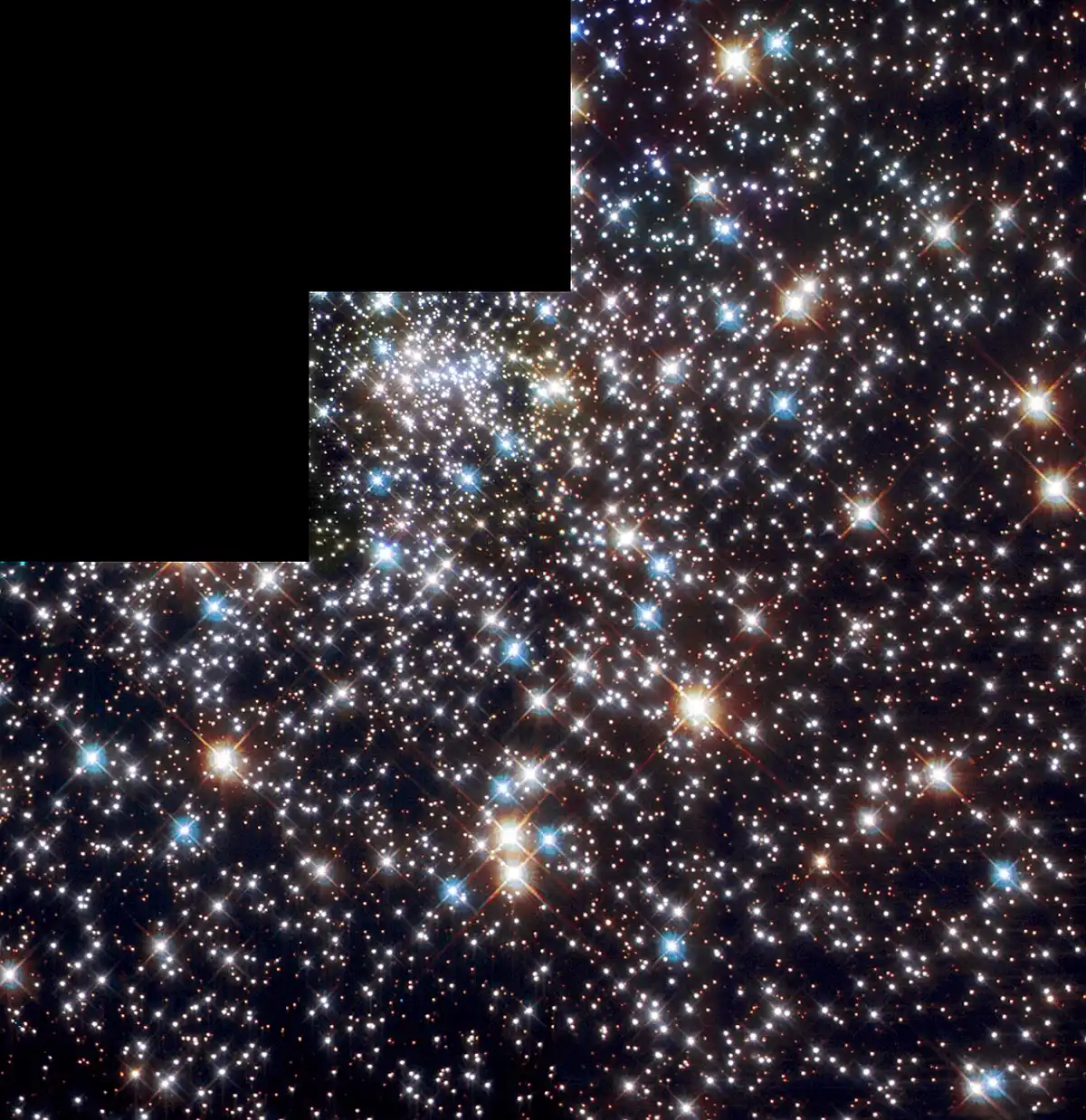
This ESA/NASA/ESA Hubble Space Telescope Wide Field Planetary Camera 2 image shows the globular cluster NGC 6397 in the constellation Ara (the Altar). It is composed of six exposures through different filters: violet/indigo (Strömgren u, 345 nm, 15080 seconds), blue (B, 418 nm, 8580 seconds), dark green (V, 515 nm, 978 seconds), light green (H-alpha, 656 nm, 24180 seconds), red-orange (R, 678 nm, 1538 seconds), and red (I, 839 nm, 978 seconds). The cluster is home to a highly unusual system consisting of a fast spinning pulsar and a bloated red companion star. Image credit: European Space Agency & Francesco Ferraro (Bologna Astronomical Observatory) (CC BY 4.0)
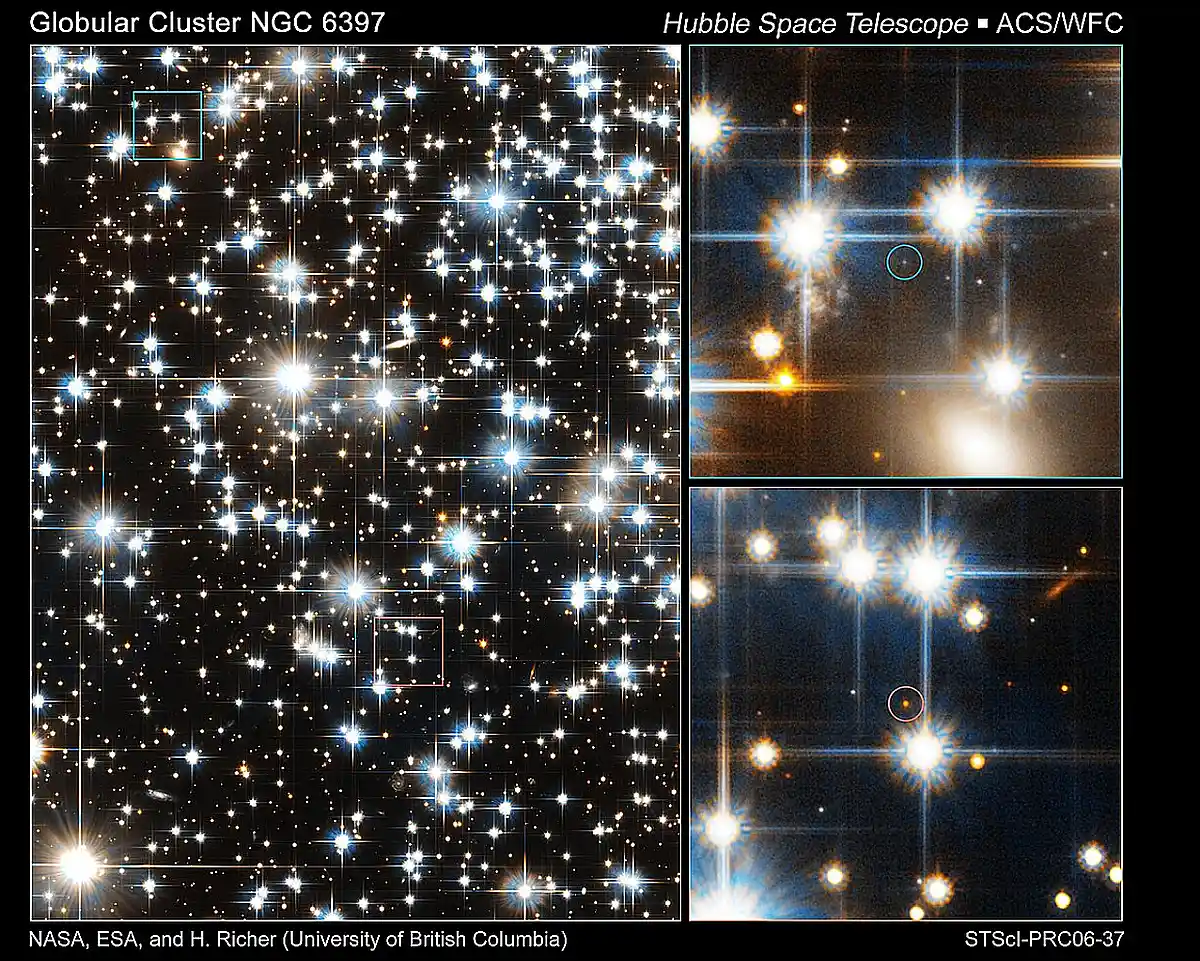
Looking like glittering jewels, the stars in this Hubble Space Telescope image at left are part of the ancient globular star cluster NGC 6397. Scattered among these brilliant stars are very faint stars. Hubble’s Advanced Camera for Surveys has taken a census of the cluster stars, uncovering the faintest stars ever seen in a globular cluster. Globular clusters are spherical concentrations of hundreds of thousands of old stars. The Advanced Camera found the faintest red dwarf stars (26th magnitude), which are cooler and much lower in mass than our Sun, and the dimmest white dwarfs (28th magnitude), the burned-out relics of normal stars. The light from the dimmest white dwarfs is equal to the light produced by a birthday candle on the Moon as seen from Earth. The image at lower right shows the faintest red dwarf star (the red dot within the red circle) spied by Hubble. The image at upper right pinpoints one of the dim white dwarfs (the blue dot within the blue circle) seen by Hubble. The white dwarf has been cooling for billions of years. It is so cool that instead of looking red, it has undergone a chemical change in its atmosphere that makes it appear blue. The images were taken with visual and red filters. Image credit: NASA, ESA, and H. Richer (University of British Columbia) (PD)