IC 4593, also known as the White-Eyed Pea Nebula, is a planetary nebula located 7,900 light years away in the northern constellation Hercules. With an apparent magnitude of 10.7 and an apparent size of 0.21 arcminutes, it can only be seen in larger telescopes.
The White-Eyed Pea Nebula was discovered by the Scottish astronomer Williamina Fleming on photographic plates obtained with the 8-inch refractor at the Harvard College Observatory in 1907. It has a diameter of around 0.96 light-years. This is a typical size for a planetary nebula, the final gasp of a Sun-like star that came to the end of its life.
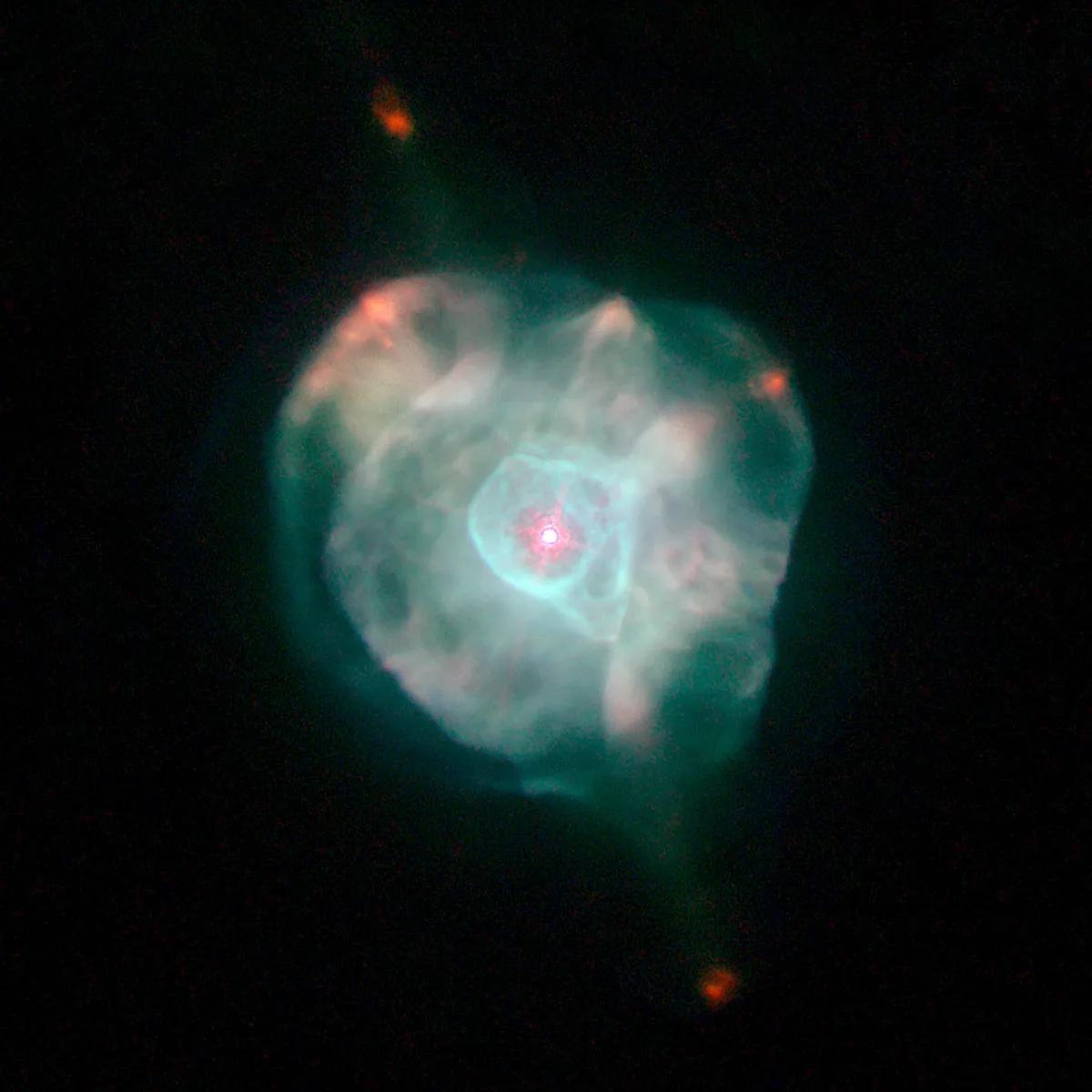
IC 4593, image credit: NASA, ESA, and The Hubble Heritage Team (STScI/AURA) (CC BY 4.0)
Structure of the White-Eyed Pea
IC 4593 has a complex structure with multiple shells of expelled material. The elliptical inner rim has an average radius of 2 arcseconds, while the circular filamentary outer shell is around 16 arcseconds across.
The inner shell is shaped by the fast stellar wind from the central star, while the outer shell is shaped by collimated outflows in different directions. The outflows culminate in lowly ionized bright knots about 12 arcseconds from the planetary nebula nucleus (PNN).
An asymmetrical outer shell extends 20 arcseconds from the central star, and there is an additional fragmented larger halo about 120 by 120 arcseconds in size around the main nebula. The halo is asymmetrical, indicating interaction with the surrounding interstellar medium.
Astronomers have detected two prominent jet-like features emanating from the inner shell to the northwest and southeast. Other jet-like features extend in different directions and are stagnated at the edge of inner ring.
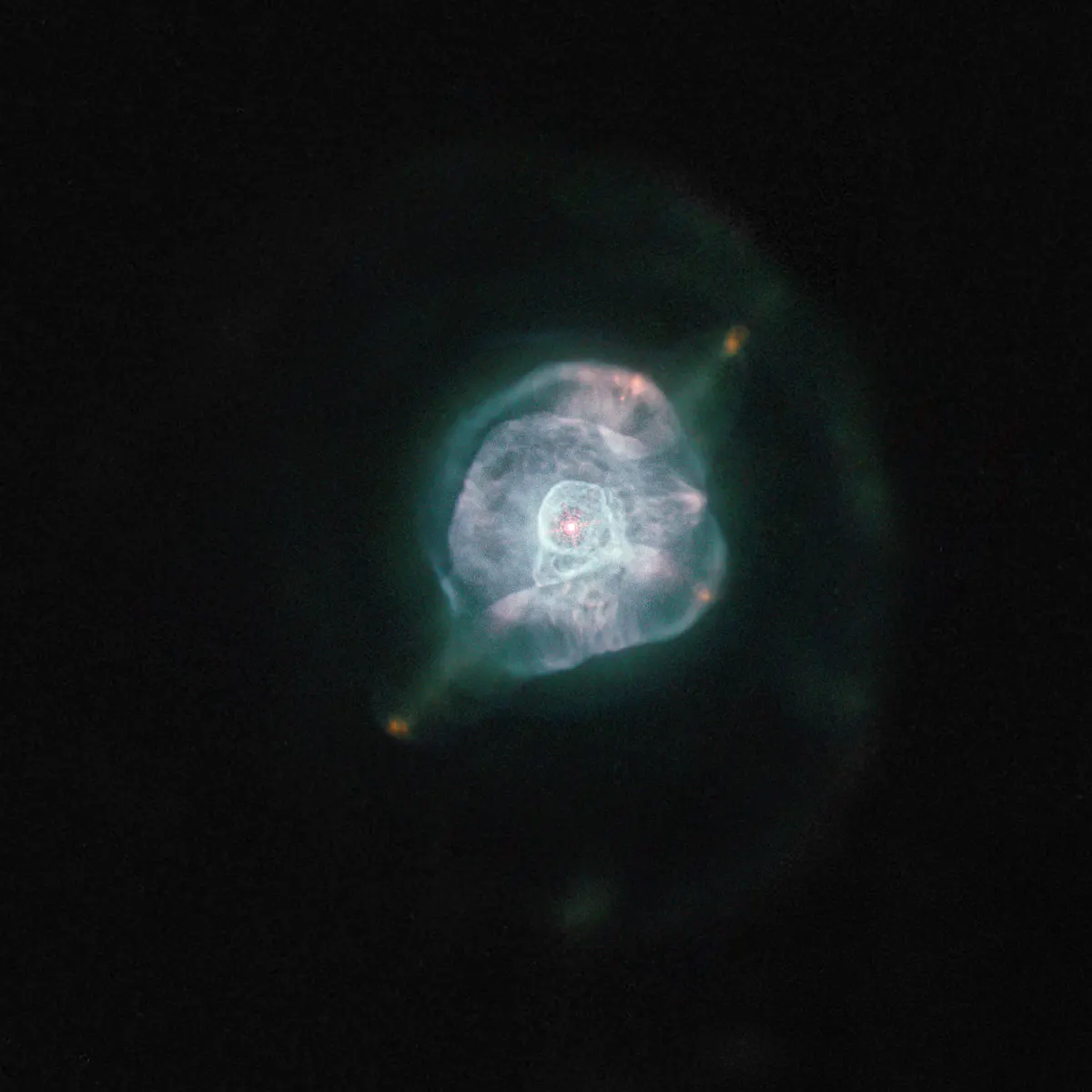
IC 4593, image credit: Judy Schmidt (CC BY 2.0)
Central star of IC 4593
The White-Eyed Pea Nebula formed when an aging star reached the end of its life and expelled its outer gaseous envelope into space. The stellar remnant, a hot white dwarf, is catalogued as HD 145649 and has the spectral type O7f. It has an estimated temperature of 30,000 to 40,000 K.
In 2004, De Marco et al. proposed that the central star may have a binary companion based on radial velocity measurements of absorption lines of He II. The presence of an orange or red dwarf companion would make the planetary nebula nucleus a candidate for binary interactions, as well as for the emission of X-rays from the companion’s coronal activity.
Hot bubble at the nebula’s core
In 2020, observations with Chandra revealed a hot bubble in the innermost cavity of IC 4593. Hot bubbles in the inner rims of planetary nebulae form as a result of interactions between the fast stellar winds from hot central stars and material ejected from these stars earlier in their evolutionary cycles, during the asymptotic giant branch (AGB) phase.
These interactions create shocked regions (hot bubbles) with temperatures that depend on the terminal wind velocities of the central stars. The shocked plasma has temperatures of over a million kelvin and can be detected in X-rays. Similar hot bubbles were previously detected in the Cat’s Eye Nebula (NGC 6543) in Draco, and the Jewel Bug Nebula (NGC 7027) and Campbell’s Star in Cygnus.
The Chandra observations yielded a temperature of 1.7 × 10⁶ K for the hot bubble in IC 4593.
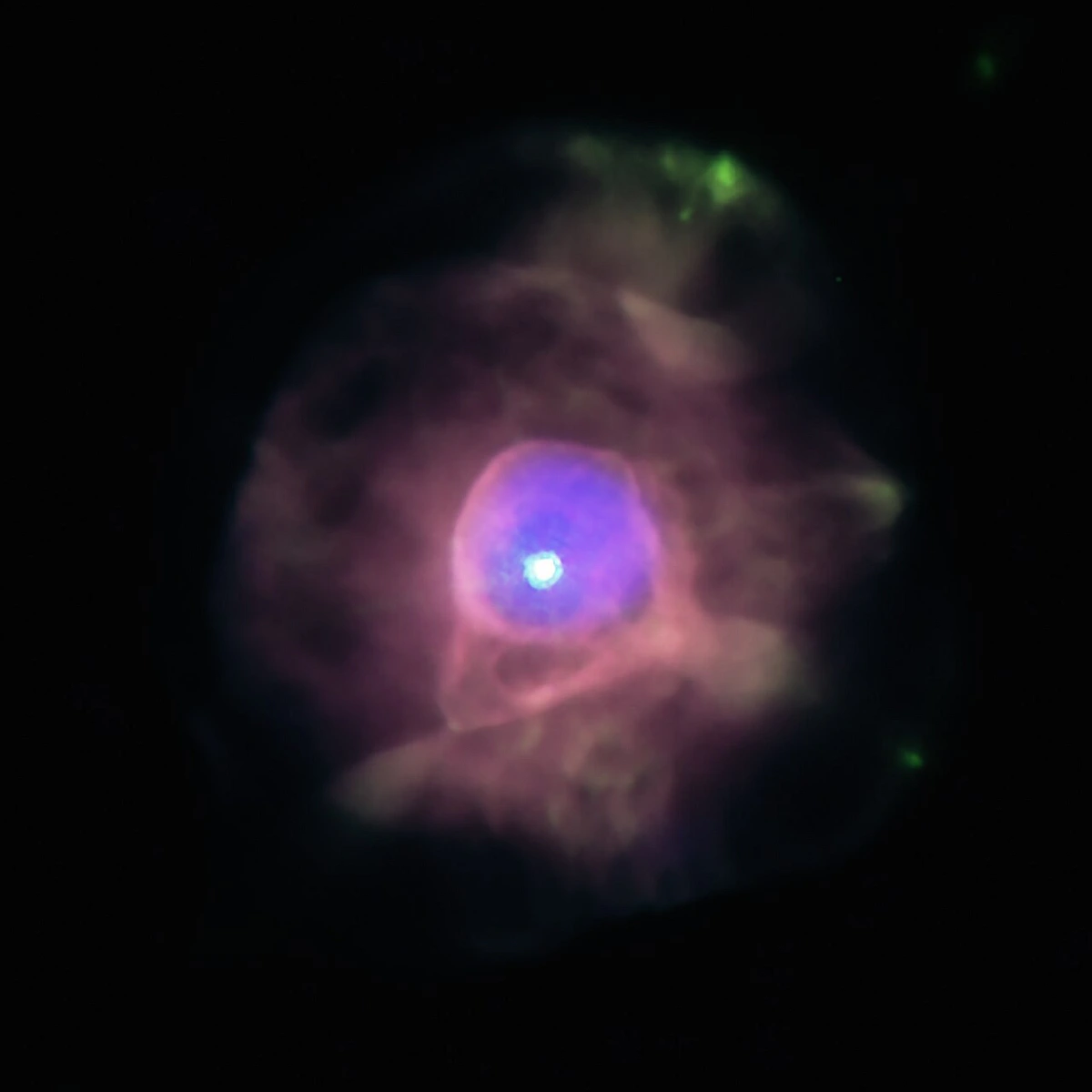
On Earth, amethysts can form when gas bubbles in lava cool under the right conditions. In space, a star with a mass similar to the Sun is capable of producing a structure on par with the appeal of these beautiful gems. As stars like the Sun run through their fuel, they cast off their outer layers and the core of the star shrinks. Using NASA’s Chandra X-ray Observatory, astronomers have found a bubble of ultra-hot gas at the center of one of these expiring stars, a planetary nebula in our galaxy called IC 4593. At a distance of about 7,800 light years from Earth, IC 4593 is the most distant planetary nebula yet detected with Chandra. This new image of IC 4593 has X-rays from Chandra in purple, invoking similarities to amethysts found in geodes around the globe. The bubble detected by Chandra is from gas that has been heated to over a million degrees. These high temperatures were likely generated by material that blew away from the shrunken core of the star and crashed into gas that had previously been ejected by the star. This composite image also contains visible light data from the Hubble Space Telescope (pink and green). The pink regions in the Hubble image are the overlap of emission from cooler gas composed of a combination of nitrogen, oxygen, and hydrogen, while the green emission is mainly from nitrogen. In addition to the hot gas, this study also finds evidence for point-like X-ray source at the center of IC 4593. This X-ray emission has higher energies than the bubble of hot gas. The point source could be from the star that discarded its outer layers to form the planetary nebula or it could be from a possible companion star in this system. Image credit – X-ray: NASA/CXC/UNAM/J. Toalá et al.; Optical: NASA/STScI (PD)
Where is IC 4593 in the sky?
The White-Eyed Pea Nebula lies in the southernmost part of Hercules, between the large polygon asterism formed by the brightest stars of Ophiuchus and the head of the Serpent. It is best observed in 15-inch and larger telescopes at high magnification.
At declination +12°, IC 4593 is visible from virtually anywhere for at least part of the year. The best time to observe the nebula and other deep sky objects in Hercules is in the month of July, when the constellation appears higher above the horizon in the early evening.
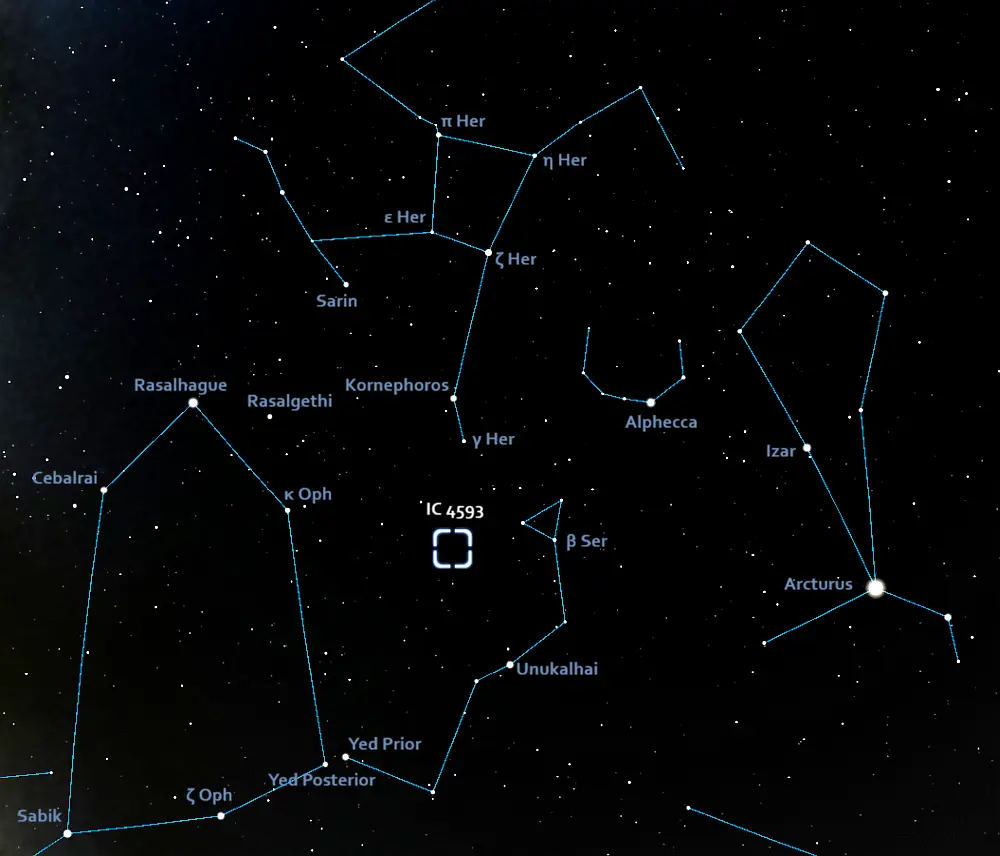
IC 4593 location, image: Stellarium (annotated for this article)
Explore other deep sky objects in Hercules:
White-Eyed Pea Nebula – IC 4593
| Constellation | Hercules |
| Object type | Planetary nebula |
| Right ascension | 16h 11m 44.5s |
| Declination | +12° 04′ 17″ |
| Apparent magnitude | 10.7 |
| Apparent size | 0.20966166′ × 0.20858167′ |
| Distance | 7,900 light years (2,422 parsecs) |
| Size | 0.96 light-years |
| Names and designations | White-Eyed Pea Nebula, IC 4593, PK 025+40 1, PN G025.3+40.8, PN ARO 27, PN VV’ 133, PN VV 79, HD 145649, GCRV 9312, TD1 18957, AG+12 1684, BWE 1609+1211, GEN# +1.00145649, TIC 119955971, AKARI-IRC-V1 J1611445+120416, GSC2 N1023001110, PLX 3676.00, TYC 953-381-1, BD+12 2966, GSC 00953-00381, uvby98 100145649, WEB 13414, CSV 101560, IRAS 16093+1211, SV ZI 1218, WISE J161144.55+120417.1, WISEA J161144.52+120417.1, NSV 7526, PPM 132071,FIRST J161144.5+120417, MITG J161144+1203, GB6 B1609+1211, 87GB 160924.7+121154, NVSS J161144+120417, Gaia DR2 4457218245479455744, Gaia DR3 4457218245479455744 |