Caroline’s Cluster is a bright open star cluster located south of the celestial equator in the constellation Canis Major (the Great Dog). With an apparent magnitude of 7.2 and an apparent size of 12.1 arcminutes, it is easily observed in small telescopes. It is listed as NGC 2360 in the New General Catalogue and Caldwell 58 in the Caldwell catalogue of objects visible in amateur telescopes.
NGC 2360 lies approximately 3,200 light years away and has an estimated age of around 900 million years.
Caroline’s Cluster is one of several open star clusters in Canis Major that are visible in small telescopes. The bright Messier 41, located near Sirius, is visible to the unaided eye on a clear night and is the only Messier object in the constellation. The Tau Canis Majoris Cluster (NGC 2362) near Wezen is the only other Caldwell object in Canis Major. Both Caroline’s Cluster and the Tau Canis Majoris Cluster are listed in the Herschel 400 catalogue of objects observable with amateur telescopes, along with NGC 2204 near Mirzam and NGC 2354 near Wezen.
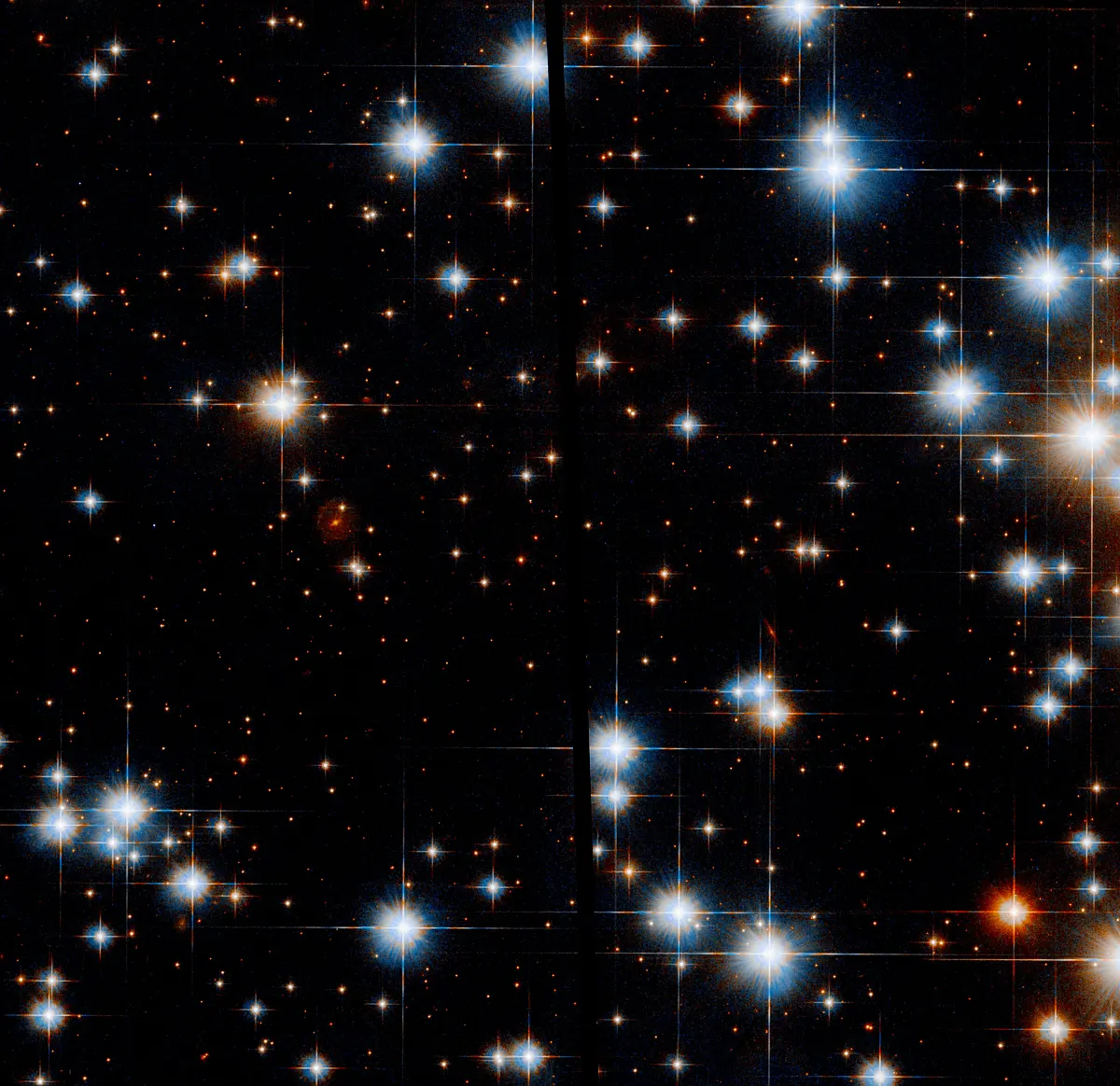
Caldwell 58, also known as NGC 2360 or Caroline’s Cluster, was discovered by and named after the German astronomer Caroline Herschel in 1783. The younger sister of famed astronomer William Herschel, Caroline was the first woman to win the prestigious Gold Medal of the Royal Astronomical Society. She earned this award for her work verifying her brother’s astronomical observations and compiling a catalog of nebulae to aid other astronomers. Astronomers used Hubble to study white dwarfs in Caldwell 58 and better understand the age of our galaxy. After a Sun-like star has exhausted its supply of nuclear fuel and ejected its outer layers of gas, what is left behind is the hot core of the star — a white dwarf. These objects cool over a period of billions of years and are some of the oldest stars in our galaxy. Some white dwarfs pulse regularly as they cool. The time between these pulsations changes over the white dwarf’s lifetime, so the time between pulses can be used to estimate how quickly the white dwarf is cooling, and thus how long it has been cooling. This information is useful to astronomers because it means pulsating white dwarfs can be used as chronometers, or “clocks,” that constrain the age of our galaxy. These observations of Caldwell 58 were made with Hubble’s Advanced Camera for Surveys to help astronomers calibrate white-dwarf chronometers. Image credit: NASA, ESA, and T. von Hippel (Embry-Riddle Aeronautical University); Processing: Gladys Kober (NASA/Catholic University of America) (CC BY 2.0)
Discovery and historical background
NGC 2360 was discovered by the German astronomer Caroline Herschel using a small refractor on February 26, 1783. The cluster was her first original discovery. Herschel listed the cluster as No. 2 in her catalogue and described it as a “beautiful cluster of pretty compressed stars near ½° diameter.”
On the same night, Herschel independently spotted Messier 110, the fainter of the two companions of the Andromeda Galaxy included in the Messier catalogue. M110 had been discovered by Charles Messier a decade earlier but was only formally added to the Messier catalogue at the suggestion of Kenneth Glyn Jones in 1967.
Caroline’s brother William Herschel recorded his first observation of NGC 2360 on February 4, 1785, and catalogued the cluster as WH VII 12. He credited his sister for the discovery in his 1786 catalogue.
English astronomer Admiral William Henry Smyth described NGC 2360 as a “tolerably compressed but extensive cluster, on the boundary between the Unicorn, and the Greater Dog.”
Danish astronomer John Louis Emil Dreyer subsequently included the cluster in his New General Catalogue of 1888, assigning it the designation NGC 2360.
NGC 2360 should not be mistaken for Caroline’s Rose Cluster (NGC 7789), a brighter and more distant open cluster in the northern constellation of Cassiopeia. NGC 7789 is also popularly known as the White Rose Cluster. It appears near Caph, the rightmost star of Cassiopeia’s W.
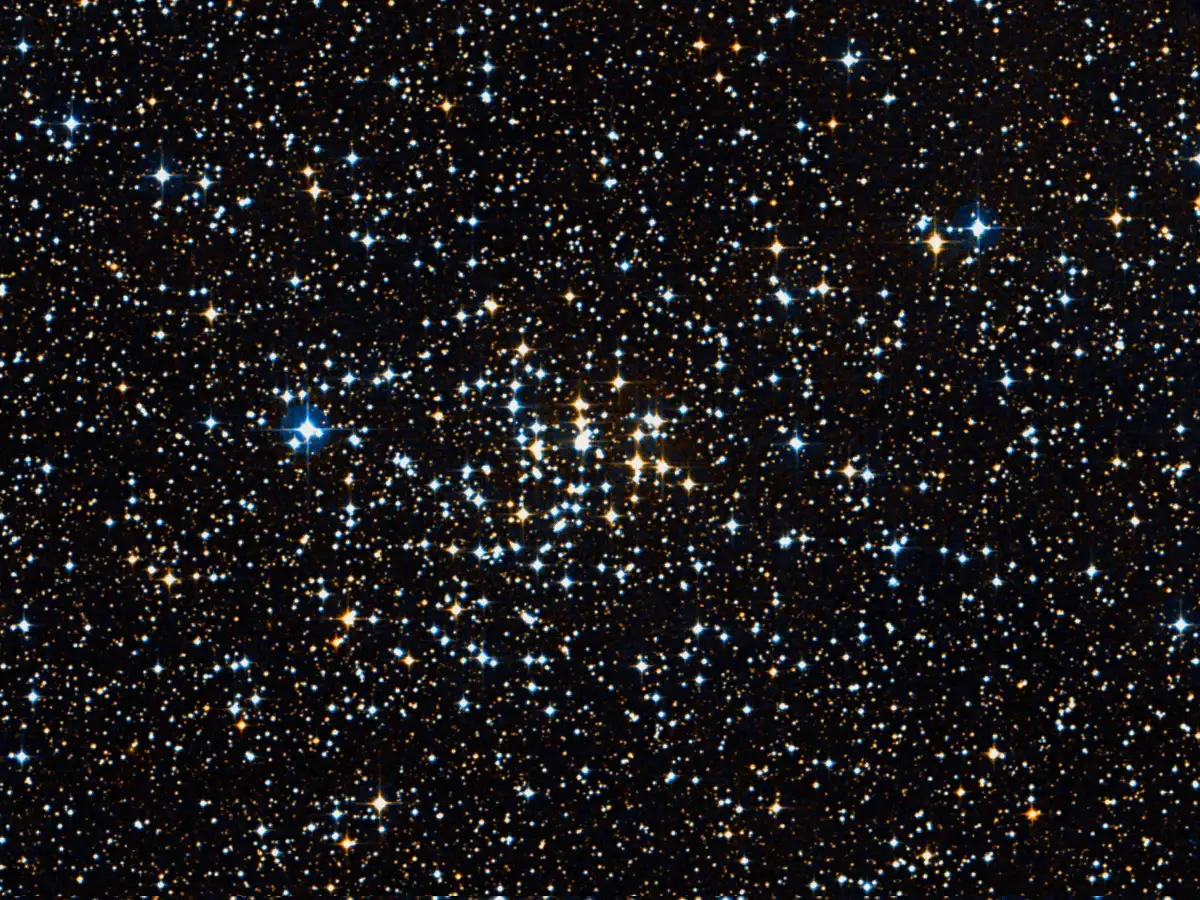
Caroline’s Cluster (NGC 2360), image credit: ESO/Digitized Sky Survey 2 (CC BY 4.0)
Physical characteristics and age of NGC 2360
Caroline’s Cluster has an estimated age of 891 million years, making it older than many of the bright open clusters we can observe. In comparison, the Pleiades (M45) are 75 – 150 million years old and the Hyades are around 625 million years old, while Praesepe (M44) is 600 – 700 million years old. Those clusters appear brighter primarily because they lie much closer to us, at distances of 444 light-years (the Pleiades), 153 light-years (the Hyades), and 610 light-years (Praesepe).
NGC 2360 was previously believed to be much older. An age of 2.2 billion years was derived in a 1990 study by Jean-Claude Mermilliod and Michel Mayor. The astronomers found masses of 1.8 -1.9 for the cluster’s stars at the end of the main sequence, too small to evolve through helium flash.
More recent studies, however, paint a different picture. A 2025 study led by Anna C. Childs, Department of Physics and Astronomy at Northwestern University, found an age of 1.069 billion years, a mass of 827 solar masses, and a distance 3,633 light-years (1,114 parsecs) based on Gaia DR3. A separate 2025 study places the cluster 3,438 light-years (1,054 parsecs) parsecs away.
A 2020 study found a mass range of 2.12 to 1.04 solar masses for the cluster members and a total mass of 379.77 solar masses. The researchers also concluded, at a 90 percent confidence level, that mass segregation is present in NGC 2360. Mass segregation is a process by which more massive members of the cluster drift inward toward the cluster’s centre while less massive members migrate toward the outskirts.
The same team derived a half-radius of 4.6 light-years (1.4 parsecs) for the cluster and a tidal radius of 31 light-years (9.46 parsecs).
NGC 2360 was identified as an intermediate-age cluster by Becker in 1960 and 1968 and Olin J. Eggen in 1968. Eggen found that the brightest star in the cluster’s field of view, HD 56847, was in fact a distant supergiant unrelated to the cluster. HD 56847 has an apparent magnitude of 8.96 and is situated at the cluster’s eastern end.
Eggen also identified one or possibly two blue stragglers in the cluster. These are stars that appear much younger, bluer and more luminous than other members of the cluster. Believed to form through stellar collisions, blue stragglers are commonly found in the densely packed centres of globular clusters.
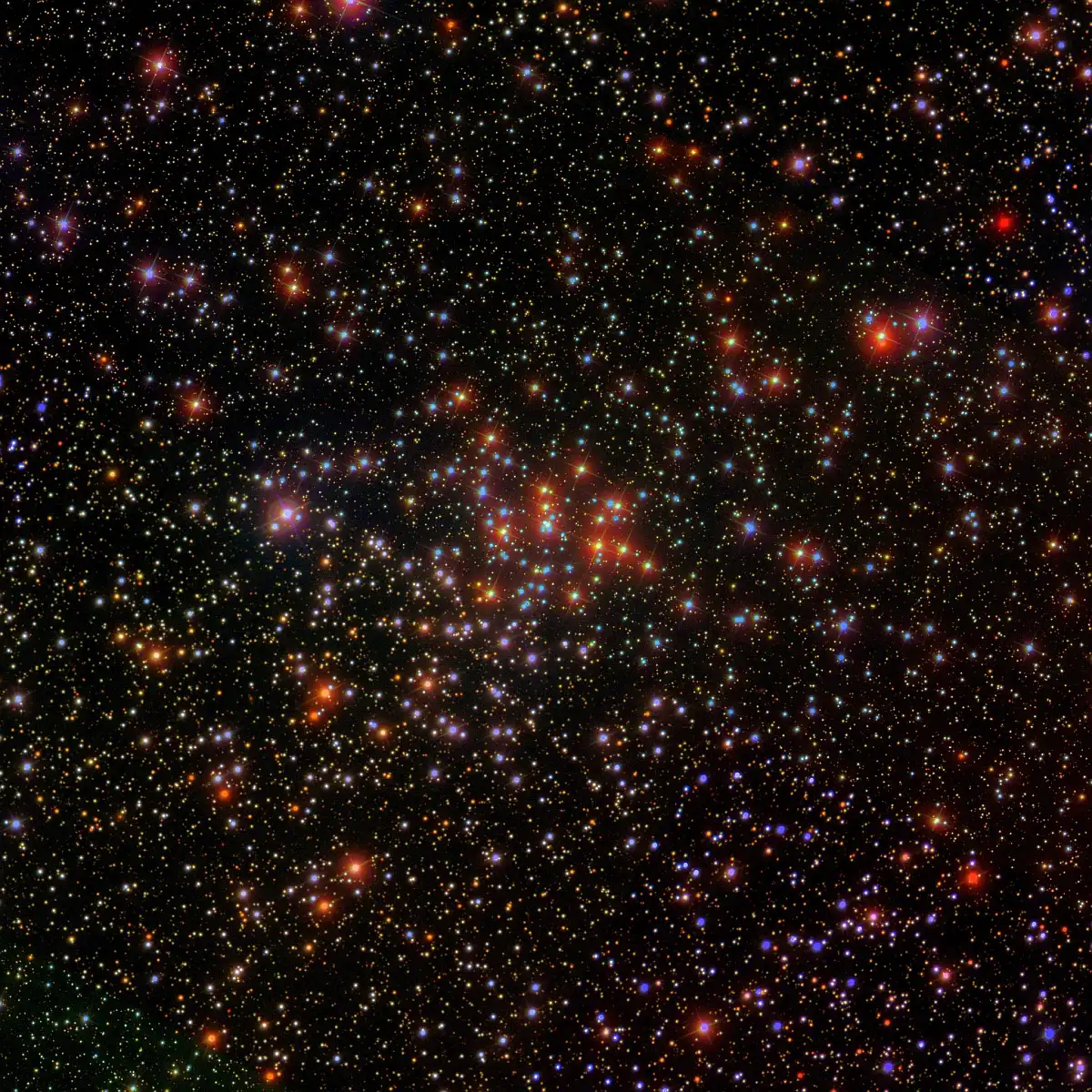
The sky image of Caroline’s Cluster (NGC 2360) is obtained by Sloan Digital Sky Survey, DR14 with SciServer. Credit: Sloan Digital Sky Survey (CC BY 4.0)
Distance and size
Estimates of the distance of NGC 2360 have varied from 3,200 to 3,700 light years in recent decades. A 2018 study by Cantat-Gaudin et al. placed the cluster at a distance of 3,164 light years (970 parsecs).
A 2020 study found a cluster radius of 12.1 ± 0.1 arcminutes and identified 332 cluster members based on the proper motion data from Gaia DR2. The researchers derived a distance of 3,203 ± 430 light-years (982 ± 132 parsecs) and a parallax-based distance of 3,516 ± 163 light-years (1,078 ± 50 parsecs). They determined a logarithmic age of 8.95 ± 0.05 (891 million years) for the cluster. A 2023 study gives a logarithmic age of 9.106 and a distance of 1,036 parsecs.
Observing NGC 2360
With an apparent magnitude of 7.2, Caroline’s Cluster is invisible to the unaided eye, even in exceptionally good conditions. However, in small telescopes it ranks among the visually richest star clusters of the winter sky. It lies in the constellation Canis Major (the Great Dog), close to the border with Puppis (the Stern).
How to find Caroline’s Cluster
Caroline’s Cluster appears in the region of the Great Dog’s head, in the same part of the sky as Sirius (Alpha Canis Majoris) and the fainter Muliphein (Gamma Canis Majoris). It lies 3.5 degrees east of Muliphein and 7.5 degrees east-northeast of Sirius, close to the imaginary line extended from the bright Aldebaran in Taurus through Bellatrix in Orion.
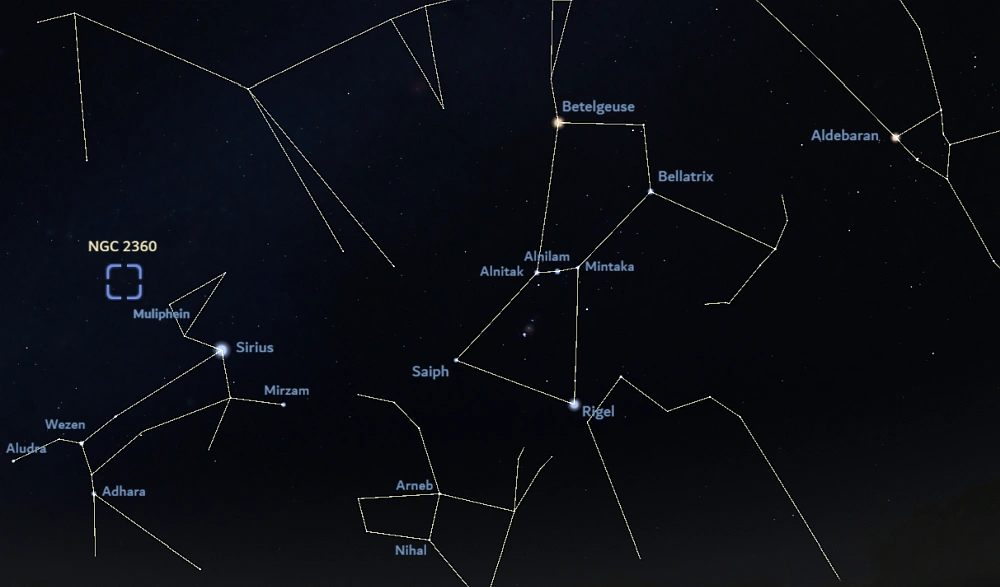
Location of NGC 2360 (Caroline’s Cluster), image: Stellarium (annotated for this article)
Surroundings
NGC 2360 lies around 2.5 degrees west of the border with the constellation Puppis and 5 degrees west-southwest of the bright open clusters Messier 46 and Messier 47. The Snowman Nebula (Sh2-302) and the planetary nebula NGC 2440 (the Insect Nebula) are also found in this region of the sky. The famous Thor’s Helmet Nebula (NGC 2359) appears north of Caroline’s Cluster.
The eclipsing binary star R Canis Majoris appears less than a degree southeast of NGC 2360. This Algol-type system is believed to be an interacting binary star, in which material from one star flows toward the other. The system’s brightness varies from magnitude 5.7 to 6.34, on the border of unaided eye visibility, with a period of around 1.1359 days.
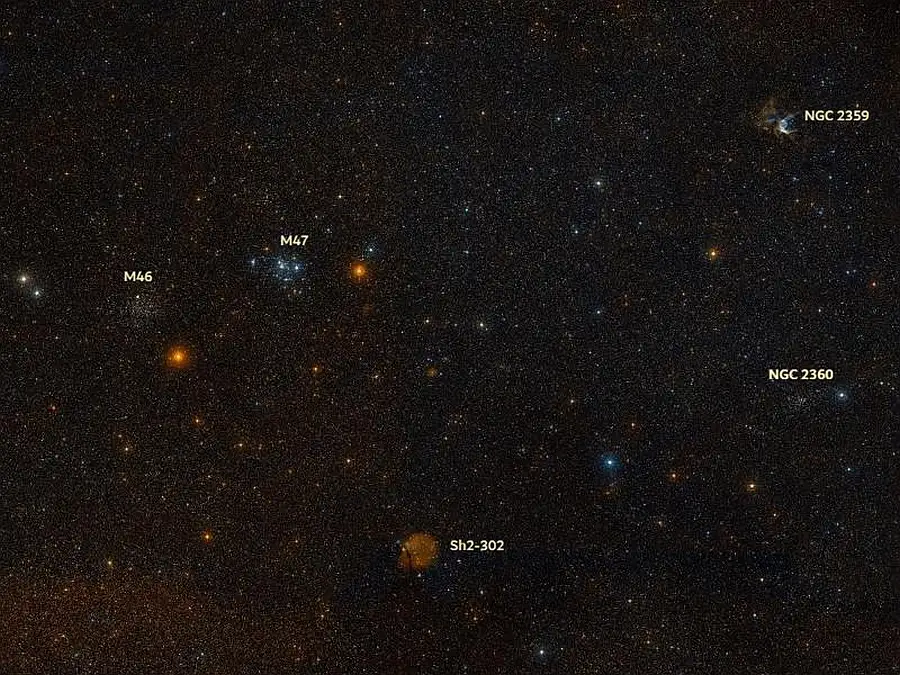
NGC 2360, M46, M47 and Thor’s Helmet Nebula NGC 2359), image credit: ESO/Digitized Sky Survey 2 (CC BY 4.0)
How NGC 2360 appears in telescopes
Caroline’s Cluster is visible in small, 7×35 binoculars, in which it appears as a small patch of light. In exceptionally good conditions, parts of the cluster can be resolved even at this small aperture.
Small telescopes will reveal the cluster’s rich star field at modest magnification. At 72×, the stellar bar of NGC 2360 becomes more pronounced, and several rows of stars appear separated by pronounced dark lanes. An 8-inch telescope will resolve well over 50 stars. The chains of stars become particularly striking in 15-inch and larger telescopes at 100× or higher magnification.
Seasonal visibility
The best time of the year to observe Caroline’s Cluster and other deep sky objects in Canis Major is February, when the Great Dog appears higher in the evening sky. The constellation is prominent in the sky throughout the northern hemisphere winter and can be observed from September to June.
At declination -16°, NGC 2360 is visible from all locations south of the latitude 74° N, in other words, from most inhabited locations on Earth.
Explore other deep sky objects in Canis Major:
- Dolphin Head Nebula (Sh2-308)
- NGC 2207 and IC 2163
- Tau Canis Majoris Cluster (NGC 2362)
- Seagull Nebula (IC 2177)
- Thor’s Helmet Nebula (NGC 2359)
Caroline’s Cluster – NGC 2360
| Constellation | Canis Major |
| Object type | Open cluster |
| Right ascension | 07h 17m 45.8s |
| Declination | −15° 38′ 21″ |
| Apparent magnitude | 7.2 |
| Apparent size | 12.1′ |
| Distance | 3,203 ± 430 light-years (982 ± 132 parsecs) |
| Names and designations | Caroline’s Cluster, NGC 2360, Caldwell 58, C58, Collinder 134 (Cr 134), Melotte 64, Mel 64, [KC2019] Theia 1473 |