The Phantom Streak Nebula (NGC 6741) is a planetary nebula located approximately 7,000 light years away in the northern constellation Aquila. It has an apparent visual magnitude of 11. With an apparent size of only 0.1 arcminutes, it is a challenging target for amateur telescopes.
How the Phantom Streak Nebula formed
NGC 6741 formed when an aging, Sun-like star reached the end of its life and puffed its outer layers into space. These layers of gas now glow in the hot ultraviolet light emitted by the stellar remnant left behind at the nebula’s core.
Despite the name, planetary nebulae like the Phantom Streak have nothing to do with planets. The term was first used in the 18th century, when observers found these glowing shells to resemble the disks of gas giants such as Uranus. The name stuck even though astronomers now understand planetary nebulae to be glowing gaseous envelopes of evolved stars similar to the Sun.
In several thousand years, the expelled material will dissipate into the surrounding interstellar medium and the core of the central star will gradually cool and fade as a dim white dwarf.
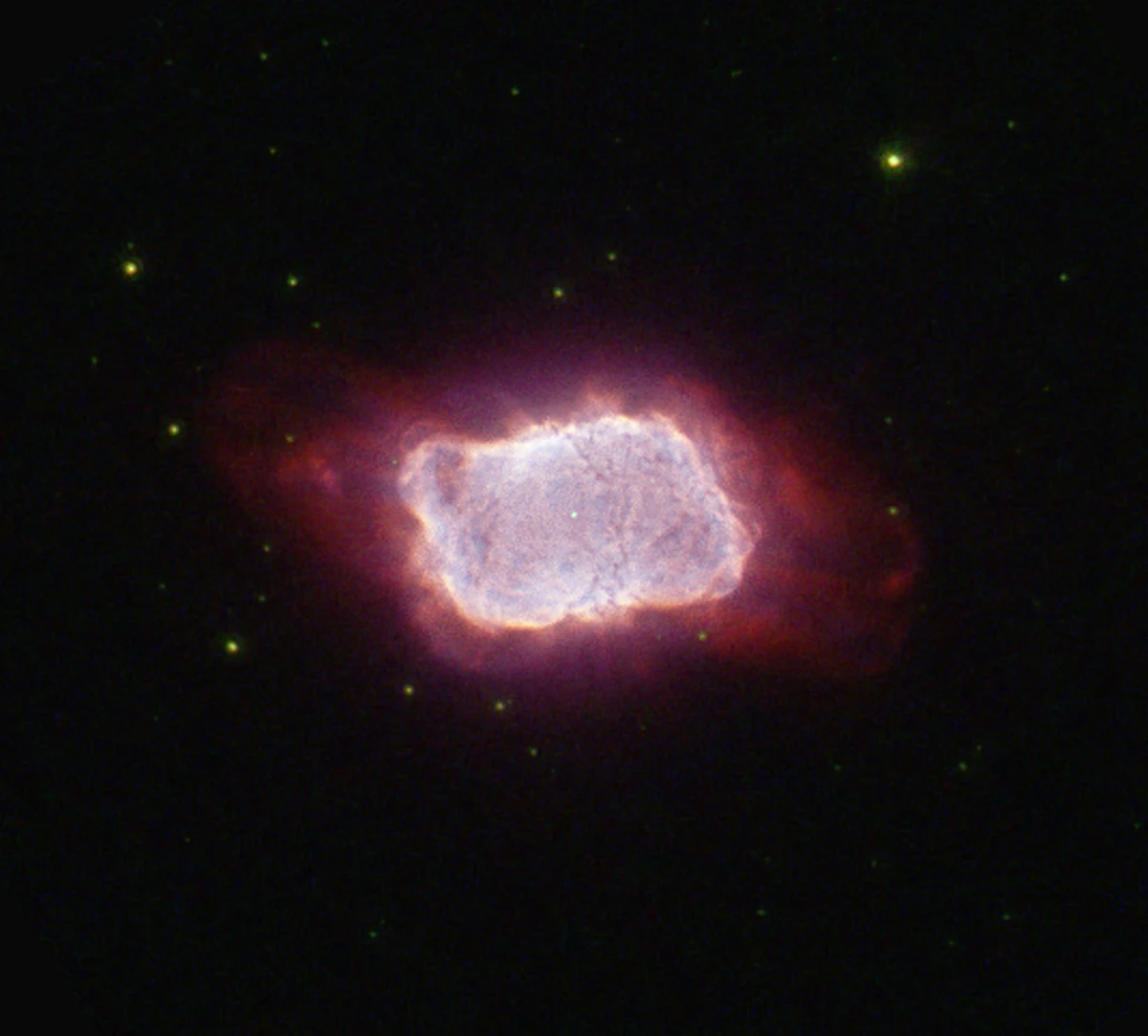
The Phantom Streak Nebula (NGC 6741), image credit: Judy Schmidt (CC BY 2.0)
A nebula in its final act: The recombination phase
The Phantom Streak is a dense, massive, fast-evolving nebula that has been undergoing a recombination phase for the last 200 years. This is the last phase of a planetary nebula’s life cycle.
For most of its existence, a planetary nebula is ionized by the intense ultraviolet light from its central star, which strips electrons from the surrounding gas, keeping the clouds of expelled material glowing.
However, once the central post-AGB star sees its energy output drop, it stops emitting high energy UV radiation. It begins cooling along what astronomers call the white dwarf cooling track. With less UV light reaching the nebula, the gas clouds return to a neutral state.
Over time, the recombination process causes the nebula to fade from view, even as the material keeps drifting away from the central star.
A dense, compact structure
The Phantom Streak Nebula has a roughly prolate spheroid shape with major, intermediate and minor semi-axes of 0.117 light-years (0.036 parsecs), 0.065 light-years (0.02 pc), and 0.059 light-years (0.018 pc).
The nebula’s dense central body is surrounded by an ionization front and a dense spherical halo with a radius of 0.261 light-years (0.08 pc). The halo contains much of the nebula’s mass. Seen from Earth, it spans 15 arcseconds in the sky, while the main body is only 7 by 5 arcseconds across.
With an estimated age of only 1,400 years, NGC 6741 is quite young for a planetary nebula, which helps explain why it is still so compact and dense.
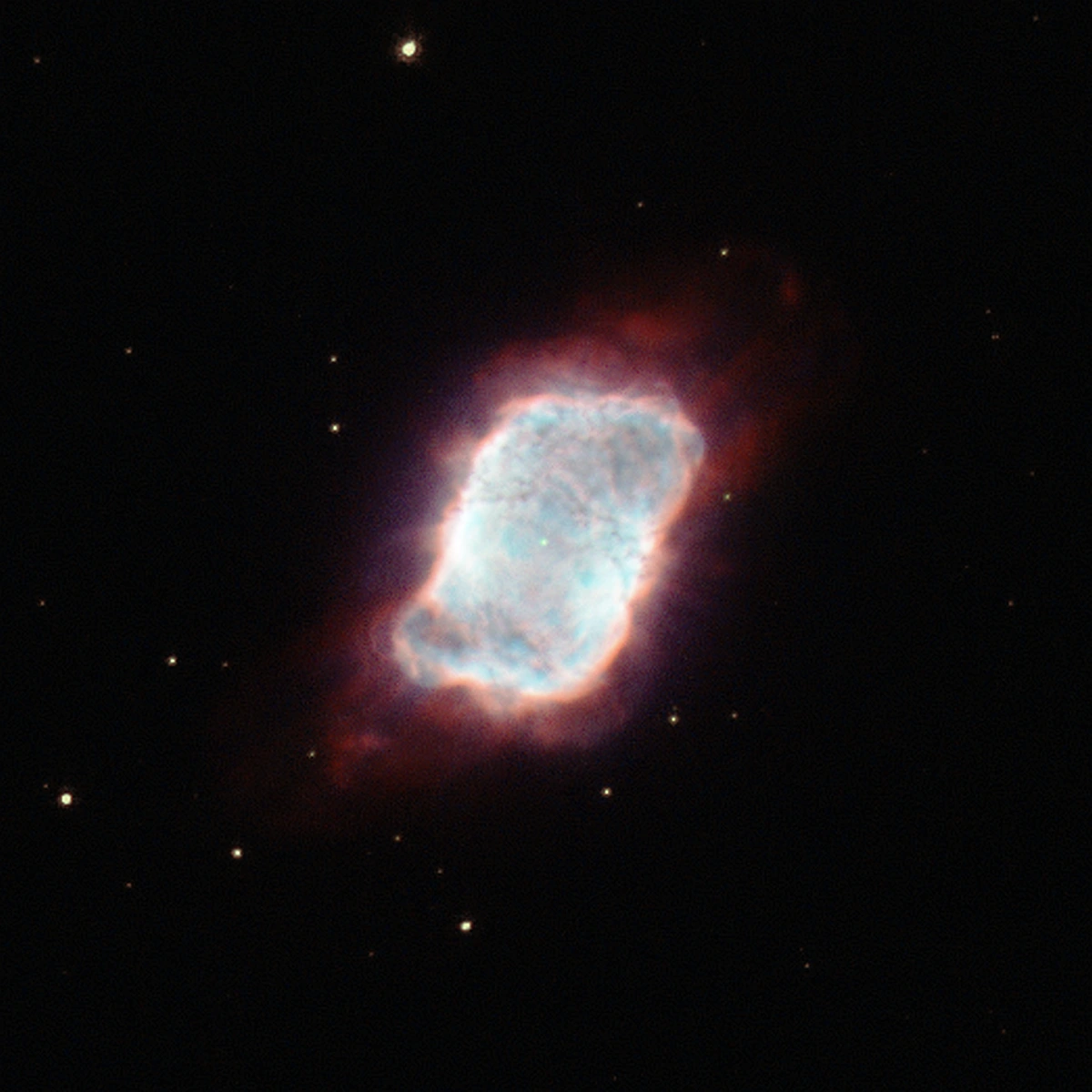
The NASA/ESA Hubble Space Telescope snapped this striking image of an aging star whose outer layers of gas have blown off into space. These gases glow in the fierce ultraviolet glare from the hot, small remnant of the star at the cloud’s centre. Planetary nebulae are short-lived and come in a wide assortment of shapes and sizes. Only about a fifth are spherical, and others can look like rings, discs, tubes or be entirely without symmetry, owing to distortions introduced by magnetic fields, binary central stars and as-yet unexplained phenomena. NGC 6741 does contain a second star and is thought to be well along in its period as a planetary nebula, and has assumed more of a rectangular shape, rather like a luminous pillow. This picture was created from images taken with Hubble’s Wide Field Planetary Camera 2. The red light was captured through a filter that isolated the red glow from hydrogen (F658N), light through a yellow filter was coloured green (F555W), and the blue was a combination of the green and the glow of oxygen (F555W and F502N). The exposure times were ten minutes (F658N), two minutes (F555W) and ten minutes (F502W). The field of view spans just 24 arcseconds. Image credit: ESA/Hubble and NASA (CC BY 3.0)
The central star of NGC 6741
The nebula’s central star is an exceptionally hot post-asymptotic giant branch (post-AGB) remnant with an estimated mass of 0.66 to 0.68 solar masses, somewhat heavier than the average planetary nebula progenitor.
Most of the star’s energy is emitted in ultraviolet light, invisible to the human eye. The star’s measured brightness is close to magnitude 20, much fainter than the surrounding nebula, making the star difficult to detect.
Discovery of NGC 6741
Even though it is quite bright for a planetary nebula, the Phantom Streak eluded astronomers until August 19, 1882, when American astronomer and physicist Edward Charles Pickering discovered it in the rich Milky Way field near the Eagle’s tail.
Pickering spotted the nebula using the 15-inch refractor at Harvard College Observatory. Earlier observers likely passed it over because of its tiny apparent size and location in a crowded stretch of the Milky Way’s bright band.
How the Phantom Streak got its name
The nebula’s evocative name was given to it by the American amateur astronomer John Mallas in his article “Visual Atlas of Planetary Nebulae V,” published in the Review of Popular Astronomy in 1963.
Describing the nebula, Mallas noted, “First you see it and then you don’t. It is one of the smallest planetaries in this list (…) Almost uniform in brightness, the ends appear broken and diffused.”
The name is an apt description of the nebula’s elusive quality. NGC 6741 is a tricky object to track down in the eyepiece.
Location of the Phantom Streak Nebula
The Phantom Streak Nebula lies in the western part of Aquila, close to the imaginary line extended from Alshain (Beta Aquilae) through Guqi (Delta Aquilae). It appears in the region between Lambda Aquilae and Alya (Theta Serpentis), less than five degrees north of Lambda Aquilae.
With an apparent size of 0.1 arcminutes, the nebula is not easily found in small telescopes. It requires a larger aperture and high magnification to be seen clearly.
Because of its high surface brightness, an aperture of around 8 inches is generally enough for picking out the nebula’s small disk from the surrounding star field, but the details can only be seen in larger instruments.
The best time of the year to observe the Phantom Streak Nebula and other deep sky objects in Aquila is during the northern hemisphere summer, when the Eagle flies high overhead in the early evening.
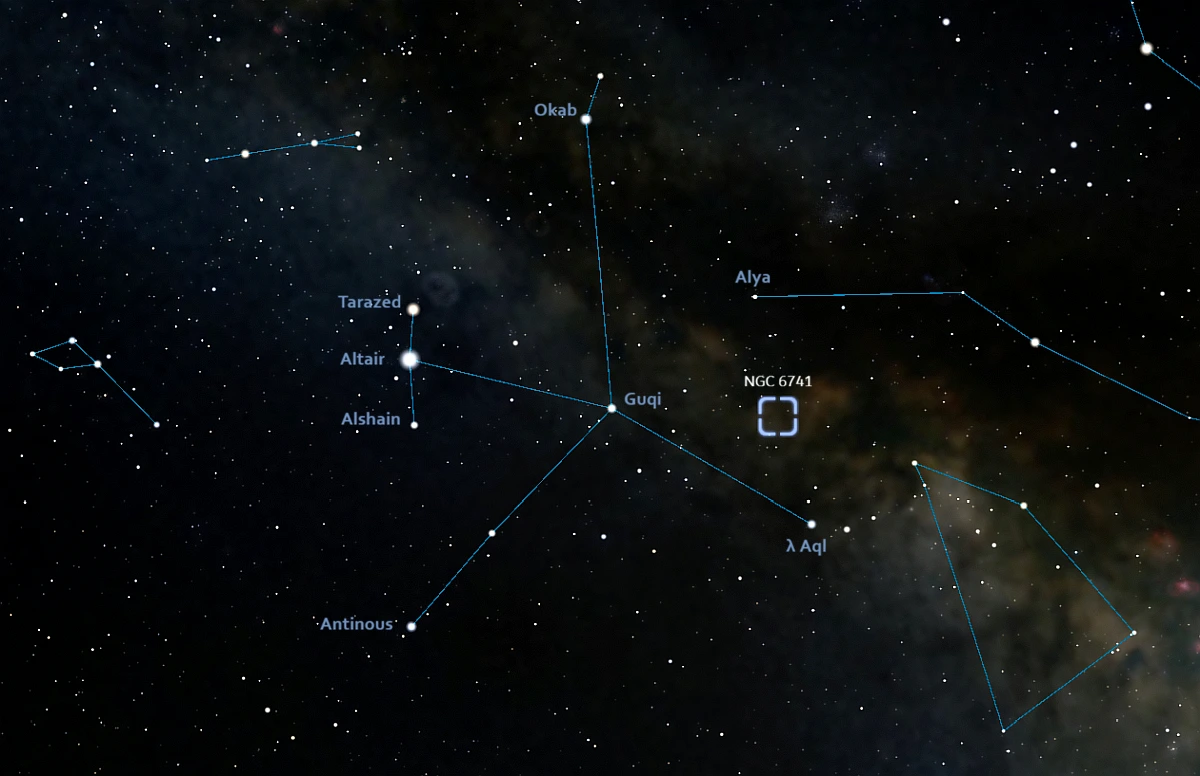
Location of NGC 6741 (the Phantom Streak Nebula), image: Stellarium (annotated for this article)
Explore other deep sky objects in Aquila:
- Snowglobe Nebula (NGC 6781)
- Glowing Eye Nebula (NGC 6751)
- Manatee Nebula (Westerhout 50)
- Starfish Nebula (IRAS 19024+0044)
Phantom Streak Nebula – NGC 6741
| Constellation | Aquila |
| Object type | Planetary nebula |
| Right ascension | 19h 00m 02.3s |
| Declination | -00° 31′ 23″ |
| Apparent magnitude | 11 |
| Apparent size | 0.1′ |
| Distance | 7,000 light-years (2,146 parsecs) |
| Names and designations | Phantom Streak Nebula, NGC 6741, PK 033-02 1, PN G033.8-02.6, PN ARO 53, PN VV 217, PN VV’ 474, Jonckheere 475, PN Sa 2-380 |