Arp 263 (NGC 3239) is an irregular galaxy located approximately 25 – 32.6 million light-years away in the constellation Leo. Nicknamed the Loony Galaxy for its unusual appearance, it appears as a triangle-shaped patch of stars, gas and dust.
NGC 3239 is around 40,000 light-years in diameter. It is larger than the Large Magellanic Cloud (32,200 light-years across), but much smaller than our own Milky Way galaxy (87,400 ly). With an apparent magnitude of 13.5 and an apparent size of 3.1 by 1.9 arcminutes, it is a difficult object for amateur telescopes.
The galaxy’s irregular morphology is the result of a merger with a smaller, low-mass galaxy. The F-type star BD+17 2217, which lies much closer to us, completes the galaxy’s loony appearance. With an apparent magnitude of 10, it easily outshines the background galaxy.
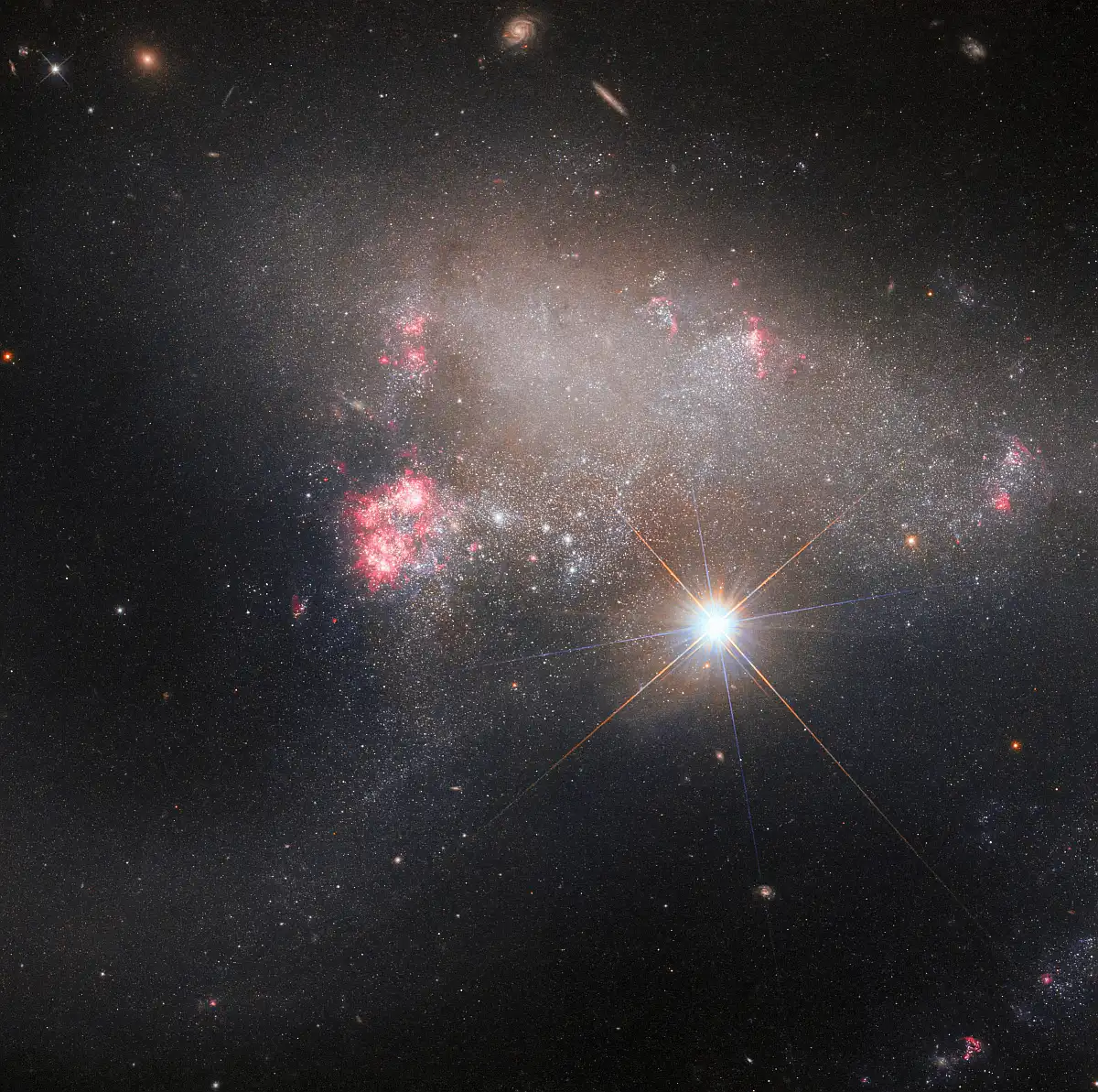
The irregular galaxy Arp 263 lurks in the background of this image from the NASA/ESA Hubble Space Telescope, but the view is dominated by a stellar photobomber; the bright star BD+17 2217. Arp 263 — also known as NGC 3239 — is a patchy, irregular galaxy studded with regions of recent star formation, and astronomers believe that its ragged appearance is due to its having formed from the merger of two galaxies. Two different Hubble investigations into Arp 263, using two of Hubble’s third-generation instruments, contributed data to this image. The first investigation was part of an effort to observe the sites of recent supernovae, such as the supernova SN 2012A that was detected just over a decade ago in Arp 263. Astronomers used Hubble’s powerful Wide Field Camera 3 to search for lingering remnants of the colossal stellar event. The second investigation is part of a campaign using Hubble’s Advanced Camera for Surveys to image all the previously unobserved peculiar galaxies in the Arp catalogue, including Arp 263, in order to find promising subjects for further study using the NASA/ESA/CSA James Webb Space Telescope. The interloping foreground star, BD+17 2217, is adorned with two sets of criss-crossing diffraction spikes. The interaction of light with Hubble’s internal structure means that concentrated bright objects such as stars are surrounded by four prominent spikes. Since this image of BD+17 2217 was created using two sets of Hubble data, the spikes from both images surround this stellar photobomber. The spikes are at different angles because Hubble was at different orientations when it collected the two datasets. Image credit: ESA/Hubble & NASA, J. Dalcanton, A. Filippenko (CC BY 4.0)
Traces of an invisible encounter
The scrappy appearance of Arp 263 and the bright pink patches that mark areas of star formation suggest that the galaxy is the product of a galactic merger.
The cosmic loon appears very asymmetrical and is not uniformly bright. The central region, about 1 arcminutes across, is considerably brighter than the rest of the galaxy and shines in the ultraviolet part of the spectrum. This indicates the presence of active star formation.
The galaxy is very rich in gas. Researchers have found that the mass of the gas exceeds the mass of the stellar population. Some of the gas was expelled from the galaxy’s disk during the encounter with the smaller galaxy and is now falling back onto NGC 3239.
Arp 263 has two short stellar tails. Combined with its distorted shape, the diffuse tidal tails provide evidence of the merger in the past. However, NGC 3239 does not appear to have any nearby companions and astronomers have not found any remnants of an absorbed smaller galaxy.
The galaxy is believed to have consumed a dwarf satellite that has since dissolved in the more massive neighbour. The densest part of the remnant may lie near the emission region that appears north of the bright foreground star.
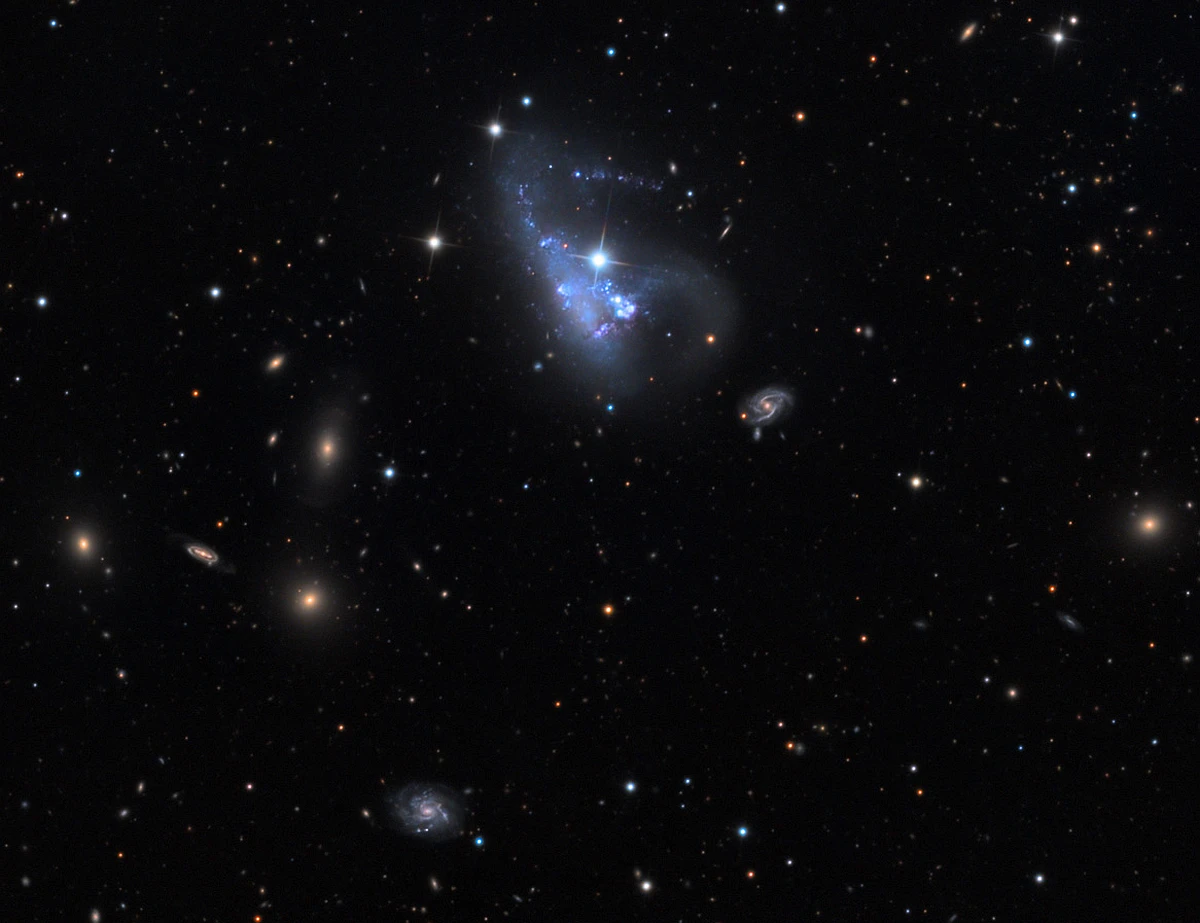
Arp 263, image credit: Adam Block/Mount Lemmon SkyCenter/University of Arizona (CC BY-SA 3.0 US)
Star formation in Arp 263
The most intense star formation takes place in the galaxy’s central region. Enhanced star forming activity is also evident over a large area in the eastern portion of the galaxy.
Regions of stellar birth are also visible in the chain of bright clumps in the galaxy’s western tidal arm, which shine prominently in the ultraviolet. Chains of bright clumps that appear evenly spaced in tidal structures are common in merging and interacting galaxies.
The young stars formed in the bright clumps are only several million years old, while the stars in the galaxy’s diffuse regions are over 1 billion years old.
Researchers estimate that NGC 3239 has a star formation rate of 0.6 solar masses per year.
The bright H II region in the southeastern portion of the galaxy was catalogued as VV95b by Boris Vorontsov-Velyaminov.
Discovery and observations
NGC 3239 was discovered by the German-born British astronomer William Herschel on March 21, 1784. Herschel catalogued the object as IV 10.
American astronomer Halton Arp listed the galaxy in his 1966 Atlas of Peculiar Galaxies as an example of a galaxy with irregular clumps.
Supernova 2012A
Arp 263 hosted the first supernova observed in 2012. Catalogued as SN 2012A, the Type II-P supernova shone at magnitude 14.4 at discovery and peaked at magnitude 13.6. It was discovered by Bob Moore, Jack Newton, and Tim Puckett 25 arcseconds east and 16 arcseconds south of the galaxy’s centre on January 7, 2012.
Astronomers believe that the progenitor of SN 2012A was a red supergiant with a mass 10 to 15 times that of the Sun. Observations of the supernova have led to a distance estimate of around 10 megaparsecs for the galaxy.
How to find Arp 263
Arp 263 lies within the familiar constellation figure of the celestial Lion. It appears south and a little east of the bright Algieba (Gamma Leonis), one of the stars that form the Sickle of Leo, above the imaginary line connecting Regulus (Alpha Leonis) at the Lion’s heart and Zosma (Delta Leonis) at its hip.
At declination +17°, the galaxy lies close enough to the celestial equator to be visible from virtually any location on Earth for at least part of the year.
The best time of the year to observe Arp 263 and other deep sky objects in Leo is in the month of April, when the constellation appears higher above the horizon in the early evening.
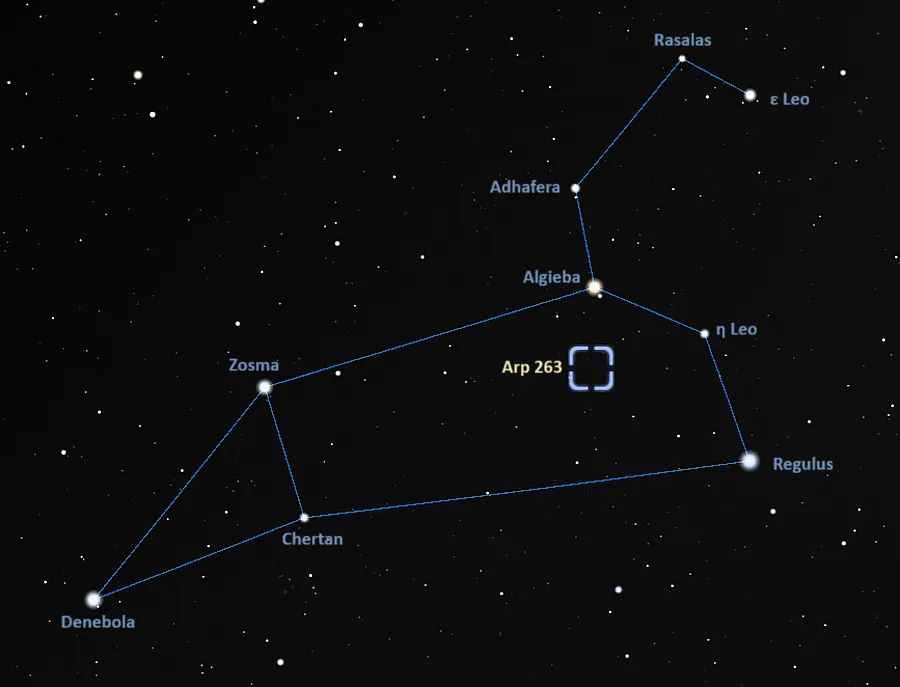
Location of the Loony Galaxy (Arp 263), image: Stellarium (annotated for this article)
Explore the stars and deep sky objects in Leo:
- Frosty Leo Nebula (IRAS 09371+1212)
- Owl Galaxy (NGC 3758)
- Copeland’s Septet
- Sickle of Leo
- Regulus (Alpha Leonis)
Arp 263
| Constellation | Leo |
| Object type | Irregular galaxy |
| Morphological type | IB(s)mpec |
| Right ascension | 10h 25m 06.24s |
| Declination | +17° 09′ 37.8″ |
| Apparent magnitude | 13.5 |
| Apparent size | 3′.13834 × 1′.92412 |
| Distance | 25 million light-years (7.7 megaparsecs) or 32.6 Mly (10 Mpc) |
| Size (diameter) | 40,000 light-years (12,264 parsecs) |
| Redshift | 0.002522 |
| Heliocentric radial velocity | 755 ± 3 km/s |
| Names and designations | Loony Galaxy, NGC 3239, Arp 263, APG 263, LEDA 30560, PGC 30560, MCG +03-27-025, UGC 5637, VV 95, KPG 236, KPG 236a, LCSB L414, IRAS 10224+1724, IRAS F10223+1724, TC 528, 2MASX J10250486+1709492, 2MASXI J1025056+170937, Z 1022.4+1725, SDSS J102504.88+170949.4, UZC J102505.8+170939 |