Rubin’s Galaxy is an exceptionally large barred spiral galaxy located approximately 274 million light-years away in the northern constellation Perseus. Popularly known as the Godzilla galaxy, it is one of the largest spiral galaxies known. It is listed as UGC 2885 in the Uppsala General Catalogue of Galaxies (UGC).
The Godzilla galaxy has a diameter of 438,000 light-years. It is one of the largest galaxies in the local universe. However, it is considerably smaller than the Condor Galaxy (NGC 6872) in the southern constellation Pavo, the largest spiral galaxy known. The record-holding behemoth has an isophotal diameter of 717,000 light-years, more than eight times the Milky Way’s diameter.
The Godzilla galaxy has long puzzled astronomers because, despite its enormous size, it does not show evidence of collisions or smaller infalling galaxies. It has an undisturbed spiral structure and no tidal tails. High-mass galaxies are believed to grow to such gigantic sizes through collisions and mergers, and by accreting their much smaller satellite galaxies.
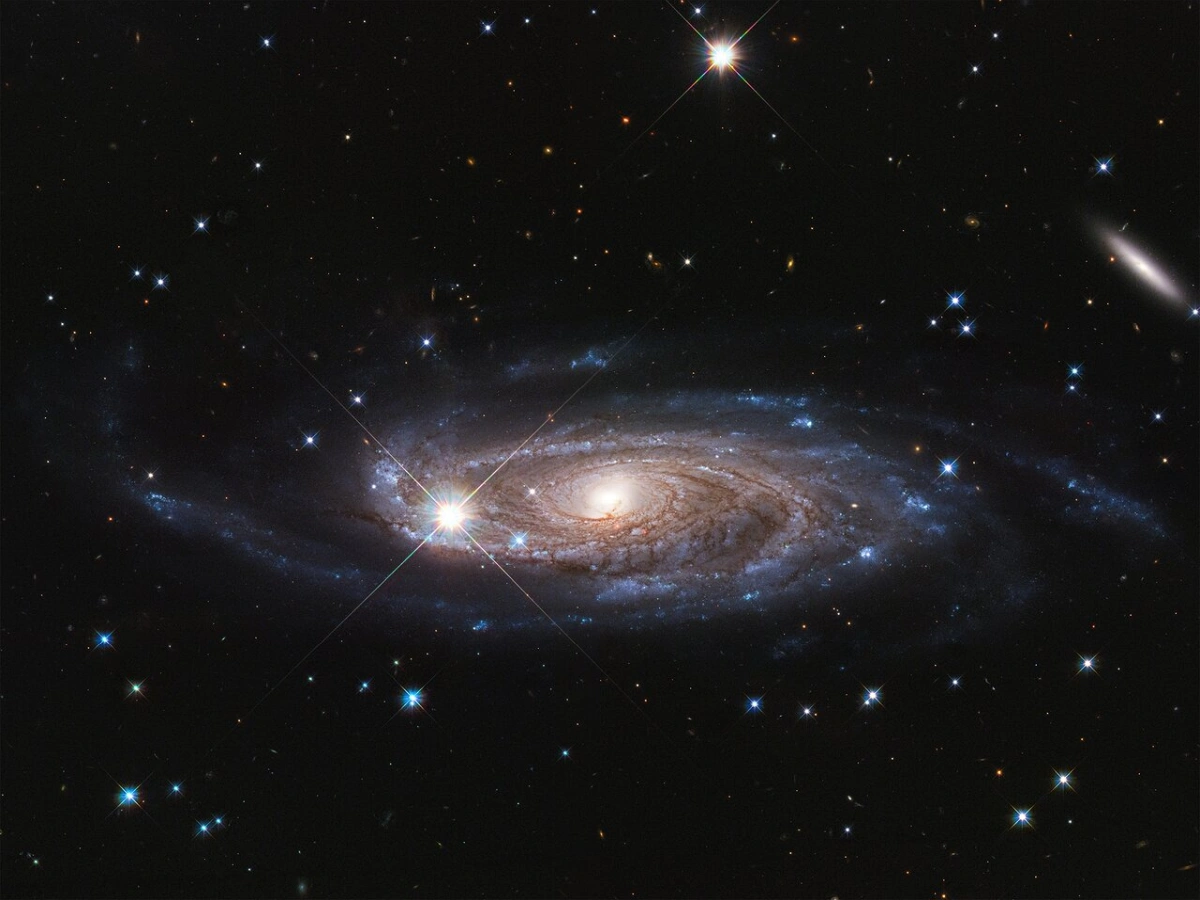
This Hubble Space Telescope photograph showcases the majestic spiral galaxy UGC 2885, located 232 million light-years away in the northern constellation Perseus. The galaxy is 2.5 times wider than our Milky Way and contains 10 times as many stars. A number of foreground stars in our Milky Way can be seen in the image, identified by their diffraction spikes. The brightest star photobombs the galaxy’s disk. The galaxy has been nicknamed “Rubin’s galaxy,” after astronomer Vera Rubin (1928 – 2016), who studied the galaxy’s rotation rate in search of dark matter. Image credit: NASA, ESA, and B. Holwerda (University of Louisville) (CC BY 4.0)
Collisions and mergers would have contributed to the monstrous size of this galaxy over time. However, UGC 2885 has smooth spiral arms wrapped neatly around the bright core. The galaxy’s globular cluster population also indicates an uneventful accretion history.
Additionally, the galaxy’s central supermassive black hole appears relatively inactive. It would not be dormant if it had infalling material from accreted galaxies to chew on. The star formation rate in the Godzilla galaxy is about half that of our own Milky Way galaxy. It would likely be greater if there had been any encounters in the recent past.
In 2024, a team led by Matheus C. Carvalho of University of Western Ontario, Canada, observed the galaxy with the Canada-France-Hawaii Telescope (CFHT) in Hawaii and the IRAM 30m radio telescope in Spain. They found a molecular hydrogen mass of 189 trillion solar masses and a star formation rate of only 1.63 solar masses per year, which is unusually low for such a large spiral galaxy. The astronomers proposed that the galaxy had multiple cycles of star formation periods, which increased its stellar mass to its present state. However, they did not find evidence of any major starburst activity or merger in the galaxy’s recent past.
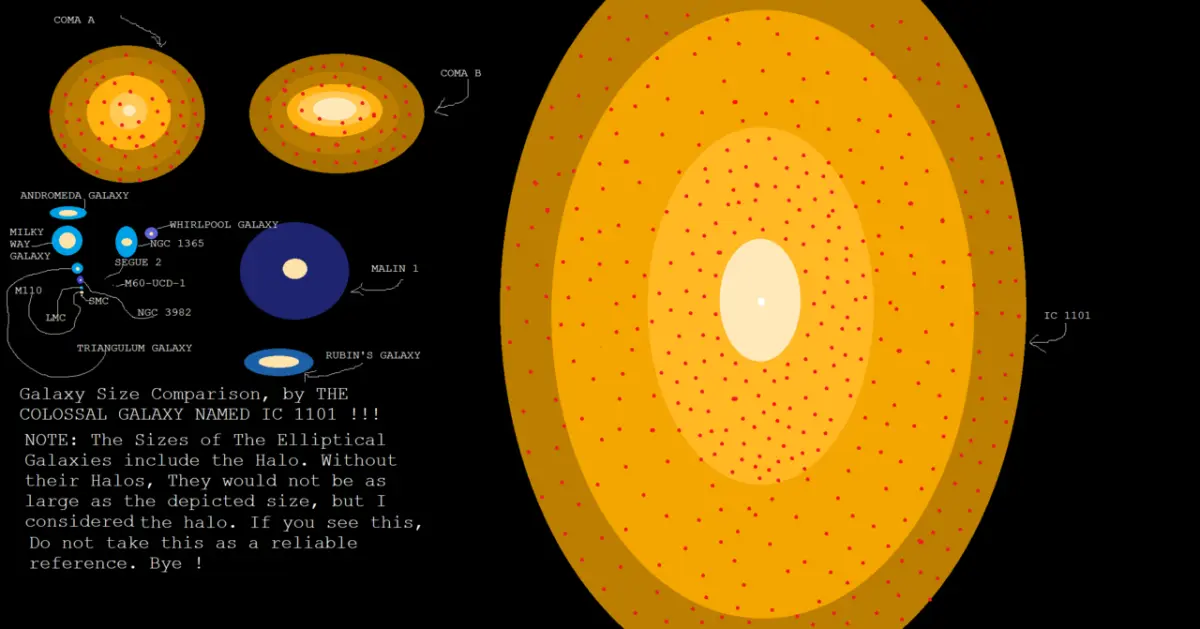
Galaxy size comparison, image credit: Wikimedia Commons/THE COLOSSAL GALAXY NAMED IC1101 (CC BY-SA 4.0)
Rubin’s Galaxy forms a small group with the galaxies LEDA 14008 (UGC 2881) and LEDA 5060601.
The giant galaxy may be an outlying member of the Perseus-Pisces Supercluster, one of the largest structures known in the observable universe. The chain of galaxy clusters stretches across over 40 degrees of the sky and lies at a distance of 250 million light years. The most prominent clusters include Abell 262, Abell 347, and Abell 426. Rubin’s Galaxy lies 8-9 degrees from the centre of the Perseus cluster.
Facts
The giant spiral galaxy was named Rubin’s Galaxy after the American astronomer Vera Rubin. Rubin did not discover the galaxy herself. However, she studied it extensively at the Carnegie Institution of Washington in the 1980s. Rubin’s work and observations of UGC 2885 and other galaxies led to the discovery of the first evidence for dark matter. By measuring the galaxy’s rotation curve, the pioneering astronomer found that the galaxy’s outer regions rotated faster than the visible matter alone could explain.
Vera Rubin was known for her work on galaxy rotation rates and for discovering the first evidence for the galaxy rotation problem. While investigating the rotation curves of spiral galaxies like UGC 2885 and the nearby Andromeda, she found that the outermost components of galaxies were moving as quickly as the innermost ones.
Rubin’s work demonstrated that spiral galaxies rotate quickly enough to fly apart if the gravity of all their stars was all that was keeping the galaxies together. This indicated that galaxies were held together by a vast amount of unseen mass and that up to 50 percent of their mass was concentrated in the dark galactic halo.
In 1980, Rubin published a study of rotational properties of 21 spiral galaxies, including UGC 2885. She found a radius of 122 kiloparsecs and a mass of 2.2 × 10¹¹ M⊙ for the galaxy, identifying UGC 2885 as the largest known spiral galaxy of the morphological type Sc (indicating loosely wound spiral arms).
UGC 2885 was named Rubin’s Galaxy by a team of astronomers led by B. W. Holwerda, University of Louisville, in 2020. The team presented observations of the giant spiral made by the Wide Field Camera 3 (WFC3) aboard NASA’s Hubble Space Telescope (HST) just in time for the celebration of the telescope’s 30th anniversary in orbit.
The Godzilla galaxy hosted two supernovae observed in recent decades. The supernova SN 2002F was detected by LOTOSS (Lick Observatory and Tenagra Observatory Supernova Searches) on January 17, 2002. It shone at magnitude 18.1 and was classified as a type II supernova. It was located 48.4 arcseconds west and 20.9 arcseconds south of the galactic nucleus.
Another type II supernova, designated SN 2025aant, was discovered by the Asteroid Terrestrial-impact Last Alert System (ATLAS) on October 15, 2025. At the time of discovery, it had an apparent visual magnitude of 18.424.
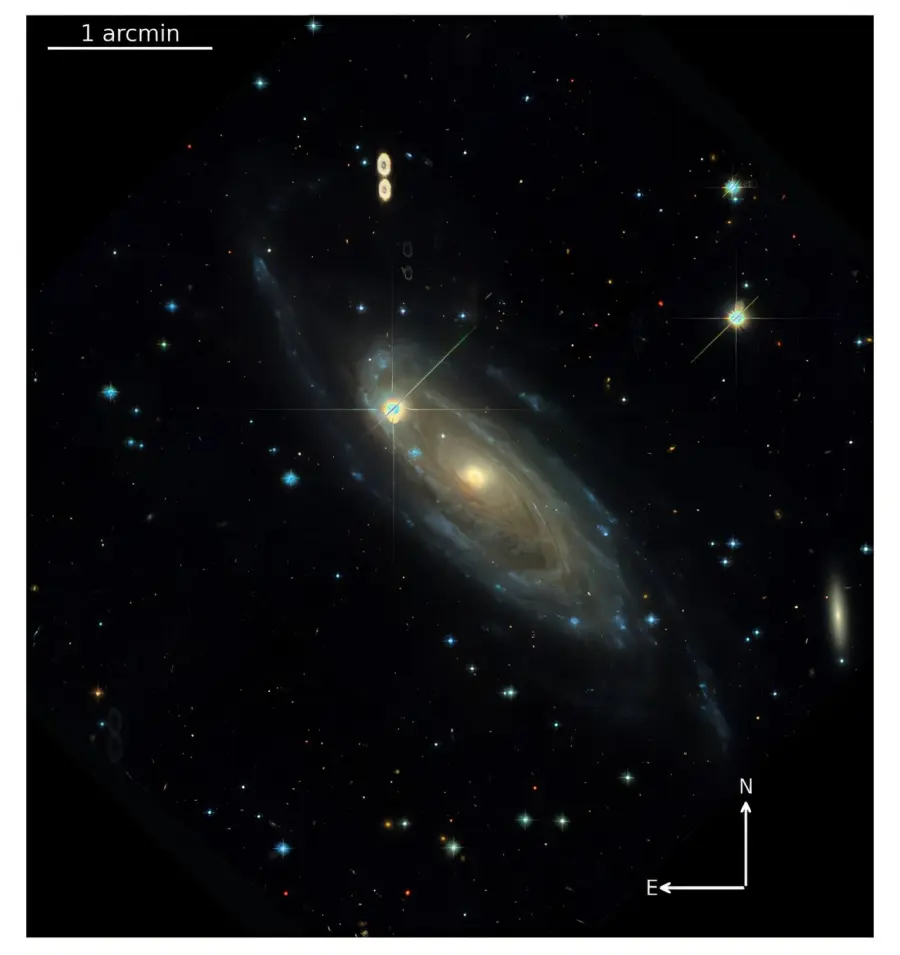
Rubin’s Galaxy, colour composite of HST/WFC3 images. Credit: Carvalho et al, 2024 (PD)
Location
Rubin’s Galaxy lies in the southern part of Perseus, near the massive blue supergiant Menkib (Xi Persei, mag. 4.04). It appears in the same region of the sky as the California Nebula (NGC 1499), a large emission nebula ionized by Menkib.
With an apparent magnitude of 13.5 and an apparent size of 5.5 by 2.5 arcminutes, the Godzilla galaxy is a challenging target for amateur telescopes. It never rises for observers south of the latitude 54° S.
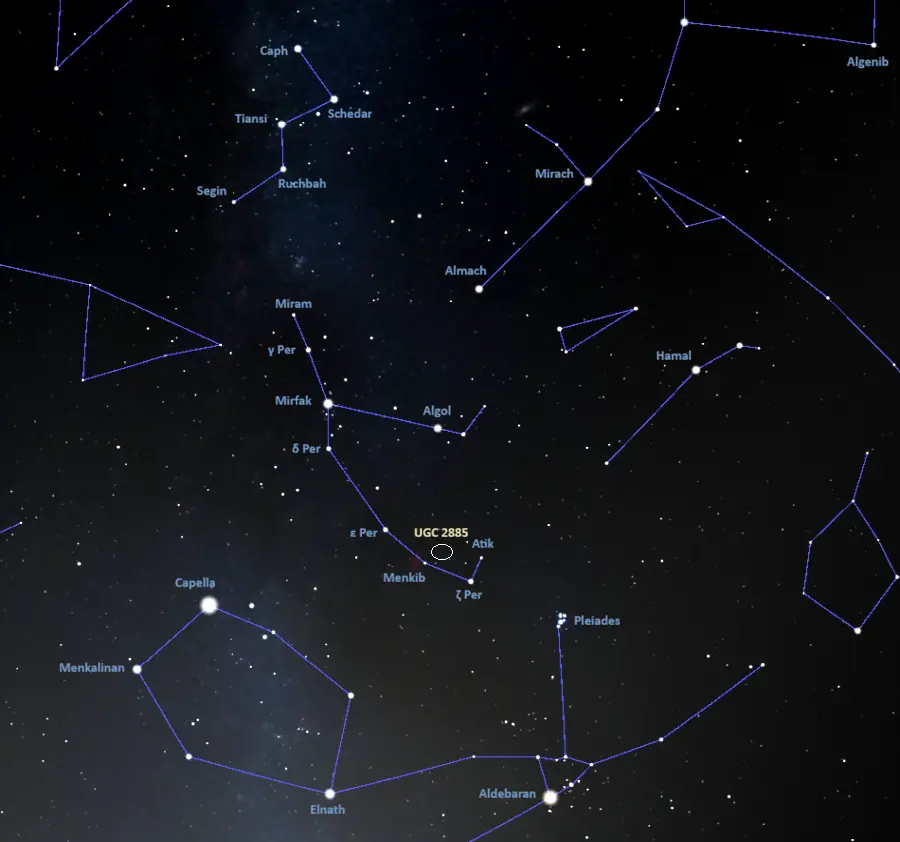
Rubin’s Galaxy location, image: Stellarium
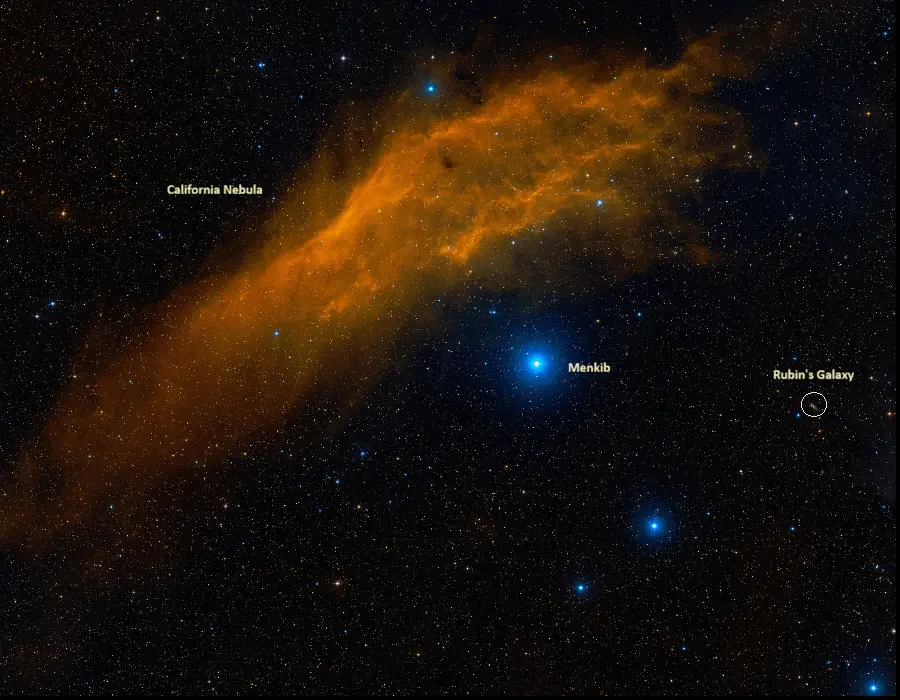
California Nebula, Menkib and Godzilla Galaxy, image credit: ESO/Digitized Sky Survey 2 (CC BY 4.0)
Rubin’s Galaxy – UGC 2885
| Constellation | Perseus |
| Object type | Spiral galaxy |
| Morphological type | SA(rs)c |
| Right ascension | 03h 53m 02.4589142328s |
| Declination | +35° 35′ 22.174136556″ |
| Apparent magnitude (V) | 13.5 |
| Apparent magnitude (B) | 14.4 |
| Apparent magnitude (G) | 19.090185 ± 0.017388 |
| Apparent size | 5.5′ × 2.5′ |
| Distance (comoving) | 274.0 ± 19.24 million light-years (84.0 ± 5.9 megaparsecs)h −1/0.6774 |
| Distance (light-travel) | 269 Mly (82.48 Mpc)h−1/0.6774 |
| Redshift | 0.019350 ± 0.000010 |
| Heliocentric radial velocity | 5,801 ± 3 km/s |
| Galactocentric velocity | 5,870 ± 4 km/s |
| Size (diameter; 25.0 B-mag arcsec−2) | 438,060 × 201,500 light-years (134.31 × 61.78 kiloparsecs) |
| Size (diameter; 20.0 K-mag arcsec−2) | 216,110 × 90,769 ly (66.26 × 27.83 kpc) |
| Mass | 2 trillion M☉ |
| Names and designations | Rubin’s Galaxy, Godzilla Galaxy, UGC 2885, LEDA 14030, PGC 14030, MCG +06-09-012, IRAS 03497+3526, IRAS 03498+3526, CGCG 526-012, PSCz P03497+3526, Z 039.8+3527, Z 526-12, TC 49, UZC J035302.4+353522, [M98c] 034948.6+352633, [HVG99b] 03498+3527, [WGB2006] 034948+35270 a, Gaia DR2 219771110013777792, Gaia DR3 219771110013777792 |