The Dragon’s Head Nebula is an H II region located in the Large Magellanic Cloud (LMC), a satellite galaxy of the Milky Way. The glowing cloud of ionized gas is part of a larger star-forming complex north of the LMC’s galactic bar. It lies in the southern constellation Dorado (the Dolphinfish) and is listed as NGC 2035 in the New General Catalogue.
NGC 2035 was discovered by the Scottish astronomer James Dunlop from Australia on August 3, 1826. Like all emission nebulae, it glows because it hosts many young, exceptionally hot stars whose energetic ultraviolet radiation ionizes the surrounding hydrogen gas, making it produce its own light.
The Dragon’s Head is an active star forming region. It is part of an extended region of emission nebulae designated N59, which also includes the nebulae NGC 2029, NGC 2032, and NGC 2040. These clouds of gas and dust are associated with the stellar association LH 82. The emission region is several hundred light years across.
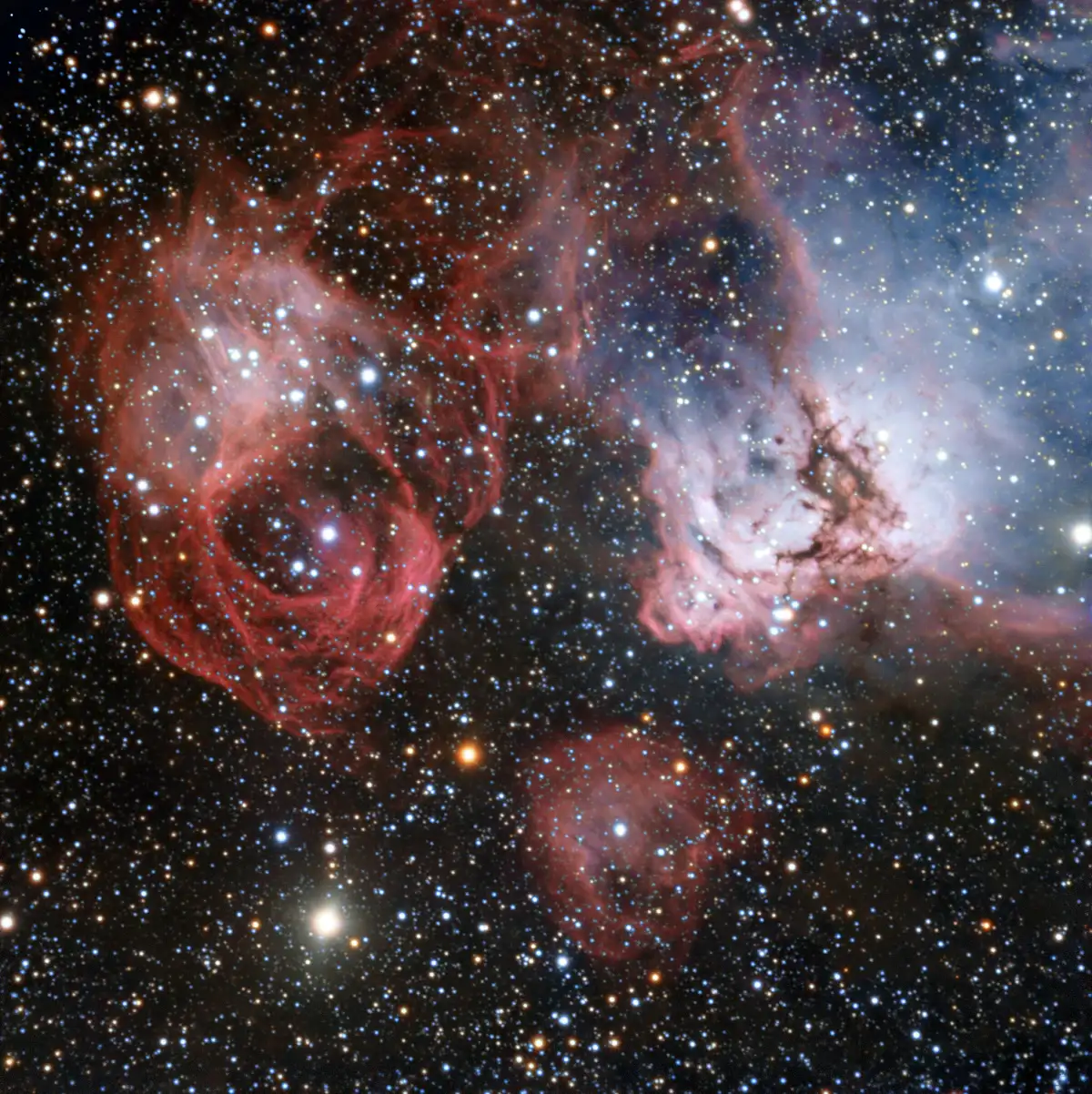
The Large Magellanic Cloud is one of the closest galaxies to our own. Astronomers have now used the power of the ESO’s Very Large Telescope to explore NGC 2035, one of its lesser known regions, in great detail. This new image shows clouds of gas and dust where hot new stars are being born and are sculpting their surroundings into odd shapes. Image credit: ESO (CC BY 4.0)
The role of massive young stars in nebular sculpting
NGC 2035 was nicknamed the Dragon’s Head Nebula because a large plume of material that extends from the emission nebula has been twisted into a roughly circular shape that resembles the head of a dragon. The filamentary structure was shaped by an ancient supernova, produced by a massive star that suffered a core collapse at the end of its life cycle. The supernova event has created a prominent eye in the centre of the filamentary nebula.
The powerful stellar winds of the very young stars formed in the region play a key role in the nebula’s appearance. They erode the surrounding clouds, while their strong ultraviolet radiation makes the clouds glow. The bright emission region is interspersed with dark patches of dust that create twisting lanes across NGC 2035.
Location and cosmic neighbourhood
The Dragon’s Head Nebula is part of the Large Magellanic Cloud, one of the nearest galaxies to the Milky Way. Located approximately 163,000 light years away, the dwarf galaxy is about 32,200 light years across. Even though it has only a hundredth of the Milky Way’s mass, it is the fourth largest galaxy in the Local Group, after the Andromeda Galaxy, the Milky Way, and the Triangulum Galaxy.
The Magellanic spiral is rich in star forming nebulae and young clusters. The Tarantula Nebula, the largest stellar nursery in the LMC, is the most active star forming region in the Local Group of galaxies.
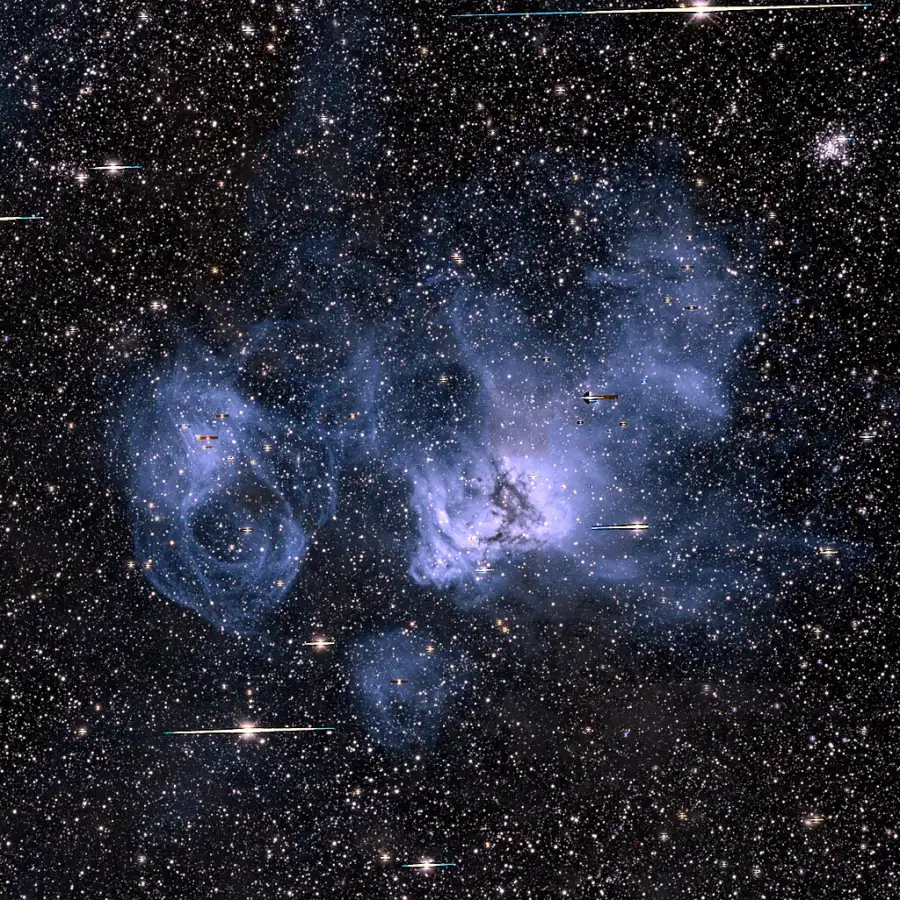
NGC 2035 and the surrounding region, image credit: Legacy Surveys / D. Lang (Perimeter Institute), NERSC (CC BY-SA 4.0)
Complex of emission nebulae
NGC 2035 is part of a larger complex of emission nebulae that includes NGC 2029, NGC 2032 and NGC 2040. Like NGC 2035, NGC 2029 and NGC 2032 are H II regions, while NGC 2040 is a supernova remnant. The remnant is catalogued as SNR 0536-67.6 or DEM L 241.
NGC 2035 and the nearby NGC 2032 form the bright core of the larger H II region N59A. The two emission nebulae are part of the same stellar nursery but are divided by a thick dust lane. The dust lane is a site of active star formation.
The larger emission nebula N59 lies at the edge of the supershell LMC 4, the largest supergiant shell of gas in the Large Magellanic Cloud. LMC 4 contains numerous young OB associations of massive young stars associated with H II complexes, including N59, N51, N56, and N57. It is located on the northern edge of the galaxy.
NGC 2032 is popularly known as the Seagull Nebula, but it should not be mistaken for the other Seagull Nebula (IC 2177), located on the border between the constellations Monoceros and Canis Major. The name is sometimes used for the entire emission region around NGC 2032.
In 1998, a team of astronomers led by M. Rosado found an expansion motion of 24 km s-1 for the bright core of N59A. They proposed that either a supernova event or the strong stellar winds of massive stars embedded in the nebula were responsible for the high kinetic energy required for this motion. These stars provide the wind power to drive the fast expansion of the nebula.
The researchers noted a supernova remnant in the region, SNR 0536-676, that lies in the nebula N59B. SNR 0536-676 was first identified by Mathewson et al. in 1985. It is the remnant that gives the nebular clouds the appearance of a dragon’s head.
The massive star HDE 269810 (R122) ionizes an extended shell of material and likely some nebulosity further away. With a mass of more than 100 solar masses and a luminosity of a million Suns, R122 is one of the most massive and luminous stars known.
Position in the Large Magellanic Cloud
NGC 2035 appears in the northern part of the Large Magellanic Cloud, north of the larger and better-known Tarantula Nebula (30 Doradus).
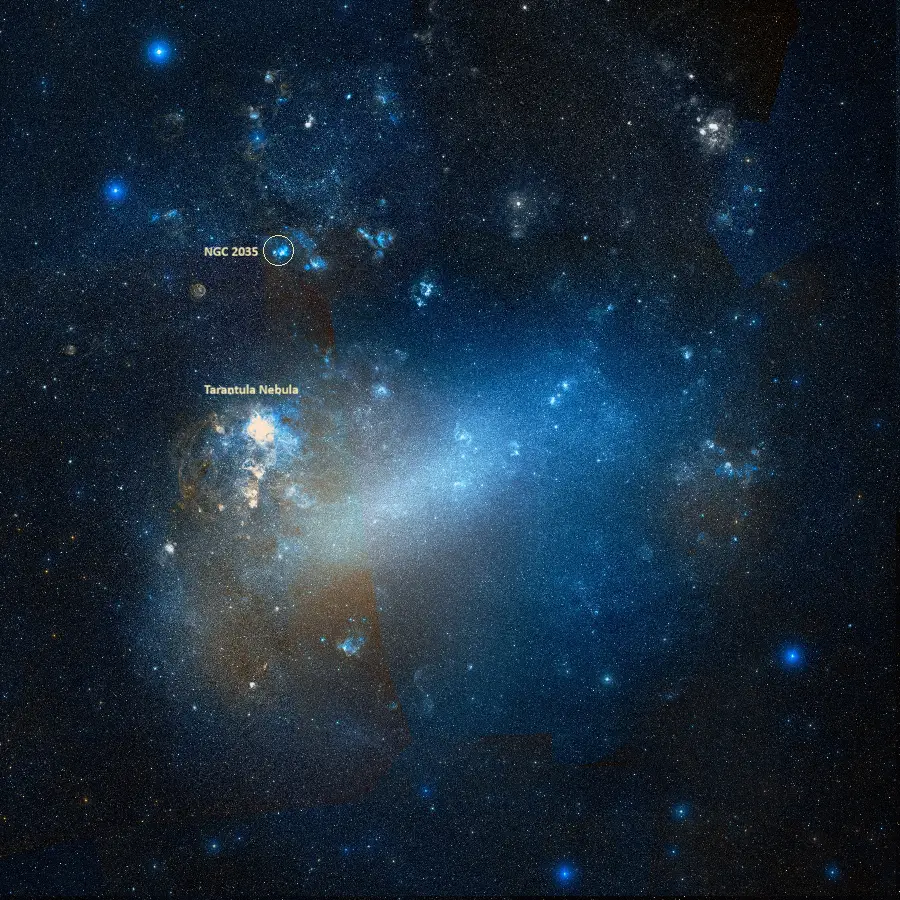
The Dragon’s Head Nebula in the Large Magellanic Cloud, image credit: ESO/Digitized Sky Survey 2 (CC BY 4.0)
Nearby nebulae and star-forming regions
The Dragon’s Head Nebula and the larger N59 region lie in the vicinity of several other prominent nebulae and associated open clusters.
The Cosmic Reef (NGC 2014 and NGC 2020), another popular astrophotography target, appears in the same region of the Large Magellanic Cloud. It consists of the red emission nebula NGC 2014 and the blue nebula NGC 2020 surrounding a massive Wolf-Rayet star roughly 200,000 times more luminous than the Sun.
Several open clusters appear in the same area. NGC 2053 appears northeast of the Dragon’s Head Nebula and NGC 2021 lies to the northwest. The brighter NGC 2004 lies just northwest of NGC 2021.
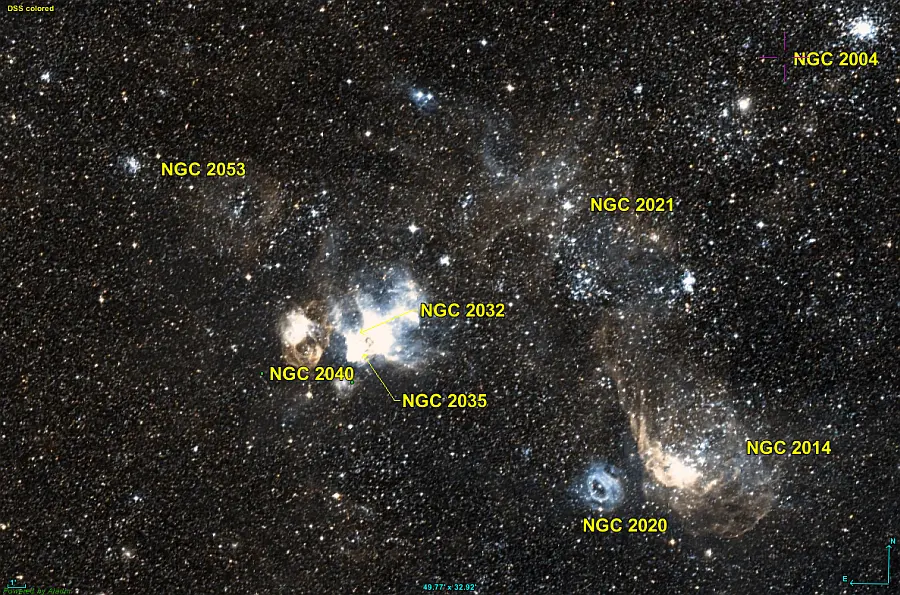
Image created using Aladin Sky Atlas software from the Strasbourg Astronomical Data Centre and data from DSS (Digitized Sky Survey). Image credit: Donald Pelletier (CC BY-SA 4.0)
How to find the Dragon’s Head Nebula
The Dragon’s Head Nebula lies in the small, faint constellation of Dorado. It appears close to the midpoint of the imaginary line connecting Epsilon and Theta Doradus, in the direction of the brighter Tarantula Nebula.
At declination -68°, NGC 2035 is best seen from the southern hemisphere. It never rises above the horizon for observers north of the latitude 21°-22° N.
The best time of the year to observe the Dragon’s Head Nebula and other deep sky objects in Dorado is during the month of January, when the constellation appears higher in the sky in the early evening.
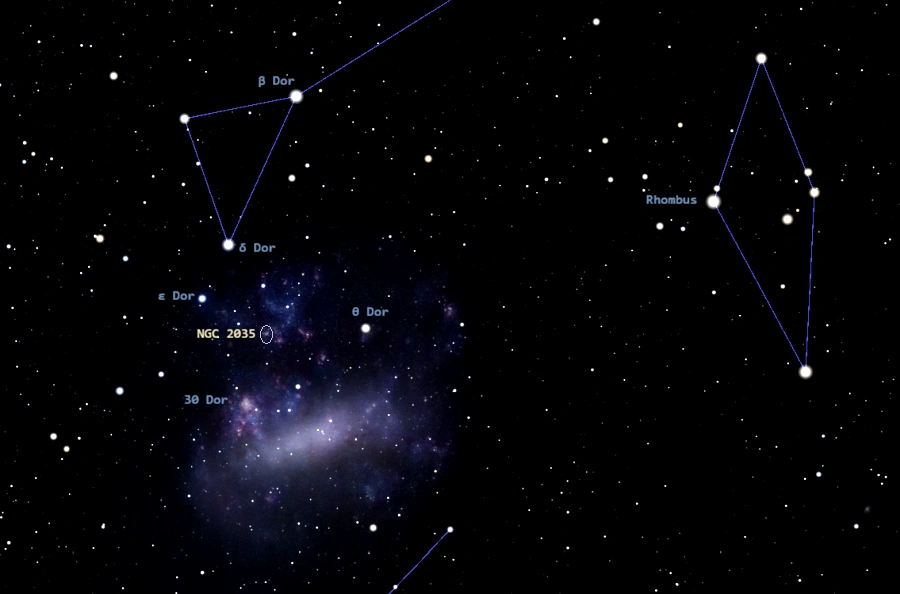
The location of NGC 2035, image: Stellarium (annotated for this article)
Explore other deep sky objects in Dorado:
- Large Magellanic Cloud (LMC)
- Tarantula Nebula (30 Doradus)
- R136 Cluster
- Supernova 1987A
- Ghost Head Nebula (NGC 2080)
- Spanish Dancer Galaxy (NGC 1566)
Dragon’s Head Nebula – NGC 2035
| Constellation | Dorado |
| Object type | H II region |
| Right ascension | 05h 35m 30.0s |
| Declination | −67° 35′ 00″ |
| Apparent magnitude | 10.99 |
| Apparent size | 3.0 ′ |
| Names and designations | Dragon’s Head Nebula, NGC 2035, ESO 56-EN161, 2MASX J05353417-6735319 |