The Cloverleaf Quasar is a distant quasar whose light is split into four distinct images by gravitational lensing, creating a clover-shaped pattern. The quasar lies 11 billion light years away in the constellation Boötes. It is catalogued as H1413+117 and QSO J1415+1129.
Quasars are exceptionally luminous active galactic nuclei (AGNs) containing supermassive black holes with masses that range from millions to billions of solar masses. When these central black holes actively accrete material, the galactic nuclei turn on and increase in luminosity. Emissions from quasars are fueled by the accretion of material onto the central supermassive black holes, which are surrounded by gaseous accretion disks.
Discovered in 1984, the Cloverleaf Quasar is associated with a remote starburst galaxy and provides astronomers with a glimpse into star formation in the early universe. It is one of the few quadruple-image quasars known, along with the Einstein Cross in the constellation Pegasus.

Chandra X-ray Image of Cloverleaf Quasar This is Chandra’s X-ray view of the so-called Cloverleaf quasar, a single object whose image has been reproduced four times through an effect known as “gravitational lensing.” This process occurs when the gravitational field of a massive, intervening object bends and magnifies light from a distant quasar to produce the multiple images. The foreground galaxies in this case are too faint to be seen in these images. Image credit: NASA/CXC/Penn State/G.Chartas et al. (PD)
Gravitational lensing: Seeing four images of a single object
The quasar H1413+117 is visible despite lying at a great distance thanks to the effect of gravitational lensing. Predicted by Einstein’s General Theory of Relativity, gravitational lensing is the bending and magnifying of light from distant objects by one or more massive objects in the foreground. The gravitational fields of the foreground objects act as natural lenses for the light of the more remote objects when the light passes close by them.
The light of lensed objects may be bent into multiple images, and the images may appear brighter than the distant objects themselves normally would. The light amplification makes it possible for astronomers to detect and study these objects, which would otherwise be too faint and inaccessible to modern telescopes.
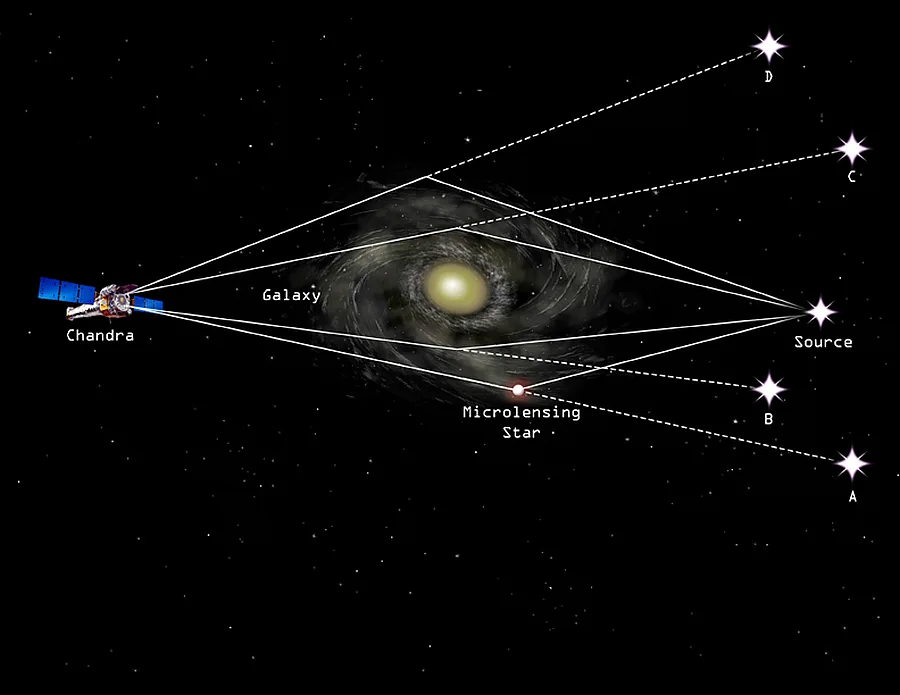
Single cosmic objects may appear as multiple images to astronomers through a process known as gravitational lensing. This effect occurs when the gravitational field of one or more foreground galaxies bends and magnifies light from a much more distant object to produce multiple images, as shown in the artist’s rendering. In the case of the Cloverleaf quasar, Chandra’s X-ray view found four separate images of this single object that is 11 billion light years away. Image credit: NASA/CXC/M.Weiss (PD)
Host galaxy: Star formation in the early universe
The Cloverleaf Quasar is associated with a distant starburst galaxy whose light is lensed into a partial Einstein ring. In gravitational lenses, a perfect ring only appears when the source, the lensing object and the observer are exactly aligned.
Astronomers have detected molecular gas in the Cloverleaf’s host galaxy. The gas, mainly carbon monoxide (CO), is the oldest molecular material discovered to date. It indicates large-scale star formation in the early universe. At high redshift, the Cloverleaf Quasar is the brightest source of CO emission known.
The presence of molecular gas is evidence of an intense burst of star formation that is increasing the luminosity of the quasar. A 2023 study reported the detection of a radio jet on one side of the quasar. The jet is located around 1.15 kiloparsecs northwest of the starburst galaxy’s centre. The researchers proposed that it may indicate the co-existence of feedback from the AGN both by wind and jet in the quasar.
The Cloverleaf Quasar has an extensive molecular disk around 1.6 kpc in diameter and a molecular gas mass of around 1010 solar masses. Astronomers have estimated a star formation rate of 103 solar masses per year for the host galaxy.
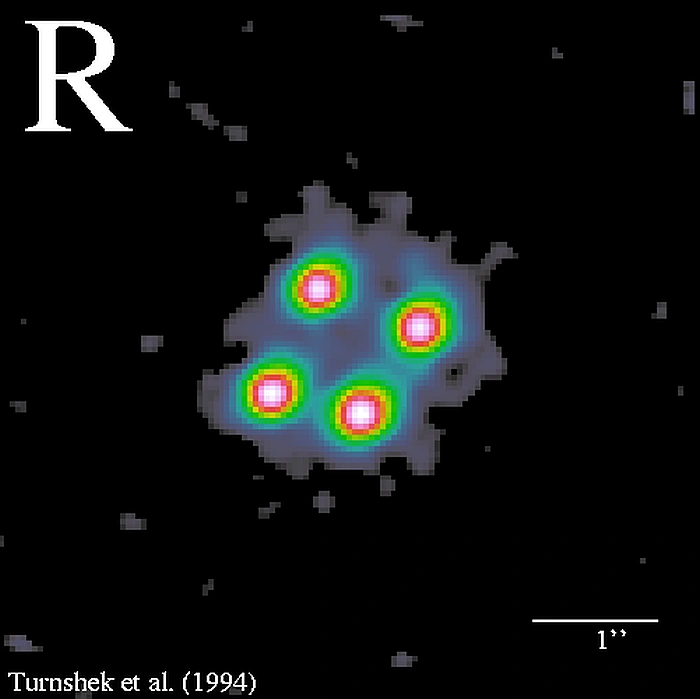
This optical image of the Cloverleaf quasar was taken with the Hubble Space Telescope as part of the CfA-Arizona Space Telescope Lens Survey. The position of the images in the X-ray sources align very well with Hubble pictures. Image: NASA/STScI/D.Turnshek (PD)
Companion connected by a bridge of gas
In 2022, researchers studied archival data obtained with the Atacama Large sub-Millimetre Array (ALMA) to catalogue the carbon monoxide and dust in the host galaxy, and discovered a companion galaxy. The companion lies at a projected distance of 33 kiloparsecs from the Cloverleaf and is 4-5 times less massive.
The companion is connected to the Cloverleaf galaxy by a large bridge of gas, indicating that it is being stripped and consumed by its more massive neighbour. This was the first direct detection of galaxy stripping in the very distant universe. The larger galaxy will likely completely consume the companion in the next hundred million years.
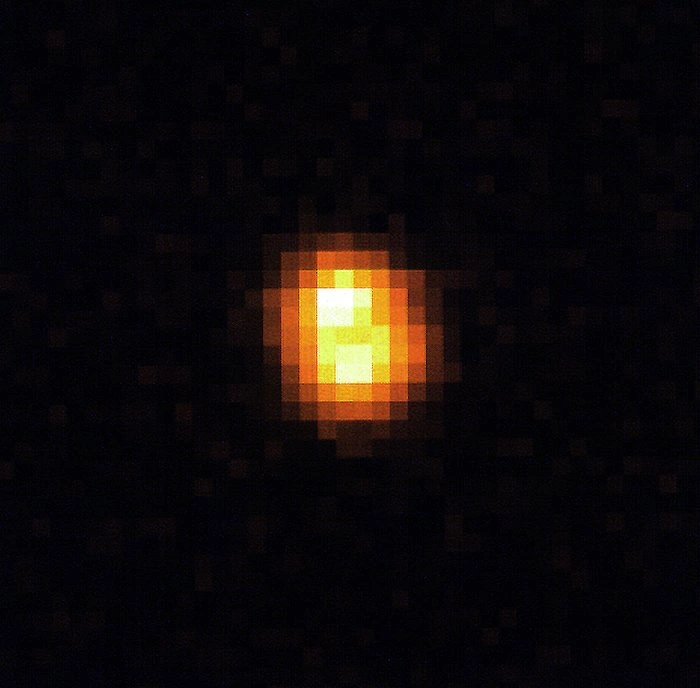
The Cloverleaf Quasar, so named because it is actually a single object appearing as four, courtesy of gravitational lensing. In this phenomenon, foreground galaxies bend and magnify the distant quasar’s light into four point sources of illumination. Credit: ESO (CC0 1.0)
The cloverleaf pattern: Why one leaf shines brighter
One of the images of the Cloverleaf Quasar appears brighter at optical and X-ray wavelengths. This is particularly true for X-rays.
Astronomers have suggested that this may be caused by gravitational microlensing, which can occur if a star or binary system in one of the foreground galaxies moves in front of the small region near the Cloverleaf’s central supermassive black hole, the main source of X-ray emissions.
This region is less than a hundredth of a light year across or even smaller, while the region emitting the visible light is 10 or more times larger.
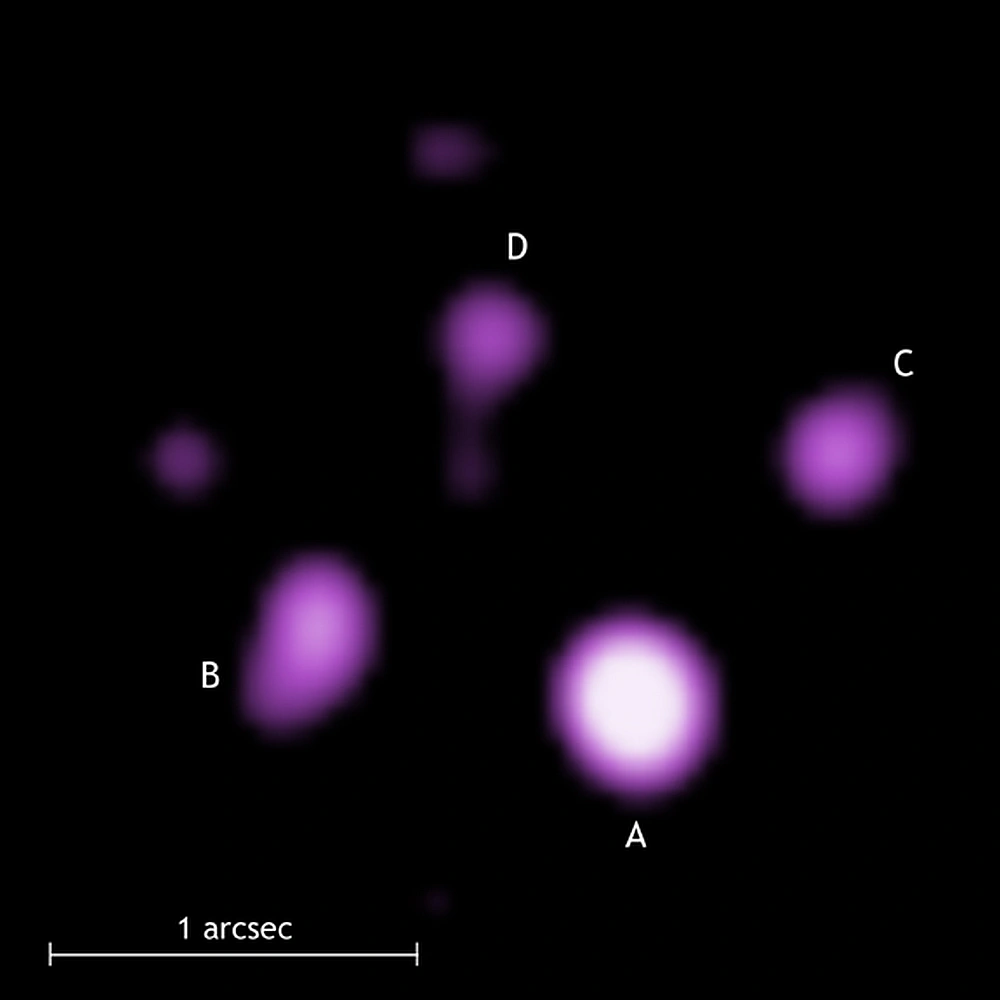
One of the images in the Cloverleaf is brighter than the others in both optical and X-ray light. This is due to “microlensing,” where a single or binary star in one of the intervening galaxies passes directly in front of the small, X-ray producing region around the quasar’s supermassive black hole. X-ray microlensing gives astronomers a new and exceptionally precise probe of the gas flow around the supermassive black hole. Scale: Image is 2 arcsec across. Image credit: NASA/CXC/Penn State/G.Chartas et al (PD)
The foreground galaxy acting as a cosmic lens
The cloverleaf-like arrangement of the images of H1413+117 is produced by the gravitational field of one or more galaxies that lie much closer to us. These galaxies are too faint to be visible in images of the Cloverleaf.
The lensing galaxy was resolved by a team at the University of Liège, Belgium, in 2006. The researchers analyzed archival data obtained with the Near Infrared Camera and Multi-Object Spectrometer (NICMOS-2) aboard the Hubble Space Telescope and found the primary lensing galaxy along with a partial Einstein ring.
The Einstein ring is the gravitationally lensed image of the Cloverleaf Quasar’s host galaxy.
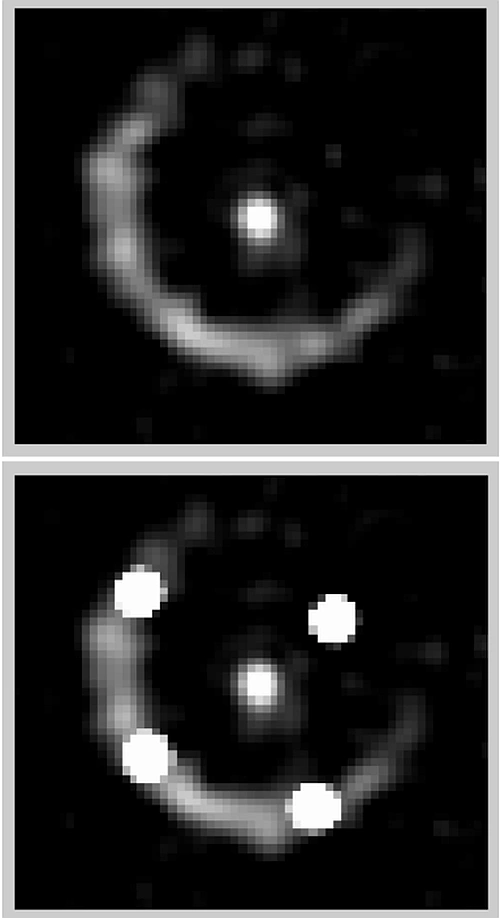
Cloverleaf quasar and the Einstein ring, image: V. Chantry, P. Magain, ESO (CC BY 4.0)
Discovery and early observations
The four images of the Cloverleaf Quasar were discovered by Hazard, Morton, Terlevich and McMahon in 1984. The international team of astronomers reported the object to be one of the brightest Broad Absorption Line Quasi-Stellar Objects (BAL QSOs) discovered to date. The study announcing the discovery was published in The Astrophysical Journal.
In 1988, Magain et al. reported gravitational lensing in the system. The team studied the four images of the quasar, similar in brightness and separated by around 1 arcsecond. After analyzing the spectra of two images, they found them to be identical apart from the presence of gas clouds in the same line of sight as one of the images. The astronomers concluded that the Cloverleaf was, beyond any doubt, a lensed system and not a cluster of quasars. The study was published in the journal Nature in July 1988.
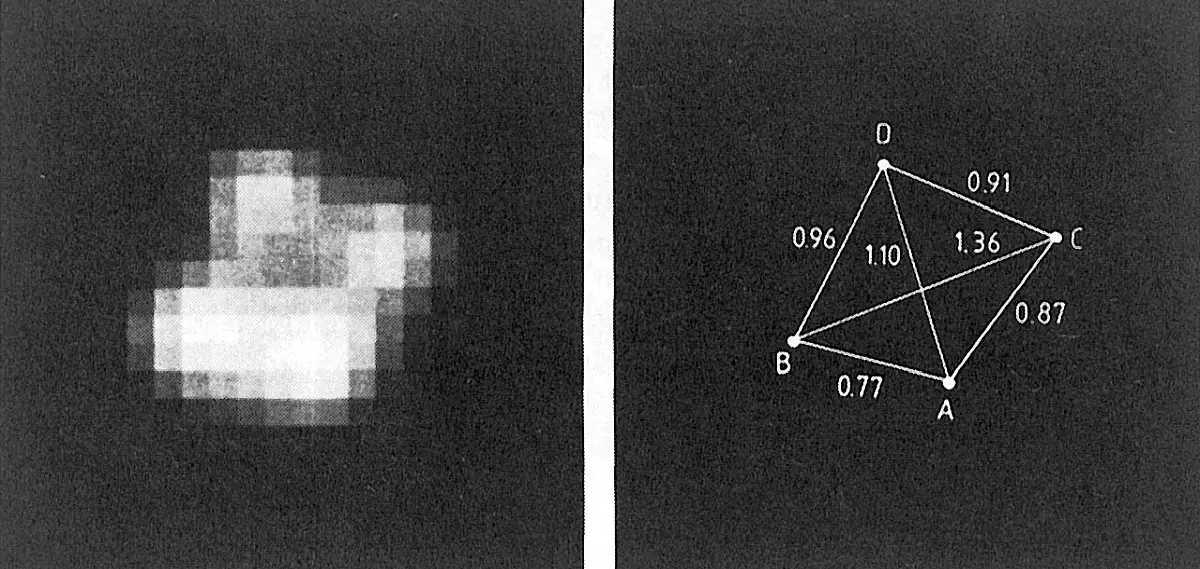
Left: The central area of a CCD image of the quadruply lensed quasar H 1413+117 (the Cloverleaf), obtained in red light on 8 March 1988 at the ESO/MPI 2.2 m telescope. The four images are clearly separated; they all belong to the same object. Right: The geometry of the system. The four images of the quasar are called A, B, C and D, in order of decreasing brightness. The distances between them are indicated in arcseconds. Image: ESO (CC BY 4.0)
Where is the Cloverleaf Quasar in the sky?
The Cloverleaf Quasar appears in the southern part of Boötes, about 8 degrees south of the bright Arcturus (Alpha Boötis). With an apparent magnitude of 17, the quasar is out of reach for amateur telescopes. It may be spotted, but not resolved, in larger telescopes.
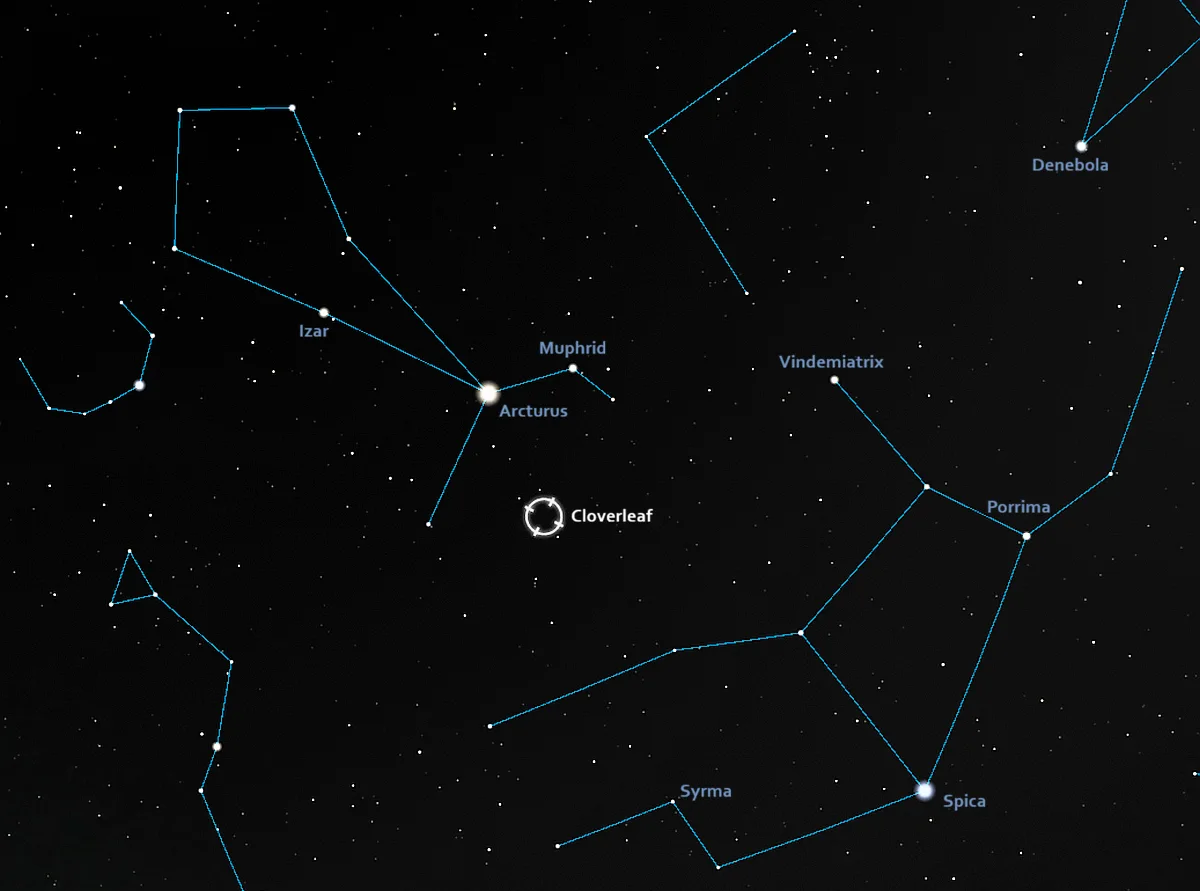
Location of the Cloverleaf Quasar, image: Stellarium (annotated for this article)
Explore the stars, asterisms and deep sky objects in Boötes:
- Teacup Galaxy (SDSS J1430+1339)
- Exclamation Point Galaxy (Arp 302)
- The Kite
- Arcturus (Alpha Boötis)
- Boötes Dwarf Galaxy (Boötes I)
Cloverleaf Quasar
| Constellation | Boötes |
| Object type | Gravitationally lensed quasar |
| Right ascension | 14h 15m 46.27s |
| Declination | +11° 29′ 43.4 |
| Apparent magnitude | 17 |
| Distance | 11 billion light-years |
| Redshift | 2.56 |
| Names and designations | Cloverleaf Quasar, QSO J1415+1129, QSO B1413+1143, QSO B1413+117, TIC 421729964, WISE J141546.24+112943.5, WISEA J141546.23+112943.5, SDSS J141546.24+112943.4, H 1413+117, LAMOST J141546.24+112943.44, SQUAD DR1 J141546+112943, [HB93] 1413+117, [SBS92] 1413+117, [HMT84] 1413+117, [HSN2016] J213.94+11.49, 2MASS J14154625+1129434, [BDW2002] q1413+1143, 2XMM J141546.2+112943, 3XMM J141546.2+112943, JCMTSE J141546.2+112943, JCMTSF J141546.2+112943, [VV2000] J141546.3+112944, [VV2003] J141546.3+112944, [VV2006] J141546.3+112944, [VV2010] J141546.3+112944, [VV96] J141546.3+112944, [VV98] J141546.3+112944 |