The Exclamation Point Galaxy (Arp 302) is a pair of spiral galaxies located 450 million light-years away in the constellation Boötes (the Herdsman). The two gas-rich galaxies are in an early stage of interaction. The pair is also catalogued as VV 340 and UGC 9618.
The galaxies that form the cosmic exclamation point are LEDA 53433 (Arp 302A, VV 340A) and LEDA 53432 (Arp 302B, VV 340B). They have a combined apparent magnitude of 11.3 and an apparent size of 1.6 arcminutes. Individually, the galaxies shine at magnitudes 15.3 and 15.7. In research papers, they are often referred to as Arp 302N (north) and Arp 302S (south).
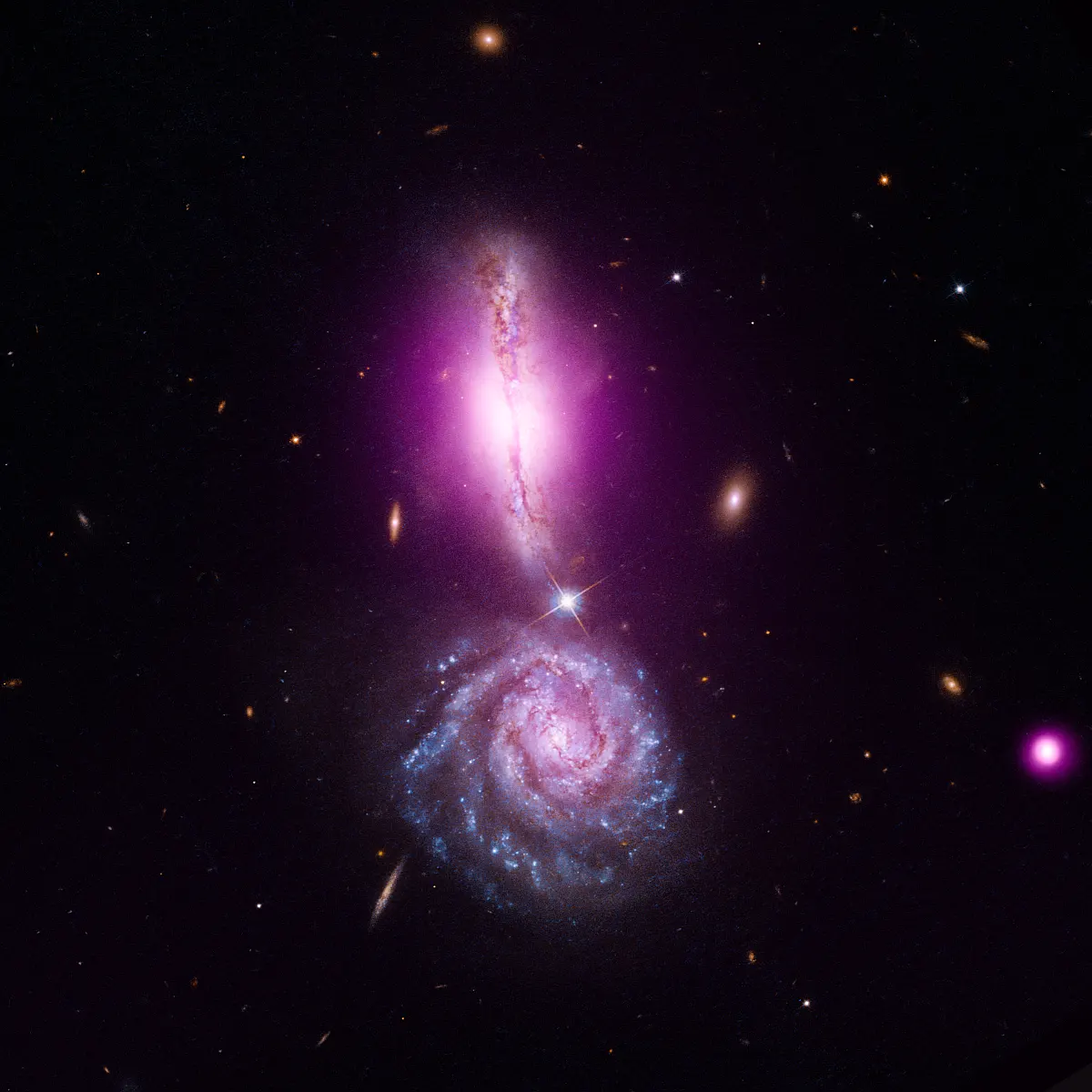
This composite image of VV 340 contains X-ray data from Chandra (purple) and optical data from Hubble (red, green, blue). The two galaxies shown here are in the early stage of an interaction that will eventually lead to them merging in millions of years. The Chandra data shows that the northern galaxy contains a rapidly growing supermassive black hole that is heavily obscured by dust and gas. Data from other wavelengths shows that the two interacting galaxies are evolving at different rates. Image credit – X-ray: NASA/CXC/IfA/D.Sanders et al; Optical NASA/STScI/NRAO/A.Evans et al. (PD)
Why the galaxies look like an exclamation point
Arp 302A and Arp 302B have different orientations with respect to Earth. The southern galaxy Arp 302A appears face-on and marks the dot in the exclamation point, while the slightly fainter Arp 302B appears edge-on. In images in which the northern edge-on spiral appears on top, the galactic pair looks like a giant exclamation point.
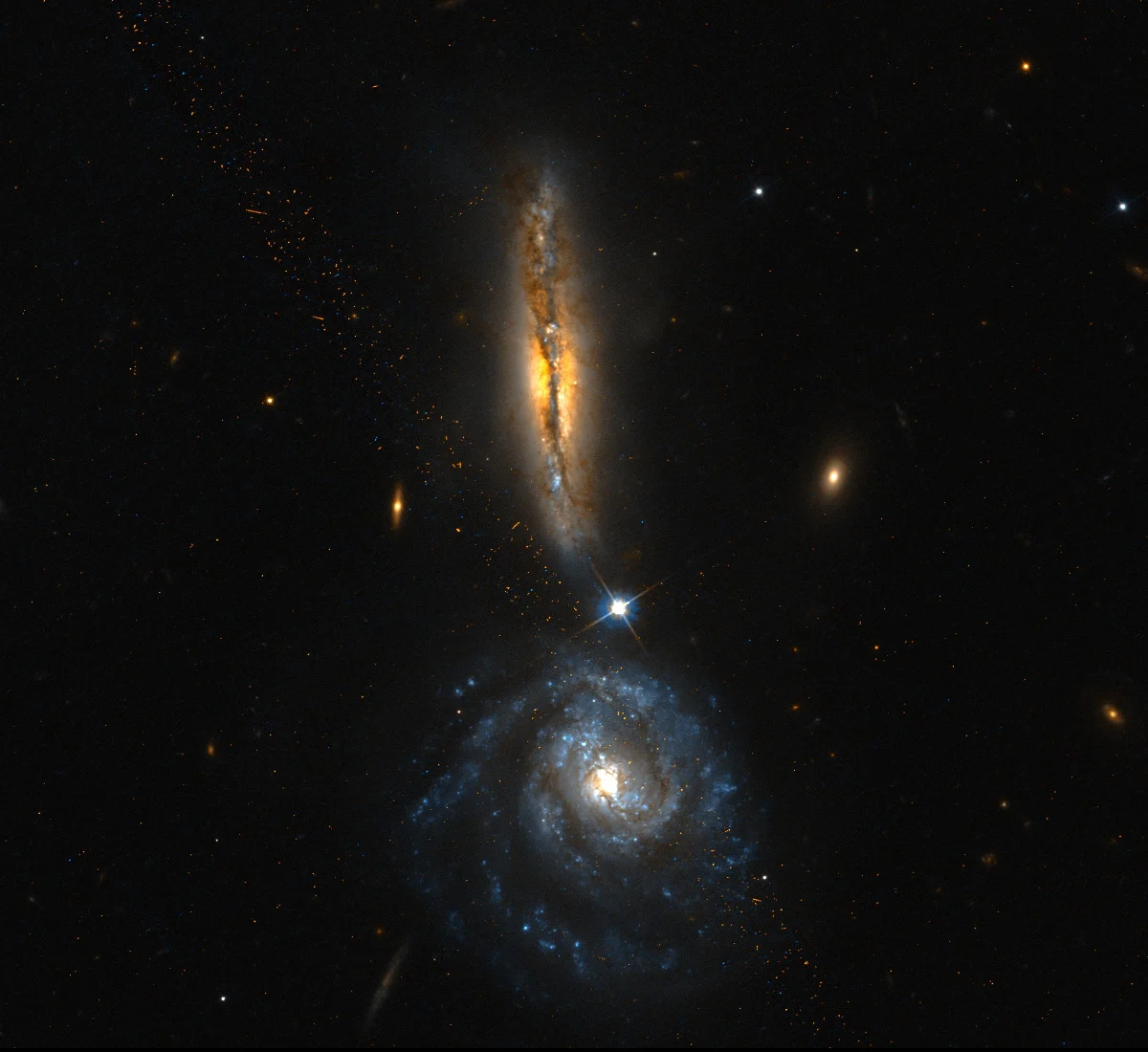
Exclamation Point Galaxy (VV 340) captured by the Hubble Space Telescope (HST), image credit: ESA, NASA & Hubble (PD)
A luminous infrared galaxy (LIRG)
Arp 302 is classified as a luminous infrared galaxy (LIRG). LIRGs typically emit more energy in the infrared than at all other wavelengths combined. Their high infrared output is usually attributed to star formation and to the presence of an active galactic nucleus (AGN) at their cores.
Many of these galaxies are in fact products of mergers of gas-rich disk galaxies. They are brighter in the infrared than in visible light because the visible light is absorbed by gas and dust. The dust re-emits the light in the infrared.
A 2003 study by Sanders et al. found an infrared luminosity of 5 × 10¹¹ solar luminosities for Arp 302. The pair’s high infrared luminosity comes primarily from its unusually large amount of molecular gas. The gas contributes to a star formation rate comparable to that of the Milky Way’s giant molecular clouds. The gas from the massive stars that are forming in the galaxies radiates large amounts of infrared light.
A multiwavelength study of Arp 302 using Hubble, Spitzer, Chandra and GALEX in 2009 pinpointed the edge-on spiral LEDA 53432 (Arp 302B) as the only source of the enhanced infrared emission. The galaxy contains an active galactic nucleus (AGN), but the contribution of the growing central supermassive black hole to the galaxy’s total energy is low. Arp 302A has a higher star formation rate and dominates the pair’s ultraviolet emissions.
A 2024 study estimated a star formation rate of 1 – 2 solar masses per year for Arp 302B based on the galaxy’s luminosity in X-rays. Observations with XMM-Newton led the researchers to propose that the galaxy’s spectral features indicate the presence of a Seyfert 2 active galactic nucleus (AGN).
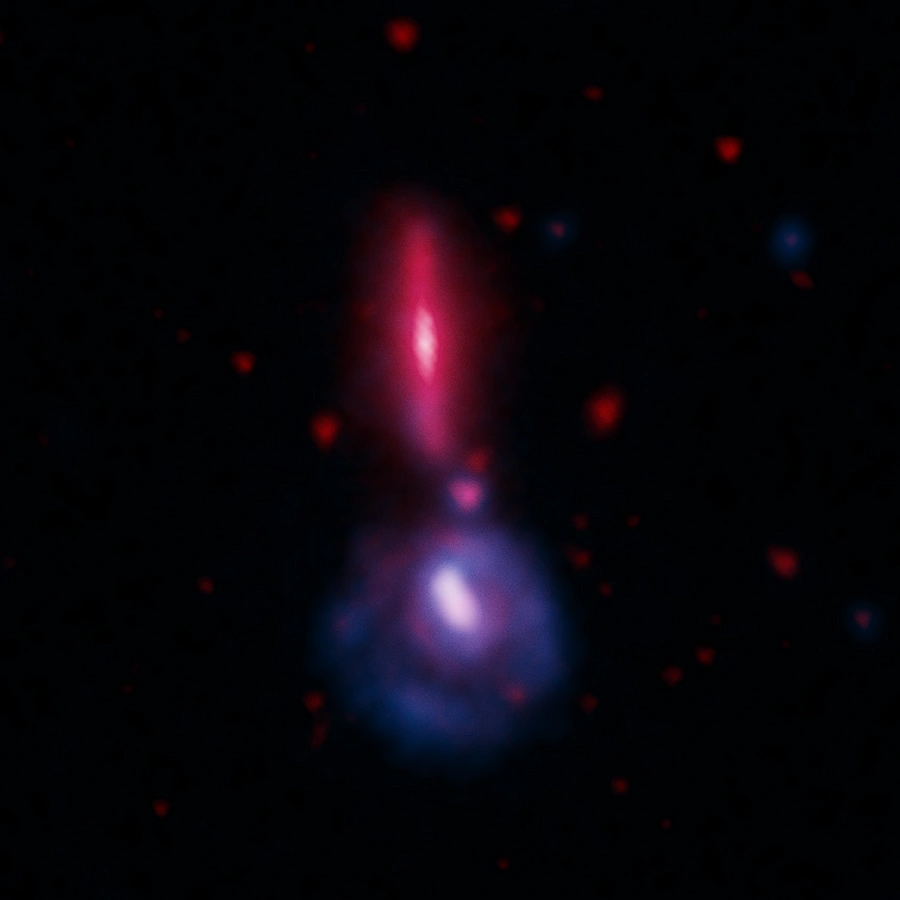
This image of VV 340 combines infrared data (red) and ultraviolet data (blue). The northern galaxy dominates in infrared, while the southern galaxy dominates in ultraviolet, indicating that the southern galaxy has a much higher rate of star formation. Image credit: NASA/JPL-Caltech/J. Mazzarella et al. (PD)
Current stage of the merger
Arp 302A and Arp 302B will ultimately merge to form a single larger galaxy. Their galactic nuclei are separated by around 40 arcseconds in the sky, corresponding to a physical distance of around 27.3 kiloparsecs (89,000 light-years). The separation between the galaxies suggests that they are in an early phase of interaction, before the onset of starbursts.
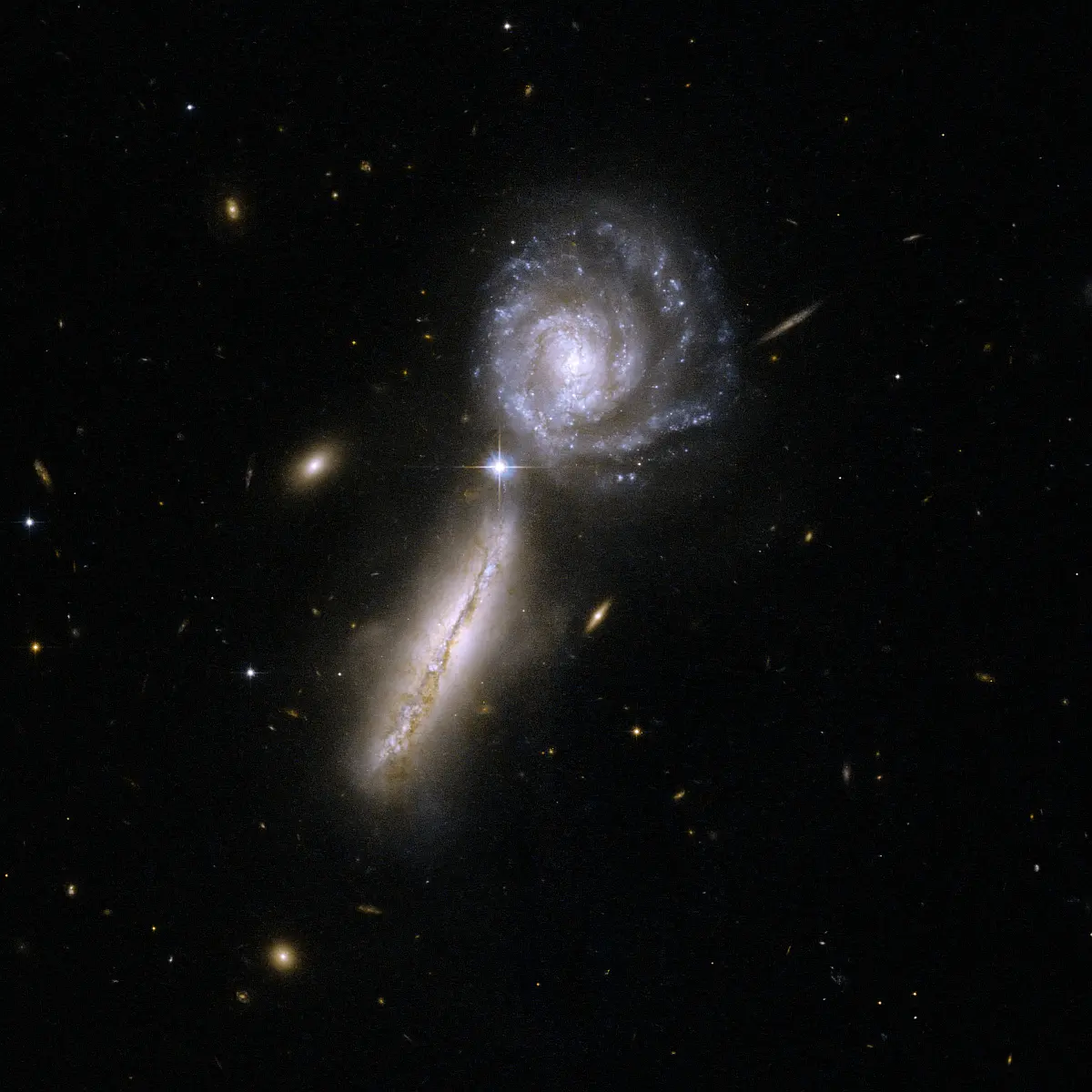
UGC 9618, also known as VV 340 or Arp 302 consists of a pair of very gas-rich spiral galaxies in their early stages of interaction: VV 340A is seen edge-on to the left, and VV 340B face-on to the right. An enormous amount of infrared light is radiated by the gas from massive stars that are forming at a rate similar to the most vigorous giant star-forming regions in our own Milky Way. UGC 9618 is 450 million light-years away from Earth, and is the 302nd galaxy in Arp’s Atlas of Peculiar Galaxies. This image is part of a large collection of 59 images of merging galaxies taken by the Hubble Space Telescope and released on the occasion of its 18th anniversary on 24th April 2008. Image credit: NASA, ESA, the Hubble Heritage (STScI/AURA)-ESA/Hubble Collaboration, and A. Evans (University of Virginia, Charlottesville/NRAO/Stony Brook University) (PD)
Location of Arp 302
The Exclamation Point Galaxy appears in the central part of Boötes (the Herdsman), near the bright Izar (Epsilon Boötis). The interacting pair can be found close to the imaginary line drawn from Rho Boötis through Izar and extended by about the same distance as that between the two stars.
Izar and Rho Boötis are part of the Kite, an asterism that dominates the Herdsman constellation. The bright Arcturus at the base of the Kite can be found by following the arc of the Big Dipper’s handle.
At declination +24° 37′, the Exclamation Point Galaxy never rises for observers south of the latitude 65° S. The best time of the year to observe Arp 302 and other deep sky objects in Boötes is during the month of June, when the constellation appears higher above the horizon in the early evening.
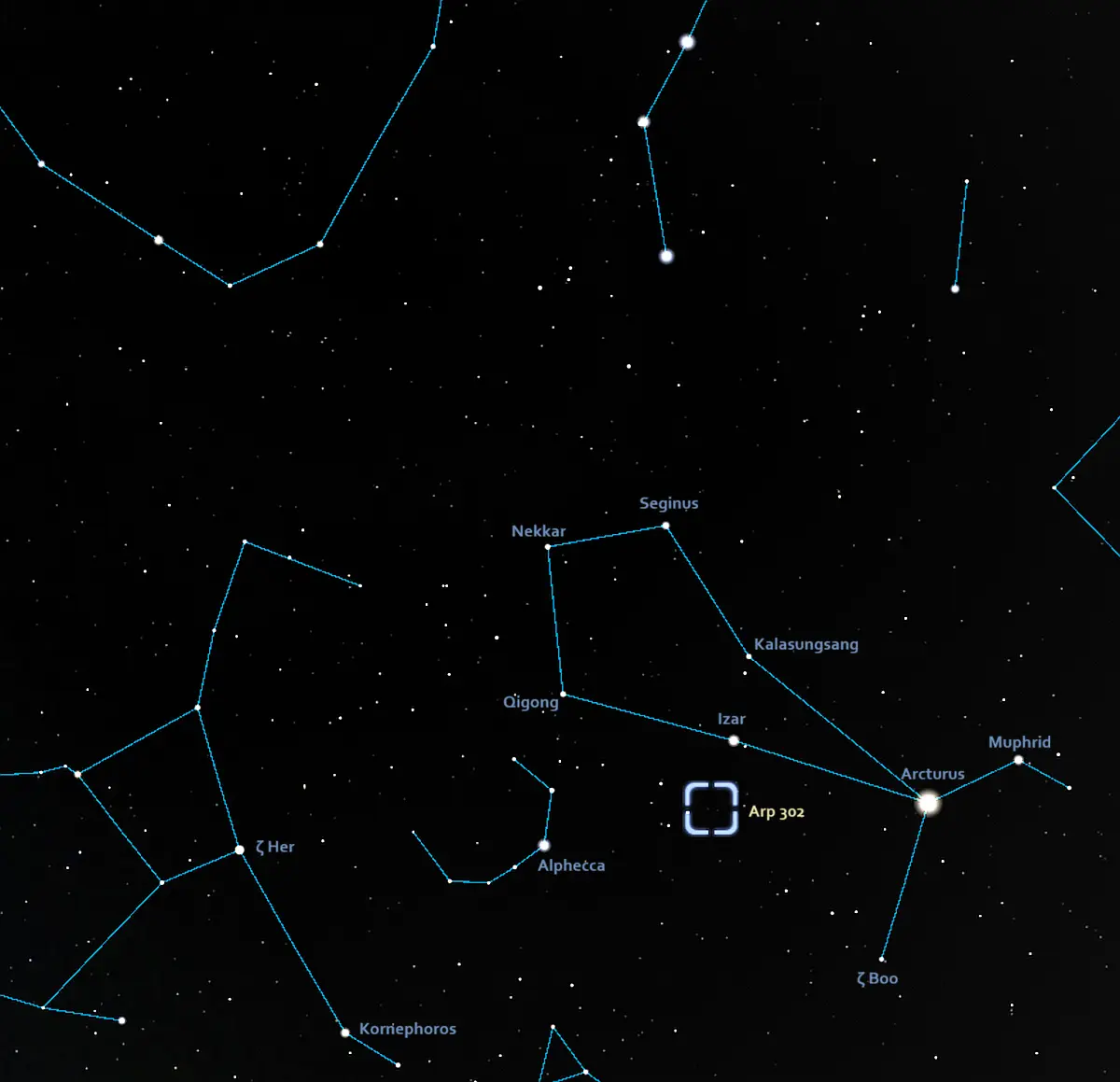
Location of the Exclamation Point Galaxy (Arp 302), image: Stellarium (annotated for this article)
Explore other interacting galaxies:
- Rose Galaxy in Andromeda
- Flying Ghost Galaxy in Pisces
- Heron Galaxy in Canes Venatici
- Antennae Galaxies in Corvus
- Mice Galaxies in Coma Berenices
Exclamation Point Galaxy
| Constellation | Boötes |
| Object type | Interacting spiral galaxies |
| Right ascension | 14h 57m 01s |
| Declination | +24° 36′ 41″ |
| Apparent magnitude | 11.3 |
| Apparent size | 1.6′ |
| Distance | 450 million light years (150 megaparsecs) |
| Names and designations | Exclamation Point Galaxy, Arp 302, VV 340, UGC 9618, KPG 446, IRAS 14547+2448, IRAS F14547+2449, PSCz Q14547+2448, Z 134-58, Z 1454.7+2448 |
Arp 302A
| Constellation | Boötes |
| Object type | Spiral galaxy |
| Morphological type | Sc |
| Right ascension | 14h 57m 00.3205510752s |
| Declination | +24° 36′ 24.138336996″ |
| Apparent magnitude | 15.3 |
| Apparent size | 0.91052′ × 0.674331′ |
| Redshift | 0.032869 |
| Heliocentric radial velocity | 9692 km/s |
| Names and designations | LEDA 53433, PGC 53433, Arp 302A, APG 302A, UGC 9618 S, VV 340a, KPG 446A, MCG+04-35-018, SDSS J145700.31+243624.2, Gaia DR2 1266297203724553856, Gaia DR3 1266297203724910208 |
Arp 302B
| Constellation | Boötes |
| Object type | Interacting spiral galaxies |
| Morphological type | S |
| Right ascension | 14h 57m 00.66647s |
| Declination | +24° 37′ 02.6720″ |
| Apparent magnitude | 15.7 |
| Apparent size | 0.713′ × 0.257′ |
| Redshift | 0.033932 |
| Heliocentric radial velocity | 10000 km/s |
| Names and designations | LEDA 53432, PGC 53432, Arp 302B, APG 302B, UGC 9618 N, VV 340b, KPG 446B, MCG+04-35-019, FIRST J145700.6+243703, 2CXO J145700.6+243703, GB6 B1454+2449, 2MASX J14570066+2437026, AGC 241225, WISEA J145700.67+243703.6, BWE 1454+2447, UZC J145700.7+243703, NVSS J145700+243701, SDSS J145700.77+243702.2, JCMTSE J145700.4+243707, JCMTSF J145700.4+243707, 87GB 145449.5+244757, 2CXO J145700.6+243703 |