Arp 194 (UGC 6945) is a group of three interacting galaxies located approximately 570 million light years away in the constellation Ursa Major (the Great Bear). The galaxies are connected by a large bridge of dust, gas and stars more than 100,000 light-years across.
The catalogue designation Arp 194 comes from American astronomer Halton Arp’s Atlas of Peculiar Galaxies (1966). Arp listed the object as an example of a galaxy with material expelled from its nucleus. This material, described as “outer material connected by thin filament to very hard nucleus,” is in fact a separate galaxy.
NASA’s Hubble Space Telescope imaged the galactic trio with its Wide Field Planetary Camera 2 in 2009, releasing the image to mark the telescope’s 19th anniversary. The Hubble observations showed that the blue stream lies in front of the southern component, which initially made it unclear whether the southern galaxy was truly interacting with the northern pair. Later observations resolved the question: the southern galaxy had in fact passed through the gaseous disk of the northern component, creating the bridge between them.
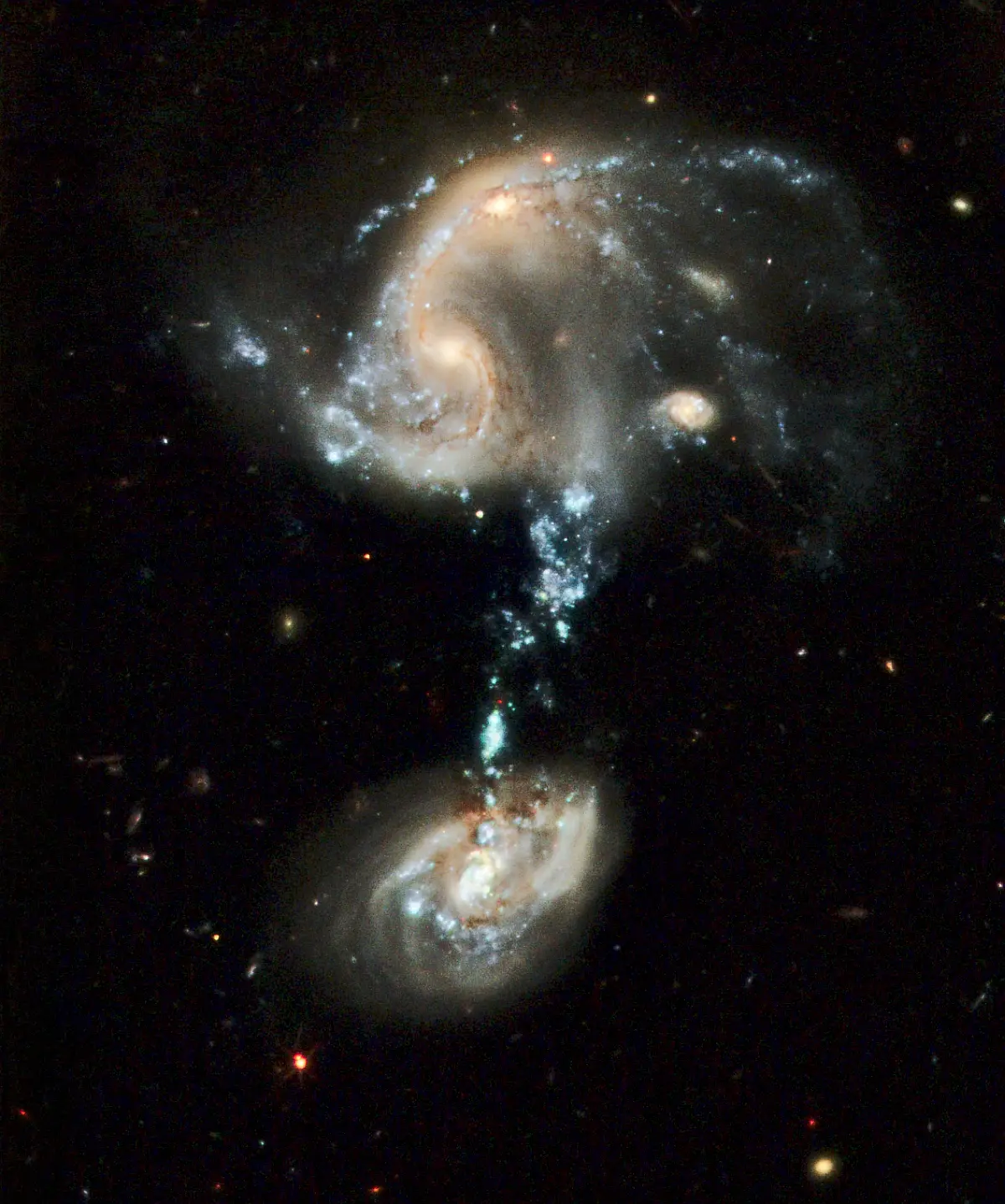
Just when you thought these interactions couldn’t look any stranger, this image of a trio of galaxies, called Arp 194, looks like one of the galaxies has sprung a leak. The bright blue streamer is really a stretched spiral arm full of newborn blue stars. This typically happens when two galaxies interact and gravitationally tug at each other. Resembling a pair of owl eyes, the two nuclei of the colliding galaxies can be seen in the process of merging at the upper left. The blue bridge looks like it connects to a third galaxy. In reality the galaxy is in the background and not connected at all. Hubble’s sharp view allows astronomers to try and visually sort out what are foreground and background objects when galaxies, superficially, appear to overlap. This picture was issued to celebrate the 19th anniversary of the launch of the Hubble Space Telescope aboard the space shuttle Discovery in 1990. Image credit: NASA, ESA, and the Hubble Heritage Team (STScI/AURA) (PD)
The northern galaxies
The northern component of Arp 194 is the result of a merger at least two galaxies whose nuclei shine bright in images taken by Hubble. The galaxies appear to be in an early stage of merging. They have an apparent size of 0.8 × 0.6 arcminutes.
The two disk galaxies are connected by a stellar bridge or a distorted spiral arm. They are surrounded by an expanding collisional ring structure that contains gas and regions of active star formation.
In a galaxy merger like this one, two galaxies are drawn together by gravity and gradually combine into one larger system. The process can take hundreds of millions of years. During that time, the dense, bright cores of each galaxy remain distinct before eventually coalescing. The two bright nuclei visible in the northern component indicate that the merger is still at an early stage.
The third spiral galaxy
A smaller spiral galaxy appears near the two brighter northern galaxies but appears relatively unaffected by the tidal forces of the collision. Tidal forces are gravitational effects that distort galaxies when they begin to interact with each other.
In the chaotic environment of Arp 194, it is notable that the smaller galaxy has retained its structure. However, its proximity to the interacting pair means it is still part of the same gravitational system.
The southern galaxy
The southern component of Arp 194 consists of a single large spiral galaxy that is connected to the northern pair by a blue stream of material. The galaxy has an angular size of 0′.35 × 0′.35. The Simbad database lists it as a radio galaxy.
The blue bridge of material
The most striking feature of Arp 194 is the bright blue stream of material extending from the northern component toward the southern galaxy. This stream is a starburst region containing a chain of star-forming knots and many young super star clusters composed of hot, massive stars. Astronomers estimate that the stream hosts millions of young stars that formed as a result of the galactic collision. They found no evidence of older stars in the region, only stars that are 10 to 100 million years old.
The blue colour of the stream is not a coincidence. Hot, massive young stars emit most of their light at short wavelengths, producing the vivid blue glow seen in Hubble images. In contrast, older, cooler stars tend to appear yellow or red.
The uniform youth of the stars in the bridge is one reason astronomers have studied Arp 194 so closely. The system offers a snapshot of rapid star formation triggered by a galactic collision.
Tidal bridge or splash bridge?
The bridge connecting the northern and southern galaxies is a candidate splash bridge, a structure that forms from the direct collision of two gas-rich spiral galaxies. As a result of the collision, gas is “splashed” out from the disks due to shocks and hydrodynamical processes rather than by gravitational forces alone.
The gas splashed out from the galactic disk during the collision remains gravitationally bound to the parent galaxy and will eventually fall back into it. The Taffy Galaxy in the constellation Pegasus is a prototypical example.
Like tidal bridges, splash bridges are elongated structures composed of stars and gas that connect two or more interacting galaxies. However, they form in different ways. Tidal bridges form in close interactions, much like tidal tails, and are composed of stars and gas that were pulled out of the disks by tidal forces. As gravity pulls streamers of gas and stars from each galaxy, it forms a connecting structure made largely of older stars. These bridges are typically found in encounters in which the galactic disks do not directly clash.
Splash bridges are not primarily formed by tidal forces and are temporary gas structures. They are the result of a more direct impact. Gas from both disks collides head-on at high speed, sending material outward. Because this gas has not had time to form stars before the collision, any stars that do appear in the bridge are very young, having formed from the compressed gas after impact.
The material in the splash bridge is re-accreted by the nearest galaxy over the course of the merger. When the galaxies ultimately merge, whatever material is left in the bridge will also be merged into the new larger galaxy.
A hybrid structure
A 2024 study published in Monthly Notices of the Royal Astronomical Society found that the stream connecting the northern and southern galaxies in Arp 194 may be a hybrid tidal/splash bridge.
Unlike most known splash bridges, it hosts a stream of star-forming knots that extends for tens of kiloparsecs (one kiloparsec is roughly 3,260 light-years). The presence of active star formation within the bridge is unusual for a splash bridge, which typically suppresses star formation due to turbulence in the colliding gas clouds.
The tidal dwarf galaxy
In 2016, Zasov et al. confirmed, in a paper published in Monthly Notices of the Royal Astronomical Society, that a bright region in the bridge is a tidal dwarf galaxy with an estimated age of 10 million to 100 million years. The dwarf is gravitationally bound to the southern galaxy and is falling onto it.
Tidal dwarf galaxies are small, gravitationally bound galaxies that form from the debris of galactic collisions. They are built from material stripped from the outer disks of larger galaxies during an interaction. Because they form from pre-enriched disk material, tidal dwarfs tend to have a higher abundance of heavy elements than typical dwarf galaxies of comparable size. The one found in Arp 194 offers a rare opportunity to study this process in detail.
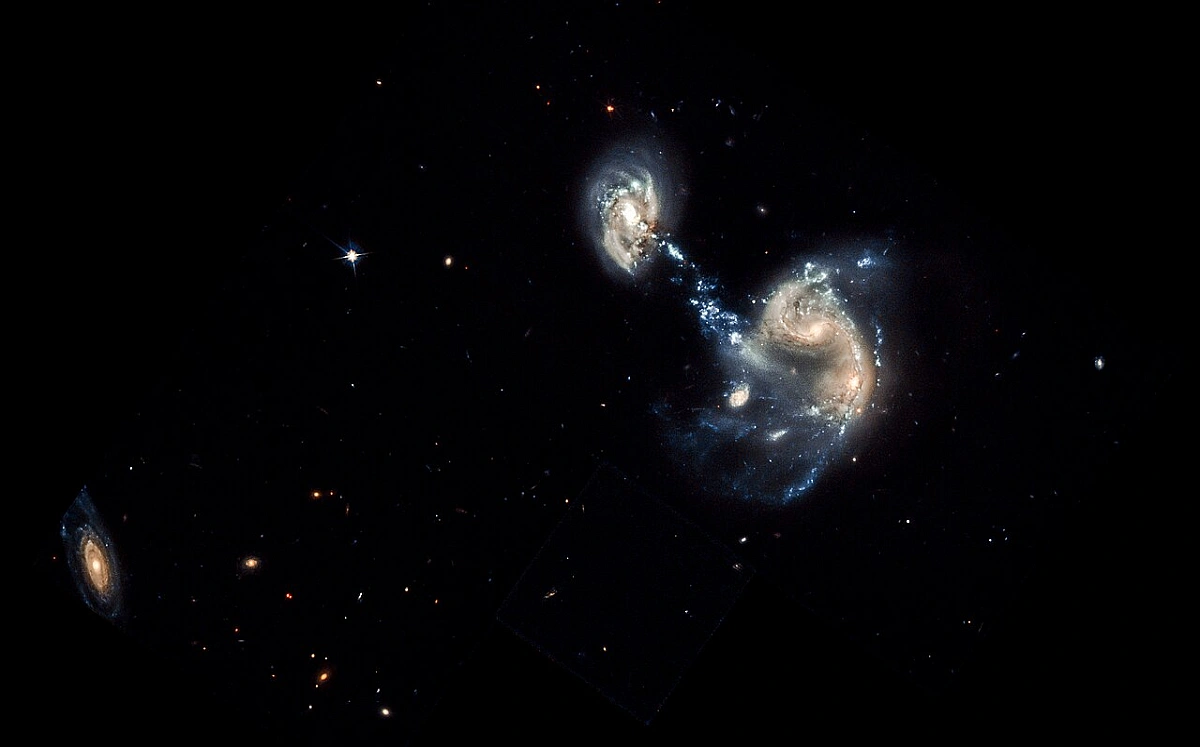
Arp 194 (UGC 6945), image credit: NASA/Hubble Team/Hubble Heritage/Kevin M. Gill (CC BY 2.0)
Compact galaxy group
The Simbad database lists Arp 194 as a member of the galaxy group SDSSCGB 19. The compact galaxy group includes:
- the spiral galaxy SDSS J115754.85+362333.8 (the left galaxy in the northern component)
- the irregular galaxy SDSS J115754.45+362341.2 (the right northern galaxy)
- the radio galaxy SDSS J115756.56+362300.1 (the southern galaxy)
- the face-on spiral galaxy SDSS J115753.83+362319.9 (the smaller galaxy right of the main pair)
- SDSS J115753.27+362326.7 (the galaxy appearing above the small face-on spiral)
A compact galaxy group is a small, dense cluster of galaxies that are close to one another in space. Because the member galaxies are gravitationally bound, they interact more frequently than galaxies in looser groupings, making them valuable for studying collisions and mergers.
How to find Arp 194
Arp 194 lies in the southern part of Ursa Major, near the border with Canes Venatici (the Hunting Dogs). It is located roughly halfway between Megrez in the Big Dipper and Denebola at the Lion’s tail. The interacting galaxies appear close to the imaginary line connecting Cor Caroli in Canes Venatici and Alula Borealis in the Great Bear’s rear foot.
Arp 194 is too small and faint to be observed visually in amateur telescopes, but it may be captured photographically in larger telescopes under dark skies. Given its small angular size, a relatively long focal length and careful guiding are needed to resolve any detail in the system.
The best time to observe the deep sky objects in Ursa Major is during the northern hemisphere spring, when the Great Bear stays high above the horizon throughout the night.
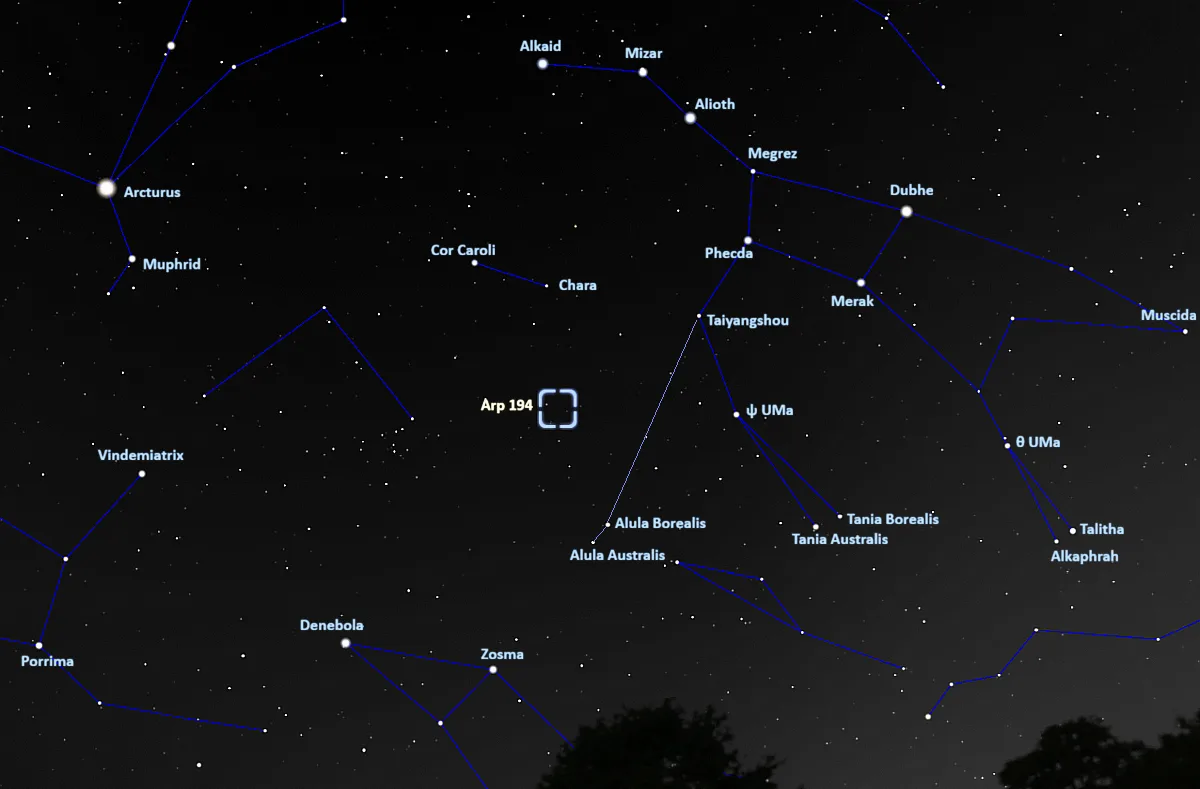
Arp 194 location, image: Stellarium (annotated for this article)
Explore other deep sky objects in Ursa Major:
- Pinwheel Galaxy (Messier 101)
- Owl Nebula (Messier 97)
- Cheshire Cat Galaxy Group (CSWA-2)
- Mayall’s Object
- Helix Galaxy (NGC 2685)
Arp 194 (UGC 6945)
| Constellation | Ursa Major |
| Object type | Interacting galaxies |
| Morphological type | S |
| Right ascension | 11h 57m 54.8497478760s |
| Declination | +36° 23′ 33.932788152″ |
| Apparent size | 0.639683′ × 0.52422′ |
| Distance | 570 million light-years (175 Mpc) |
| Redshift | 0.035091 ± 0.000420 |
| Heliocentric radial velocity | +10,336 ± 126 km s−1 |
| Names and designations | Arp 194, APG 194, LEDA 37639, PGC 37639, UGC 6945, VV 126, MCG+06-26-062, UZC J115754.9+362332, SDSSCGB 19.1, SDSS J115754.85+362333.8, 2MASS J11575487+3623340, WISE J115754.90+362333.9, Z 186-76, Z 1155.3+3640 |