Arp 107 is a pair of colliding galaxies located approximately 465 million light years away in the constellation Leo Minor. It consists of the spiral galaxy UGC 5984 (PGC 32620) and the smaller elliptical galaxy MCG+05-26-025 (PGC 32628). The interacting pair has an apparent magnitude of 14.6 and an apparent size of 1.40 by 0.11 arcminutes.
Close interactions and collisions between galaxies can significantly change the galaxies’ morphologies. Depending on the nature of the close encounter, these events can produce a broad variety of structures, including collisional rings, long tidal tails and bridges between the galaxies.
The Arp 107 systems contains a prominent spiral arm in the southern portion of the larger spiral galaxy, a bridge connecting the two galaxies in the northeast, and a tidal tail to the northwest.
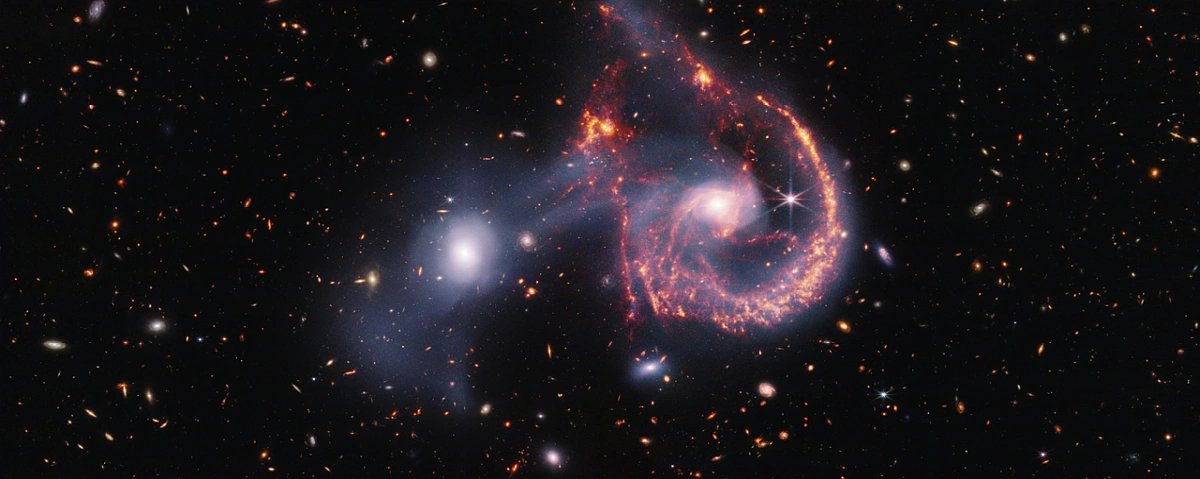
This composite image of Arp 107, created with data from the James Webb Space Telescope’s NIRCam (Near-Infrared Camera) and MIRI (Mid-Infrared Instrument) reveal a wealth of information about the star-formation and how these two galaxies collided hundreds of million years ago. his collision not only began a new bout of star formation in the region, but also an endearing smile. Credit: NASA, ESA, CSA, STScI, M. Garcia Marin (STScI) and A. Pagan (STScI) CC BY 4.0)
A cosmic odd couple
The two galaxies that form Arp 107 are very different. The larger Arp 107A (PGC 32620) is a spiral galaxy with a prominent single spiral arm that has been affected by the interaction with its smaller neighbour. Arp 107B (PGC 32628) is an elliptical galaxy, a featureless ellipsoidal ball of older, less massive stars.
The galaxies are connected by a tidal tail and faint bridge of stars, gas and dust, indicating a close interaction in the recent past. Galactic collisions cause increased star formation in the affected galaxies. They compress interstellar gas, creating the conditions to form new stars.
Arp 107 shares similarities with the better-known Cartwheel Galaxy (ESO 350-40), a striking ring galaxy in the constellation Sculptor. Both have prominent rings and are products of a direct collision with a smaller companion. However, unlike the Cartwheel, Arp 107A suffered an off-centre hit that severely affected its spiral arms.
The smiling spiral giant: PGC 32620
PGC 32620 is a giant spiral galaxy with a diameter of 348,000 light-years. While it is not as large as the Condor Galaxy (NGC 6872, 716,000 ly) in the constellation Pavo and the Godzilla Galaxy (UGC 2885, 438,060 ly) in Perseus, it is one of the larger known spiral galaxies. It dwarfs the Milky Way (87,400 ly) and its larger neighbours, including the Andromeda Galaxy (M31, 152,000 ly), NGC 2403 (Caldwell 7, 90,300 ly), the Hidden Galaxy (IC 342, 150,000 ly), the Claw Galaxy (Caldwell 62, 93,000 ly), and the Sculptor Galaxy (Caldwell 65, 120,500 ly).
PGC 32620 has an active galactic nucleus and was classified as a type 2 Seyfert galaxy by Keel et al. in 1985. It has the characteristic bright core that shines in the infrared. The supermassive black hole at the galaxy’s centre is surrounded by an accretion disk of infalling material that is detectable in the ultraviolet part of the spectrum.
While it looks like a normal spiral galaxy in visible light images, observations in other wavelengths reveal that the luminosity of the galaxy’s active core is comparable to that of the entire Milky Way.
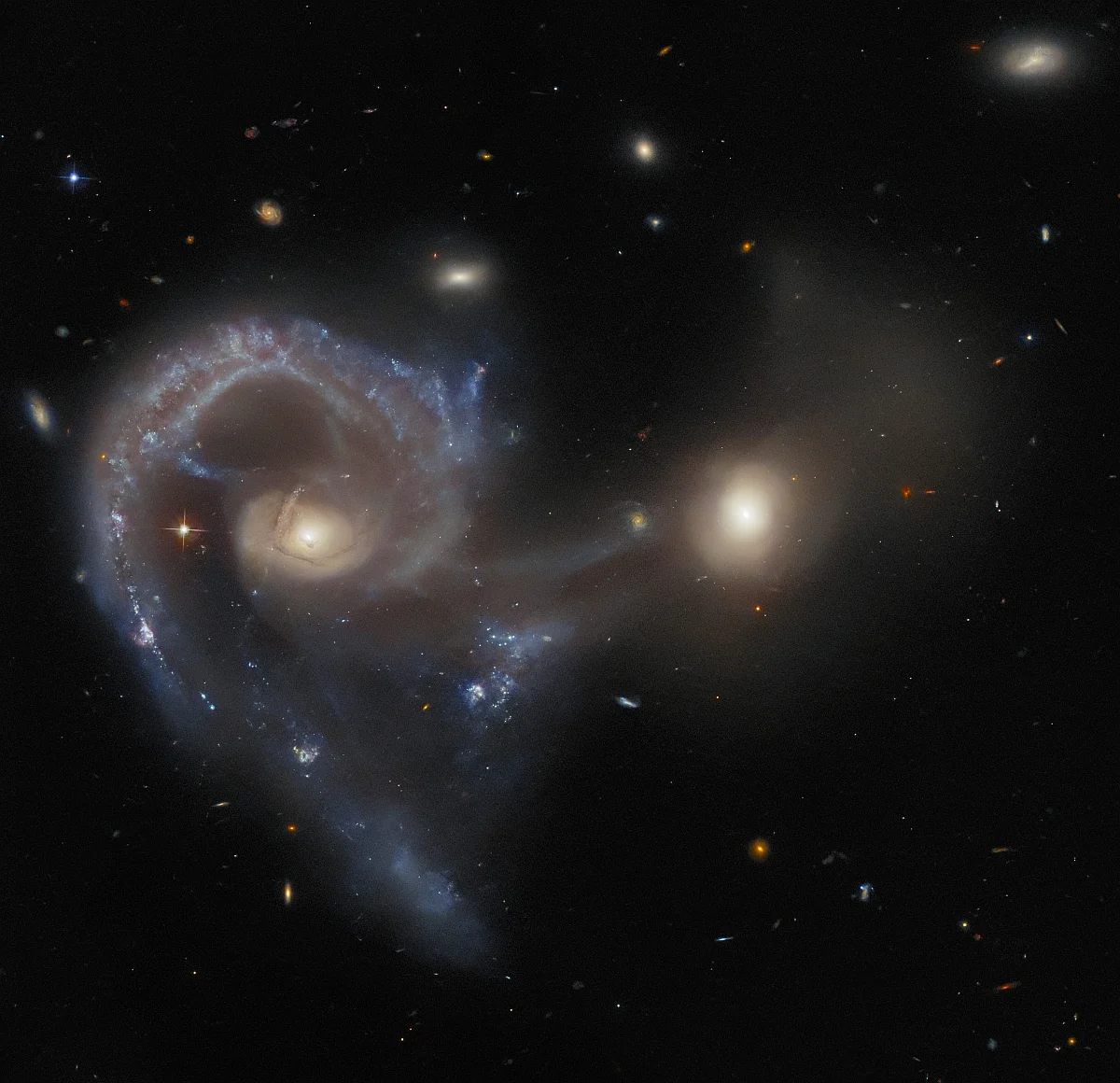
This Hubble Picture of the Week— taken using NASA/ESA Hubble Space Telescope’s Advanced Camera for Surveys (ACS) — shows Arp 107, a celestial object that comprises a pair of galaxies in the midst of a collision. The larger galaxy (in the left of this image) is an exceptionally energetic galaxy type known as a Seyfert galaxy, which house active galactic nuclei at their cores. Seyfert galaxies are notable because despite the immense brightness of the active core, radiation from the entire galaxy can be observed. This is evident in this image, where the spiraling whorls of the whole galaxy are readily visible. The smaller companion is connected to the larger by a tenuous-seeming ‘bridge’, composed of dust and gas. Arp 107 is part of a catalogue of 338 galaxies known as the Atlas of Peculiar Galaxies, which was compiled in 1966 by Halton Arp.It was observed by Hubble as part of an observing programme that specifically sought to fill in an observational ‘gap’, by taking limited observations of members of the Arp catalogue. Part of the intention of the observing programme was to provide the public with images of these spectacular and not-easily-defined galaxies. Image: ESA/Hubble & NASA, J. Dalcanton (CC BY 4.0)
Why does it look like it is smiling?
In images obtained with the Hubble, Spitzer and James Webb telescopes, Arp 107A appears as a giant cosmic smiling face. The smile is particularly striking in the James Webb images, which show two prominent eyes, a bright nose, and a big smile encircling the bright galactic core.
The galaxy’s ring-like appearance is the result of a collision with the smaller elliptical companion. Astronomers believe that PGC 32628 crashed though the larger galaxy’s disk, severely disrupting its spiral structure. The encounter produced the semicircular “smile,” formed by the galaxy’s large protruding spiral arm.
The spiral arm of Arp 107A branches out into a tidal arm of stars and gas that hosts numerous young star-forming regions and young star clusters.
The elliptical interloper: PGC 32628
PGC 32628 is slightly smaller than the Milky Way, with a diameter of 70,000 light-years. It appears significantly affected by the interaction with its larger companion, but its smooth elliptical appearance is still evident.
The galaxy is connected to its spiral neighbour by a bridge of white stars and gas that were pulled out of both galaxies during the close encounter.
Decades of discovery: From Arp’s Atlas to Webb’s infrared eye
PGC 32620 and PGC 32628 were listed as VV 233 by the Russian astrophysicist Boris Vorontsov-Velyaminov in The Atlas Catalogue of Interacting Galaxies of 1959. Vorontsov-Velyaminov identified the two objects as spiral and elliptical galaxies. He discovered most of the interacting pairs included in his Atlas on plates obtained in the Palomar Observatory Sky Survey (POSS).
American astronomer Halton Arp included the galaxies in his Atlas of Peculiar Galaxies (1966) as Arp 107. He noted, “Double arm leads to E gal., diffuse material out other side of E galaxy.”
Spitzer Space Telescope studies
In 2005, infrared observations with the Spitzer Space Telescope helped astronomers distinguish between the star forming regions of Arp 107 and distant background quasars and foreground stars. A team led by Beverly J. Smith found that the interacting system is the result of a hybrid collision, one similar to both collisional ring galaxies like the Cartwheel and to bridge/tail systems like the famous Whirlpool Galaxy (M51) in Canes Venatici.
Modelling indicated that the strongest compression occurred along the larger galaxy’s primary spiral arm, where Spitzer resolved numerous young star-forming regions. The study was published in the Astronomical Journal in November 2005.
In 2013, Lapham et al. analyzed optical, infrared and ultraviolet observations of Arp 107 and found that the star-forming regions in the system were relatively quiescent compared to those in other interacting galaxies.
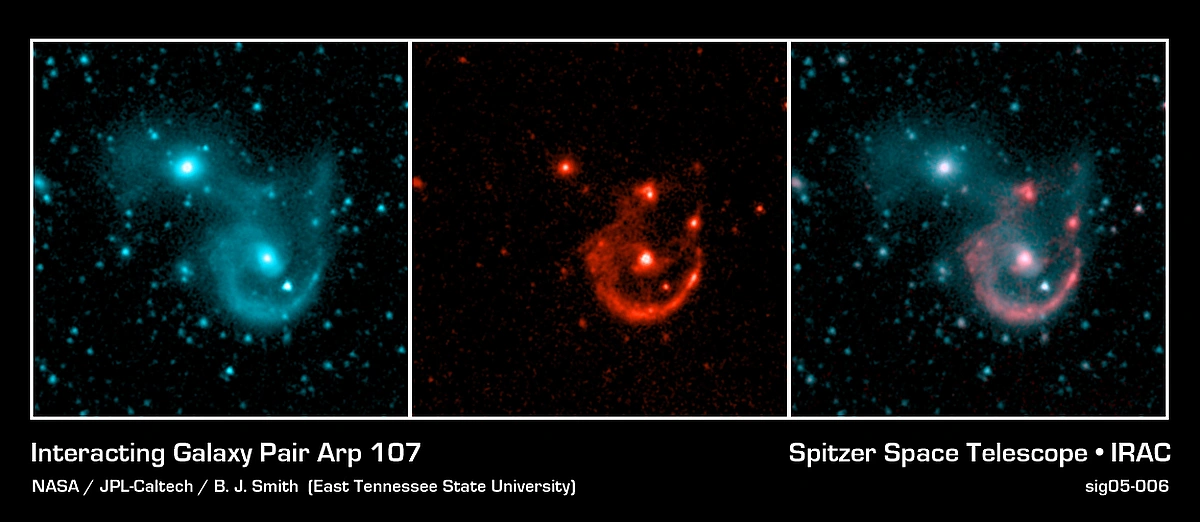
NASA’s Spitzer Space Telescope’s sensitive infrared detectors map out faint regions of new star formation in this pair of colliding galaxies known as Arp 107. Like a beautiful pearl necklace, young star clusters have formed along the ring-like tidal arm in this system. Spitzer images at 8 microns (second picture above) provide a clear view of these clumps of young stars. In contrast, in the shorter wavelength 3.6 micron band (first picture), the older stars in the small companion to the northeast and the bridge connecting the two galaxies are bright. Image credit: NASA/JPL-Caltech/B. J. Smith (East Tennessee State University) (PD)
Hubble Space Telescope imaging
In 2023, Hubble’s Advanced Camera for Surveys (ACS) captured the interacting pair as part of a limited survey of galaxies in Arp’s catalogue. The image showed the galaxies’ glowing luminous cores, bright blue star-forming regions, and the stream of material connecting the pair.
James Webb Space Telescope observations
Arp 107 was imaged by the James Webb Space Telescope (JWST) in 2024. The colliding galaxies were captured both by Webb’s NIRCam (Near-Infrared Camera) and MIRI (Mid-Infrared Instrument). Data obtained in the near-infrared has revealed the older stars in both galaxies and the white bridge of stars pulled out from the galaxies in high resolution.
MIRI provided researchers with a clearer glimpse of the Arp 107A’s bright core as well as of the star forming regions and dust in the two galaxies.
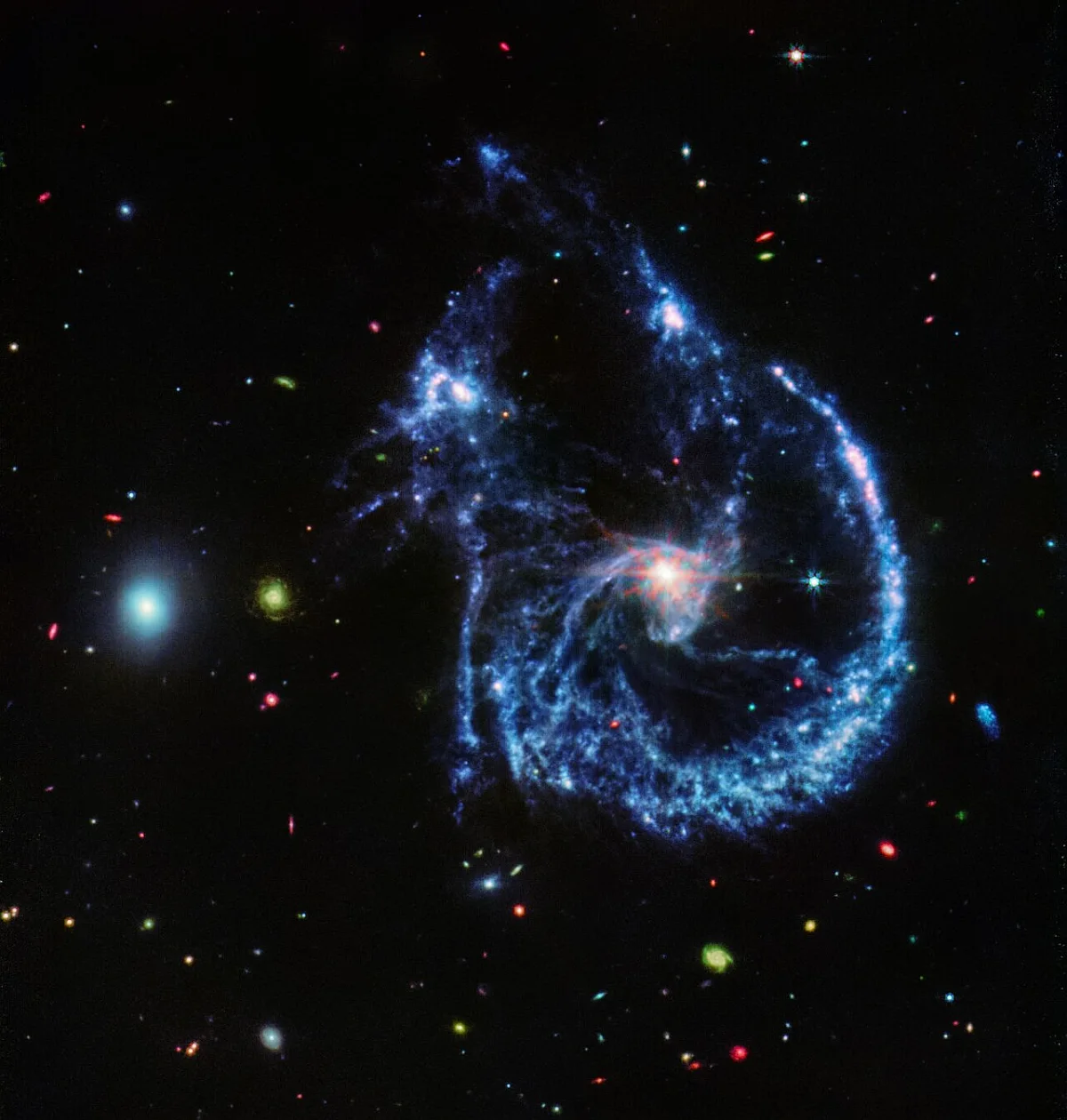
This image of Arp 107, obtained by Webb’s MIRI (Mid-InfraRed Instrument), reveals the supermassive black hole that lies in the centre of the large spiral galaxy to the right, as evidenced by the small, bright central ‘core’. This bright core, where the black hole is pulling much of the dust into lanes, also features Webb’s characteristic diffraction spikes, caused by the light that it emits interacting with the structure of the telescope itself. Perhaps the defining feature of the region, which MIRI reveals, are the millions of young stars that are forming, highlighted in blue. These stars are surrounded by dusty silicates and soot-like molecules known as polycyclic aromatic hydrocarbons. The small elliptical galaxy to the left, which has already completed much of its star formation, is composed of many of these organic molecules. Image credit: NASA, ESA, CSA, STScI (CC BY 4.0)
How to find Arp 107
Arp 107 lies in the faint constellation Leo Minor (the Smaller Lion), in the same area as the constellation’s brightest star, Praecipua. The interacting pair can be found using the more conspicuous stars of the Three Leaps of the Gazelle asterism in Ursa Major and the Sickle of Leo in Leo.
The Three Leaps asterism consists of three pairs of stars (Alula Borealis and Alula Australis, Tania Borealis and Tania Australis, and Talitha and Alkaphrah) that mark the Great Bear’s feet. Praecipua appears in the region between the first and second leaps.
The colliding galaxies appear a little more than halfway from Tania Australis to Zosma at the Lion’s hip, or about a quarter of the way from Alula Australis to Epsilon Leonis at the tip of the Sickle.
With an angular size of 1.4 by 0.11 arcminutes, Arp 107 is a difficult target even for larger amateur telescopes.
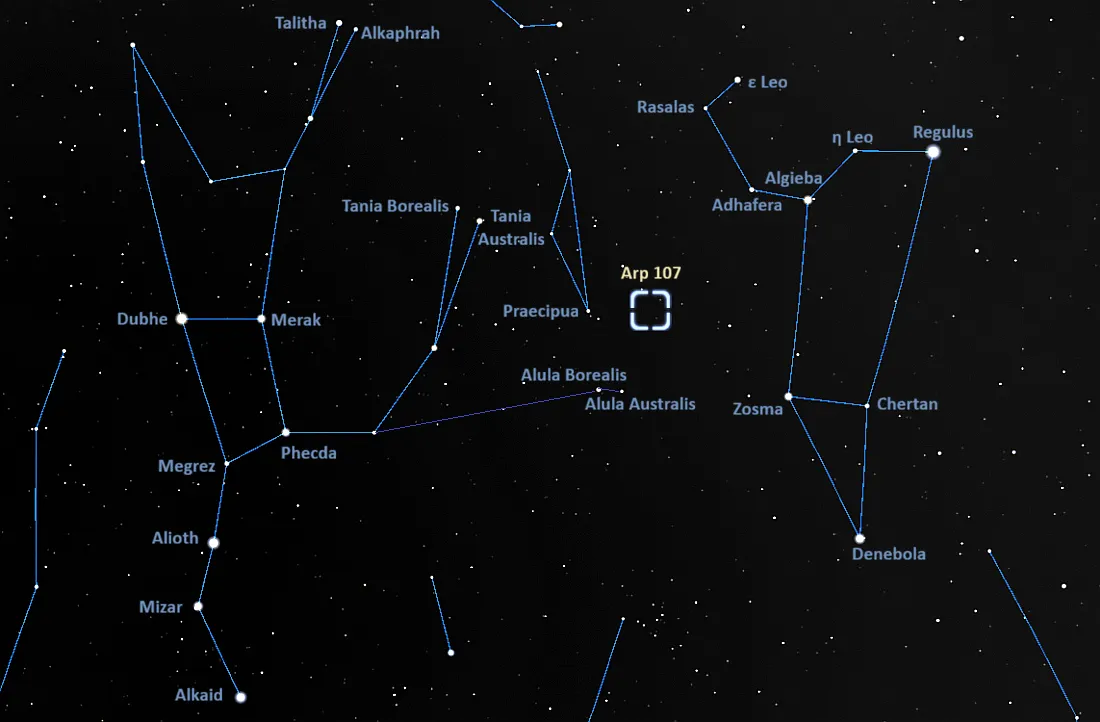
Arp 107 location, image: Stellarium (annotated for this article)
Explore other interacting galaxies listed in Arp’s catalogue:
- Rose Galaxy (Arp 273) in Andromeda
- Tadpole Galaxy (Arp 188) in Draco
- Arp 272 in Hercules
- Loony Galaxy (Arp 263) in Leo
- Arp 220 in Serpens
- Arp 194 in Ursa Major
Arp 107
| Constellation | Leo Minor |
| Object type | Interacting galaxies |
| Apparent magnitude (B) | 14.6 |
| Distance | 465 million light-years (142.57 megaparsecs) |
| Names and designations | Arp 107, APG 107, UGC 5984, KPG 254, VV 233 |
PGC 32620
| Object type | Spiral galaxy |
| Morphological type | SA(s)cP |
| Right ascension | 10h 52m 14.9479088736s |
| Declination | +30° 03′ 28.370430468″ |
| Apparent size | 1.2924′ × 0.8783′ |
| Size | 348,000 light-years |
| Redshift | 0.03451 |
| Heliocentric radial velocity | 10167 km/s |
| Names and designations | PGC 32620, LEDA 32620, MCG+05-26-024, Arp 107A, APG 107A, UGC 5984a, KPG 254a, VV 233a, FIRST J105214.9+300328, CASG 71, Z 155-31, Z 1049.5+3020, [HB91] 1049+303, [SSA2005] 14, 2MASS J10521494+3003285, 2MASX J10521491+3003289, SDSS J105214.95+300328.3, TIC 165686686, UZC J105215.0+300328, Gaia DR2 734838500272473216, Gaia DR3 734838500272473216 |
PGC 32628
| Object type | Elliptical galaxy |
| Morphological type | E1P |
| Right ascension | 10h 52m 18.4900651944s |
| Declination | +30° 04′ 20.969881176″ |
| Apparent size | 0.437′ × 0.332′ |
| Size | 70,000 light-years |
| Redshift | 0.03485 |
| Heliocentric radial velocity | 10266 km/s |
| Names and designations | PGC 32628, LEDA 32628, MCG+05-26-025, KPG 254b, VV 233b, UGC 5984b, [SSA2005] 28, 2MASS J10521848+3004211, 2MASX J10521845+3004209, SDSS J105218.49+300420.9, TIC 165686682, Gaia DR3 736339745961338368 |