The Stingray Cluster is a bright open star cluster located 2,170 light-years away in the constellation Perseus. With an apparent magnitude of 6.7 and an angular size of 34.7 by 34.7 arcminutes, it can be spotted in binoculars and small telescopes. The cluster is listed as NGC 1342 in the New General Catalogue.
NGC 1342 has an estimated age of 450 million years. Its brightest stars shine at magnitude 10. The cluster is sometimes called the Little Scorpion Cluster because it resembles the constellation figure of Scorpius. The brightest portion of the cluster is 17 arcminutes across and may be visible to the unaided eye in exceptionally good conditions.
In 2025, a team of astronomers at the Programme of Astronomy and Space Sciences, Istanbul University, found 111 stars that showed the highest statistical likelihood of being members of NGC 1342. The astronomers determined a distance of 645 ± 42 parsecs (2,104 ± 137 ly) to the cluster and estimated an age of 1,000 ± 50 million years, twice that of the previous estimates. The Simbad database lists over 2,400 cluster members based on observations carried out between 2018 and 2022.
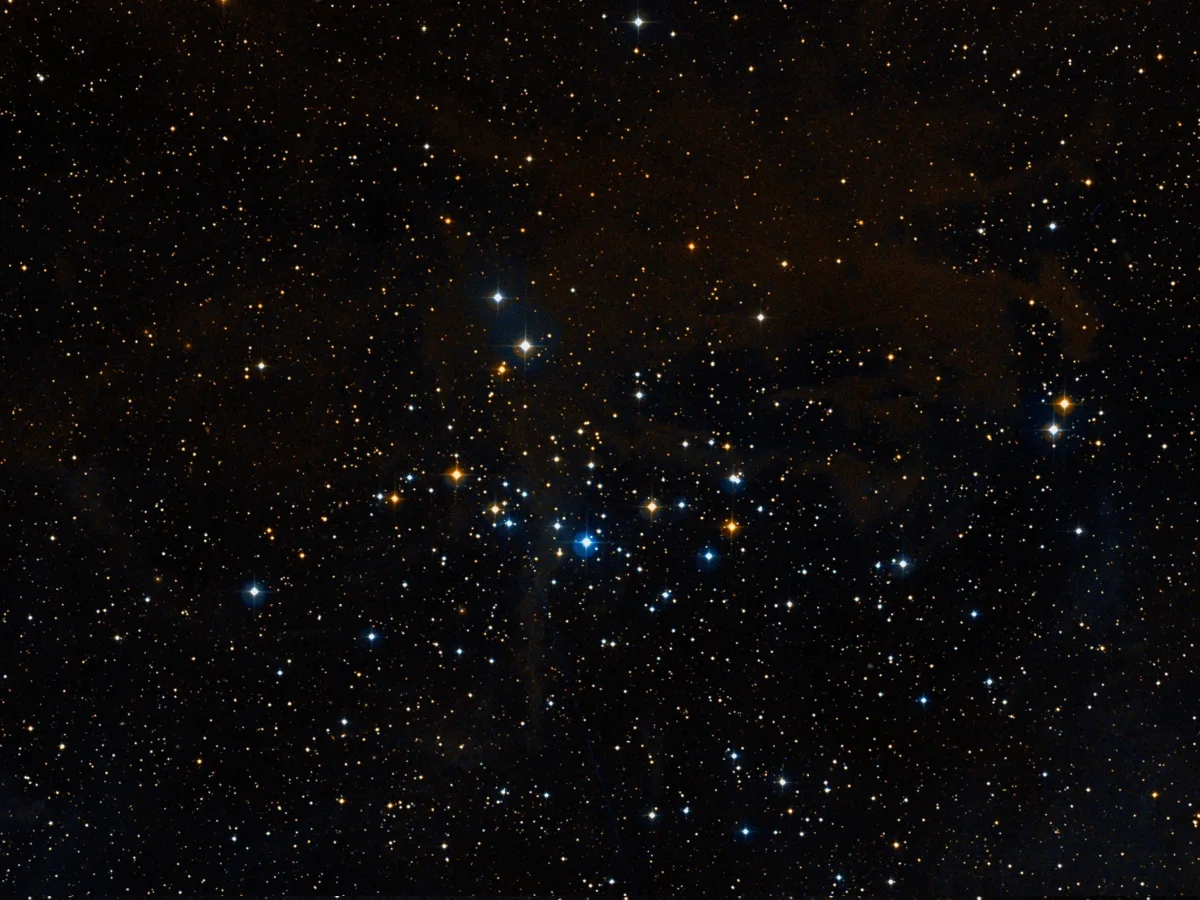
NGC 1342, image credit: ESO/Digitized Sky Survey 2 (CC BY 4.0)
Several bright and dark nebulae appear in the same wide field of view as the Stingray Cluster. These include the H II regions LBN 718, LBN 719 and LBN 720, the reflection nebula LBN 721, the dark nebula LDN 1434 and the reflection nebula vdB 18 around the variable star V496 Persei.
American astronomer Beverly Turner Lynds found these nebulae on photographic plates obtained in the National Geographic Society – Palomar Observatory Sky Survey (NGS-POSS) in the 1950s. She included them in her Catalogue of Dark Nebulae (LDN) in 1962 and Catalogue of Bright Nebulae (LBN) in 1965.
The nebula vdB 18 was found by the Dutch-Canadian astronomer Sidney van den Bergh on the Palomar Sky Survey plates in 1966. It appears close to LBN 721.
Facts
NGC 1342 was discovered by the German-born British astronomer William Herschel on December 28, 1799. Herschel listed the cluster as VIII 88 in his catalogue, noting, “A cluster of coarsely scattered large stars, about 15′ diameter.” NGC 1342 was the last open cluster discovered by Herschel. His son John Herschel observed the object on October 10, 1828, and catalogued it as h 301.
Danish astronomer John Louis Emil Dreyer included the cluster as NGC 1342 in his New General Catalogue (1888) based on Herschel’s observations.
The Stingray Cluster is one of the bright deep sky objects included in the Herschel 400 catalogue of objects that can be observed in amateur telescopes. Other deep sky objects in Perseus that are on the Herschel 400 list are the Little Dumbbell Nebula (Messier 76), the Double Cluster (NGC 869 and NGC 884), the Perseus Lenticular Galaxy (NGC 1023), and the open clusters NGC 1245, NGC 1444, NGC 1513, NGC 1528, and NGC 1545.
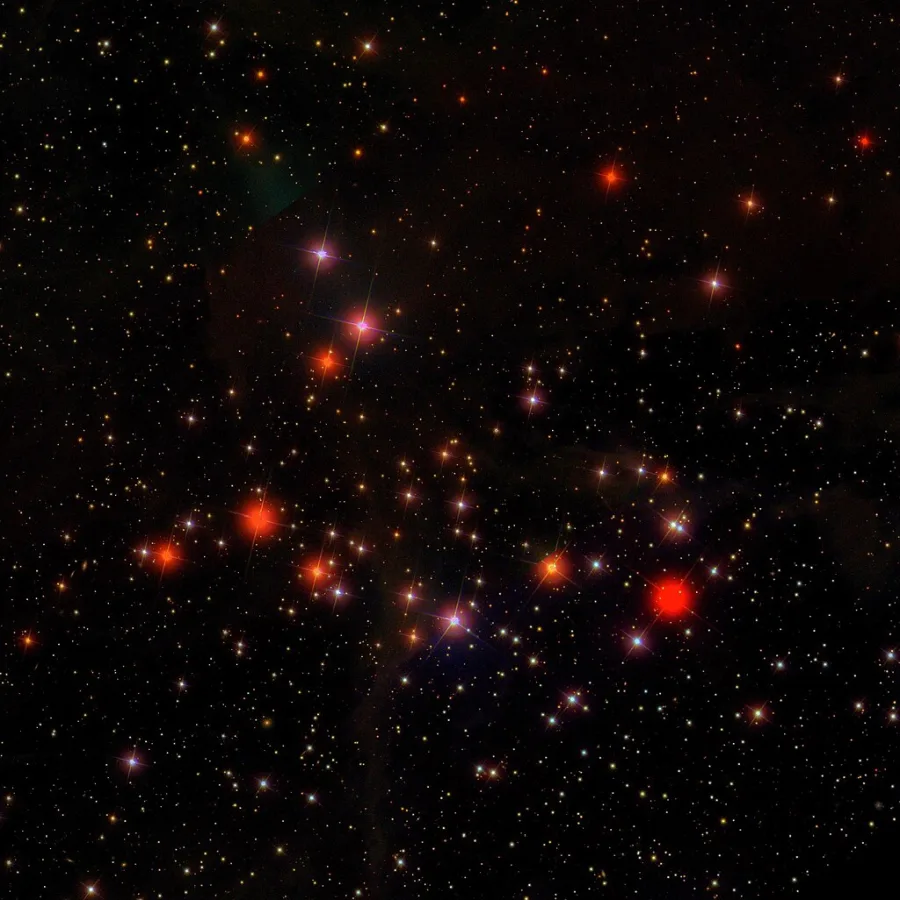
NGC 1342, image credit: Sloan Digital Sky Survey (SDSS) (CC BY 4.0)
How to find NGC 1342
The Stingray Cluster lies in the southern part of the constellation Perseus, roughly halfway between the bright Algol (Beta Persei) and Zeta Persei. At declination +37° 23′, it never rises above the horizon from locations south of the latitude 52° S.
The best time of the year to observe NGC 1342 and other deep sky objects in Perseus is during the month of December, when the constellation appears higher above the horizon around 9 pm.
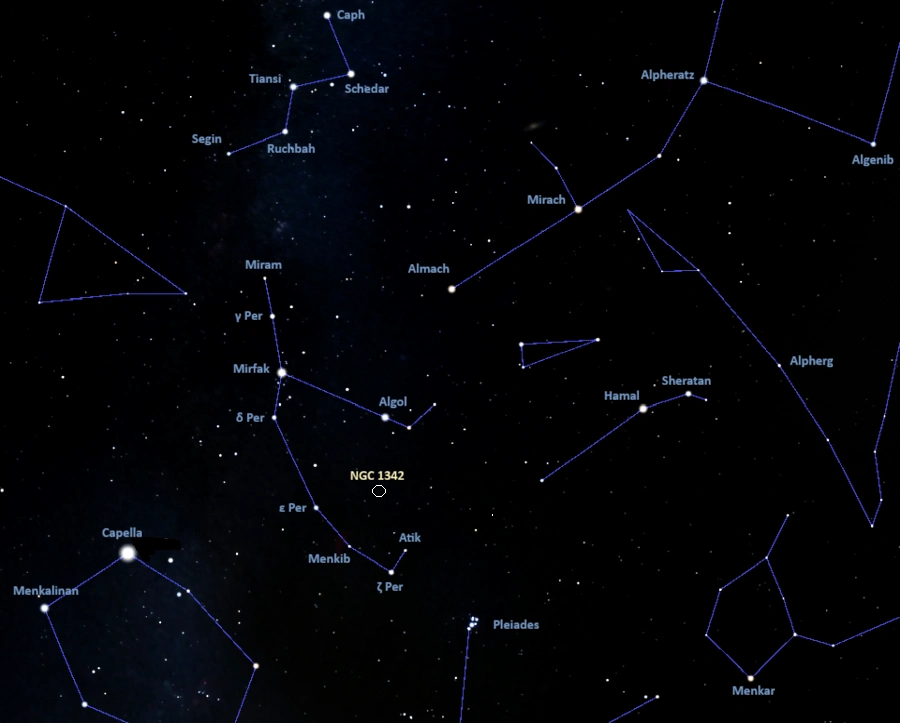
Location of the Stingray Cluster (NGC 1342), image: Stellarium
Stingray Cluster – NGC 1342
| Constellation | Perseus |
| Object type | Open cluster |
| Right ascension | 03h 31m 37.4s |
| Declination | +37° 23′ 23″ |
| Apparent magnitude | 6.7 |
| Apparent size | 34.7′ × 34.7′ |
| Distance | 2,170 light-years (665 parsecs) |
| Age | 450 million years |
| Names and designations | Stingray Cluster, Little Scorpion Cluster, NGC 1342, Collinder 40, Cr 40, [KC2019] Theia 853, [KPR2004b] 45, [KPS2012] MWSC 0283, C 0328+371 |