The Spanish Dancer Galaxy is an intermediate spiral galaxy located approximately 69 million light-years away in the southern constellation Dorado (the Dolphinfish). It is listed as NGC 1566 in the New General Catalogue. With an apparent magnitude of 9.73 and an apparent size of 8.51 by 5.37 arcminutes, the galaxy can be observed in larger telescopes. It is one of the brightest and nearest Seyfert galaxies to the Sun.
The Spanish Dancer appears face-on and has the morphological class SAB(rs)bc, indicating wound spiral arms, a weak bar around the nucleus, and an incomplete ring around the bar. NGC 1566 has strong and symmetrical spiral arms that harbour hot blue star clusters. The young clusters are interspersed among dark lanes of dust and contrasted against the galaxy’s numerous pink star forming regions.
NGC 1566 is an active galaxy with a supermassive black hole that has an estimated mass of (1.3 ± 0.6) × 107 solar masses. It is classified as a Seyfert galaxy, but its type is uncertain and keeps changing.
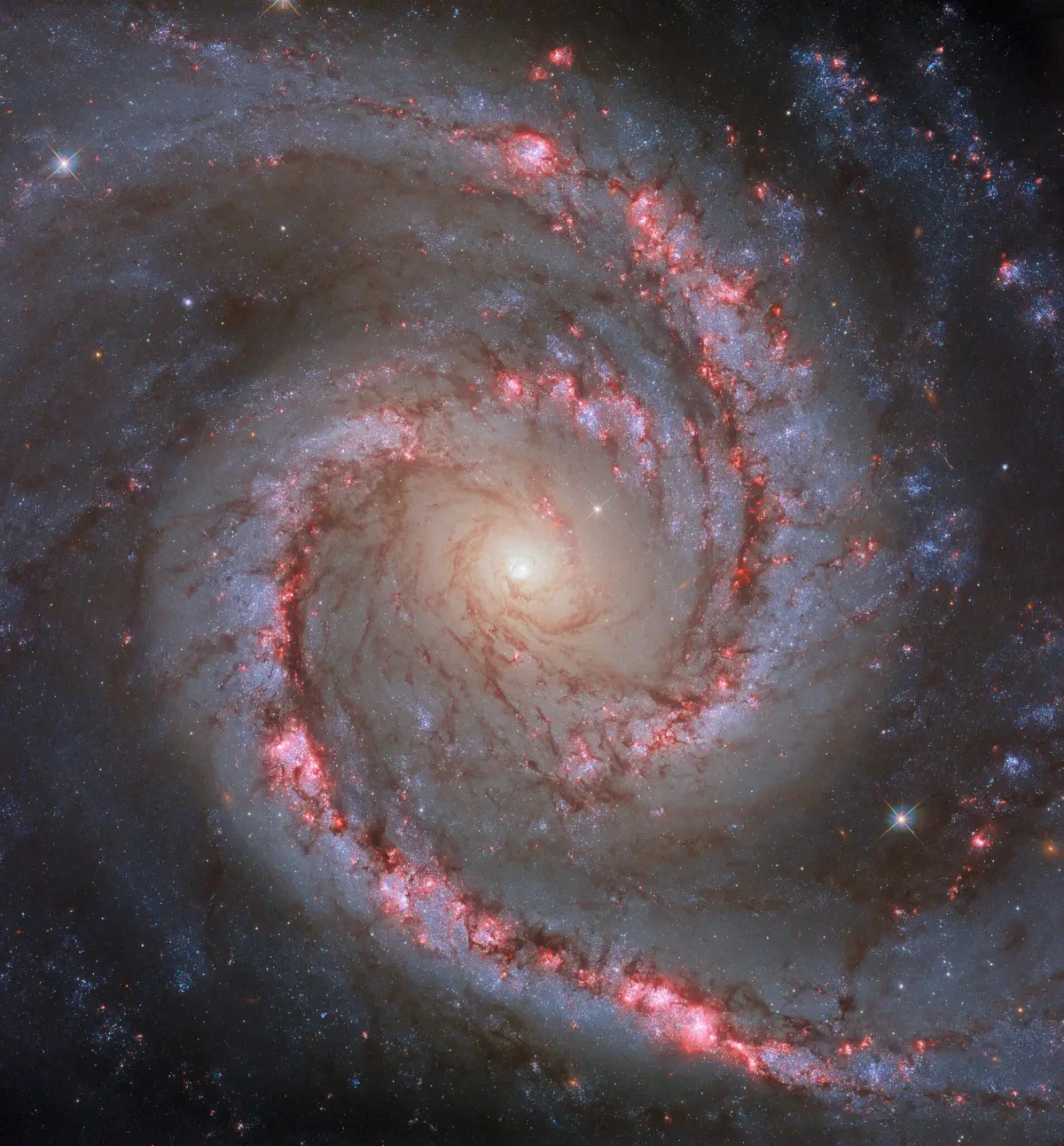
This vibrant and dynamic-looking image features the spiral galaxy NGC 1566, which is sometimes informally referred to as the ‘Spanish Dancer Galaxy’. Like the subject of another Hubble Picture of the Week, NGC 1566 is a weakly-barred or intermediate spiral galaxy, meaning that it does not have either a clearly present or a clearly absent bar-shaped structure at its centre. The galaxy owes its nickname to the vivid and dramatic swirling lines of its spiral arms, which could evoke the shapes and colours of a dancer’s moving form. Image credit: ESA/Hubble & NASA, D. Calzetti and the LEGUS team, R. Chandar (CC BY 4.0)
Seyfert galaxies have very luminous nuclei with supermassive black holes surrounded by accretion disks of infalling material. These disks emit in the ultraviolet part of the spectrum. The luminosity of these galaxies’ cores is comparable to the luminosity of an entire galaxy the size of the Milky Way.
The Spanish Dancer Galaxy has a high mass ratio of neutral hydrogen gas to the mass of the stars. Astronomers have estimated a mass of 1.4 × 10¹⁰ M☉ of H I and an absolute luminosity of 3.7 × 10¹⁰ L☉ for the galaxy. NGC 1566 has a hot gas halo that stretches out to 94,585 light-years (29 kpc) from the galaxy.
The Spanish Dancer is the nearest known galaxy with a CL AGN (Changing-look Active Galactic Nucleus). This class of active galactic nuclei is characterized by the variability of broad emission lines with periods ranging from months to years. The glowing galactic core of NGC 1566 has been observed to change its Seyfert type repeatedly within months.
NGC 1566 is the most prominent member of the Dorado Group, one of the most populated groups of galaxies in the southern celestial hemisphere. The group stretches across 10 degrees of the apparent sky. Other bright members include the elliptical galaxy NGC 1549 and lenticular galaxy NGC 1553. These galaxies lie at the centre of the group and are in the process of interacting.
NGC 1566 is the brightest member of the NGC 1566 Group, one of the three smaller groups within the Dorado Group. It is interacting with several smaller members of the group. Observations in the radio band have revealed a mild warp in the galaxy’s neutral hydrogen and an asymmetrical disk, likely caused by the interaction.
Galaxy groups like the Dorado Group consist of gravitationally bound galaxies. However, the membership of several galaxies that appear in the same line of sight is uncertain because their exact distances are difficult to determine. The distance to the Spanish Dancer itself has varied between 20 million light years (6 Mpc) and 68 million light years (21 Mpc) in the recent years.
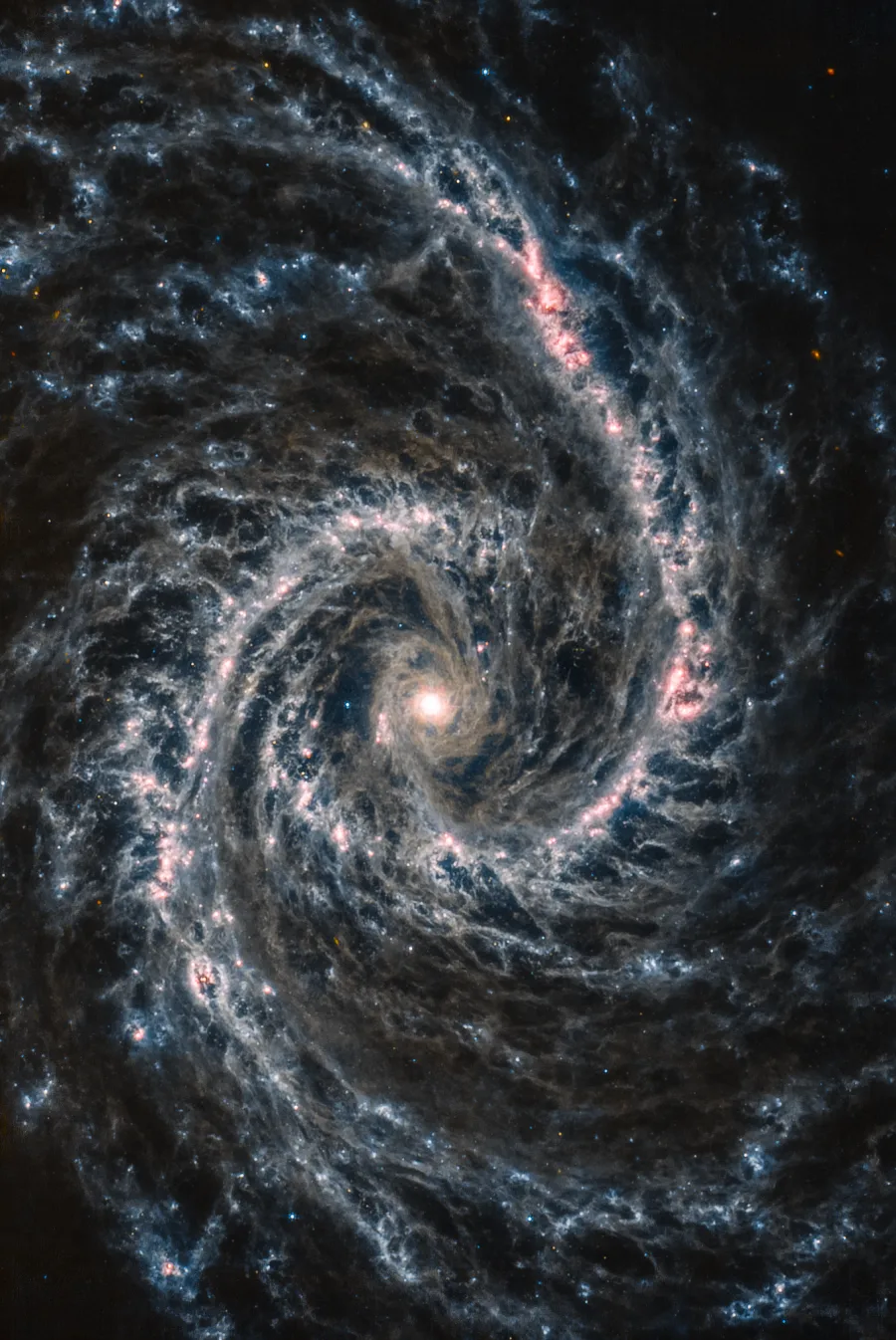
NGC 1566 captured by the MIRI instrument on the James Webb Space Telescope (JWST), image credit: NASA/ESA/CSA/Judy Schmidt (CC BY 2.0)
Facts
The Spanish Dancer Galaxy was discovered by the Scottish astronomer James Dunlop from Australia on May 28, 1826.
Three supernovae were observed in the galaxy in the recent decades. The supernova SN 2010el was discovered on June 19, 2010. It occurred 13 arcseconds west and 22 arcseconds south of the galactic nucleus and was classified as a type Iax supernova. It shone at magnitude 16.8.
The type II supernova ASASSN-14ha was detected by the All-Sky Automated Survey for SuperNovae (ASAS-SN) on September 10, 2014. It had an apparent magnitude of 14.6.
The most recent supernova, SN 2021aefx, was a type Ia supernova detected on November 11, 2021. It shone at magnitude 17.24 and reached magnitude 12. It was the brightest supernova observed in 2021.

SN 2021aefx in NGC 1566 at ≈2–21 μm. Left panel: MIRI F1130W PHANGS-JWST image of NGC 1566 showing the location of SN 2021aefx, marked with a green circle. Right panels: zoom-ins on SN 2021aefx in each PHANGS-JWST filter. The top four panels show 200 pc × 200 pc cutouts from NIRCam images at 2.0–3.6 μm. The bottom four panels show 1 kpc × 1 kpc MIRI images at 7.7–21 μm. The inner green circle marks the aperture used in the photometry measurement, and the two concentric dashed cyan circles mark the inner and outer apertures used for the background subtraction. Credit: ESA/NASA/Webb (CC BY 4.0)
Location
NGC 1566 lies in the faint southern constellation of Dorado, about 3.5 degrees south of the variable star Gamma Doradus (mag. 4.25).
At declination -55°, the galaxy is best observed from the southern hemisphere. It never rises above the horizon for observers north of the latitude 35° N.
The best time of the year to observe the Spanish Dancer and other deep sky objects in Dorado is during the month of January, when the constellation appears higher above the horizon in the early evening.
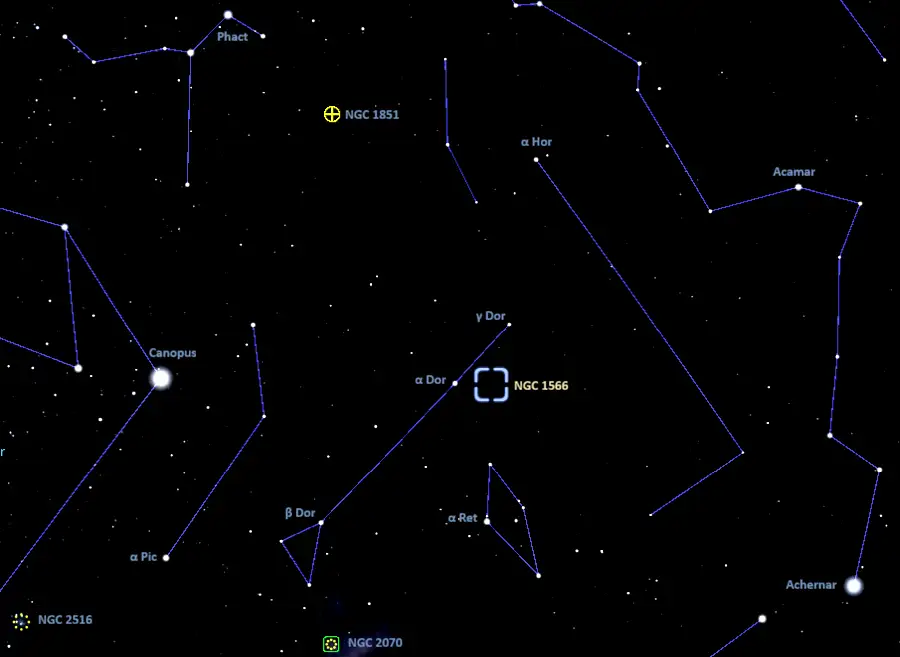
Location of the Spanish Dancer Galaxy (NGC 1566), image: Stellarium
Spanish Dancer Galaxy – NGC 1566
| Constellation | Dorado |
| Object type | Spiral galaxy |
| Morphological type | SAB(rs)bc |
| Right ascension | 04h 20m 00.3968473248s |
| Declination | −54° 56′ 16.624708764″ |
| Apparent magnitude | 9.73 ± 0.03 |
| Apparent size | 8′.51 × 5′.37 |
| Distance | 69 million light-years (21.3 megaparsecs) |
| Redshift | 0.00473963 ± 0.0005 |
| Heliocentric radial velocity | 1418 ± 150 km/s |
| Size | 118,175 light-years (36.25 kiloparsecs) |
| Mass | 6.5 × 10¹⁰ M☉ |
| Names and designations | Spanish Dancer, NGC 1566, LEDA 14897, PGC 14897, FAUST 547, ESO 157-20, ESO-LV 157-0200, GLEAM J042001-545606, PMN J0419-5455, RBS 534, HIPASS J0419-54, SINGG HIPASS J0419-54, ISOSS J04199-5458, PKS J0420-5455, PKS 0418-550, ACT-S J041959-545618, ACT-S J042000-545622, 1E 0418.9-5503, 2E 988, 2E 0418.9-5503, 1ES 0418-55.0, IRAS 04189-5503, IRAS F04188-5503, 2MASX J04200041-5456161, SGC 041853-5503.4, PBC J0419.7-5456, RX J0420.0-5456, 1RXS J042000.5-545617, PSCz Q04189-5503, MBG 04189-5503, SPASS J042001-545531, SPT-S J041959-5456.2, SRGA J042000.7-545613, SUMSS J042001-545613, SWIFT J0420.0-5457, SWIFT J0420.0-5456, [DML87] 604, WISE J042000.38-545616.6, XMMSL1 J041959.8-545618, [BBW2000] FD 41, [CHM2007] HDC 279 J042000.41-5456161, [CHM2007] LDC 328 J042000.41-5456161, [VDD93] 38, [DSB94] 42, [VV2000c] J042000.7-545617 , [VV2003c] J042000.7-545617, [FS90] Dorado 53, [KKF2005] 10, [LB2005] NGC 1566 X1, [HB91] 0418-550, [SLK2004] 420, [VV2010c] J042000.7-545617, [VV2006c] J042000.7-545617, [WTW94] 0418-550, [VV98c] J042000.7-545617, [M98c] 041853.0-550324, Gaia DR2 4779165759875235200, Gaia DR3 4779165759875235200 |
Images
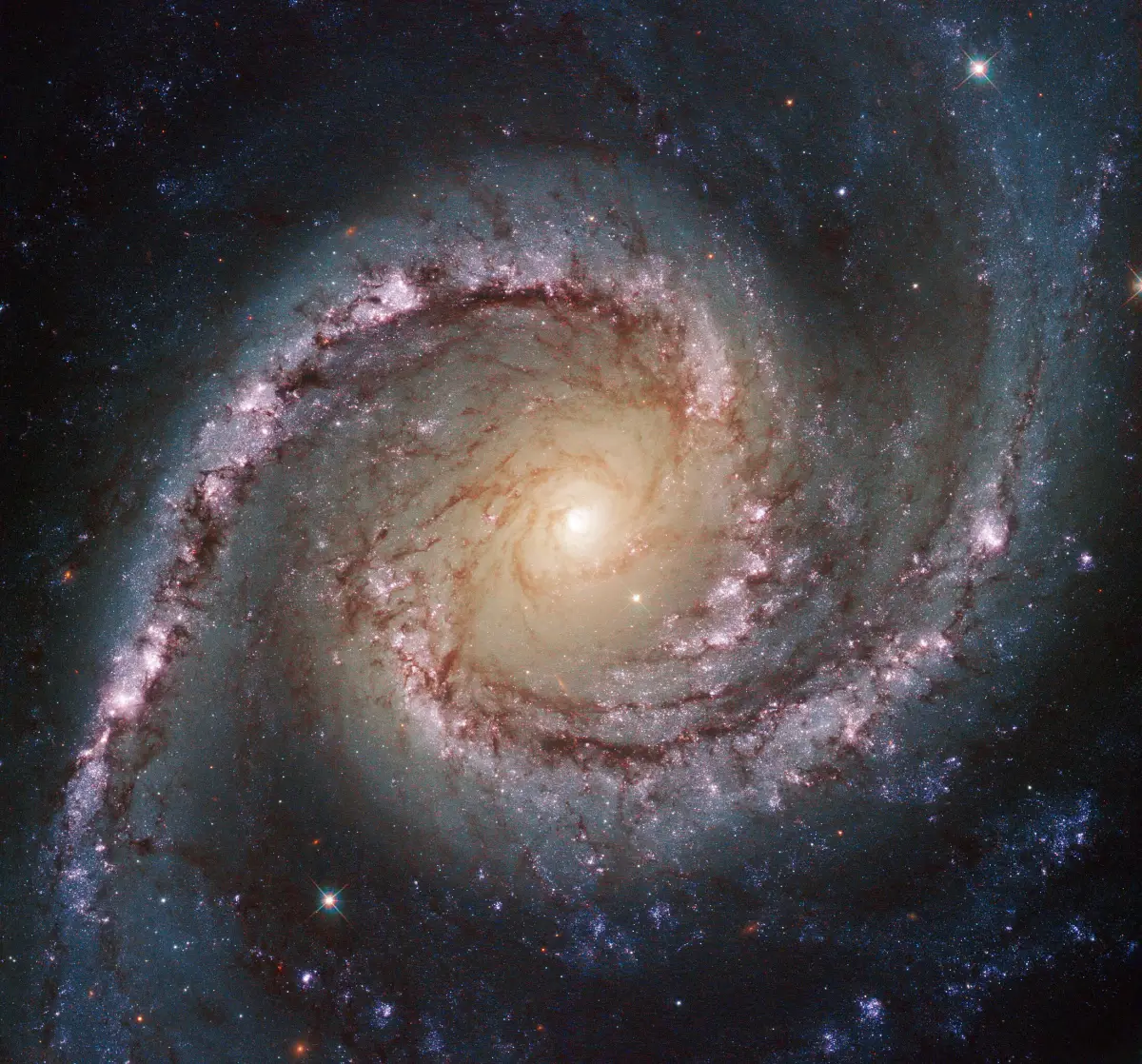
This Hubble image shows NGC 1566, a beautiful galaxy located in the constellation of Dorado (The Dolphinfish). NGC 1566 is an intermediate spiral galaxy, meaning that while it does not have a well defined bar-shaped region of stars at its centre — like barred spirals — it is not quite an unbarred spiral either. The small but exceptionally bright nucleus of NGC 1566 is clearly visible in this image, a telltale sign of its membership of the Seyfert class of galaxies. The centres of such galaxies are very active and luminous, emitting strong bursts of radiation and potentially harbouring supermassive black holes that are many millions of times the mass of the Sun. NGC 1566 is not just any Seyfert galaxy; it is the second brightest Seyfert galaxy known. It is also the brightest and most dominant member of the Dorado Group, a loose concentration of galaxies that together comprise one of the richest galaxy groups of the southern hemisphere. This image highlights the beauty and awe-inspiring nature of this unique galaxy group, with NGC 1566 glittering and glowing, its bright nucleus framed by swirling and symmetrical lavender arms. This image was taken by Hubble’s Wide Field Camera 3 (WFC3) in the near-infrared part of the spectrum. Image: ESA/Hubble & NASA; Acknowledgement: Flickr user Det58 (CC BY 3.0)
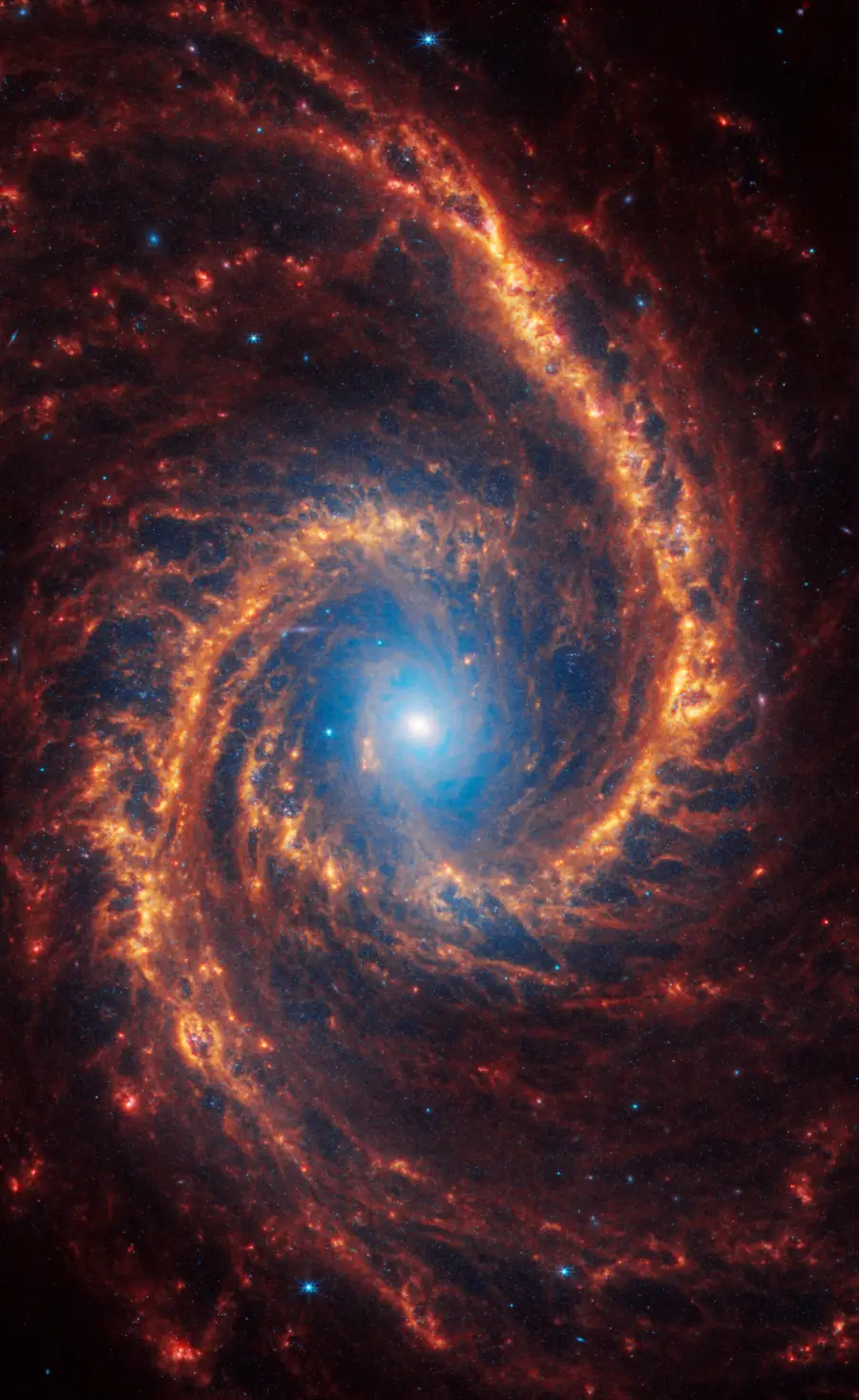
This spiral galaxy was observed as part of the Physics at High Angular resolution in Nearby GalaxieS (PHANGS) program, a large project that includes observations from several space- and ground-based telescopes of many galaxies to help researchers study all phases of the star formation cycle, from the formation of stars within dusty gas clouds to the energy released in the process that creates the intricate structures revealed by Webb’s new images. Image: NASA, ESA, CSA, STScI, J. Lee (STScI), T. Williams (Oxford), R. Chandar (UToledo), D. Calzetti (UMass), PHANGS Team (CC BY 4.0)
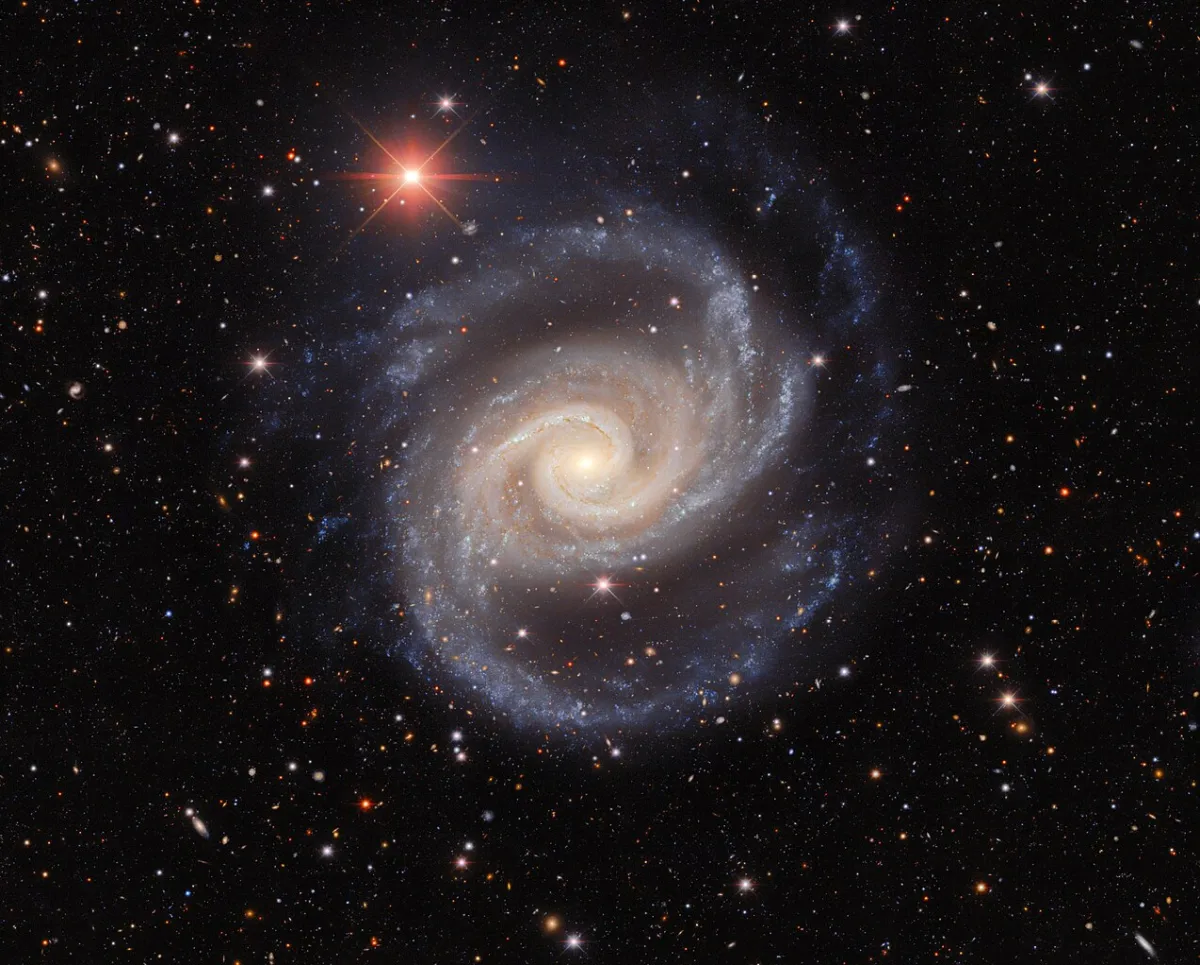
This image, taken by astronomers using the US Department of Energy-fabricated Dark Energy Camera on the Víctor M. Blanco 4-meter Telescope at Cerro Tololo Inter-American Observatory, a Program of NSF’s NOIRLab, captures the galaxy NGC 1566 as it twirls, flinging its arms through the vastness of space. Colloquially nicknamed the Spanish Dancer, this spiral galaxy is often studied by astronomers learning about galaxy groups, stars of different ages, and galactic black holes. Credit: Dark Energy Survey/DOE/FNAL/DECam/CTIO/NOIRLab/NSF/AURA; Image processing: T.A. Rector (University of Alaska Anchorage/NSF’s NOIRLab), J. Miller (Gemini Observatory/NSF’s NOIRLab), M. Zamani & D. de Martin (NSF’s NOIRLab) (CC BY 4.0)
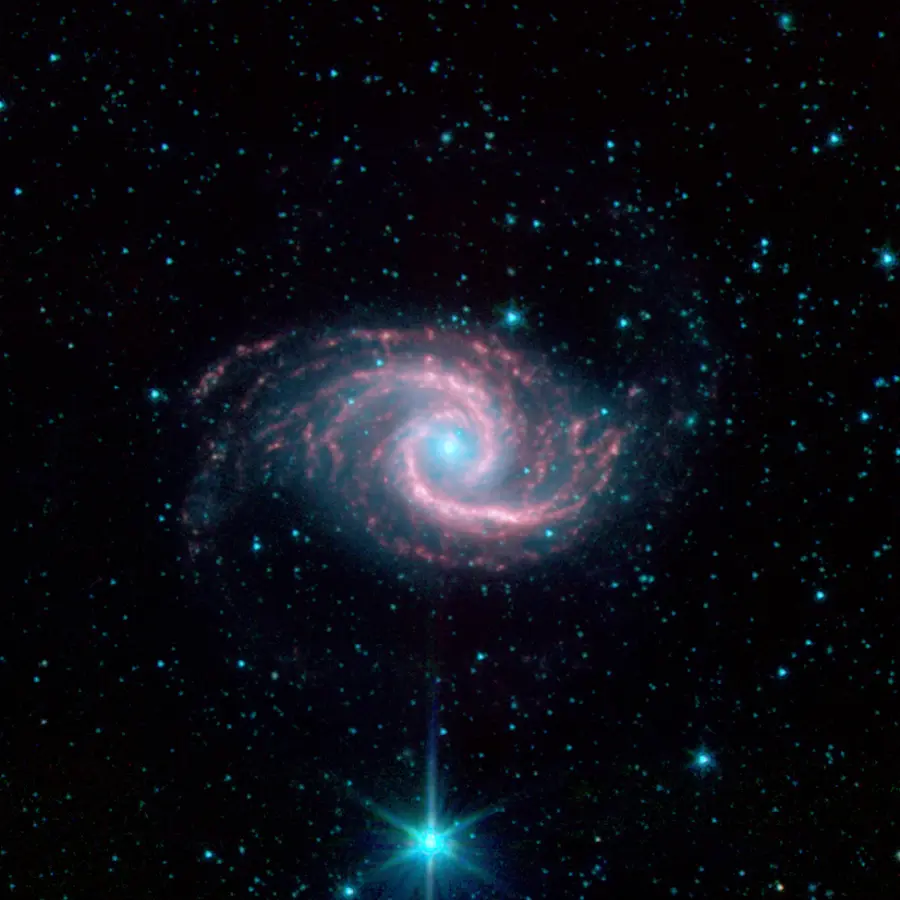
This beautiful spiral galaxy NGC 1566, located approximately 60 million light-years away in the constellation Dorado was captured by the Spitzer Infrared Nearby Galaxies Survey (SINGS) Legacy Project using the telescope’s Infrared Array Camera (IRAC). The faint blue light is coming from mature stars, while the “glowing” red spiral arms indicate active star formation and dust emission. Much of the active star formation is seen in the two symmetric arms that are reminiscent of other grand design spirals such as the Whirlpool galaxy. The small and very luminous blue nucleus suggests that this is a Seyfert galaxy (a galaxy that is actively emitting radiation from a very small region in its core). The SINGS image is a four-channel false-color composite, where blue indicates emission at 3.6 microns, green corresponds to 4.5 microns, and red to 5.8 and 8.0 microns. The contribution from starlight (measured at 3.6 microns) in this picture has been subtracted from the 5.8 and 8 micron images to enhance the visibility of the dust features. Image credit: NASA/JPL-Caltech/R. Kennicutt (University of Arizona) and the SINGS Team (PD)