Pandora’s Cluster (Abell 2744) is a giant cluster of galaxies located approximately 4 billion light-years away in the constellation Sculptor. It has an angular size of 7 arcminutes. It is the product of a collision between at least four smaller galaxy clusters that occurred over a period of 350 million years.
Pandora’s Cluster is one of the most massive galaxy clusters known. It formed as a result of merger and has since grown by accreting smaller subclusters.
The cluster is composed primarily of dark matter, which makes up around 75 percent of its mass. The member galaxies themselves contribute only 5 percent of the cluster’s mass, while hot gas makes up around 20 percent of the total mass of Abell 2744. A 2024 study derived a total mass of (2.56 ± 0.26)×1015 M⊙ for the cluster.
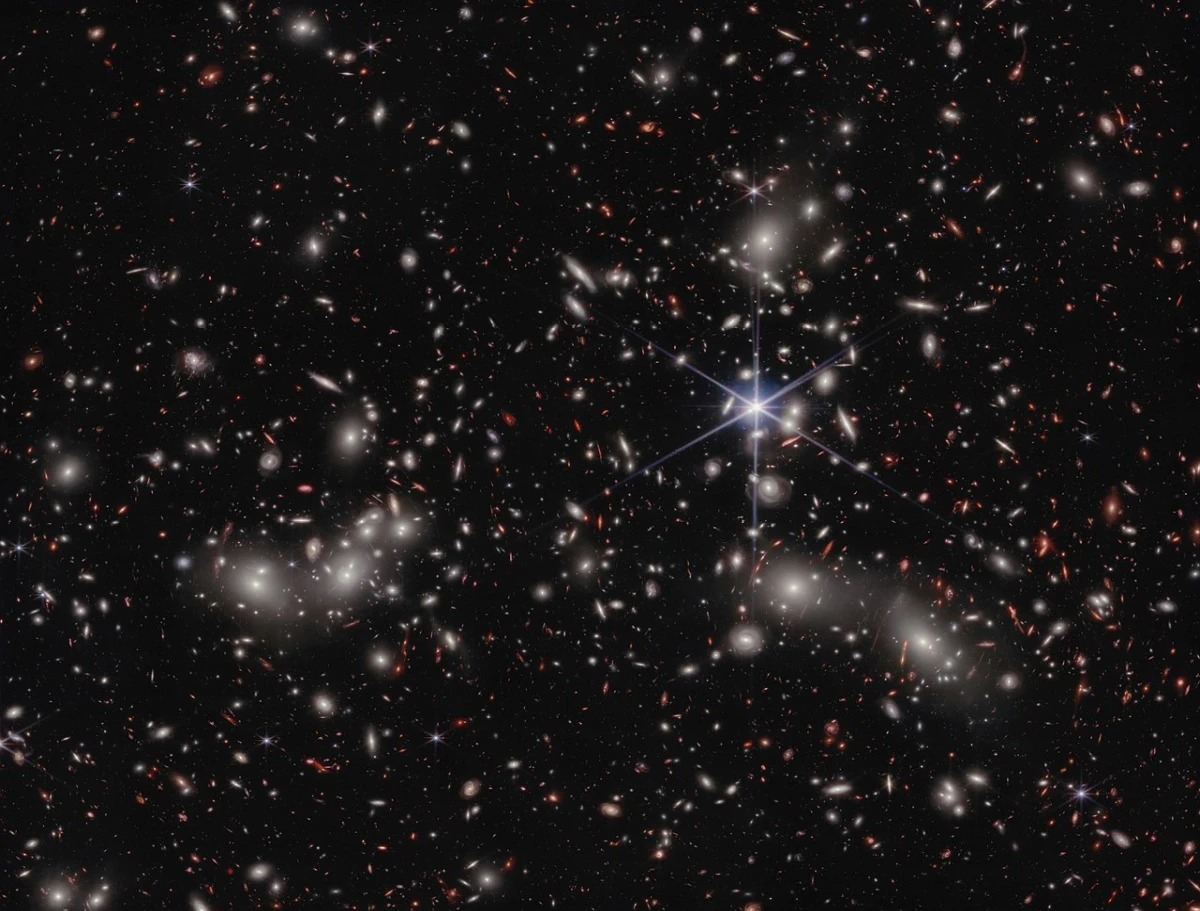
Astronomers estimate 50 000 sources of near-infrared light are represented in this image from the NASA/ESA/CSA James Webb Space Telescope. Their light has travelled through various distances to reach the telescope’s detectors, representing the vastness of space in a single image. A foreground star in our own galaxy, to the right of the image centre, displays Webb’s distinctive diffraction spikes. Bright white sources surrounded by a hazy glow are the galaxies of Pandora’s Cluster, a conglomeration of already-massive clusters of galaxies coming together to form a mega cluster. The concentration of mass is so great that the fabric of spacetime is warped by gravity, creating a natural, super-magnifying glass called a ‘gravitational lens’ that astronomers can use to see very distant sources of light beyond the cluster that would otherwise be undetectable, even to Webb.These lensed sources appear red in the image, and often as elongated arcs distorted by the gravitational lens. Many of these are galaxies from the early universe, with their contents magnified and stretched out for astronomers to study. Image credit: NASA, ESA, CSA, I. Labbe (Swinburne University of Technology), R. Bezanson (University of Pittsburgh), A. Pagan (STScI) (CC BY 4.0)
The presence of dark matter can only be inferred from the cluster’s gravitational effect. The giant galaxy cluster serves as a gravitational lens that bends and magnifies the light of distant galaxies that appear behind the cluster from our point of view. The distortion of the light of these background galaxies has helped astronomers map the distribution of dark matter in Abell 2744.
The gas in Pandora’s Cluster is exceptionally hot and appears luminous in the X-ray band but not at other wavelengths. The cluster has a strong central radio halo and an extended tail. The halo was discovered by Giovannini et al. in 1999. The presence of a radio halo is typically associated with cluster mergers.
Abell 2744 was nicknamed Pandora’s Cluster by a team of astronomers led by J. Merten because of the variety and depth of phenomena that it hosts. The cluster harbours a huge diversity of galaxies, hot X-ray gas in the intracluster medium, and an estimated total population of around 113,000 globular clusters. It shows weak and strong lensing of background objects, providing astronomers with new insights into these distant objects.
In 2011, Merten and his team identified 34 images of 11 gravitationally lensed galaxies around the southern core of Pandora’s Cluster. The researchers combined data obtained with the Hubble Space Telescope (HST), the Very Large Telescope (VLT) and the Subaru Telescope to produce a detailed mass map of the cluster. After analysing the merging cluster, the team found that the merging event unleashed a series of unexpected phenomena and a variety of substructures, including strong-lensing features in the cluster’s core. The team estimated a total mass of 1.8 ± 0.4 × 10¹⁵ M☉ for the cluster within a radius of 1.3 Mpc.
In 2023, observations with the James Webb Space Telescope (JWST) provided astronomers with a new understanding of the cluster’s complex structure. Webb’s infrared view uncovered around 50,000 sources in the near-infrared band.
Observations in the medium band revealed galaxies with strong polycyclic aromatic hydrocarbon (PAH) emission, which indicates dusty star formation. These galaxies are mostly found in the outskirts of Pandora’s Cluster. Astronomers believe that they were accreted by the cluster only recently. The high rate of star formation in the galaxies is likely triggered by interactions as the galaxies fall into the intracluster medium.
Observations with Webb’s NIRCam have led to the detection of 1,956 individual magnified clumps hosted in 476 galaxies. Most of these are large stellar regions.
In 2024, observations with the Chandra X-ray Observatory showed the disruption of the cores of the three subclusters of Pandora’s Cluster. Chandra data also confirmed the presence of a shock in the northwest subcluster. Simulations indicate that there was a head-on merger between the northern and southern subclusters around 500 – 600 million years ago, followed by the first infall of the northwestern subcluster.
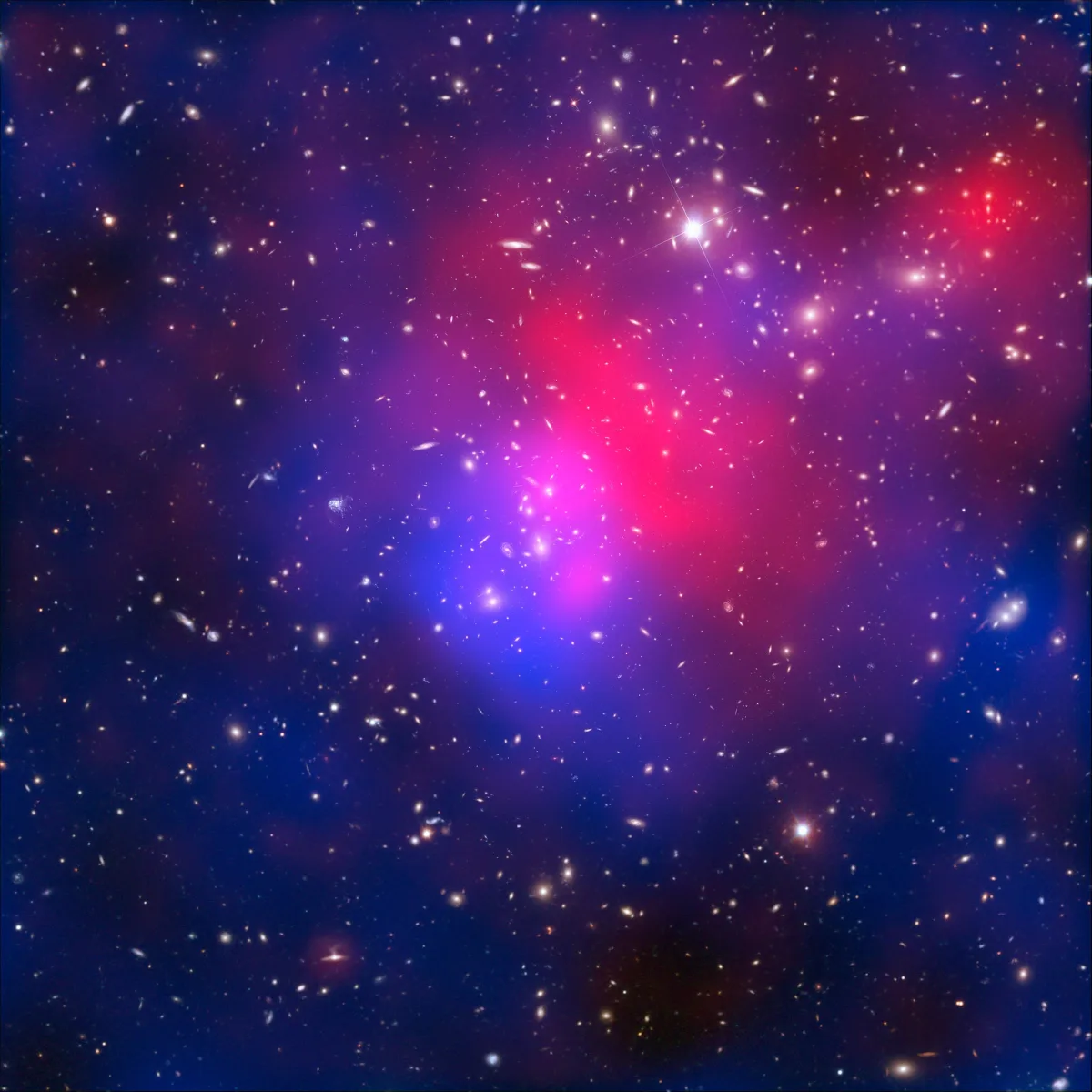
Abell 2744, nicknamed Pandora’s Cluster. The galaxies in the cluster make up less than five percent of its mass. The gas (around 20 percent) is so hot that it shines only in X-rays (coloured red in this image). The distribution of invisible dark matter (making up around 75 percent of the cluster’s mass) is coloured here in blue. The image is a composite of separate exposures made by Hubble Space Telescope ACS detectors, the ESO’s Very Large Telescope (VLT), and the Chandra ACIS detector. Hubble provides the central, most detailed part of the image, while the VLT, which has a wider field of view, provides the outer parts of the image. Image credit: NASA, ESA, J. Merten (Institute for Theoretical Astrophysics, Heidelberg/Astronomical Observatory of Bologna), and D. Coe (STScI) (CC BY 4.0)
Pandora’s Cluster is a powerful gravitational lens. The cluster’s lensing effect has made it possible for astronomers to discover some of the most distant galaxies known. These galaxies appear red in images obtained with Webb. Many of them appear as elongated arcs. Some appear as little red dots (LRDs), compact red objects at high redshifts believed to be dusty active galactic nuclei (AGNs).
Two of these galaxies, named UNCOVER-z12 and UNCOVERz-13, are high-redshift star-forming galaxies located 32.21 and 32.56 billion light-years away. These galaxies were discovered by the James Webb telescope in November 2023. They coalesced only 330 million years after the Big Bang.
UNCOVER-z13 is the fourth most distant object known in the observable universe, as of 2025. In comparison, the current record-holder, MoM-z14 in the constellation Sextans, lies 33.8 billion light-years away. It was discovered by the JWST in May 2025.
The gravitational lensing effect of massive objects like Abell 2744 has led to discoveries of many deep sky objects located at great distances from the solar system. These objects provide insight into the evolution of galaxies in the early universe and help astronomers study the Cosmic Dawn (the Epoch of Reionization), the period within the first billion years after the Big Bang, when the first stars and galaxies formed.
Pandora’s Cluster lies in the faint southern constellation of Sculptor. It appears roughly a third of the way from the blue giant Alpha Sculptoris, the constellation’s brightest star, to Fomalhaut in Piscis Austrinus. The cluster cannot be observed in amateur telescopes.
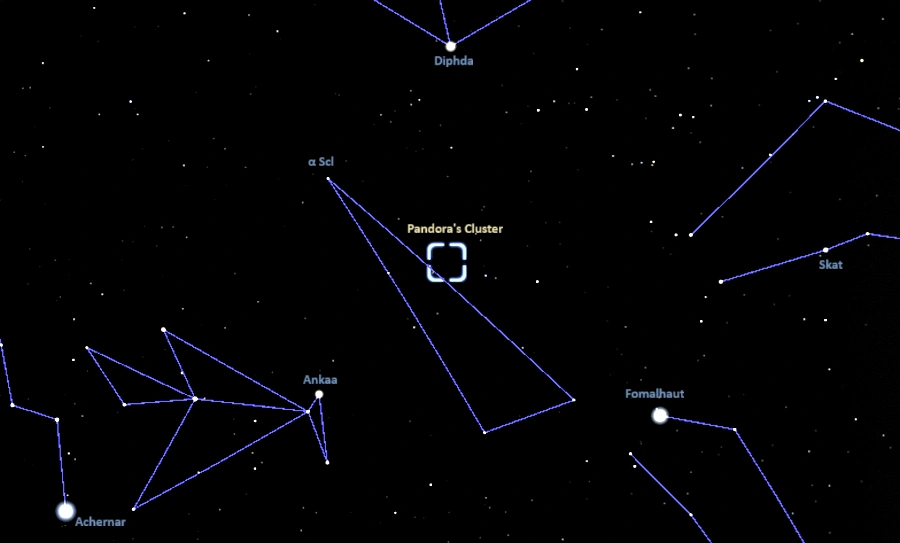
Pandora’s Cluster location, image: Stellarium
Pandora’s Cluster – Abell 2744
| Constellation | Sculptor |
| Object type | Galaxy cluster |
| Right ascension | 00h 14m 19.51s |
| Declination | −30° 23′ 19.18″ |
| Apparent size | 7.0′ × 7.0′ |
| Distance | 3,982 million light years (1,221 megaparsecs) |
| Redshift | 0.30800 |
| Names and designations | Pandora’s Cluster, Abell 2744, ACO 2744, ACCG 118, ACT-CL J0014.3-3022, AM 0011-303, BAX 003.5813-30.3887, MCS J0014.3-3022, MCXC J0014.3-3023, PLCKESZ G008.93-81.23, PSZ1 G009.02-81.22, PSZ2 G008.94-81.22, PSZRX G008.92-81.24, RBS 34, RXC J0014.3-3022, RXC J0014.3-3023, 1RXS J001419.1-302216, [DBG99] 5, XCLASS 20073 |
Images
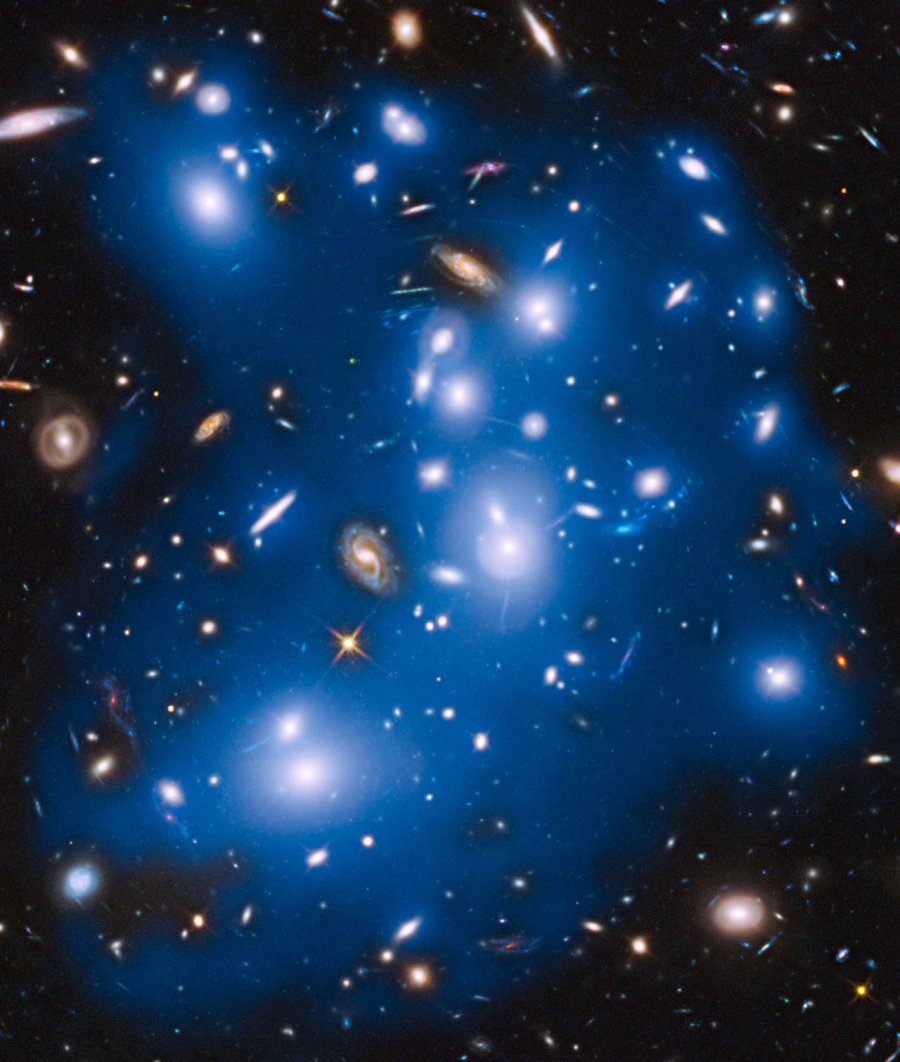
The massive galaxy cluster Abell 2744, nicknamed Pandora’s Cluster, takes on a ghostly look in this NASA/ESA Hubble Space Telescope view. In this image the total starlight from the cluster has been artificially coloured blue. This reveals that not all the starlight is contained within the cities of stars— the galaxies — which appear as bright blue-white blobs. A fraction of the starlight is also dispersed throughout the cluster, as seen in the darker blue regions. This light comes from dead galaxies. The galaxies were torn apart long ago by the cluster’s gravitational forces, and their stars were scattered into what is known as intracluster space — the space between the galaxies. These orphaned stars roam the cluster, without being gravitationally tethered to any single galaxy. Because these extremely faint stars are brightest at near-infrared wavelengths of light, this type of observation could only be accomplished with Hubble’s infrared sensitivity to extraordinarily dim light. The galaxies that are not coloured blue are either in the foreground or background and are not part of the cluster. Image credit: NASA, ESA, M. Montes (IAC), and J. Lotz, M. Mountain, A. Koekemoer, and the HFF Team (STScI) (CC BY 4.0)
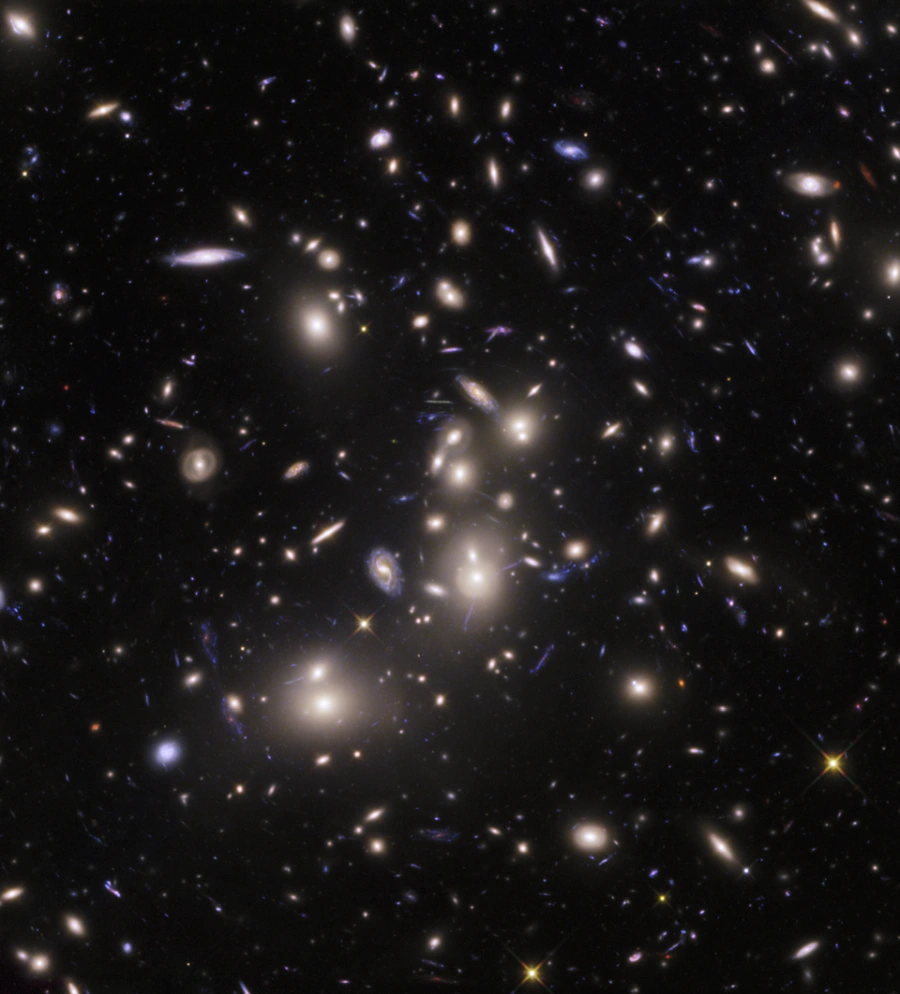
Pandora’s Cluster, image credit: Judy Schmidt (CC BY 2.0)
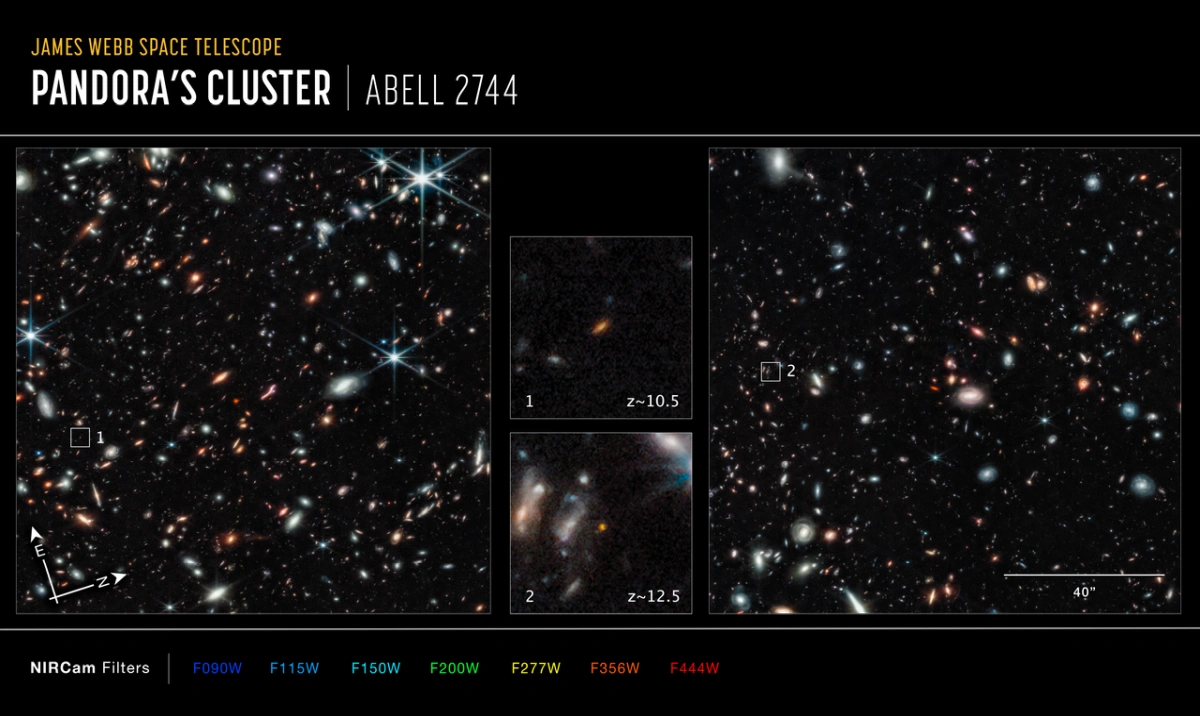
Images of Pandora’s Cluster, Abell 2744, captured by Webb’s Near-Infrared Camera (NIRCam). Image: NASA, ESA, CSA, T. Treu (UCLA) (CC BY 4.0)
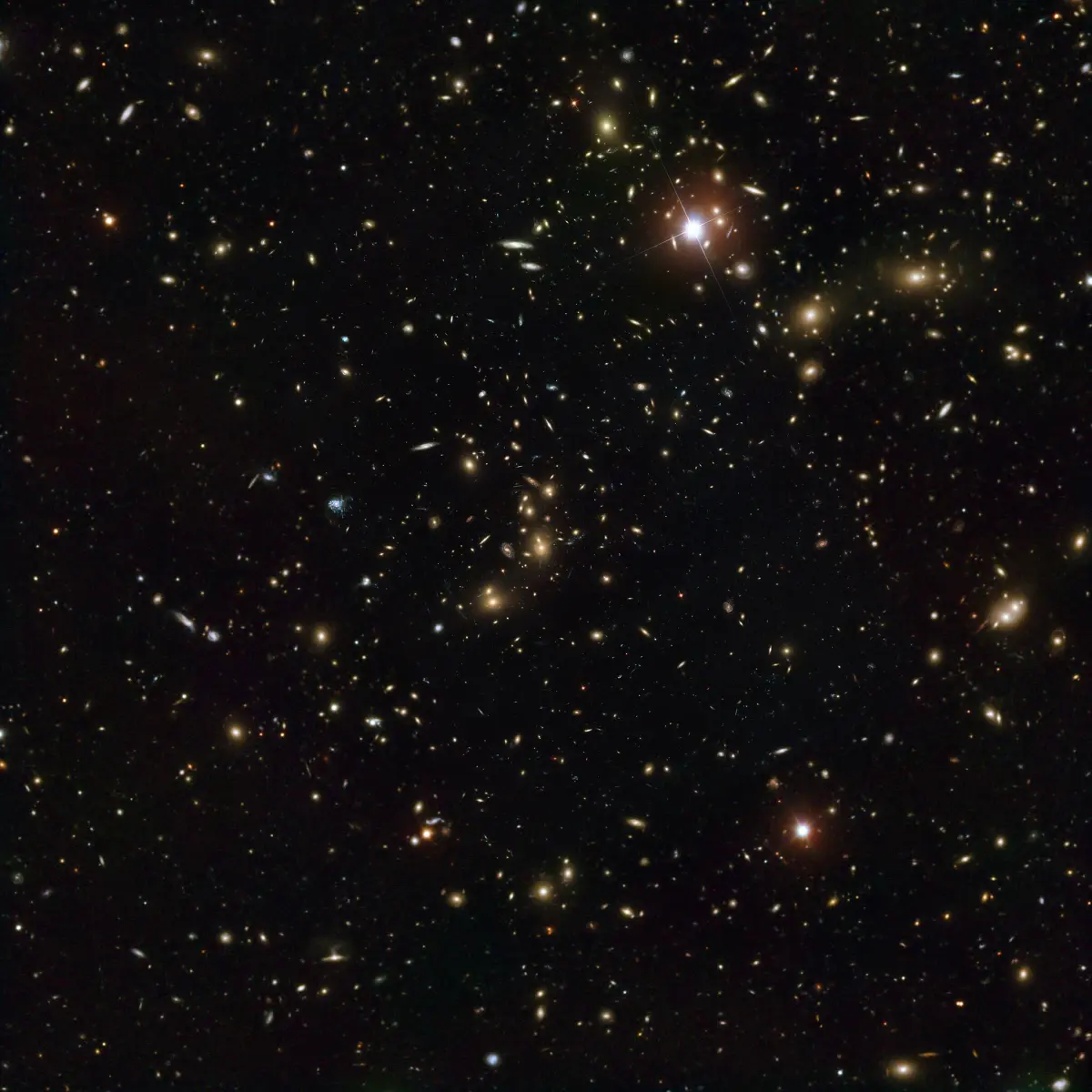
This image of galaxy cluster Abell 2744 combines data from the NASA/ESA Hubble Space Telescope’s Advanced Camera for Surveys (ACS), with an image taken with the ESO VLT. Hubble provides the central, most detailed part of the image, while the VLT offers a wider field of view. This object has been nicknamed Pandora’s Cluster because of the many different and strange phenomena that were unleashed by a huge collision that occurred over a period of 350 million years. A simultaneous pile-up between at least four separate clusters has produced strange effects that have never been seen together before. Image credit: NASA, ESA, ESO and D. Coe (STScI)/J. Merten (Heidelberg/Bologna) (CC BY 4.0)
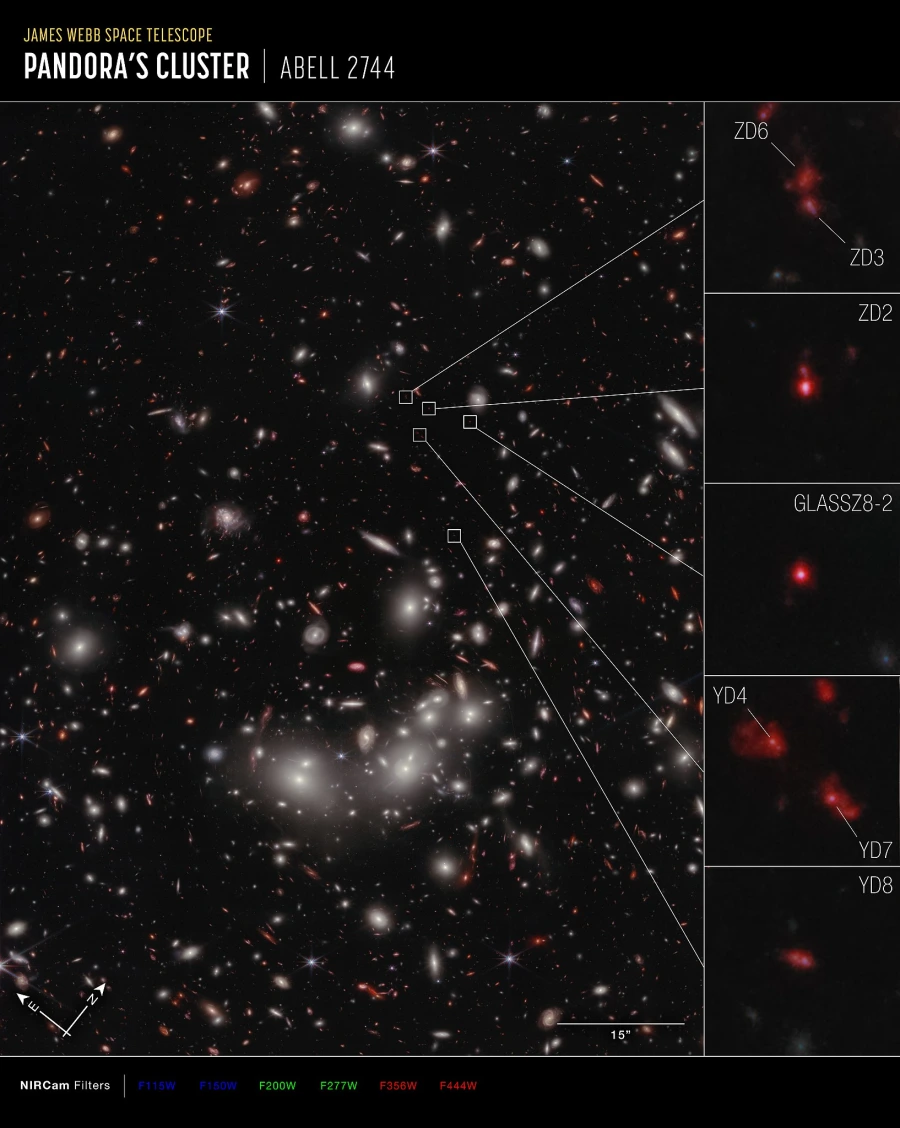
The seven galaxies highlighted in this image from the NASA/ESA/CSA Telescope have been confirmed to be at a distance that astronomers refer to as redshift 7.9, which correlates to 650 million years after the big bang. This makes them the earliest galaxies yet to be spectroscopically confirmed as part of a developing cluster.The seven galaxies confirmed by Webb were first established as candidates for observation using data from the NASA/ESA Hubble Space Telescope’s Frontier Fields program. The program dedicated Hubble time to observations using gravitational lensing, to observe very distant galaxies in detail. However, because Hubble cannot detect light beyond near-infrared, there is only so much detail it can see. Webb picked up the investigation, focusing on the galaxies scouted by Hubble and gathering detailed spectroscopic data in addition to imagery. Image: NASA, ESA, CSA, T. Morishita (IPAC), A. Pagan (STScI) (CC BY 4.0)