The Northern Trifid Nebula is a diffuse nebula located approximately 2,100 light years away in the northern constellation Perseus. The H II region is catalogued as NGC 1579 in the New General Catalogue. It is associated with a young open star cluster.
Like its better-known southern namesake, the Trifid Nebula (Messier 20) in the constellation Sagittarius, NGC 1579 has a trifurcated appearance and contains emission, reflection and dark nebulosity. Both nebulae have prominent dark dust lanes that contrast with the striking blue and red hues of the diffuse bright nebulae. The Northern Trifid is commonly classified as a reflection nebula. Its reddish glow comes from hydrogen alpha emission.
The hot emission-line star LkHα 101 is responsible for most of the ionizing radiation that gives the nebula its red glow in long-exposure images. The heavily reddened, highly luminous star illuminates the central region of the dark cloud L1482. The star’s light is heavily reddened, dimmed and scattered by dust. The surrounding cloud contains at least 35 other emission-line stars and a total of about a hundred fainter stars.
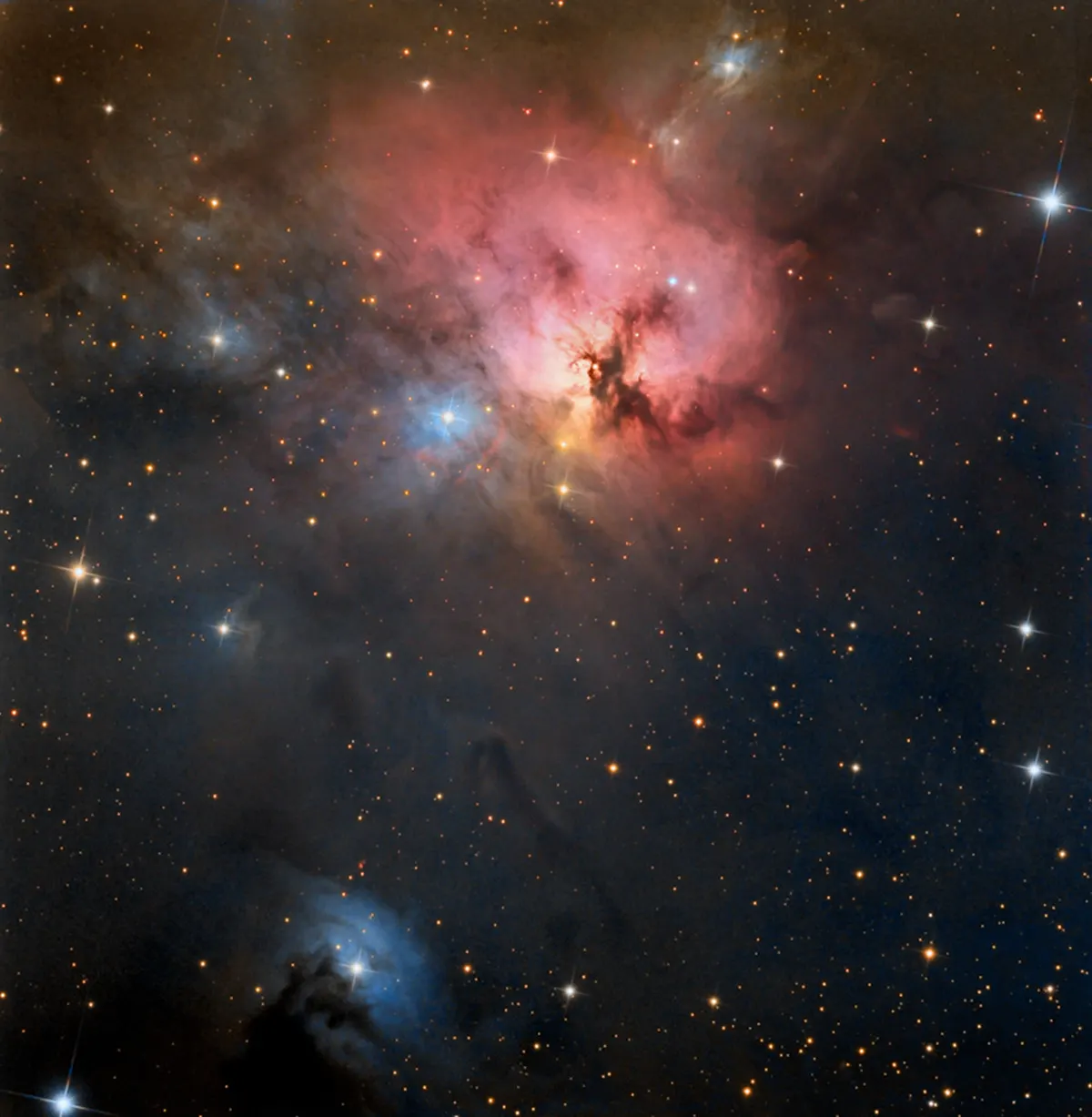
Northern Trifid Nebula (NGC 1579) captured using the 0.8m Schulman Telescope at the Mount Lemmon SkyCenter, image credit: Adam Block/Mount Lemmon SkyCenter/University of Arizona (CC BY-SA 4.0)
These hot young stars are responsible for illuminating the Northern Trifid Nebula. They emit intense ultraviolet light that makes the surrounding clouds of dust and gas glow.
LkHα 101 is the most prominent member of a young open cluster associated with NGC 1579. It has an apparent visual magnitude of 15.71 and a luminosity of 8,000 Suns. A 2004 study by Herbig et al. found a median age of only 0.5 million years and a distance of 700 parsecs (2,283 light-years) for the stars in the cluster. The astronomers found LkHα 101 to be an early B-type zero-age main sequence star.
NGC 1579 is embedded at the eastern edge of a giant molecular cloud called the California Molecular Cloud. It is the only H II region in the cloud. It is embedded in the dark nebula L1482, which is a filament of the larger California Molecular Cloud.
The massive cloud was first identified in a study published in 2009. It lies at a distance of 450 ± 23 parsecs (1,468 ± 75 light years) from the Sun and has a diameter of 261 light years. The nebula L1482 has a mean Gaia DR2 distance of 511 parsecs (1,667 ly).
The California Molecular Cloud was named after its most prominent optical feature, the famous California Nebula (NGC 1499) near the hot blue giant Menkib in Perseus. The cloud has an estimated mass of 105 solar masses and is one of the largest and most massive giant molecular clouds in the Sun’s neighbourhood. It is similar in size and mass to the Orion Molecular Cloud in the constellation Orion. However, it has a much lower rate of star formation and contains fewer young stellar objects (YSOs).
The California Molecular Cloud was discovered by a team of astronomers at the Harvard-Smithsonian Center for Astrophysics, the European Southern Observatory (ESO), and the Calar Alto Observatory in 2009. The study announcing the discovery was published in The Astrophysical Journal. The dark nebulae L1441, L1442, L1449, L1456, L1459, L1473, L1478, L1482 and L1483 appear to be part of the cloud complex. The star LK Hα 101 may be the most massive young star in the cloud.
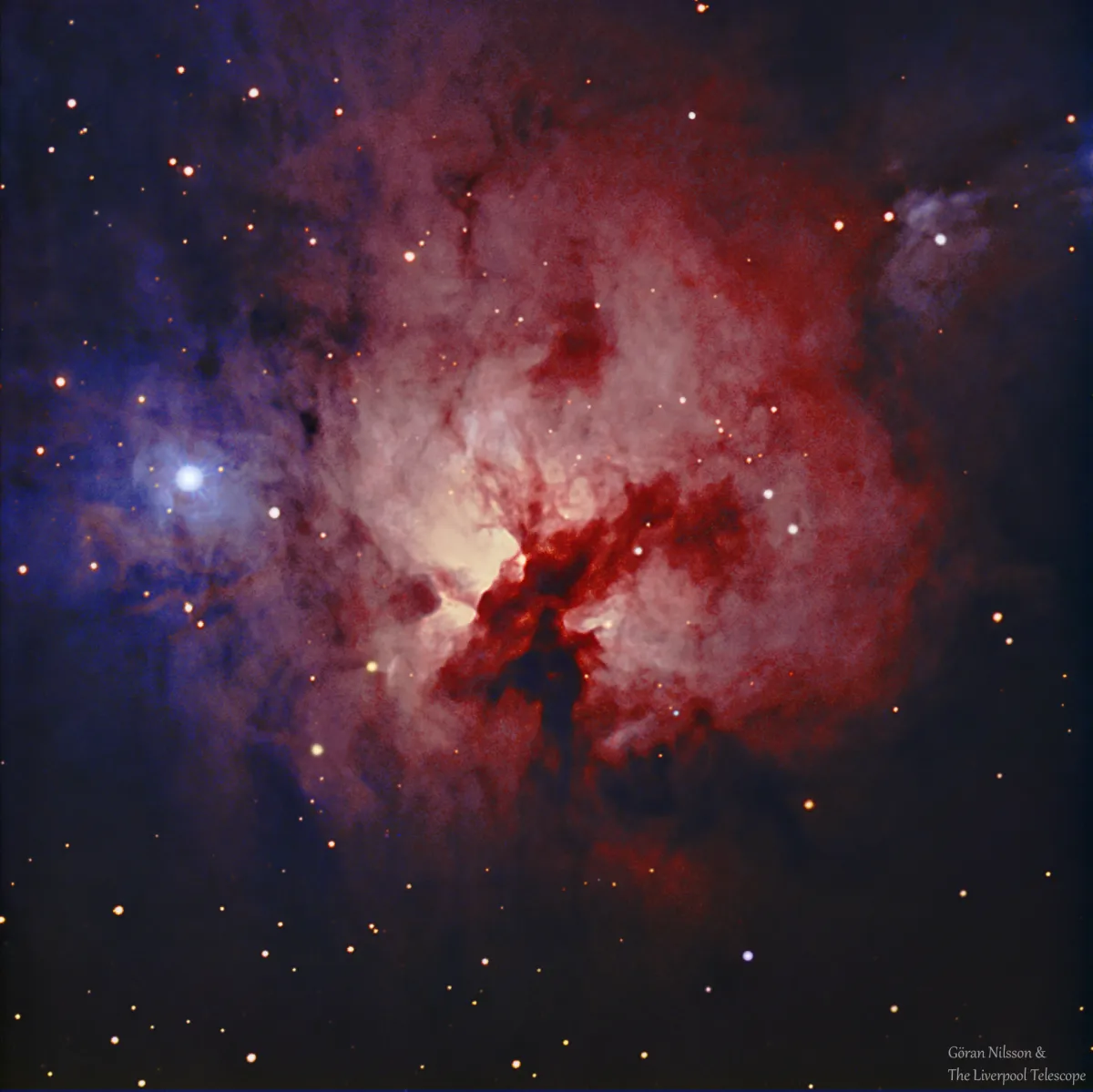
HaRGB image of the Northern Trifid Nebula NGC 1579. Data from the Liverpool Telescope, a 2 m RC telescope on La Palma, processed by Göran Nilsson. 72 x 95s exposures totaling 1.9 hours. Credit: Göran Nilsson & The Liverpool Telescope (CC BY-SA 4.0)
Facts
The Northern Trifid Nebula was discovered by the German-born British astronomer William Herschel on December 27, 1788. Herschel catalogued the object as WH I 217.
Danish astronomer John Lous Emil Dreyer included the nebula as NGC 1579 in his New General Catalogue of 1888 based on Herschel’s observations. Dreyer described the object as “Quite bright, quite large, irregularly round, much brighter in the middle, star 8. Size at a distance of 2 arc minutes at a position angle of 350°.”
The Northern Trifid Nebula is much smaller than the better known Trifid Nebula. It has a radius of 4 light-years. The larger Trifid Nebula lies around 4,100 light-years away, which means that it is 2,000 light-years more distant than NGC 1579. It has a radius of 21 light-years and an angular size of 28 arcminutes. With an apparent magnitude of 6.3, the associated star cluster can be seen in binoculars and is visible to the unaided eye in exceptionally good conditions.
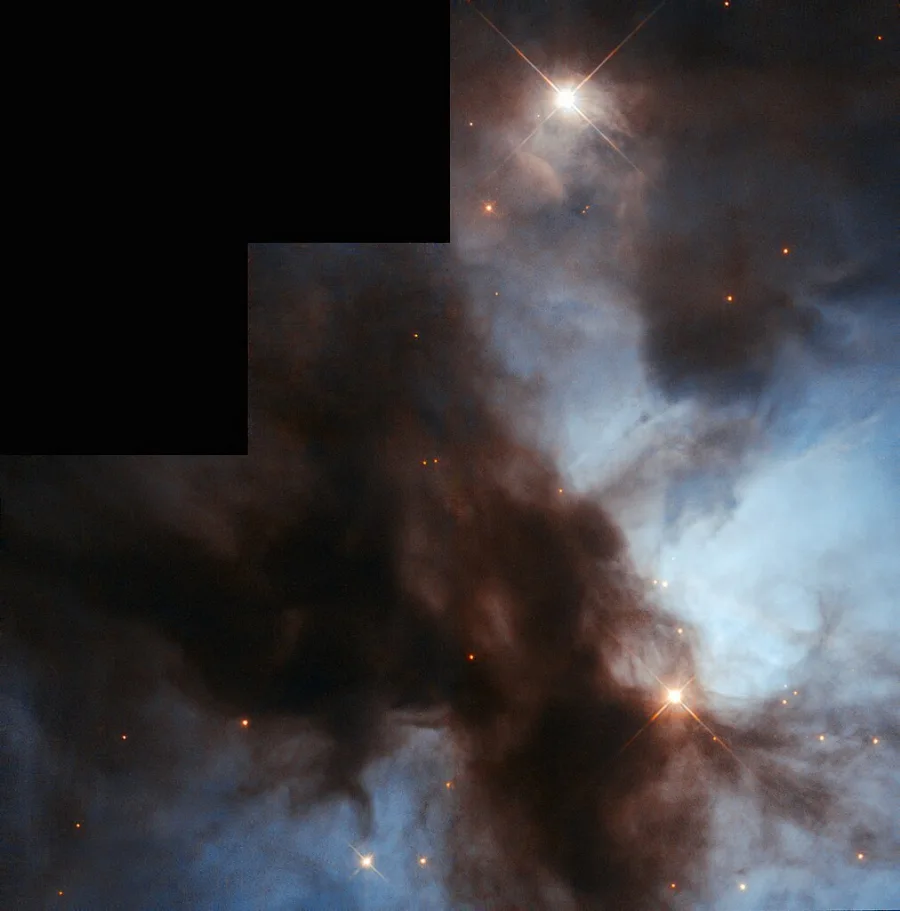
Unlike the venomous fictional plants that share its name, the Trifid of the North, otherwise known as the Northern Trifid or NGC 1579, poses no threat to your vision. The nebula’s moniker is inspired by the better-known Messier 20, the Trifid Nebula, which lies very much further south in the sky and displays strikingly similar swirling clouds of gas and dust. The Trifid of the North is a large, dusty region that is currently forming new stars. These stars are very hot and therefore appear to be very blue. During their short lives they radiate strongly into the gas surrounding them, causing it to glow brightly. Many regions like the Trifid of the North — named H II regions — are clumpy and strangely shaped due to the powerful winds emanating from the stars within them. H II regions also have relatively short lives, furiously forming baby stars until the immense winds from these bodies blow the gas and dust away, leaving just stars behind. The image above, captured by the NASA/ESA Hubble Space Telescope, shows the bright body of the nebula, with dark dust lanes snaking across the frame. The Trifid of the North glows strongly due to the many stars within it, like young binary EM* LkHA 101. Visible to the bottom right of the image, this binary is thought to be surrounded by a hundred or so fainter and less massive stars, making up a recently formed cluster. It lies behind a cloud of dust so thick that it is almost invisible to astronomers at optical wavelengths. Infrared imaging has now penetrated this dusty veil and is uncovering the secrets of this binary star, which is about five thousand times brighter than our own Sun. Image credit: ESA/Hubble & NASA; Acknowledgement: Bruno Conti (CC BY 3.0)
How to find NGC 1579
The Northern Trifid Nebula lies in the region between the bright Capella in the constellation Auriga and the Pleiades cluster in Taurus. It can be found roughly halfway between Hassaleh (Iota Aurigae) and Menkib (Xi Persei).
NGC 1579 is best seen in large telescopes at high magnification. At declination +35°, it is visible from locations north of the latitude 54° S.
The best time of the year to observe the Northern Trifid Nebula and other deep sky objects in Perseus is during the month of December, when the constellation appears higher above the horizon around 9 pm.
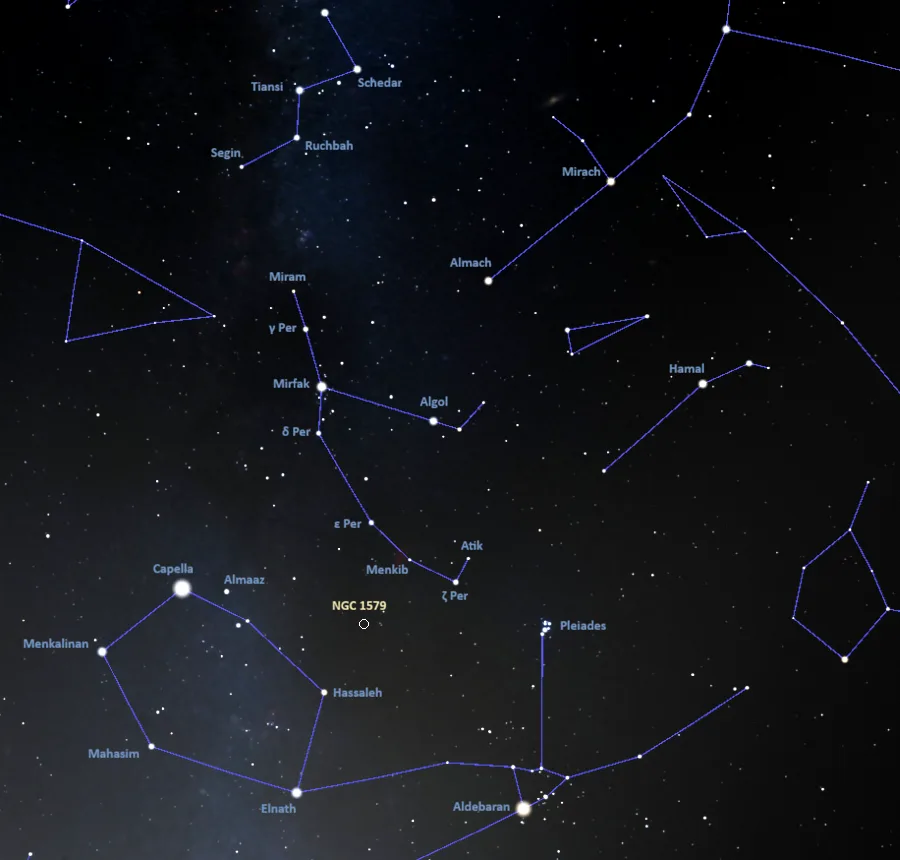
Location of the Northern Trifid Nebula (NGC 1579), image: Stellarium
Northern Trifid Nebula – NGC 1579
| Constellation | Perseus |
| Object type | Diffuse nebula |
| Right ascension | 04h 30m 03.4s |
| Declination | +35° 19′ 30″ |
| Apparent size | 12′ × 8′ |
| Distance | 2,100 light-years (644 parsecs) |
| Radius | 4 light-years |
| Names and designations | Northern Trifid Nebula, Trifid of the North, NGC 1579, Sharpless 2-222, Sh2-222, Cederblad 35, Ced 35, LBN 767, LBN 165.38-08.73, DG 34, [B77] 70, [TP72] 12 |

NGC 1579, false-color composite of Infrared, Red and Blue filter photographic plate images taken by the 1.2m Oschin Schmidt telescope at Palomar Observatory, credit: Caltech / Palomar / STScI / Hypatia Alexandria (CC BY 2.0)