NGC 5882 is a planetary nebula located 7,700 light years away in the southern constellation Lupus. With an apparent magnitude of 10.9 and an apparent size of only 14 arcseconds, it is a challenging target for amateur telescopes. It appears near the massive blue star system Epsilon Lupi.
In telescopes, NGC 5882 appears as a small cyan disk and is sometimes known as the Ghost of Uranus. It shares the nickname with the brighter Blue Planetary Nebula (NGC 3918) in the constellation Centaurus.
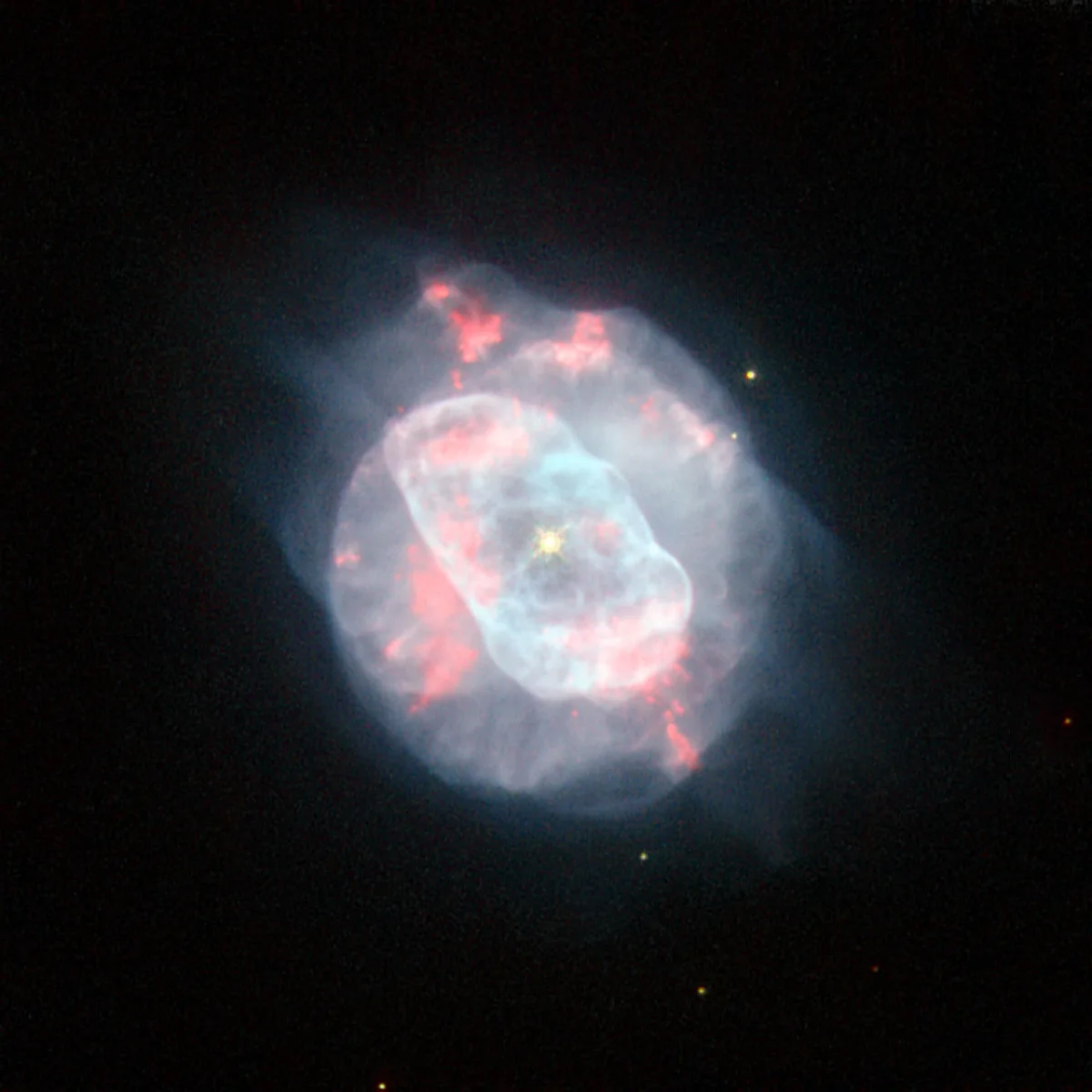
The NASA/ESA Hubble Space Telescope has captured a planetary nebula with unconventional good looks. Planetary nebulae signal the demise of mid-sized stars (up to about eight times the mass of the Sun); when the star’s hydrogen fuel supply is exhausted, its outer layers expand and cool, creating a cocoon of gas and dust. This gas then glows as it is bathed in the strong ultraviolet radiation from the central star. NGC 5882 is a quite bright, but small, example of a planetary nebula that lies deep in the southern Milky Way in the constellation of Lupus (The Wolf). Planetary nebulae sometimes have a perfectly symmetrical appearance, with gas being bellowed out from the dying star evenly in every direction. However, this isn’t the case for NGC 5882, as this Hubble image shows. It appears to have two distinct, but non-uniform regions: an elongated inner shell of gas and a fainter aspherical shell that surrounds it. Hubble’s sharp view reveals the intricate knots, filaments and bubbles within these shells. But it’s the central star at the heart of the planetary nebula that dominates the image, shining brightly with an incredible surface temperature of about 70 000 degrees Celsius. (For comparison, the surface temperature of the Sun is only about 5500 degrees Celsius.) The high surface temperature of this white dwarf is a result of the star’s struggle for survival, finding new ways to prevent itself from collapsing under its own gravity. Image credit: ESA/Hubble & NASA (CC BY 3.0)
A Sun-like star’s final chapter
The glowing shell of gas formed when a star similar to the Sun reached the end of its life and cast off its outer layers into space. Planetary nebulae are produced by stars that are not massive enough to go out as supernovae. When they exhaust their hydrogen fuel, intermediate-mass stars expand into red giants. Over time, they shed their outer gaseous envelopes, which then expand and are illuminated by the hot remnant cores. NGC 5882 has an average expansion velocity of 12.5 km/s.
Planetary nebulae typically last only a few tens of thousands of years before dispersing into the surrounding interstellar medium. The central white dwarfs gradually cool over billions of years.
A two-shell structure
NGC 5882 is structured in two distinct shells. The elliptical inner shell has an apparent size of 11 by 6 arcseconds and contains multiple bubble-like features along the surface of the inner rim. The rounder outer shell is 15 arcseconds across and expands at a higher velocity than the inner one.
The main nebula is surrounded by a faint extended halo that stretches up to 160 arcseconds.
The knots, bubbles, complex arcs and filamentary halos of NGC 5882 make it appear very similar to the better-known Cat’s Eye Nebula (NGC 6543) in the constellation Draco.
The central star of NGC 5882
The nebula’s central star is catalogued as HD 135456 and has the spectral class O(H) f. It has an apparent magnitude of 13.43 and is slightly offset from the nebula’s centre. The hot stellar remnant has a radius only 22.7 percent that of the Sun and an energy output of 830 solar luminosities.
NGC 5882 has similar elemental abundances to the Sun, with the exception of nitrogen, which is enriched by a factor of two. This indicates that the central star was in the low-to-intermediate mass range, with a mass of less than 3 solar masses.
The nitrogen enhancement suggests that the star did not undergo what astronomers call the “second dredge-up,” a mixing event during which fusion products from the stellar interior are mixed into the star’s outer layers, where they become visible in its spectrum.
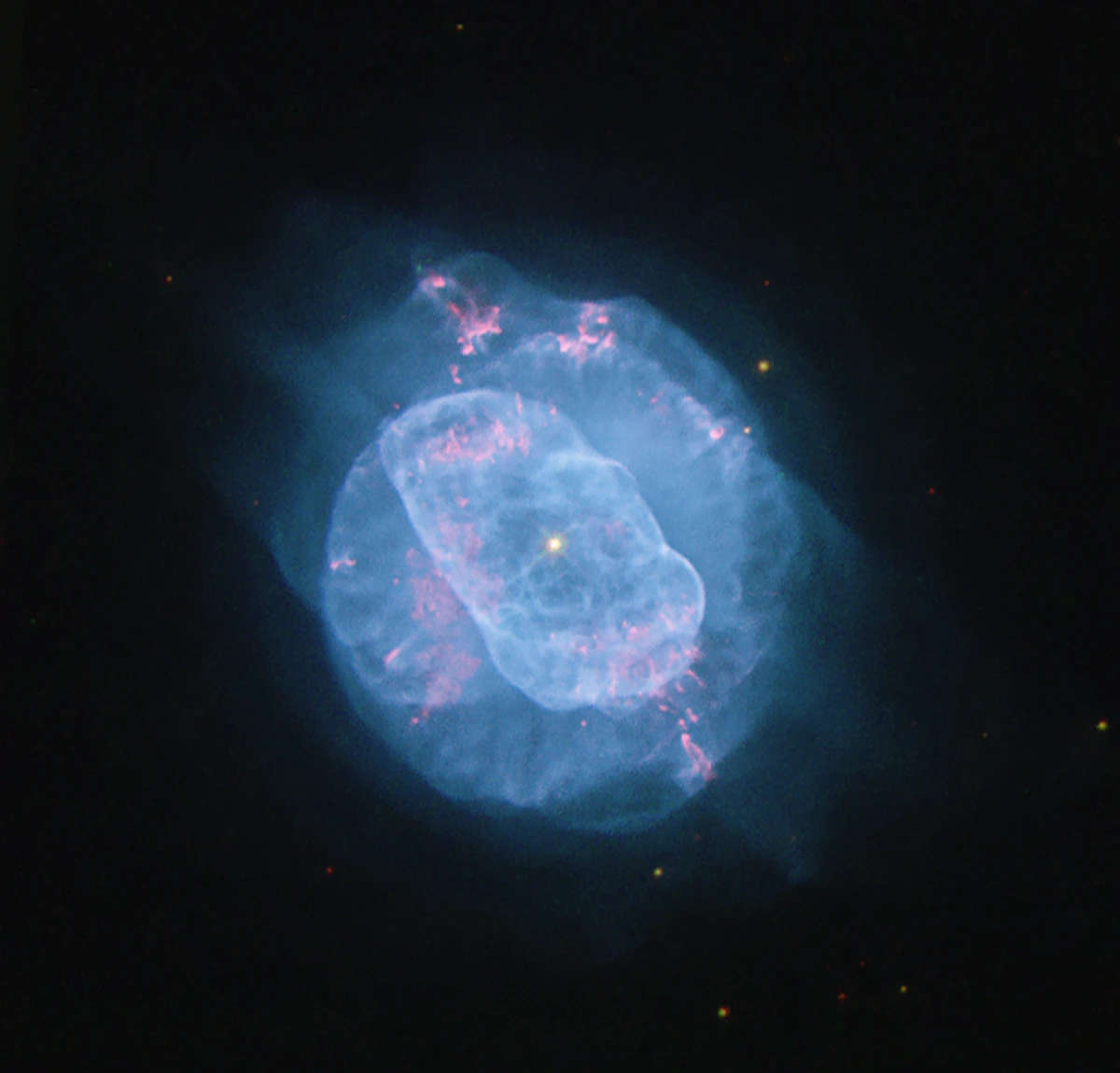
NGC 5882 by the Hubble Space Telescope, credit: ESA/NASA, Judy Schmidt (CC BY 2.0)
Discovery of NGC 5882
NGC 5882 was discovered by the British astronomer John Herschel from the Cape of Good Hope in South Africa on July 2, 1834. In a letter to astronomer Francis Baily sent on October 22, 1834, Herschel wrote:
“On the 2nd of July I was fortunate enough to light on another very delicate and beautiful planetary nebula in R. A. 15h 5m 15s, N. P. D. 135° 1′ (1830.0), having a diameter of 1s35 in time, and a perfectly sharp disc, equal to a star of the 8.9 mag. in light. (My assistant, J. Stone, to whom I [showed] it, said it was like the moon, round and clean, only smaller.)”
Herschel later listed the nebula as object number 3594 in his catalogue, describing it as “a most elegant and delicate planetary nebula (…) perfectly sharp, not the slightest haziness. A very fine object.”
Danish astronomer John Louis Emil Dreyer added the nebula to his New General Catalogue (1888) as NGC 5882, describing it as “very small, round, quite sharp.”
Scottish astronomer Williamina Fleming discovered the nebula on a plate obtained at Harvard College Observatory’s Peruvian Station and announced the discovery in 1894. However, the object was not identified as NGC 5882 at the time, which led to it being listed as IC 1108 in the second Index Catalogue.
How to find NGC 5882
NGC 5882 appears 1.5 degrees southwest of Epsilon Lupi, a relatively bright (mag. 3.41) multiple star system that lies close to the imaginary line extended from Iota Centauri (Kulou) through Eta Centauri, or about a quarter of the way from Alpha Lupi to the bright Larawag in Scorpius.
In small telescopes, the nebula appears as a small, sharp disk. Like all planetary nebulae, it is best seen at higher magnifications, which help distinguish it from a faint star.
At declination -46°, the Ghost of Uranus is best seen from the southern hemisphere. It never rises above the horizon for observers north of the latitude 44° N.
The best time of the year to observe deep sky objects in Lupus is in June, when the constellation appears higher in the sky in the early evening.
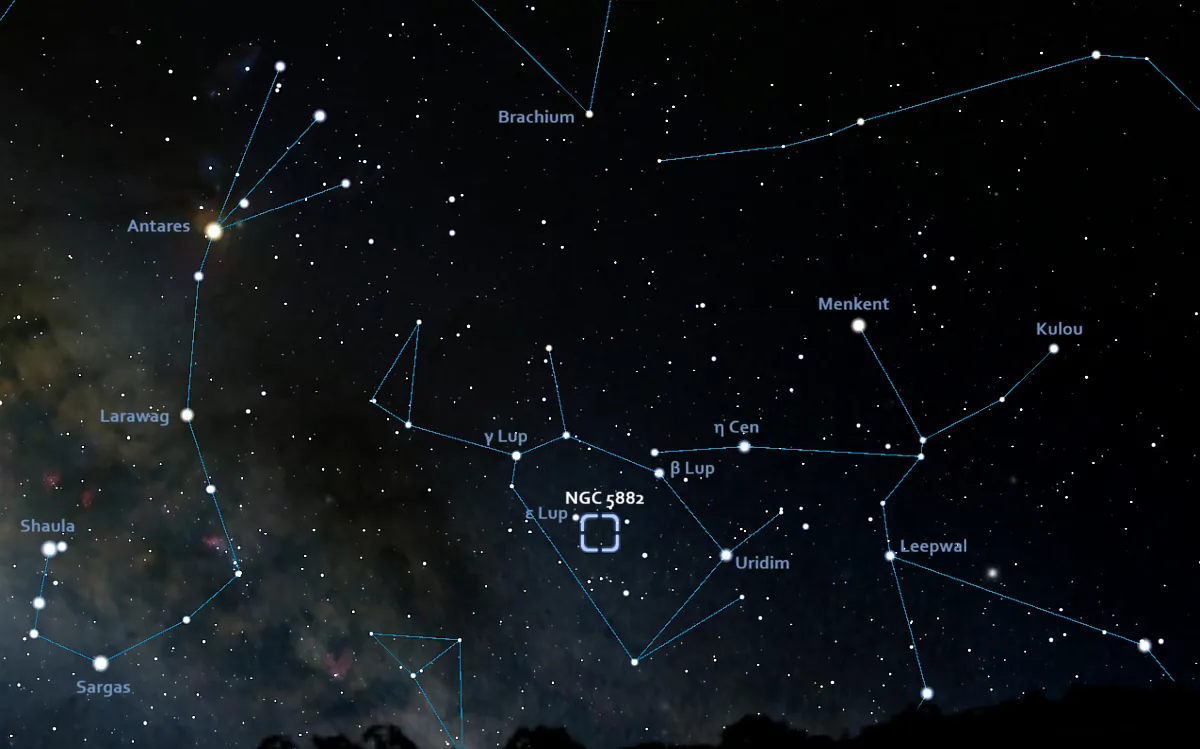
NGC 5882 location, image: Stellarium (annotated for this article)
Explore other planetary nebulae in the southern sky:
- Retina Nebula (IC 4406) in Lupus
- Southern Own Nebula (ESO 378-1) in Hydra
- Hourglass Nebula (MyCn 18) in Musca
- Robin’s Egg Nebula (NGC 1360) in Fornax
- Little Gem Nebula (NGC 6818) in Sagittarius
- Blue Planetary Nebula (NGC 3918) in Centaurus
- Spare Tyre Nebula (IC 5148) in Grus
NGC 5882
| Constellation | Lupus |
| Object type | Planetary nebula |
| Right ascension | 15h 16m 49.9562553264s |
| Declination | – 45° 38′ 58.616280132″ |
| Apparent magnitude | 10.9 |
| Apparent size | 14″ |
| Distance | 7,700 light-years (2,400 parsecs) |
| Names and designations | NGC 5882, PN G327.8+10.0, PMN J1516-4538, Henize 2-122, Hen 2-122, VV 71, IC 1108, Sa 2-118, WRAY 16-171, ARO 505, PK 327+10 1, SCM 90, ATPMN J151649.8-453858, VV’ 122, ESO 274-7, IRAS 15134-4527, IRAS F15134-4527, HD 135456, StWr 4-13, TYC 8294-398-1, GSC 08294-00398, SUMSS J151649-453857, GCRV 8827, GSC2 S23313212232, SPASS J151651-453930, AT20G J151650-453857, ATPMN J151649.9-453858, WEB 12754, CD -45 9789, CPD -45 7306, Gaia DR2 6000019147299399936, Gaia DR3 6000019147299399936 |