NGC 2547, also known as the Golden Earring Cluster, is a bright open cluster located approximately 1,190 light years away in the southern constellation Vela (the Sails). With an apparent magnitude of 4.7 and an apparent size of 20 arcminutes, it can be observed in binoculars and small telescopes.
The Golden Earring Cluster was discovered by Nicolas Louis de Lacaille from the Cape of Good Hope in South Africa in 1751. The French astronomer spotted it in a small refractor with less than 2 centimetres aperture.
The cluster is around 37.7 million years old and is one of the youngest open clusters visible to amateur astronomers. It has been studied extensively for its stellar rotation rates, magnetic activity, and circumstellar debris disks, making it a valuable laboratory for astronomers studying the formation of stars and planetary systems.
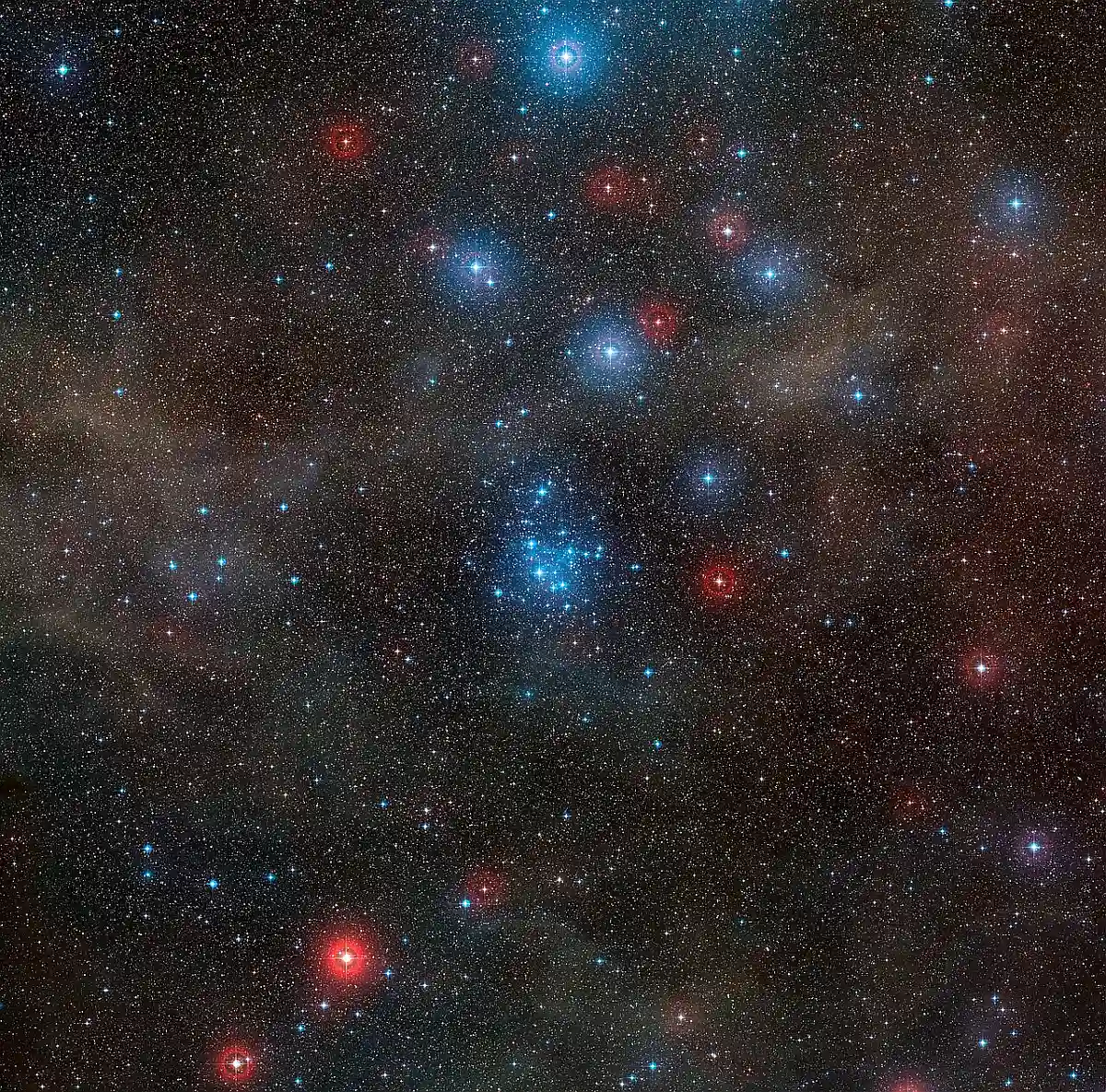
This picture was created from images forming part of the Digitized Sky Survey 2. It shows the rich region of sky around the young open star cluster NGC 2547 in the southern constellation of Vela. Image credit: ESO/Digitized Sky Survey 2 (PD)
Open clusters like NGC 2547 play a crucial role in discovering how stellar properties determine stellar life cycles. Members of an open cluster all formed together from the same material at around the same time. By analyzing their properties, including mass and luminosity, astronomers can predict their fuel consumption rates and identify their evolutionary stages.
Interloper in the Vela OB2 region
NGC 2547 appears in the same region as the Vela OB2 association, a young stellar family that includes the massive star system Gamma Velorum. However, it is not a member of Vela OB2. The cluster is older and has very different kinematics from the Vela group. It is believed to be an interloper in the region. Researchers have proposed that the cluster formed around 100 parsecs from Vela OB2 and is currently only passing through it.
In 2015, researchers discovered a younger population of stars in the same area as NGC 2547. These stars have different kinematics from NGC 2547 and similar motion and age to Gamma Velorum B. They form an extended low-mass component of Vela OB2. These findings highlight the complexity of stellar groupings in this part of the sky.
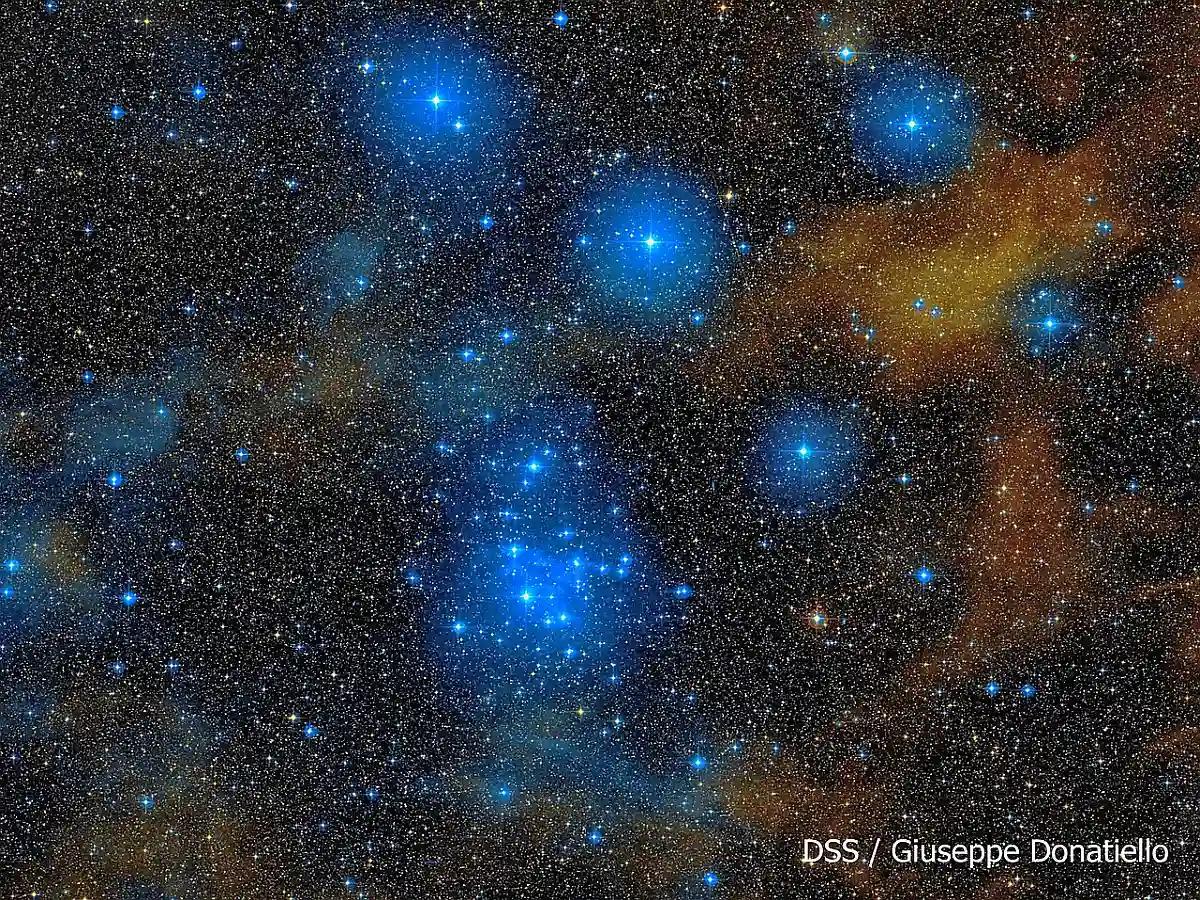
NGC 2547, image credit: Credit: DSS / Giuseppe Donatiello (CC0 1.0)
Member of Vela Population IV
The Golden Earring Cluster is linked to a broader pattern of star formation in this area of the sky. It has a very similar age to the open clusters Trumpler 10 in Vela, the Pi Puppis Cluster (Collinder 135) and NGC 2451B in Puppis, and Collinder 140 in Canis Major.
This has led astronomers to propose that these clusters may have formed from the same event that triggered a burst of star formation in the region. Astronomers refer to these clusters as Vela Population IV.
In 2019, a team led by T. Cantat-Gaudin showed that the clusters shared not only a common motion through space, but that they were still physically connected by a continuous distribution of stars. The connection between the clusters provides important insights into large-scale star formation processes.
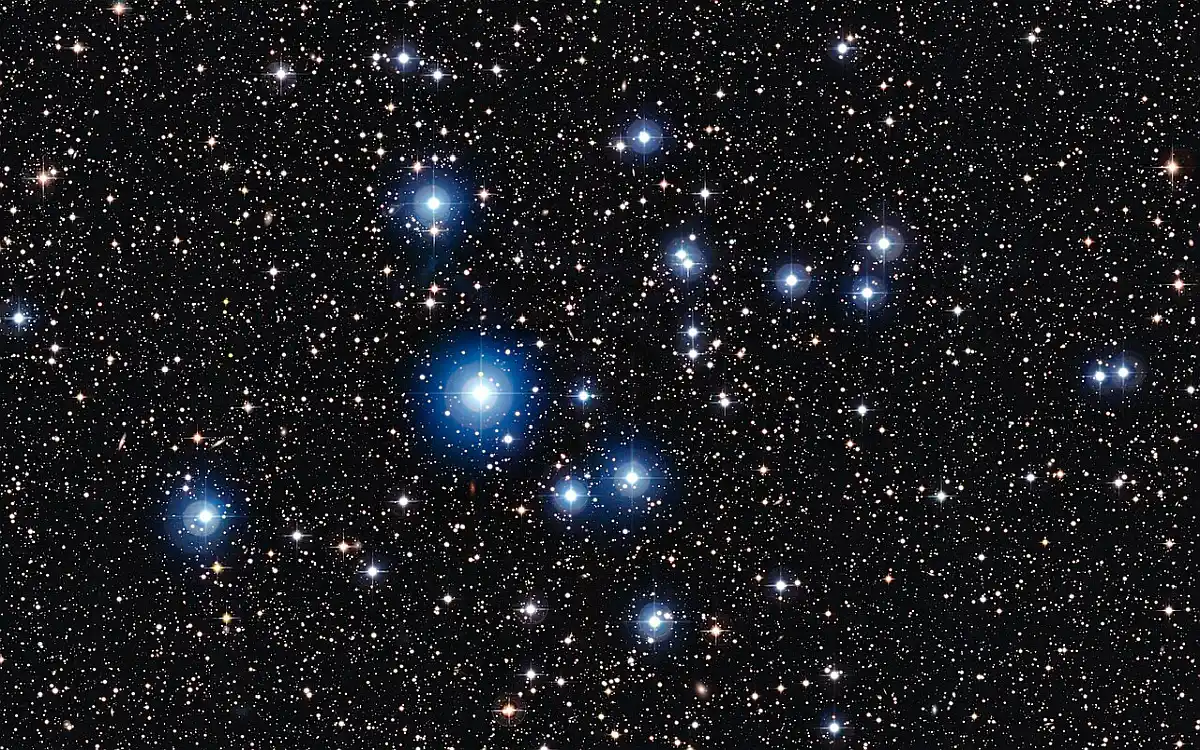
This image from the Wide Field Imager on the MPG/ESO 2.2-metre telescope at ESO’s La Silla Observatory in Chile, shows the bright open star cluster NGC 2547. Between the bright stars, far away in the background of the image, many remote galaxies can be seen, some with clearly spiral shapes. Image credit: ESO (CC BY 4.0)
Stellar population of NGC 2547
The stars of NGC 2547 reveal important details about the cluster’s evolution. NGC 2547 is believed to be around 37.7 million years old. It contains many hot blue stars but also some red and yellow members that have already evolved away from the main sequence despite their young age. Stars with a mass of more than 8 solar masses have likely already gone out as supernovae.
The brightest members of the Golden Earring Cluster shine at magnitude 10. Many of them are A-type stars, much more massive and luminous than the Sun.
Astronomers have found evidence of mass segregation among cluster members with a mass of more than 3 solar masses. Dynamical mass segregation is the process by which more massive stars tend to move towards the cluster’s centre, while the less massive ones move towards the outskirts.
A 2018 study by Bravi et al, who analysed data obtained in the Gaia-ESO Survey, provided a total mass estimate of 201 solar masses and a radius of 2.61 light-years for the cluster. Together, these findings make NGC 2547 an excellent target for studying stellar dynamics in young open clusters.
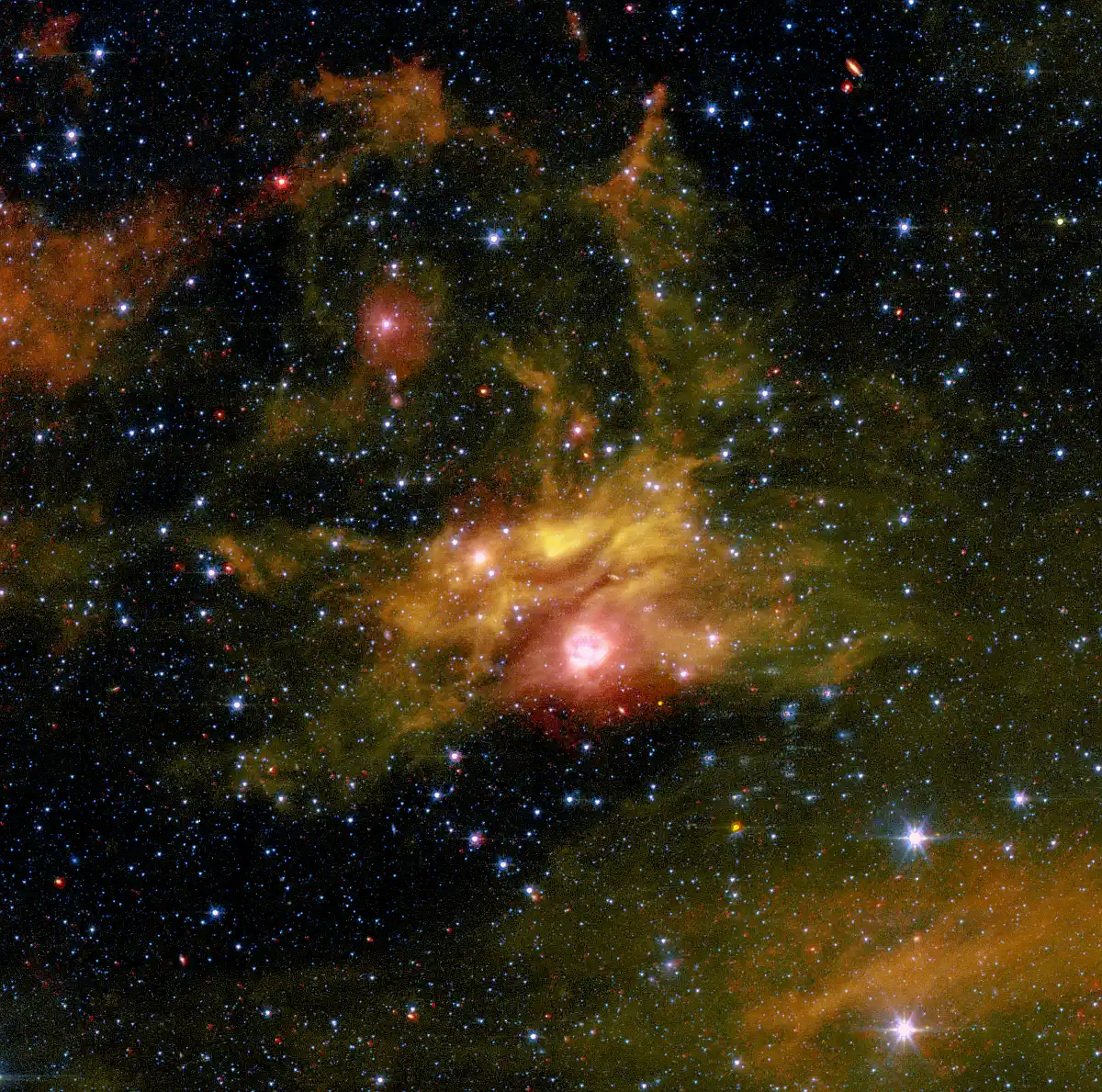
This image is a false-color image of the young star cluster NGC 2547 in the constellation of Vela. The star cluster contains the massive star HD 68478, which is located near the middle of the image and shows a shell, which could be a sign of a recent mass loss. The star cluster NGC 2547 is with an age of about 30 million years still young on astronomical timescales and still contains stars with dusty circumstellar disk in which planets could still be in the process of forming. The image was taken with the IRAC and MIPS instrument on board of NASA’s Spitzer Space Telescope. The images were downloaded from the NASA/IPAC Infrared Science Archive, which is funded by the National Aeronautics and Space Administration and operated by the California Institute of Technology. Image credit: Meli Thev (CC BY-SA 4.0)
Clues about planet formation
NGC 2547 has become one of the most important clusters for the study of debris disks and planet formation. The cluster’s age coincides with a critical stage in the assembly of rocky planetary systems. Its stars are past the point where primordial gas disks are expected to survive, but young enough to show ongoing collisions between planetesimals in the regions where terrestrial planets typically form.
Rocky Earth-like planets form from massive collisions that produce vast amounts of dust. Proto-planets form through the accretion of dust and planetesimals in protoplanetary disks. As the dust is warmed by the host star, it glows in the infrared, becoming detectable from Earth. These early processes can be directly studied within NGC 2547.
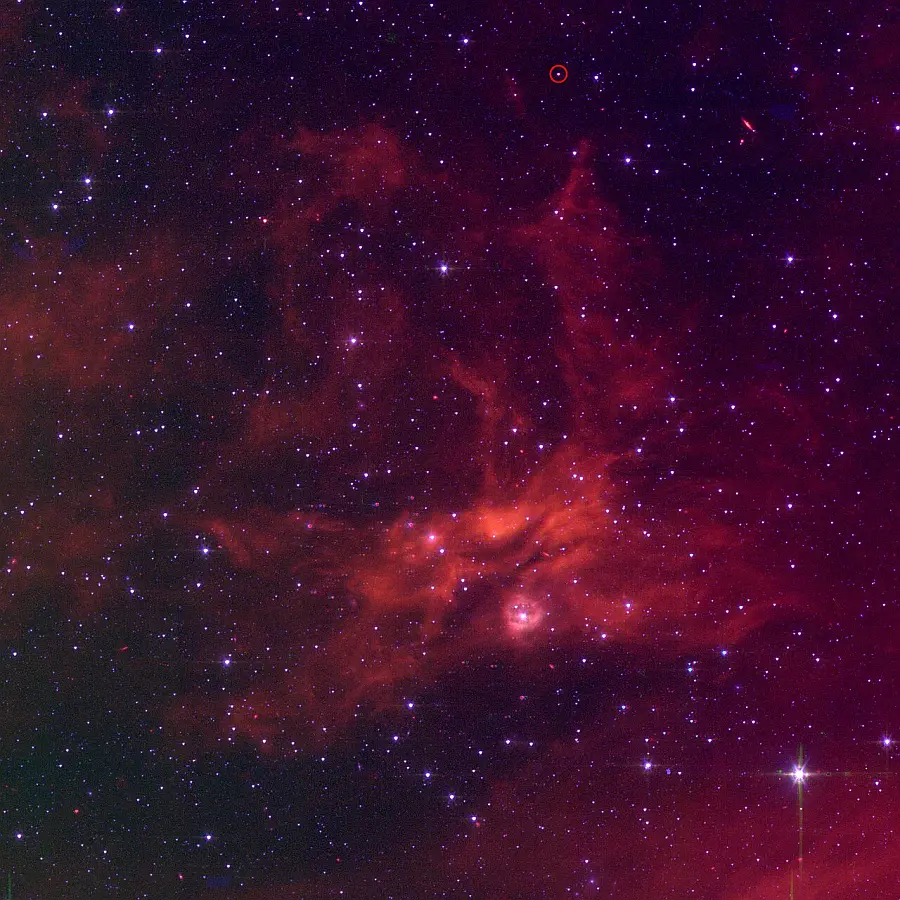
NGC 2547–ID8 (red circle, also known as 2MASS J08090250-4858172) with Spitzer. Image credit: Meli Thev (CC BY-SA 4.0)
Massive asteroid collision
The most dramatic evidence for planet formation comes from the star 2MASS J08090250-4858172, commonly referred to as NGC 2547-ID8 or simply ID8. The young Sun-like star has provided astronomers with a direct view of a collision between large asteroids that can lead to the formation of planets.
The Spitzer Space Telescope detected an eruption of a huge amount of dust in the ID8 system between August 2012 and January 2013. This was the first time researchers obtained data before and after such a collision.
The thick cloud of dust now orbits the young star in the zone where terrestrial planets may form, and the star’s age corresponds closely to the epoch in our own solar system when similar impacts are thought to have built Earth, Mars, and the other inner planets.
NASA described the observation as watching rocky planet formation happen in near real time. Later analysis confirmed that a second similar event occurred around NGC 2547-ID8 in early 2014. These observations provide a rare real-time insight into planet-building events.
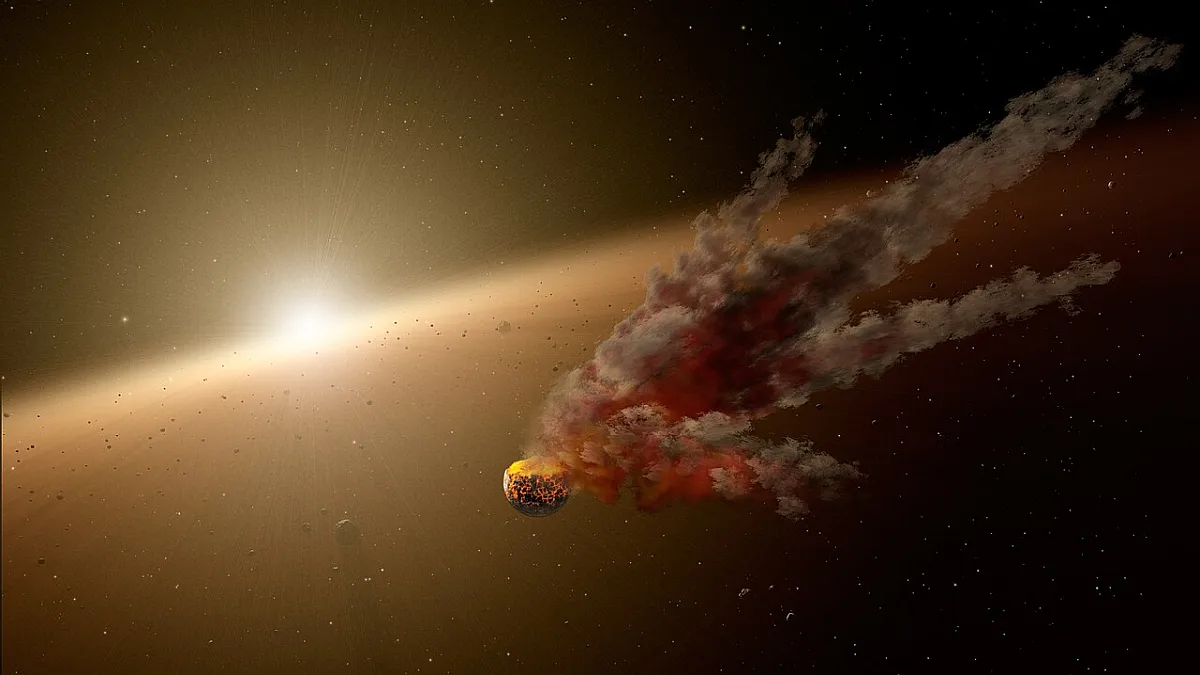
Planets, including those like our own Earth, form from epic collisions between asteroids and even bigger bodies, called proto-planets. Sometimes the colliding bodies are ground to dust, and sometimes they stick together to ultimately form larger, mature planets. This artist’s conception shows one such smash-up, the evidence for which was collected by NASA’s Spitzer Space Telescope. Spitzer’s infrared vision detected a huge eruption around the star NGC 2547-ID8 between August 2012 and 2013. Scientists think the dust was kicked up by a massive collision between two large asteroids. They say the smashup took place in the star’s “terrestrial zone,” the region around stars where rocky planets like Earth take shape. NGC 2547-ID8 is a Sun-like star located about 1,200 light-years from Earth in the constellation Vela. It is about 35 million years old, the same age our young Sun was when its rocky planets were finally assembled via massive collisions – including the giant impact on proto-Earth that led to the formation of the Moon. The recent impact witnessed by Spitzer may be a sign of similar terrestrial planet building. Near-real-time studies like these help astronomers understand how the chaotic process works. Image credit: NASA/JPL-Caltech (PD)
Peter Pan disks
ID8 was one of many stars found to have an infrared excess in NGC 2547. In 2008, astronomers identified nine M-type dwarfs that showed excess emission at 24 micrometres, indicating the presence of warm material near these red dwarfs’ snow lines.
The debris disk candidates were found orbiting at less than 1 astronomical unit from the stars. Their presence indicates that planet formation may be underway in those systems.
Later studies proposed that these M-dwarfs may host Peter Pan disks, unusually long-lived primordial disks that survive well beyond the typical disk lifetime. These gas-rich disks found around stars at unexpectedly high ages (more than 20 million years) were named Peter Pan disks because they appear to “never grow up.” Such systems challenge existing models of disk evolution.
How to find the Golden Earring Cluster
NGC 2547 appears around 2 degrees south of the bright multiple star system Regor (Gamma Velorum), along the imaginary line connecting Canopus in Carina and Suhail in Vela. The massive star system can be found by extending a line from Sirius through Wezen, the top star in a triangle near Sirius.
From the southern hemisphere, Regor can be located using the stars of the False Cross. A line drawn from Aspidiske through Alsephina, through the short axis of the asterism, points in the direction of Gamma Velorum and the Golden Earring Cluster.
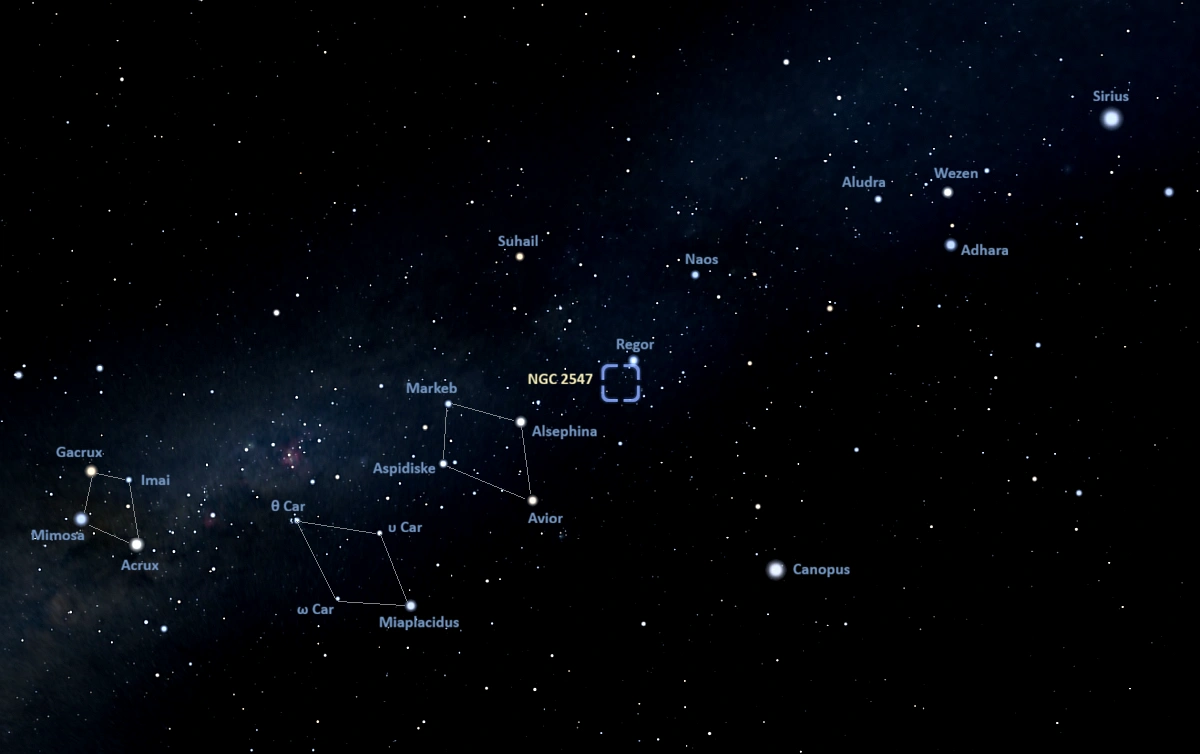
Location of NGC 2547 (the Golden Earring Cluster), image: Stellarium (annotated for this article)
Where is NGC 2547 visible
At declination -49°, NGC 2547 is best seen from the southern hemisphere. It never rises above the horizon for observers north of the latitude 40° N and only appears very low in the sky from the mid-northern latitudes.
The best time of the year to observe the Golden Earring Cluster and other deep sky objects in Vela is in March, when the constellation appears higher in the sky in the early evening.
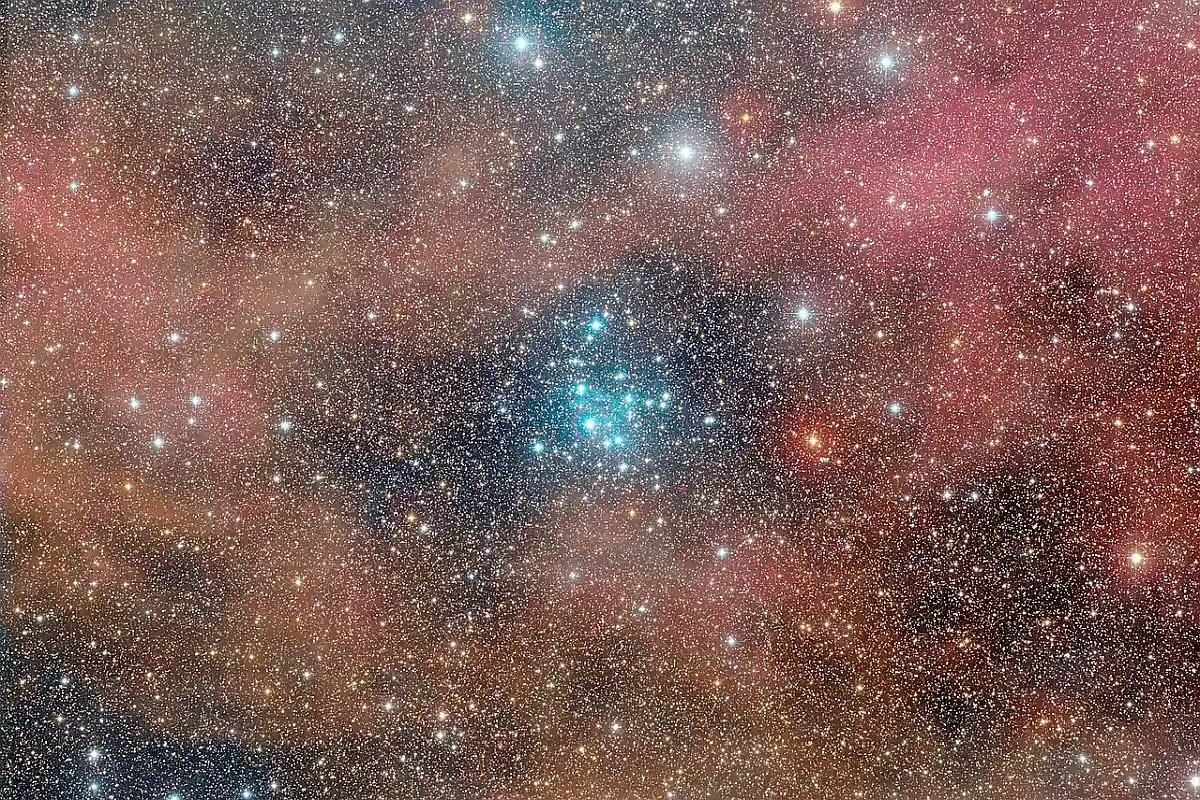
Golden Earring Cluster, image credit: DSS/Giuseppe Donatiello (CC0 1.0)
Explore other deep sky objects in Vela:
- Southern Ring Nebula (NGC 3132)
- Omicron Velorum Cluster (IC 2391)
- Vela Supernova Remnant
- Pencil Nebula (NGC 2736)
- Gum Nebula (Gum 12)
Golden Earring Cluster – NGC 2547
| Constellation | Vela |
| Object type | Open cluster |
| Right ascension | 08h 10m 01.5s |
| Declination | −49° 12′ 08″ |
| Apparent magnitude | 4.7 |
| Apparent size | 20′ |
| Distance | 1,190 light-years (364 parsecs) |
| Size (radius) | 2.61 light-years |
| Mass | 201 M☉ |
| Age | 37.7 million years (32.9 – 43.4 Myr) |
| Names and designations | Golden Earring Cluster, NGC 2547, Collinder 177, Cr 177, Melotte 84, Mel 84, Dunlop 410, BRAN 115, Lacaille III.2, C 0809-491, OCl 753.0, [KC2019] Theia 74, [BBJ2018] 3, [KPR2004b] 183, [KPS2012] MWSC 1437 |