NGC 2477 is a bright open star cluster located approximately 3,600 – 4,700 light-years away in the constellation Puppis. With an apparent magnitude of 5.8 and an apparent size of 27 arcminutes, the richly populated cluster is visible without binoculars in good conditions. It is catalogued as Caldwell 71 in the Caldwell catalogue of objects that can be observed in amateur telescopes.
NGC 2477 is one of the most visually impressive open clusters in the sky. It is popularly known as the Termite Hole Cluster or the Electric Guitar Cluster. Located near one of the most luminous stars visible to the unaided eye, NGC 2477 is a popular target for binoculars and small telescopes.
The cluster lies in the rich field of the Milky Way and occupies an area comparable to that of the full Moon. Its brightest stars have an apparent magnitude of 9.8 and can be resolved in binoculars and small telescopes.
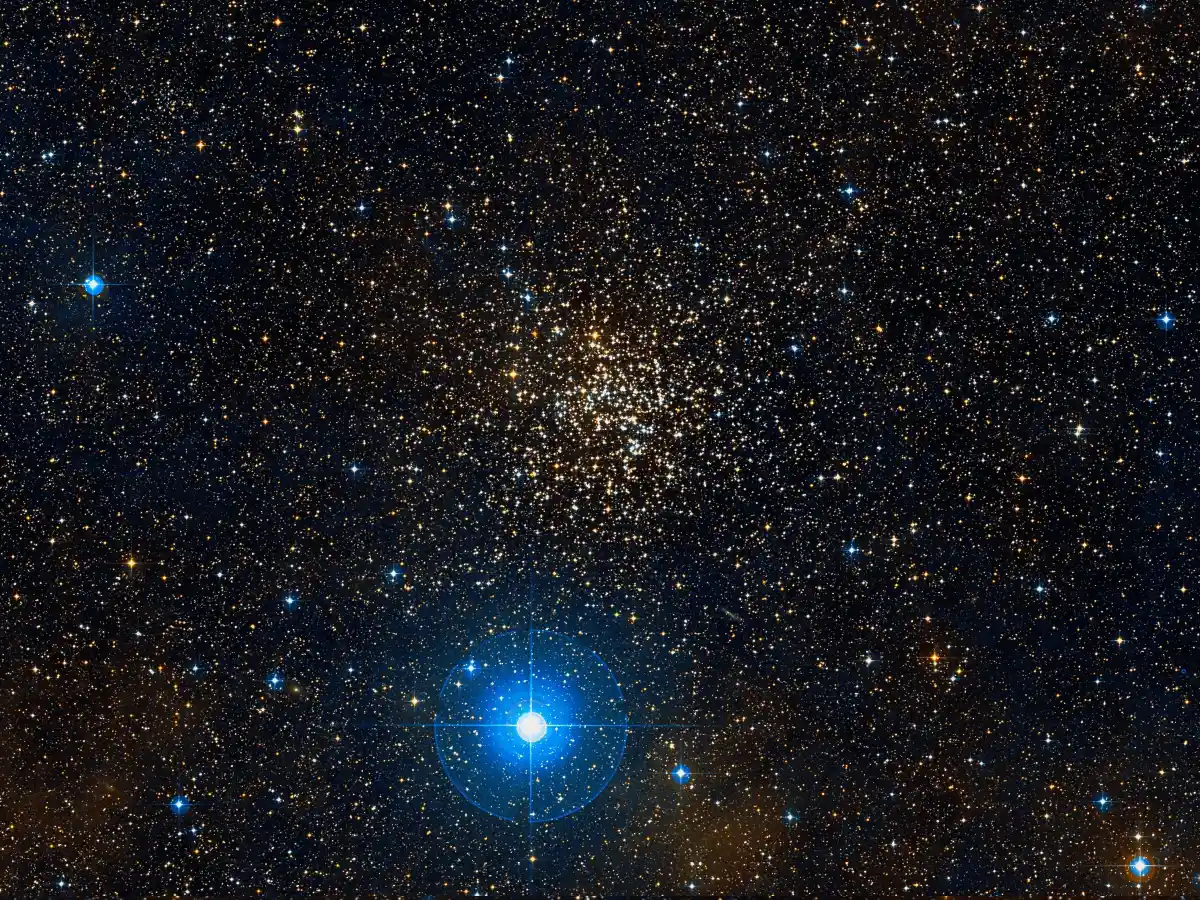
NGC 2477, image credit: ESO/Digitized Sky Survey 2 (CC BY 4.0)
A 2023 study led by M. S. Angelo found a mass of 9,800 solar masses for the cluster and identified around 25,400 members using data from the Gaia DR3 catalogue. Older sources list only 300 members.
White dwarfs as clocks for cluster evolution
One of the most important results from studies of NGC 2477 comes from its white dwarf cooling sequence, which provides an independent and powerful way to measure the cluster’s age.
In 2011, a team led by Elizabeth J. Jeffery of the Space Telescope Science Institute (STScI) derived an age of 1.035 ± 0.054 ± 0.087 for the cluster using the white dwarf sequence. The astronomers identified seven candidate white dwarfs in the cluster based on data obtained with the Hubble’s Wide Field and Planetary Camera 2 (WFPC2).
White dwarfs are the dense remnants left behind when Sun-like stars exhaust their nuclear fuel and shed their outer layers. Once formed, a white dwarf no longer generates energy and simply cools and fades at a predictable rate. The faintest white dwarfs detected in NGC 2477 represent the oldest remnants in the cluster, effectively setting a lower limit on how long stars have been evolving there.
In NGC 2477, the cooling age derived from the white dwarf population was found to be close to one billion years, in excellent agreement with ages obtained from stellar evolution models and asteroseismology. This agreement is significant because it validates both the white dwarf cooling theory and conventional cluster dating techniques, making NGC 2477 a valuable benchmark for stellar evolution studies.
NGC 2477 is unusually old for an open cluster. Open clusters typically disperse after a few hundred million years. The most massive ones can survive for a few billion years. The oldest open clusters discovered to date include Berkeley 17 (9 billion years) near the Spaghetti Nebula and the Tadpole Nebula (IC 410) in the constellation Auriga, NGC 6791 (8 billion years) in Lyra, and the Polarissima Cluster (NGC 188, Caldwell 1, 6.8 billion years) near Polaris, in the constellation Cepheus.
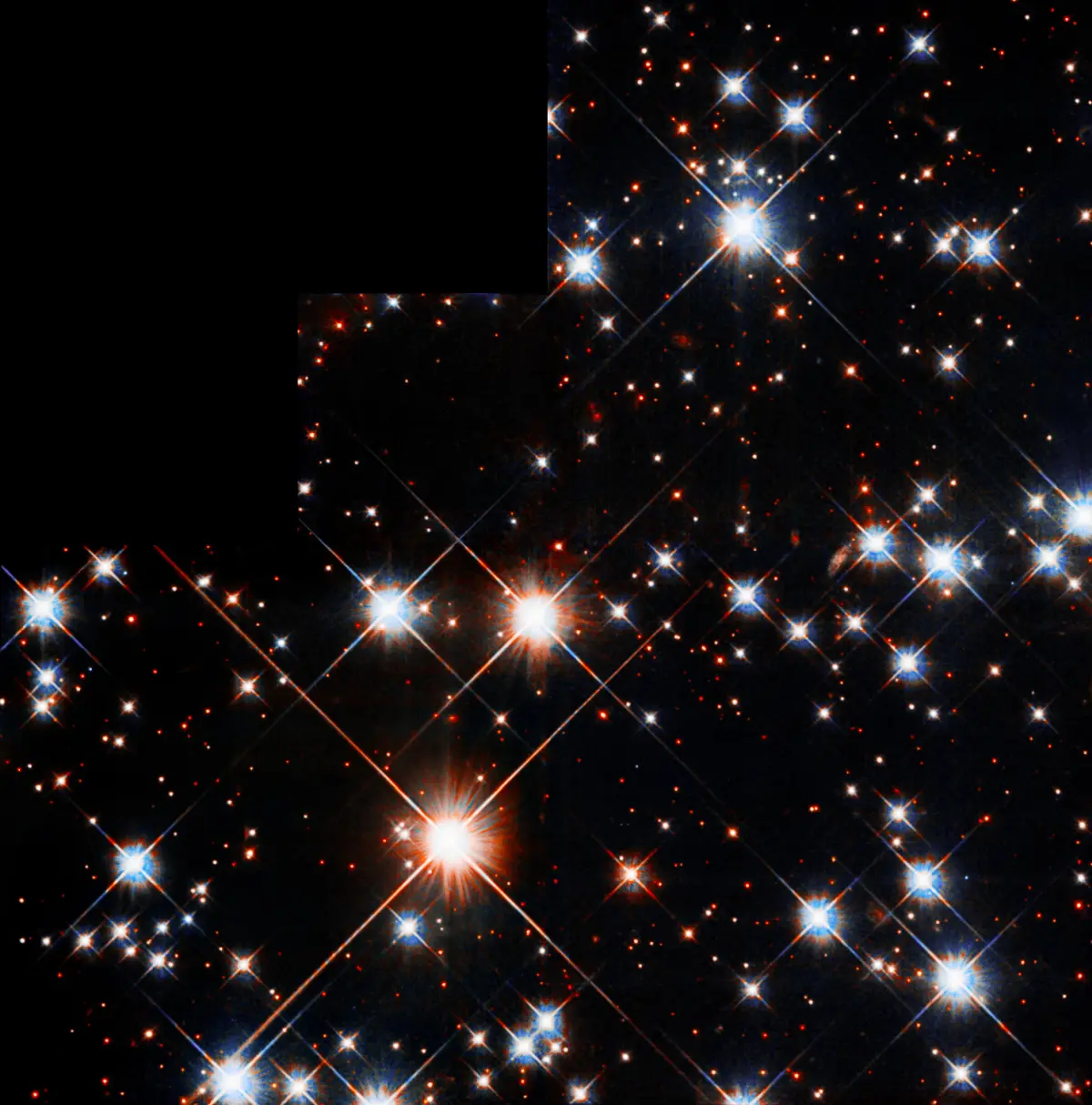
Caldwell 71, or NGC 2477, is an open star cluster. Open clusters are loosely bound collections of stars. However, Caldwell 71 is relatively compact and strikingly spherical, so it is easily mistaken for a globular cluster. It is located roughly 4,000 light-years from Earth in the constellation Puppis. With an apparent magnitude of 5.8, it appears fairly bright in the sky and can be spotted easily with a pair of binoculars. The loose open cluster NGC 2451 appears near it, and both clusters can fit in the same field of view with binoculars or a low-power telescope. Discovered by the French astronomer Nicolas-Louis de Lacaille in 1751, Caldwell 71 is best observed in the Southern Hemisphere during the summer and in the lower latitudes of the Northern Hemisphere during the winter. This image, showing just a portion of Caldwell 71, is a composite of visible and infrared observations by Hubble’s Wide Field and Planetary Camera 2. The observations were made to study the evolution of cooling white dwarfs (the dense cores left behind after a star has exhausted all of its nuclear fuel) and to investigate the cluster’s Initial Mass Function (IMF) — a tool astronomers use to describe how mass is initially distributed within a population of stars. Using Hubble’s observations, astronomers found that the IMF for Caldwell 71 was the same as the other star clusters they studied. Credit: NASA, ESA, and T. von Hippel (Embry-Riddle Aeronautical University); Processing: Gladys Kober (NASA/Catholic University of America) (CC BY 2.0)
Blue stragglers, binaries and stellar rejuvenation
Not all stars in NGC 2477 grow old at the same pace. Some cluster members refuse to age gracefully.
In 2020, Rain et al. discovered five blue stragglers and four yellow straggler candidates in NGC 2477 using astrometric and photometric data from Gaia Data Release 2 (Gaia DR2).
Blue stragglers are unusually hot, blue, luminous stars typically found in the central regions of densely populated globular and open clusters. These stars appear much younger and bluer than other stars in the vicinity. They are believed to form in collisions of binary stars that come too close to each other. The newly formed stars are more massive and appear bluer than other cluster members. Yellow stragglers are believed to be former blue stragglers that are currently evolving toward the giant branch.
The precise astrometric data obtained by the Gaia satellite allowed astronomers to cleanly separate true cluster members from unrelated field stars. Because the cluster lies in a rich Milky Way star field, earlier studies struggled with contamination: stars that only appeared to belong to the cluster based on position alone. Gaia changed that by measuring parallaxes and proper motions (motions across the sky) with extraordinary accuracy. Stellar parallax is the apparent shift in the position of a star relative to more distant background objects. It is used to determine stellar distances.
Gaia’s measurements were especially important for identifying blue and yellow stragglers. These stars are rare and sit in unusual regions of the colour–magnitude diagram, where background stars can easily masquerade as cluster members. Gaia data showed that many candidate stragglers indeed share the cluster’s motion and distance, confirming that they truly belong to NGC 2477.
That confirmation strengthened the case that these stars are products of binary evolution or stellar mergers, not observational artifacts. In short, Gaia turned intriguing candidates into solid evidence of complex stellar interactions within the cluster.
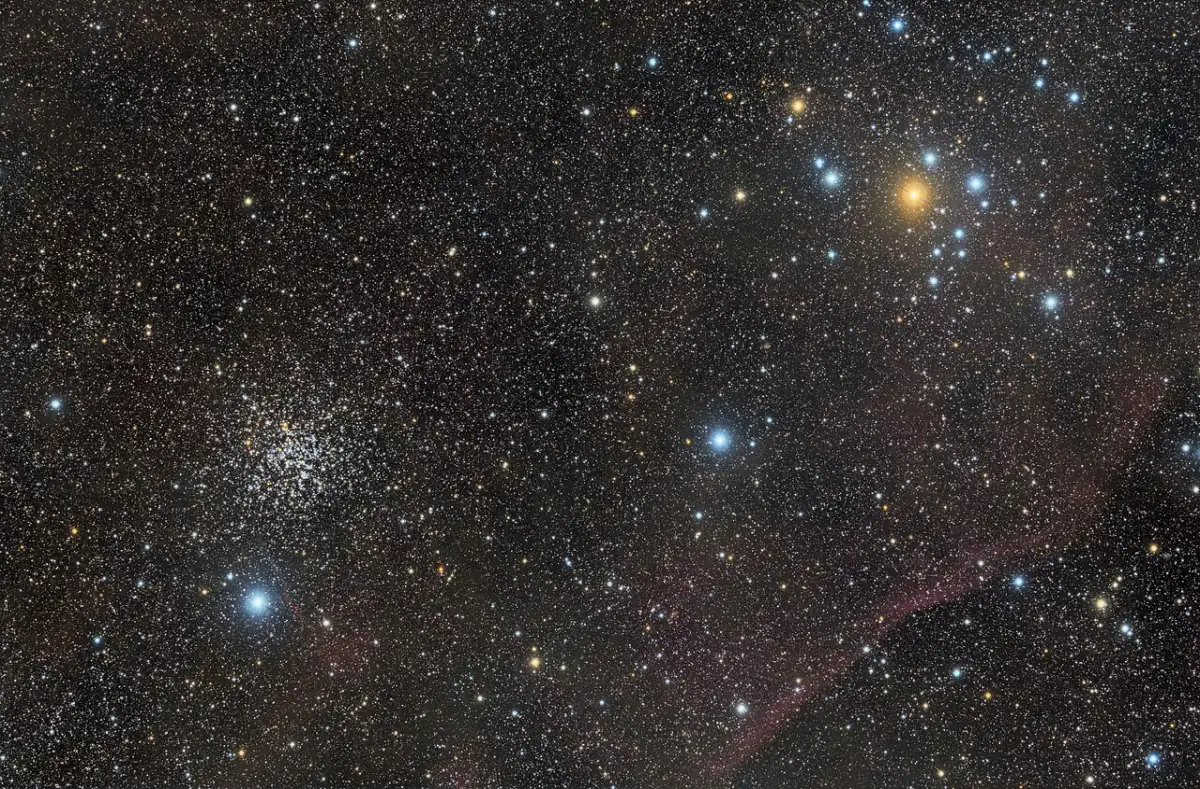
NGC 2477 (also known as Caldwell 71) is an open cluster in the constellation Puppis. It contains about 300 stars, and was discovered by Abbe Lacaille in 1751.The cluster’s age has been estimated at about 700 million years.NGC 2477 is a stunning cluster, almost as extensive in the sky as the full moon. It has been called “one of the top open clusters in the sky”, like a highly-resolved globular cluster without the dense centre characteristic of globular clusters. Credit: ESO/J.Pérez (CC BY 4.0)
Facts
NGC 2477 was discovered by the French astronomer Nicolas-Louis de Lacaille from the Cape of Good Hope in South Africa in 1751. Abbé de Lacaille spotted the cluster in his ½-inch telescope and included it as the third object on his list of 42 discovered “nebulae.” He described it as a “large nebula of 15-20 arc minutes in diameter.”
Danish astronomer John Louis Emil Dreyer listed the cluster as NGC 2477 in his New General Catalogue of 1888.
If NGC 2477 were located a little to the north, it may have made it into the Messier catalogue. It appears brighter and larger than Messier 46 (mag. 4.6, 22.8′) and Messier 93 (mag. 6.0, 10′), two other bright clusters in Puppis, but is slightly fainter and smaller than Messier 47.
The three Messier clusters lie in the northern part of Puppis, in the same region as Sirius in Canis Major. They are more easily spotted from Paris, where Charles Messier made his observations. Unlike NGC 2477, they were all discovered from Europe.
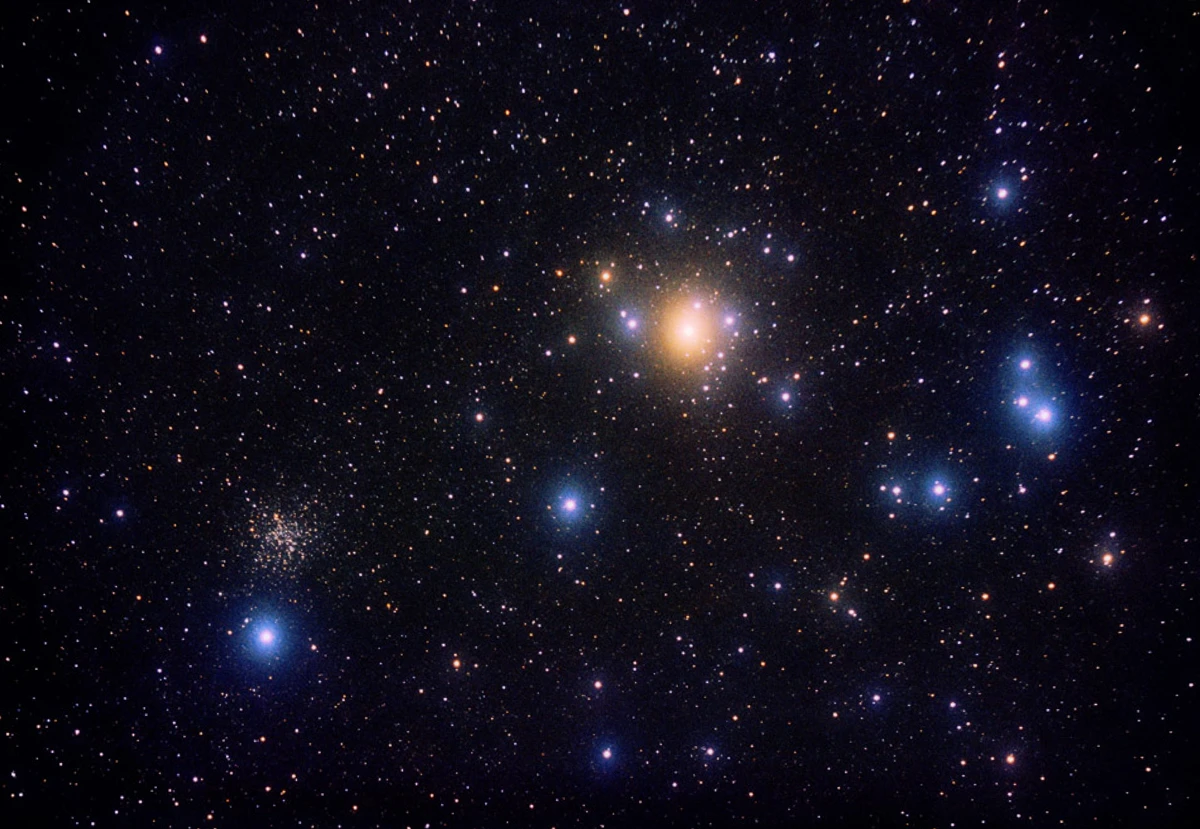
NGC 2477 and NGC 2451, credit: Wikisky (PD)
Surroundings
NGC 2477 lies only 1.5 degrees east of the brighter and larger open cluster NGC 2451. Discovered by the Italian astronomer Giovanni Battista Hodierna before 1654, NGC 2451 is believed to consist of two open clusters that lie in the same line of sight. Both clusters are much closer to us than NGC 2477. They are located at distances of 600 and 1,200 light-years. NGC 2451 has an apparent visual magnitude of 3 and an angular size of 45 arcminutes. It appears in the same wide field of view as NGC 2477.
Another bright pair of overlapping star clusters, catalogued as NGC 2546, lies about 4 degrees east of NGC 2477. Located 3,100 and 4,700 light-years away, the clusters shine at magnitude 6.3 and are 41 arcminutes across. Like NGC 2477 and NGC 2451, they are easily visible in binoculars.
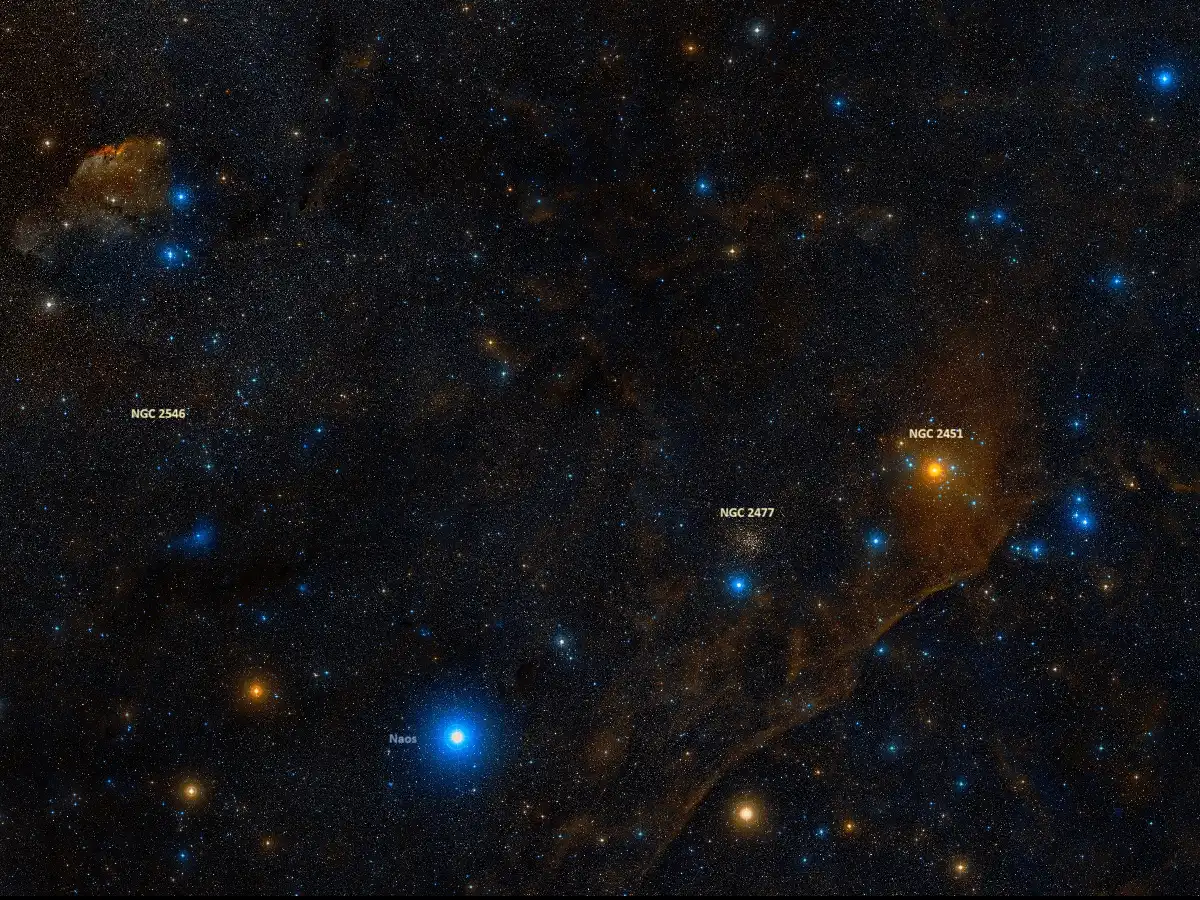
The open clusters NGC 2477, NGC 2451 and NGC 2546, image credit: ESO/Digitized Sky Survey 2 (CC BY 4.0)
How to find NGC 2477
NGC 2477 lies in the southern constellation Puppis. It appears about 2.5 degrees northwest of Naos (Zeta Puppis), the constellation’s brightest star. The luminous blue supergiant can be found by extending a line from Sirius, the brightest star in Earth’s sky, through Aludra, one of the three Canis Major stars that form a distinctive triangle below Sirius.
Naos forms a large asterism known as the Egyptian X with Phact in Columba and the bright stars of the Winter Triangle: Sirius, Procyon, and Betelgeuse. The asterism consists of two triangles that meet at Sirius, the brightest star in the sky. A line from Betelgeuse through Sirius points towards Naos. The asterism is best seen from equatorial and southern latitudes.
At declination -38° 32′, NGC 2477 is best seen from the southern hemisphere. It never rises for observers north of the latitude 51° N and only appears low above the horizon from the mid-northern latitudes.
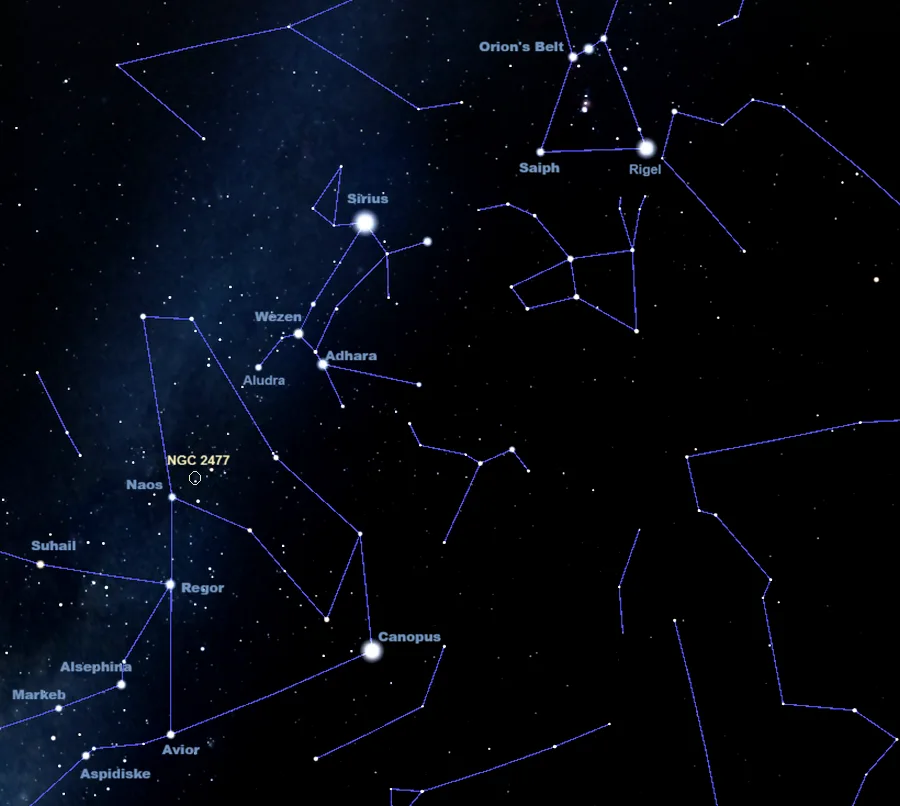
NGC 2477 location, image: Stellarium (annotated for this website)
The best time of the year to observe NGC 2477 and other deep sky objects in Puppis is during the month of February, when the constellation rises higher in the sky in the early evening.
NGC 2477 – Termite Hole Cluster
| Constellation | Puppis |
| Object type | Open cluster |
| Right ascension | 07h 52m 11.4s |
| Declination | −38° 32′ 47″ |
| Apparent magnitude | 5.8 |
| Apparent size | 27′ |
| Distance | ~ 3,600 light-years (1,100 parsecs); 4,697 light-years (1,440 pc) |
| Names and designations | Termite Hole Cluster, Electric Guitar Cluster, NGC 2477, Caldwell 71, C71, Collinder 165, Cr 165, Melotte 78, Mel 78, C 0750-384, [KPR2004b] 167 |