The Molten Ring Galaxy is a gravitationally lensed galaxy system that appears as one of the largest, most complete Einstein rings discovered to date. It lies in the faint southern constellation Fornax (the Furnace). The system is lensed by a massive galaxy cluster in the foreground. Its nickname refers both to its host constellation and its appearance, which is reminiscent of molten metal. In literature, the galaxy is referred to as GAL-CLUS-022058-38303 or GAL-CLUS-022058s.
The Molten Ring Galaxy was famously imaged by the Hubble Space Telescope (HST) in 2015. The image was released in 2020. The distorted appearance of the dusty galaxy consists of the nearly perfect Einstein ring and multiple images around the central curved arc. The light of the galaxy is magnified by a factor of 20.
Gravitational lensing is a phenomenon that allows us to see objects at great distances that would normally not be visible, even to telescopes like Hubble. The galaxy GAL-CLUS-022058s lies approximately 9.4 billion light-years away, behind the massive galaxy cluster that serves as the gravitational lens. The cluster lies much closer to us, at an estimated distance of 4 billion light-years.
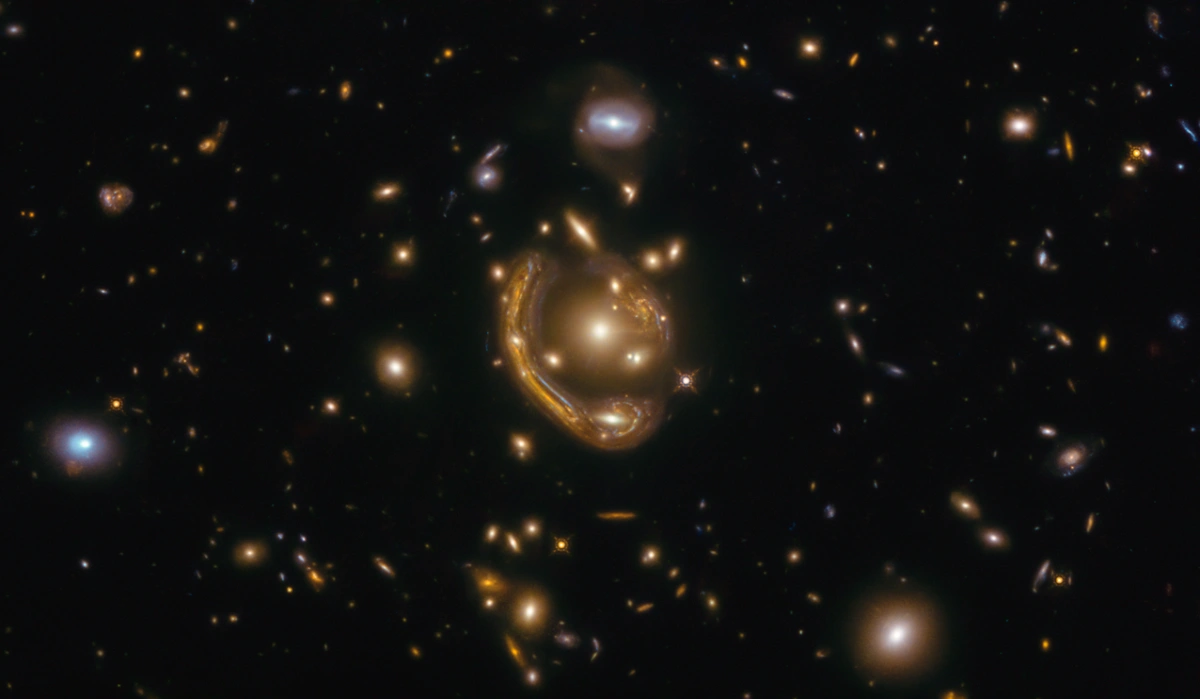
Hubble Space Telescope’s glamour shots of the universe are so revealing they nearly always have a discovery behind them. In this image, a remote galaxy is greatly magnified and distorted by the effects of gravitationally warped space. After its public release, astronomers used the picture to measure the galaxy’s distance of 9.4 billion light-years. This places the galaxy at the peak epoch of star formation in cosmic evolution. In this particular snapshot, a science discovery followed the release of a Hubble observation of a striking example of a deep-space optical phenomenon dubbed an “Einstein ring.” The photo was released in December 2020 as an example of one of the largest, nearly complete Einstein rings ever seen. The exceptionally high rate of star formation in the brightest and very dusty early galaxies saw stars being born at a rate a thousand times faster than occurs within our own galaxy. This could help explain the rapid build-up of present day giant elliptical galaxies. This object’s unusual partial ring-like appearance can be explained by a phenomenon called gravitational lensing, which causes light shining from a faraway galaxy to be warped by the gravity of an object between its source and the observer. In this case, the galaxy’s light has also been magnified by a factor of 20. This magnification, boosted by mother nature, effectively made Hubble’s observing capability equivalent to that of a 48-meter-aperture (157 feet) telescope. Image credit: ESA/Hubble & NASA, S. Jha; Acknowledgement: L. Shatz (CC BY 2.0)
An Einstein ring occurs when the light source (the distant galaxy), the massive lensing object (the foreground galaxy cluster) and the observer lie in a straight line. The gravity of the massive cluster magnifies and bends the light of the galaxy in the background, making it appear as a ring around the cluster. When the lensed galaxy, the lensing object, and the observer are not perfectly aligned, the lensed galaxy appears as an arc segment instead. The lensing effect was first proposed by Albert Einstein in 1912 and later became part of his general theory of relativity.
The Molten Ring Galaxy is an example of strong lensing, with an Einstein ring, arcs and multiple images appearing around the lensing cluster. Astronomers have identified four images of the Molten Ring around the massive elliptical galaxy in the foreground.
The Molten Ring itself is a normal star-forming galaxy with spiral arms and a central bulge. In 2021, astronomers determined a star formation rate of 70–170 M⊙yr−1 and a molecular gas mass of 2.6 × 10¹⁰M⊙ for the galaxy.
The gravity from other galaxies in the foreground cluster is expected to cause additional lensing in the future.
Gravitational lenses serve as natural “cosmic telescopes” that enhance the effective resolution of objects at great distances. They provide astronomers with insights into the star formation and structure of galaxies in the early universe. Einstein rings themselves can be used to map the mass distribution of the foreground galaxy clusters and infer the presence of dark matter.
Other well-known gravitationally lensed systems include the Cheshire Cat galaxy group (CSWA-2) and the Twin Quasar in the constellation Ursa Major, the Cloverleaf quasar in Boötes, the 8 o’clock Arc in Pisces, the Question Mark Galaxy and HE 0435−1223 in Eridanus, the Einstein Cross in Pegasus, the Sunburst Arc galaxy in Apus, and the Cosmic Horseshoe in Leo.
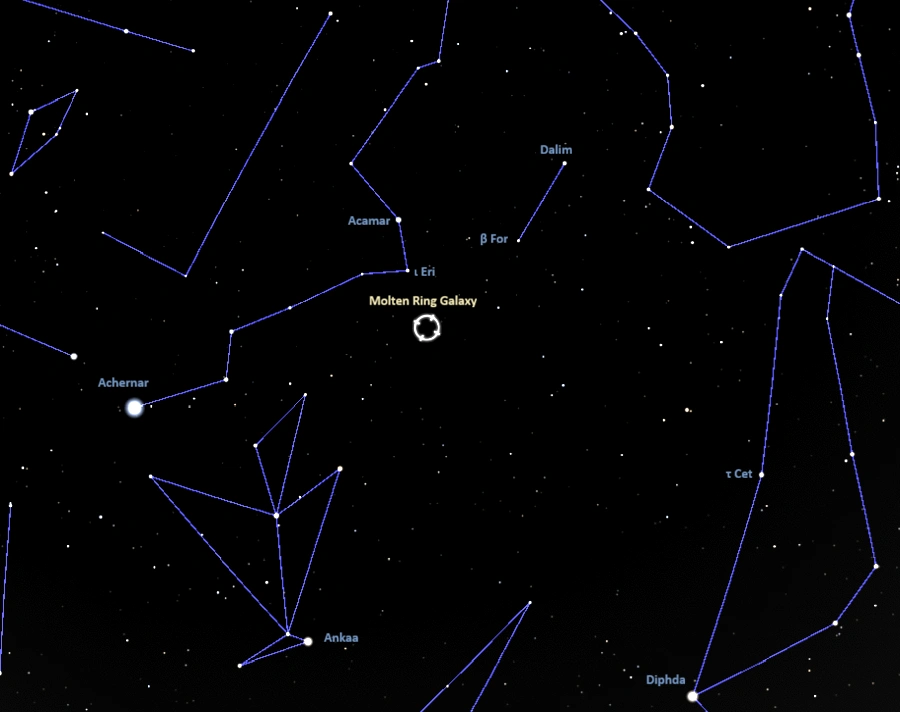
Location of the Molten Ring Galaxy, image: Stellarium
Molten Ring Galaxy – GAL-CLUS-022058s
| Constellation | Fornax |
| Object type | Gravitationally lensed galaxy system |
| Right ascension | 02h 20m 57.59s |
| Declination | -38° 33′ 04.27″ |
| Distance | 9.4 billion light-years |
| Names and designations | Molten Ring Galaxy, GAL-CLUS-022058s, GAL-CLUS-022058-38303, PKS 0218-387 |