The Homunculus Nebula is an emission and reflection nebula that surrounds Eta Carinae, a massive star system located approximately 7,500 light years away in the constellation Carina. It lies within the Carina Nebula, one of the largest stellar nurseries visible in the night sky.
The bipolar nebula is composed of the gas expelled from Eta Carinae during the star’s Great Eruption episode that occurred from 1837 to 1845, when the star ejected at least 10 to 20 solar masses of material. The nebula also contains dust that blocks much of the visible light from the massive central stellar system. The dust heats up and re-emits the light in the infrared, making the Homunculus the brightest object in the Earth’s sky at mid-infrared wavelengths.
The Homunculus Nebula is one of the best-known features of the Carina Nebula, along with the Mystic Mountain pillar, the Keyhole Nebula, and the Bok globule known as the Finger of God (or the Defiant Finger). The Homunculus contains the smaller Little Homunculus, produced during a minor eruption in 1890, and the Baby Homunculus, an even smaller expanding shell formed in a similar event in 1941.
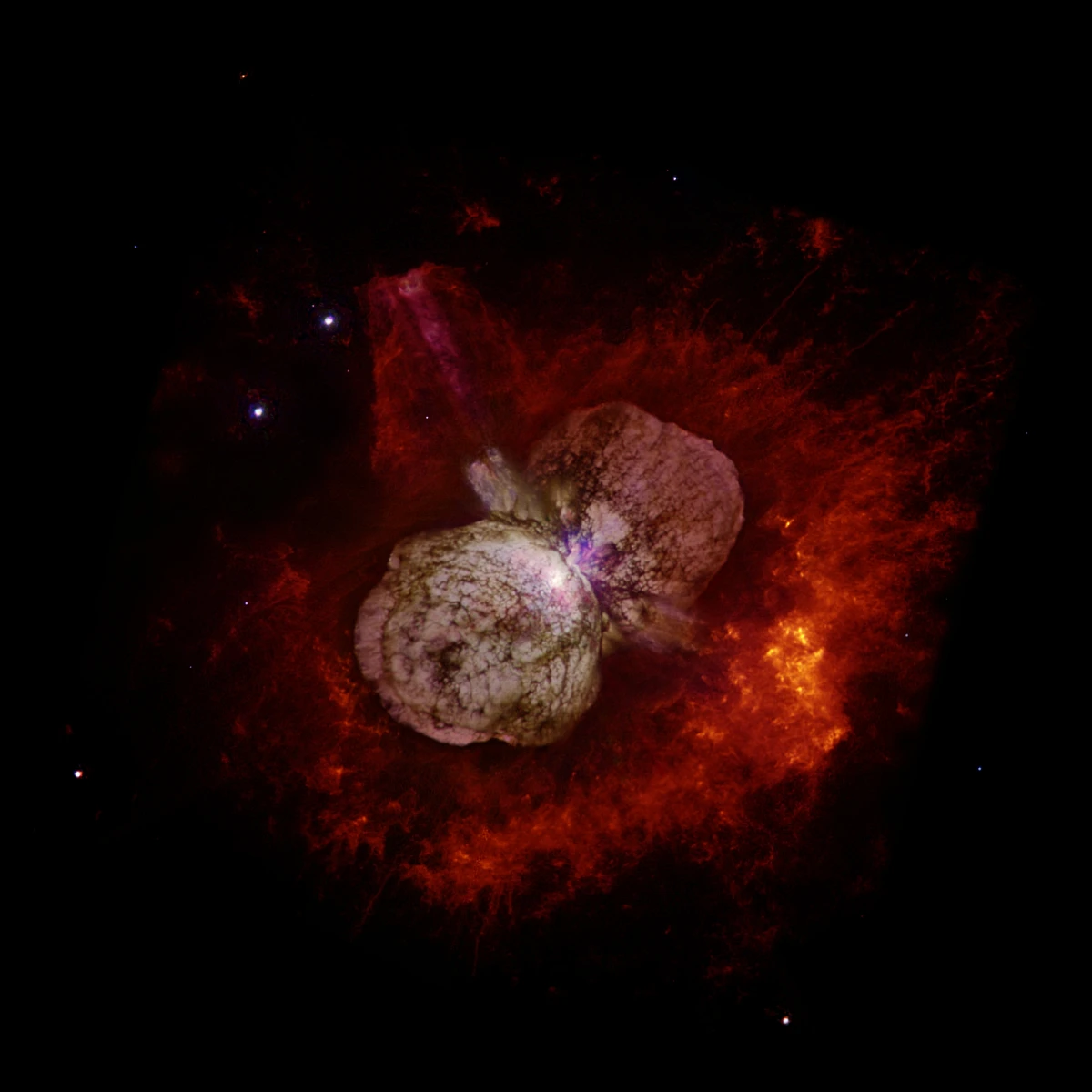
A huge, billowing pair of gas and dust clouds are captured in this stunning NASA Hubble Space Telescope image of the supermassive star Eta Carinae. Eta Carinae was observed by Hubble in September 1995 with the Wide Field and Planetary Camera 2 (WFPC2). Images taken through red and near-ultraviolet filters were subsequently combined to produce the color image shown. A sequence of eight exposures was necessary to cover the object’s huge dynamic range: the outer ejecta blobs are 100,000 times fainter than the brilliant central star. Eta Carinae suffered a giant outburst about 160 years ago, when it became one of the brightest stars in the southern sky. Though the star released as much visible light as a supernova, it survived the outburst. The eruption produced two lobes and a large, thin equatorial disk, all moving outward at about 1 million kilometers per hour. Image credit: Nathan Smith (University of California, Berkeley), and NASA (PD)
Born from chaos: The Great Eruption of the 1840s
The Homunculus Nebula was hurled into existence by the massive star Eta Carinae during the Great Eruption in the mid-19th century. The eruption originated from the primary component, Eta Carinae A. It occurred 7,500 years before it became visible from Earth in 1841. It lasted for around 18 years.
During the eruption, Eta Carinae expelled an enormous amount of gas that formed the small, elongated nebula now known as the Homunculus. The expanding shell of dust is angled so that the southeastern lobe is closer to Earth than the northwestern one.
In 2018, Smith et al. proposed that the giant eruption resulted from a merger in an unstable triple star system. Modelling indicated that the merger left behind an eccentric binary system and produced the Homunculus, while the outer ejecta resulted from grazing collisions of the inner binary system before the merger.
In 2021, Hirai et al. suggested a slightly different scenario. The team proposed a model in which the bipolar wind from the central star system after the merger was primarily responsible for creating the Homunculus Nebula.
In 2024, analysis of proper motions of the Mg II filaments supported the model proposed by Smith. A team of researchers led by Jon A. Morse found that the outer material surrounding the Homunculus is older than 1843.
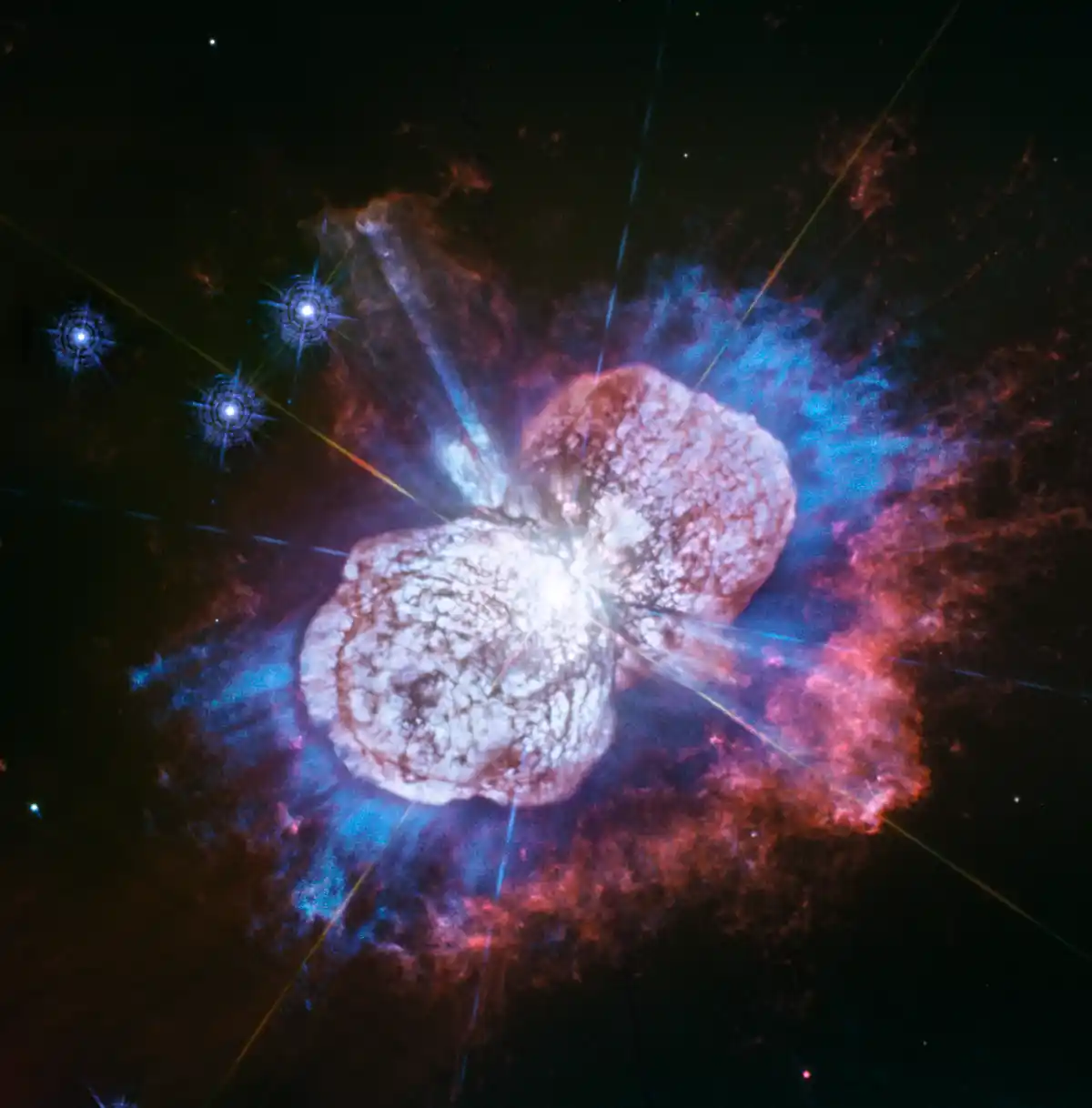
Telescopes, including Hubble, have monitored the Eta Carinae star system for more than two decades. It has been prone to dramatic outbursts, including an episode in the 1840s during which ejected material formed the bipolar bubbles seen here. Now, using Hubble’s Wide Field Camera 3 to probe the nebula in ultraviolet light, astronomers have uncovered the glow of magnesium embedded in warm gas (shown in blue) in places they had not seen it before. The luminous magnesium resides in the space between the dusty bipolar bubbles and the outer shock-heated nitrogen-rich filaments (shown in red). The streaks visible in the blue region outside the lower-left lobe are a striking feature of the image. These streaks are created when the star’s light rays poke through the dust clumps scattered along the bubble’s surface. Wherever the ultraviolet light strikes the dense dust, it leaves a long, thin shadow that extends beyond the lobe into the surrounding gas. Image: NASA, ESA, N. Smith (University of Arizona, Tucson), and J. Morse (BoldlyGo Institute, New York) (CC BY 4.0)
How much mass did Eta Carinae expel?
The Homunculus Nebula has an estimated mass between 10 and over 45 solar masses. This is the mass Eta Carinae expelled at hundreds of kilometres per second during the Great Eruption.
Astronomers have calculated the total dust mass of 0.4 solar masses for the Homunculus, which led to estimates of up to 40 solar masses of gas. The outer ejecta, expelled before the Homunculus, is believed to have a similar amount of material. This is the material into which the Homunculus is now expanding.
Astronomers believe that some of it was expelled over several decades before Eta Carinae’s Great Eruption. Studies have also found that the outer ejecta originated in two or more mass ejection episodes in the 13th and 16th centuries.
Eta Carinae: The prototype supernova impostor
The enormous outburst from Eta Carinae that produced the two polar lobes and the large equatorial disk of the Homunculus released an amount of energy comparable to that of a supernova. However, the massive star miraculously survived. What Eta Carinae underwent was a supernova impostor event, a large-scale eruption that left the star battered but alive.
The giant eruption of Eta Carinae A produced nearly as much visible light as a faint supernova. Astronomers estimate that the supernova impostor event had a luminosity of 50 million Suns at its peak. The Homunculus Nebula is the physical record of the eruption. It is a valuable source of information about giant eruptions of luminous blue variables.
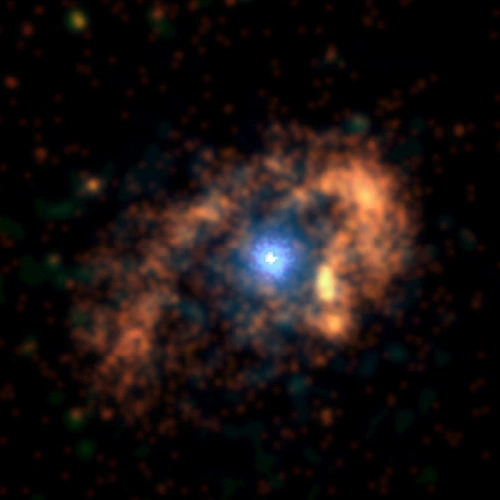
Eta Carinae captured by the Chandra X-ray Observatory, image: NASA/CXC/SAO (PD)
What 19th century astronomers witnessed (and did not understand)
While Eta Carinae was visible to the unaided eye to 19th century astronomers, the true nature of its rapid brightening remained a mystery for over a century.
During the Great Eruption, astronomers recorded the star’s sudden increase in visual magnitude and found it remarkable but the concept of a star expelling mass at hundreds of kilometres per second and sculpting a twin-lobed nebula was beyond their understanding. The Homunculus itself was not discovered for another century.
Second brightest star in the sky
Eta Carinae started to gradually brighten in late 1837. Previously an inconspicuous fourth magnitude star, it slowly climbed up the magnitude scale to become the second brightest star in the night sky by 1843. Blazing at magnitude -0.8, it was outshone only by Sirius. Astronomers in the southern hemisphere noted that it was as bright as Canopus and similar in colour to Arcturus.
From 1857, the star rapidly decreased in brightness and eventually disappeared from view entirely by 1886. The fading is attributed to the condensation of dust as the ejected material sped away from the central star. The dust in the Homunculus absorbs the light of the luminous central star system, making it appear much dimmer than it would without the extinction.
Discovery of the Homunculus Nebula
The Homunculus Nebula was first observed by Argentinian astronomer Enrique Gaviola with a 61-inch reflector from the Córdoba Observatory, Argentina, in January 1944. Gaviola was the first to use the name Homunculus. In a 1950 paper, he noted, “Under a power of 1200 diameters and star images not larger than 1” a shape resembling a ‘homunculus,’ with its head pointing northwest, legs opposite and arms folded over a fat body, could clearly be seen.”
The name Homunculus means “little man” in Latin. In medieval times, it was believed that a homunculus – a small, artificial human – could be created using alchemy. Between the late 17th and late 18th century, life was thought to begin with offspring developing from miniature preformed versions rather than through epigenesis.
At the time of discovery, the Homunculus Nebula had a central bulge, a large northwestern lobe and two smaller extensions on the opposite side, invoking the image of the little man.
The nebula was first successfully imaged in 1945.
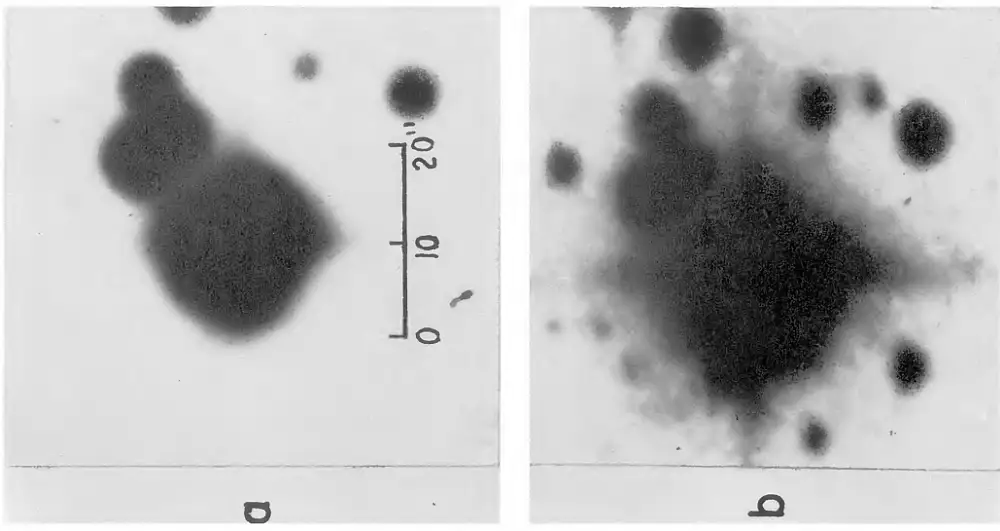
First images of the Homunculus Nebula. Figure a) 20-minute exposure on Ilford Ortho Process plate at Newtonian focus; b) 30-minute exposure on Ilford HP2 emulsion, Newtonian focus. Credit: E. Gaviola, Astrophysical Journal, 1950.
Shape of the Homunculus Nebula
The Homunculus Nebula contains two prominent lobes, each around 7 arcseconds wide and 5 arcseconds long, and a faint equatorial skirt of material only visible at certain wavelengths. The structure of the nebula is unique because the expanding cloud is still very young. It has been shaped almost entirely by Eta Carinae’s eruption and has not been significantly altered by the interaction with its environment.
The two bulging lobes of the Homunculus are joined at the narrow waist, ringed by a dusty skirt of debris. The lobes contain most of the material expelled by Eta Carinae. The material is distributed in thin shells near the poles. The shells contain a warmer inner region and a cooler outer layer. Their thinness indicates that they were ejected within a period of around five years.
Astronomers believe the bipolar shells to have been produced by polar outflows of material. The equatorial skirt was likely formed by the faster-moving material that escaped through the thinner parts of the shells.
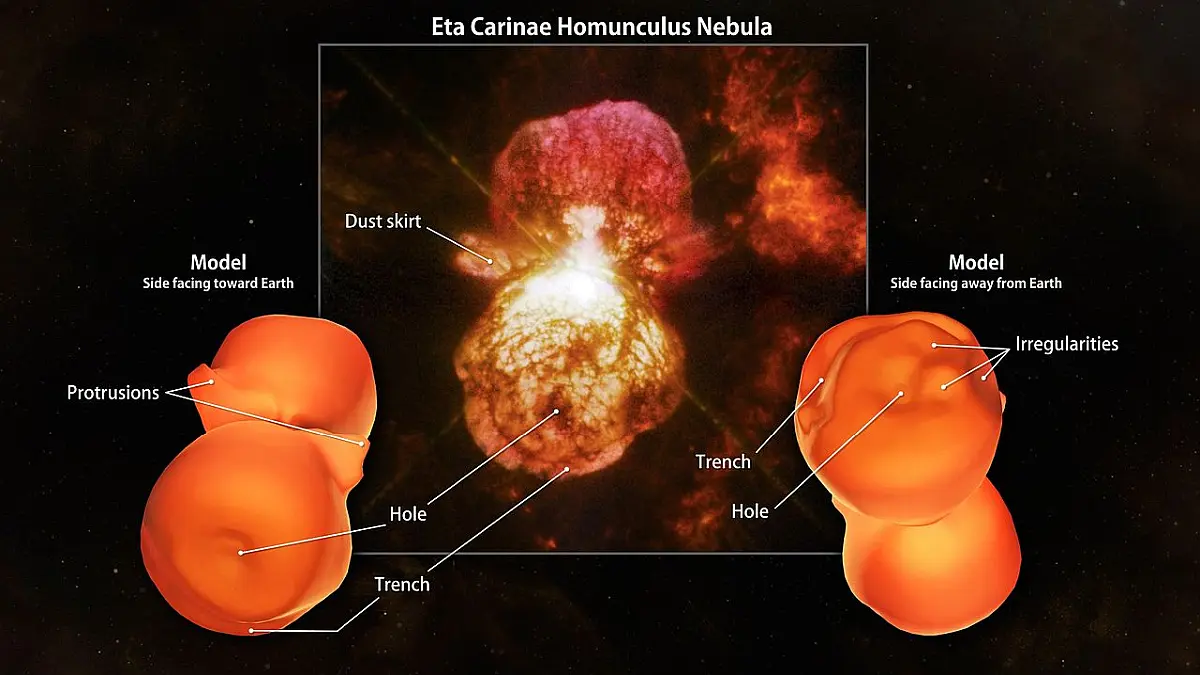
The Homunculus Nebula surrounds Eta Carinae, famously unstable massive stars in a binary system embedded in the extensive Carina Nebula about 7,500 light-years distant. Between 1838 and 1845, Eta Carinae underwent the Great Eruption becoming the second brightest star in planet Earth’s night sky and ejecting the Homunculus Nebula. The new 3D model of the still expanding Homunculus was created by exploring the nebula with the European Southern Observatory’s VLT/X-Shooter. That instrument is capable of mapping the velocity of molecular hydrogen gas through the nebula’s dust at a fine resolution. It reveals trenches, divots and protrusions, even in the dust obscured regions that face away from Earth. Credit: NASA/GSFC/SVS; Inset: NASA, ESA, Hubble SM4 ERO Team; Science Credit: W. Steffen (UNAM), M. Teodoro, T.I. Madura, J.H. Groh, T.R. Gull, A. Mehner, M.F. Corcoran, A. Damineli, K. Hamaguchi (PD)
Little Homunculus and Baby Homunculus
The Homunculus Nebula contains two smaller structures that formed in minor eruptions in the 1890s and 1941. These structures are called the Little Homunculus and the Baby Homunculus. Both are much smaller than the main nebula.
Little Homunculus
The Little Homunculus extends 3,700 astronomical units (0.06 light-years) from Eta Carinae and has an estimated mass of only 0.1 solar masses. It was discovered by a team led by Kazunori Ishibashi, Laboratory for Astronomy and Solar Physics, NASA Goddard Space Flight Center, during observations with the Space Telescope Imaging Spectrograph (STIS) aboard the Hubble Space Telescope.
In 2003, the researchers reported the presence of the smaller bipolar emission nebula embedded within the larger Homunculus. They concluded that it may have formed from a minor eruption that occurred around 1890, 50 years after the Great Eruption.
The Little Homunculus was first detected as an unknown velocity structure in 1998. It is projected on the plane of the major axis of the Homunculus. It is expanding at a velocity of 200 km/s, much more slowly than the Homunculus.
Baby Homunculus
The Baby Homunculus was discovered by a team led by Zulema Abraham, University of São Paulo, in 2014. The researchers analysed data obtained with the Atacama Large Millimeter/Submillimeter Array (ALMA) in 2012 and found the smaller shell expanding at velocities ranging between 20 and 60 km/s.
The team proposed that the Baby Homunculus was expelled from Eta Carinae around 1941, when the optical luminosity of the massive star increased to a degree similar to that observed when the Little Homunculus formed.
Expanding at over a million miles per hour
The Homunculus Nebula is expanding at around 650 km/s, or 1.5 million miles per hour. Since the Great Eruption, it has expanded to a size of about 18 arcseconds, or 0.089 parsecs (0.29 light years).
As the Homunculus continues to expand, it will dissipate into the surrounding interstellar medium, revealing the central massive binary system in several thousand years.
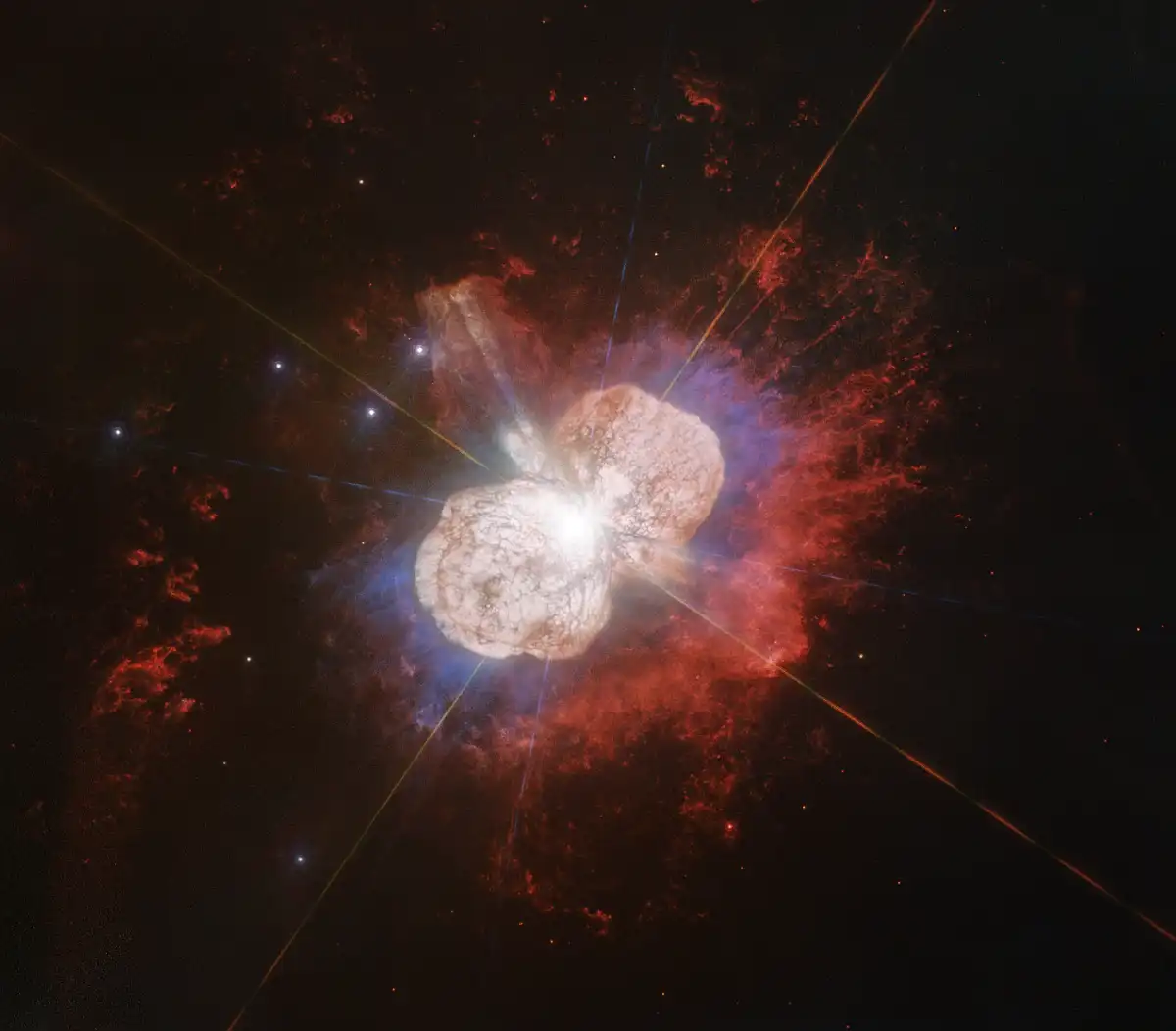
An image of Eta Carinae and its Homunculus Nebula using Hubble observations acquired in 2018. Credit: NASA, ESA (Hubble), Judy Schmidt (CC BY 2.0)
The central star system: Eta Carinae
Eta Carinae is a massive star system consisting of at least two stars located 7,500 light years away. The two known components are less than 3 million years old and have a combined luminosity of 5 million Suns. The system has an apparent magnitude of 4.2 and is currently visible to the unaided eye from areas without too much light pollution. It is the brightest point of light in the Carina Nebula.
The primary component, Eta Carinae A, is a luminous blue variable (LBV) and the companion, Eta Carinae B, is an O-type giant or supergiant, or possibly a Wolf-Rayet star.
The larger star, Eta Carinae A, has an estimated mass of 100 solar masses and a radius of around 742 solar radii. With an effective temperature of 9,470 – 35,200 K, it is 4 million times more luminous than the Sun.
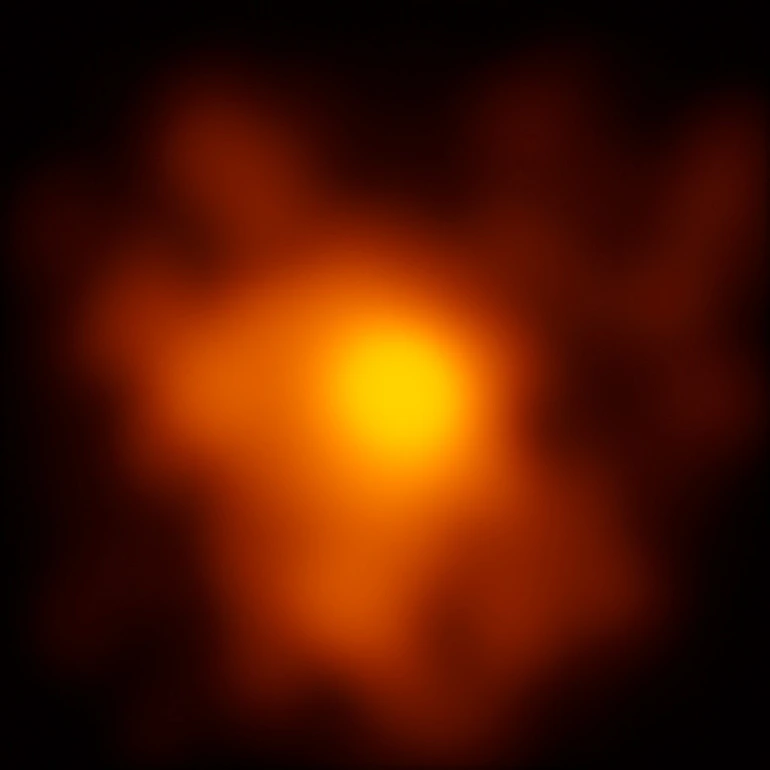
This is the best image of the Eta Carinae star system ever obtained. The observations were made with the Very Large Telescope Interferometer (VLTI) and could lead to a better understanding of the evolution of very massive stars. Credit: ESO (CC BY 4.0)
Eta Carinae B is a much smaller star, with a mass in the range between 30 and 80 solar masses and a radius between 14.3 and 23.6 times that of the Sun. It has a surface temperature of 37,200 K and shines with up to 1 million solar luminosities.
Eta Carinae A and B have an orbital period of 5.54 years. As they orbit around a common centre of mass, they come within 1.6 astronomical units of each other and drift as far apart as 30 astronomical units. At periastron (the closest approach), the separation between them is comparable to the distance between the Sun and Mars and, at apastron (the point of maximum separation), it is similar to the distance between the Sun and Neptune.
The Homunculus Nebula as a preview of a supernova remnant
Eta Carinae is not a stable, middle-aged star fusing hydrogen in its core. It is a massive, unstable, already-erupted-once system living on borrowed time. The question of what happens next is one of the most exciting in stellar astronomy.
Eta Carinae has already burned through its supply of hydrogen and is now fusing heavier elements in its core. It is in the terminal phase of a massive star’s life cycle. When it exhausts its nuclear fuel entirely, its core will collapse, releasing an amount of energy that will outshine the entire Milky Way for weeks.
From Earth, the supernova will be visible in daylight. It is expected to occur within the next 100,000 years. At a distance of 7,500 light years, it will not pose a threat to Earth.
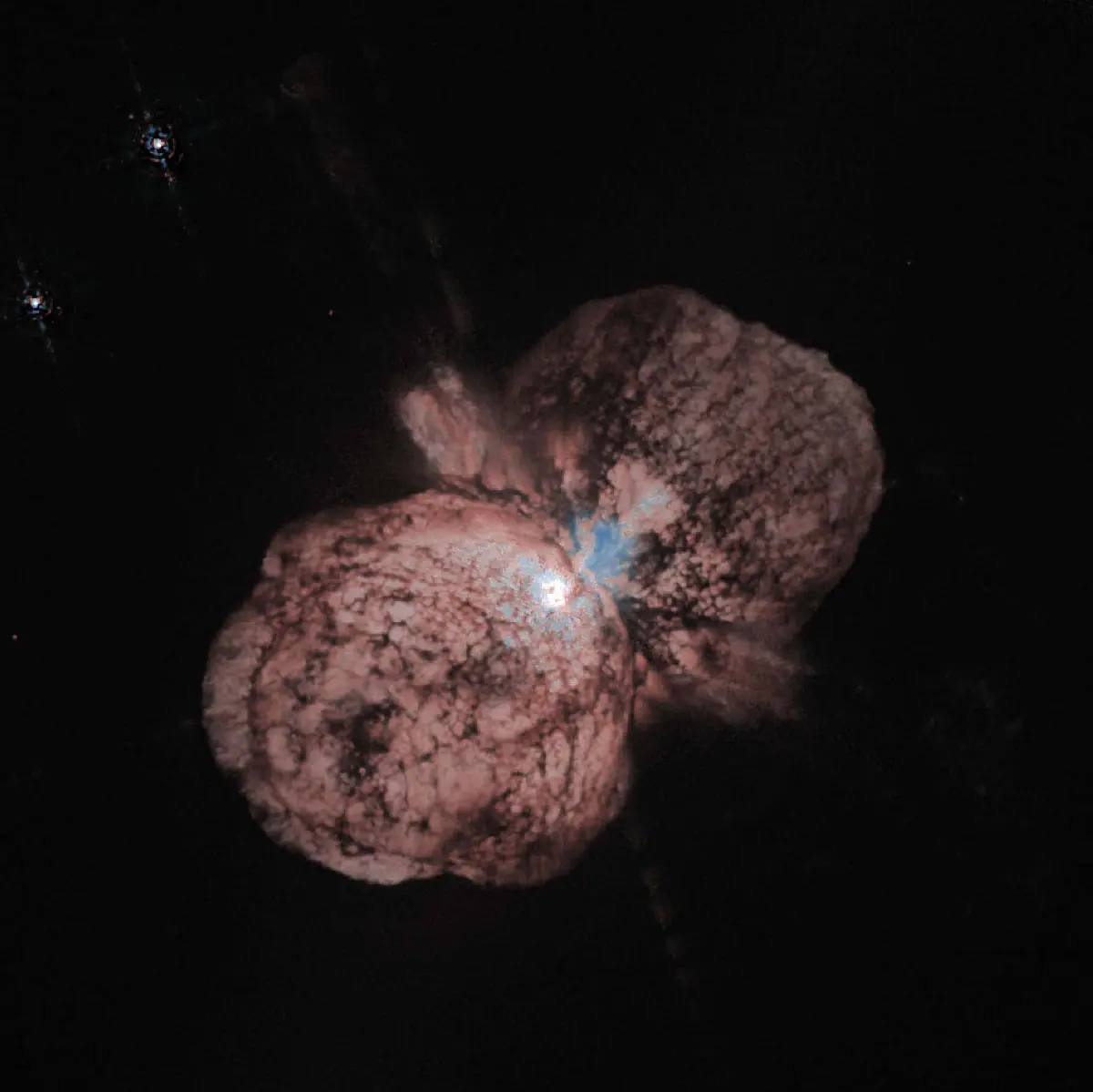
A huge, billowing pair of gas and dust clouds are captured in this stunning NASA Hubble Space Telescope image of the supermassive star Eta Carinae. Eta Carinae was observed by Hubble in September 1995 with the Wide Field Planetary Camera 2 (WFPC2). Images taken through red and near-ultraviolet filters were subsequently combined to produce the color image shown. A sequence of eight exposures was necessary to cover the object’s huge dynamic range: the outer ejecta blobs are 100,000 times fainter than the brilliant central star. The observation shows that excess violet light escapes along the equatorial plane between the bipolar lobes. Apparently there is relatively little dusty debris between the lobes down by the star; most of the blue light is able to escape. The lobes, on the other hand, contain large amounts of dust which preferentially absorb blue light, causing the lobes to appear reddish. Image: Jon Morse (University of Colorado) & NASA Hubble Space Telescope (PD)
Location of the Homunculus Nebula
The Homunculus Nebula is part of the larger Carina Nebula (Caldwell 92, NGC 3372), a large complex of bright and dark nebulae that stretches across 120 arcminutes (2 degrees) of the southern sky. With an apparent magnitude of 1.0, the bright nebula is visible to the unaided eye in clear, dark skies away from light pollution. Even though, it is technically brighter than the Orion Nebula, the Carina complex covers a much larger area and needs much more transparent skies to be visible.
Eta Carinae and the Homunculus Nebula lie in the central region of the Carina Nebula. The massive Eta Carinae system is a member of the open cluster Trumpler 16, the home of some of the most luminous stars in the Milky Way. The cluster shines at magnitude 5.0. Eta Carinae is the only member visible to the unaided eye.
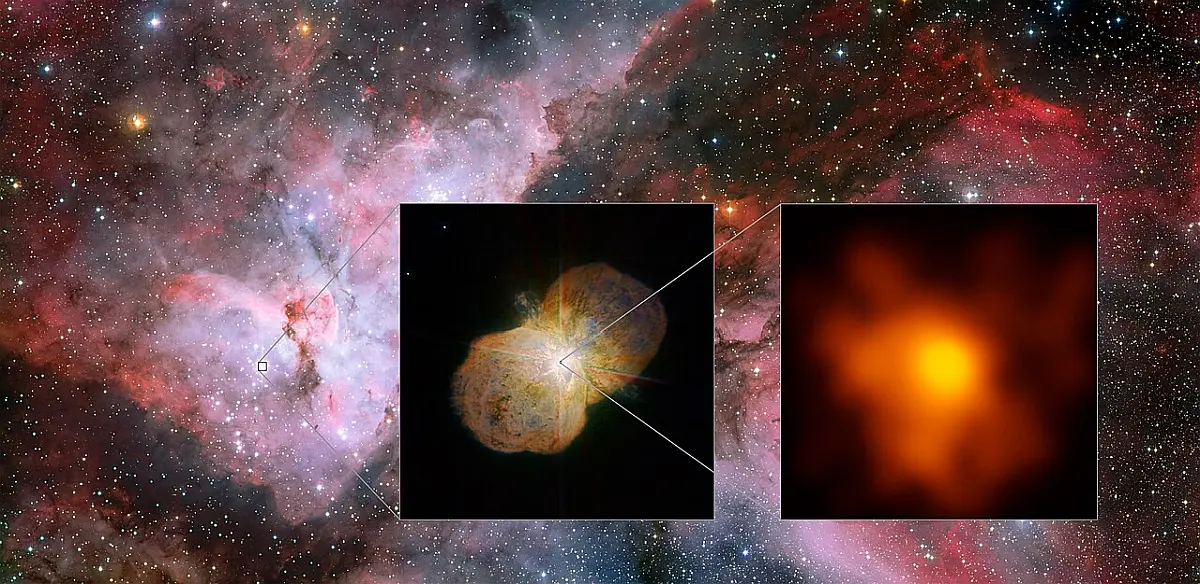
This mosaic shows the Carina Nebula (left part of the image), home of the Eta Carinae star system. This part was observed with the Wide Field Imager on the MPG/ESO 2.2-metre telescope at ESO’s La Silla Observatory. The middle part shows the direct surrounding of the star system: the Homunculus Nebula, created by the ejected material from the Eta Carinae system. This image was taken with the NACO near-infrared adaptive optics instrument on ESO’s Very Large Telescope. The right image shows the innermost part of the system as seen with the Very Large Telescope Interferometer (VLTI). It is the highest resolution image of Eta Carinae ever. Image credit: ESO/G. Weigelt (CC BY 4.0)
How to find the Homunculus Nebula
The Homunculus Nebula and the larger Carina Nebula can be found using the stars of the Diamond Cross: Miaplacidus (Beta Carinae), Omega, Upsilon and Theta Carinae. A line drawn from Miaplacidus through the midpoint of the imaginary line connecting Theta and Upsilon Carinae points in the direction of the Carina Nebula. Theta Carinae is the brightest member of the Southern Pleiades (IC 2602), an open cluster easily visible to the unaided eye.
The Carina Nebula appears roughly halfway between the Southern Cross in the constellation Crux and the False Cross in Carina and Vela. Eta Carinae appears a little more than halfway from Alsephina in the False Cross to Gacrux at the top of the Southern Cross. The star can be found by extending a line from Miaplacidus in the Diamond Cross through the fainter PP Carinae.
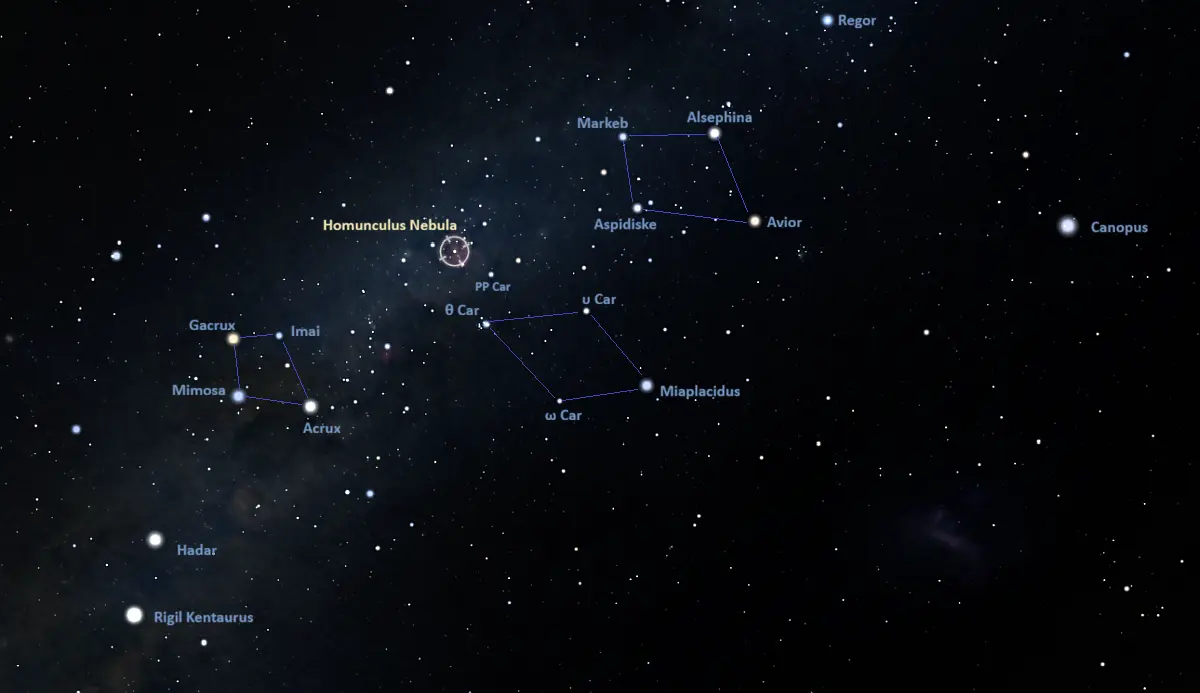
Location of the Homunculus Nebula, image: Stellarium (annotated for this article)
Observing the Homunculus Nebula
The Homunculus Nebula can be spotted in amateur telescopes at high magnification in good conditions. The two glowing lobes appear yellow or orange and can be seen in 6-inch and larger instruments.
Where is the Homunculus Nebula visible
At declination -60°, the Homunculus Nebula and Eta Carinae are best seen from the southern hemisphere. They never rise above the horizon for observers north of the latitude 30° N and only appear low in the sky from northern equatorial latitudes.
The best time of the year to observe deep sky objects in Carina is in March, when the constellation appears higher above the horizon in the early evening.
Explore other deep sky objects in Carina:
- Carina Nebula (NGC 3372)
- Southern Pleiades (IC 2602)
- Southern Beehive Cluster (NGC 2516)
- Wishing Well Cluster (NGC 3532)
- Statue of Liberty Nebula (NGC 3576)
Homunculus Nebula
| Constellation | Carina |
| Object type | Emission and reflection nebula |
| Right ascension | 10h 45m 03.6s |
| Declination | −59° 41′ 04″ |
| Apparent magnitude (including Eta Carinae) | 6.21 (-0.8 – 7.9) |
| Apparent size | 18″ |
| Distance | 7,500 light-years (2,300 parsecs) |
| Radius | 0.29 light years |