The Fossil Footprint Nebula is an emission nebula located approximately 9,800 light-years away in the constellation Perseus. The nebula’s bright central portion has an angular size of 4.8 by 4.8 arcminutes, while the whole cloud spans an area of about 25 by 21 arcminutes. The nebula is listed as NGC 1491 in the New General Catalogue and Sharpless 2-206 (Sh2-206) in the Sharpless catalogue of H II regions.
The Fossil Footprint Nebula is an H II region, a cloud of ionized interstellar atomic hydrogen in which new stars recently formed. It is sometimes called the Little Pacman Nebula because of its resemblance to the larger Pacman Nebula (NGC 281) in the neighbouring constellation Cassiopeia.
The hot young stars in NGC 1491 ionize the surrounding clouds of gas, making them appear reddish in images. The stars emit large amounts of intense ultraviolet radiation that excites the surrounding nebula, making it produce its own light. The strong stellar winds and radiation from the energetic young stars will keep eroding away the nebula’s clouds until only a young star cluster is visible in the region.
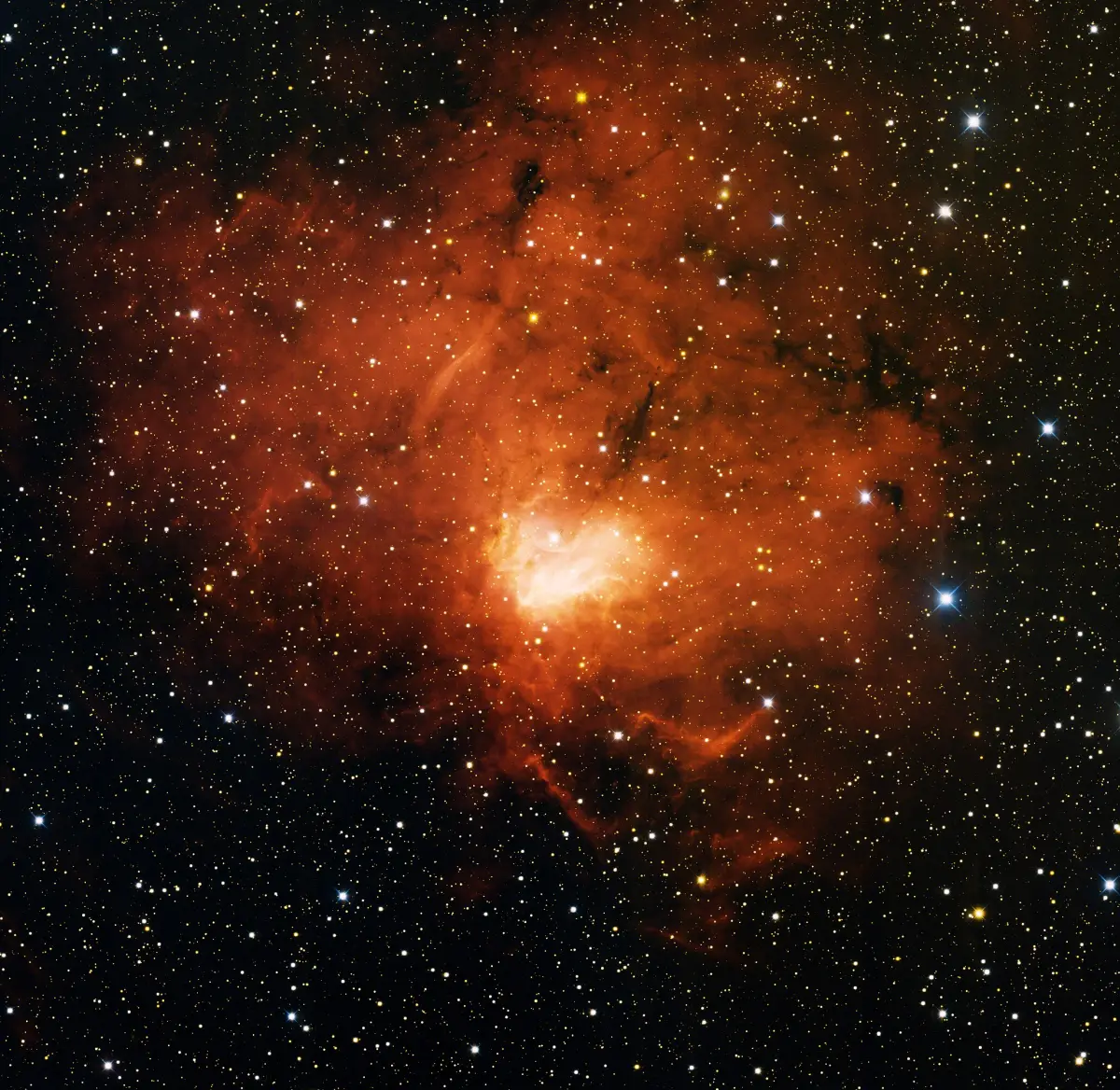
This image was obtained with the wide-field view of the Mosaic camera on the Mayall 4-meter telescope at Kitt Peak National Observatory. NGC 1491 is an emission nebula. It is glowing deep red because the hydrogen gas in the nebula is energized by hot, massive stars embedded within. These stars emit copious amounts of ultraviolet (UV) light that causes the gas to glow. The image was generated with observations in B (blue), I (orange) and Hydrogen-Alpha (red) filters. In this image, North is right, East is up. Image credit: T.A. Rector (University of Alaska Anchorage), H. Schweiker & S. Pakzad (NOIRLab/NSF/AURA) (CC BY 4.0)
One of these massive stars, BD+50 866, is an O5-type star that shines at 11th magnitude. It lies near the center of the nebula and is responsible for a lot of the ionization.
The star lies in the central cavity of the dense gas cloud. It is surrounded by a small oval bubble that appears similar to the Bubble Nebula (NGC 7635) in the constellation Cassiopeia. The bubble formed as a result of interaction of the star’s stellar wind and material in the surrounding molecular cloud. It is about 60 arcseconds across, corresponding to a physical diameter of 3 light years. The larger nebula itself is about 100 light years across.
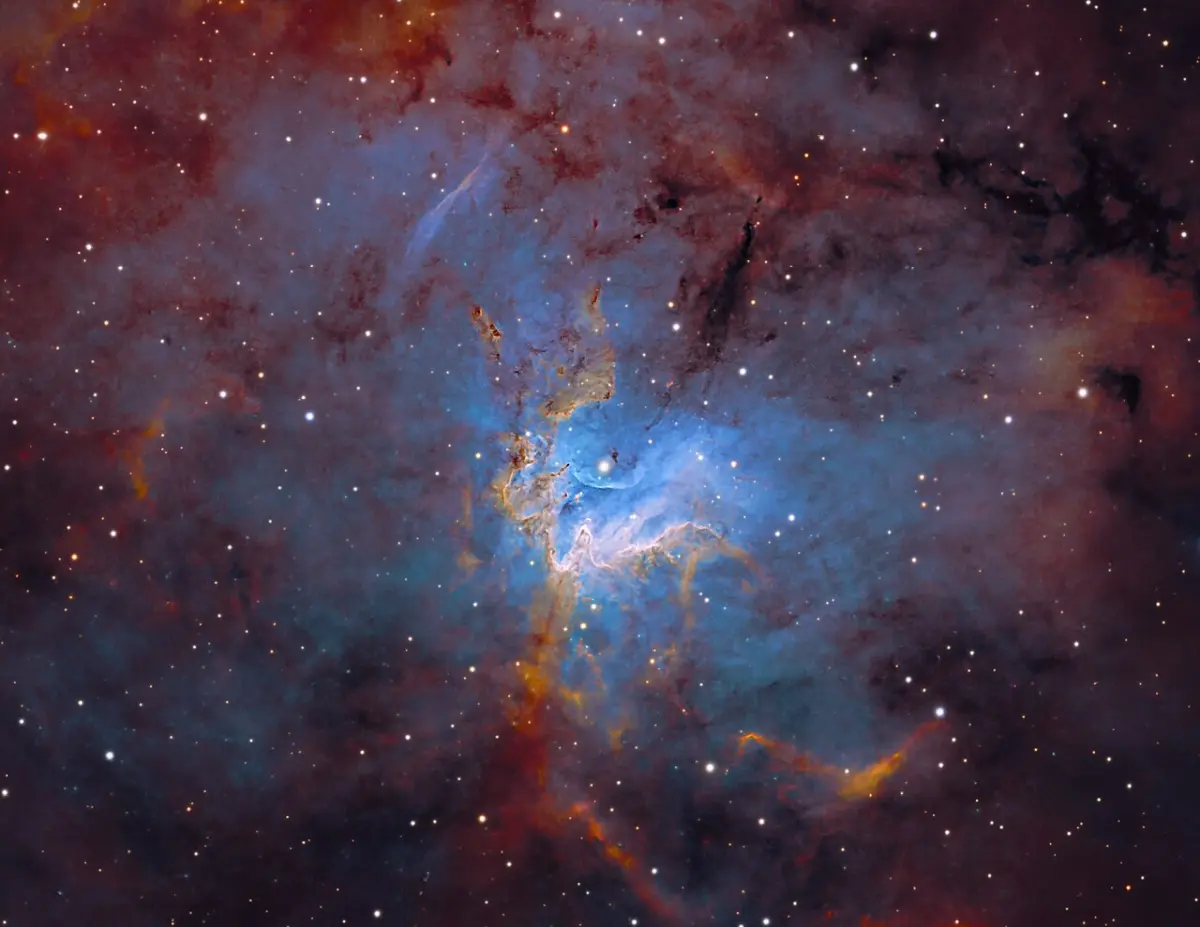
The centre of NGC 1491, image credit: Wikimedia Commons/Peter Kennett (CC BY 4.0)
Facts
The Fossil Footprint Nebula was discovered by the German-born British astronomer William Herschel on December 28, 1790. Herschel catalogued the nebula as H I 258 and described it as “Very bright, irregular figure, round, brighter in the middle, 5′ long 4′ broad. A pretty large star in it towards the following side, but unconnected.” The German astronomer discovered the bright nearby open star clusters NGC 1528 and NGC 1545 on the same night.
Danish astronomer John Louis Emil Dreyer included the nebula as NGC 1491 in his New General Catalogue of 1888 based on Herschel’s observations.
In the 1950s, American astronomer Stewart Sharpless listed NGC 1491 as Sharpless 2-206 (Sh2-206) in his catalogue of H II regions. The nebula is also included as LBN 704 in the Lynds’ Catalogue of Bright Nebulae, compiled by the American astronomer Beverly Turner Lynds in the 1960s.
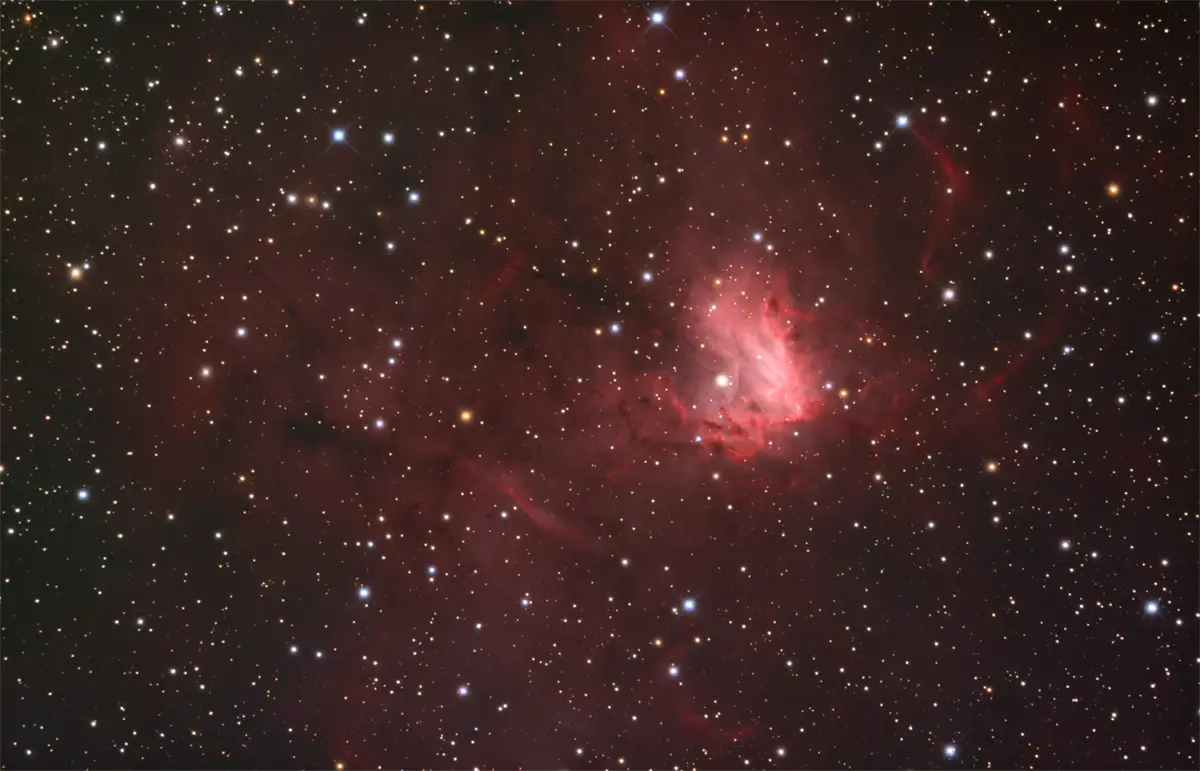
Fossil Footprint Nebula, credit: Adam Block/Mount Lemmon SkyCenter/University of Arizona (CC BY-SA 3.0 US)
Location
The Fossil Footprint Nebula appears in the region of the Segment of Perseus, a curving line of stars that stretches between Cassiopeia’s W and Auriga’s hexagon. The nebula appears east of the supergiant Mirfak and the Alpha Persei Cluster and about 1.1 degrees north-northwest of the fainter Lambda Persei (mag. 4.29). Lambda Persei and the Fossil Footprint Nebula appear roughly a third of the way from Mirfak to the bright Capella in Auriga, a little north of the imaginary line connecting the two bright stars.
The Fossil Footprint Nebula can be observed in a medium-sized telescope in good conditions but is best seen in large telescopes at high magnification. In 8- and 10-inch telescopes, it appears as a faint fan-shaped arc. Larger instruments reveal more of the nebula’s details.
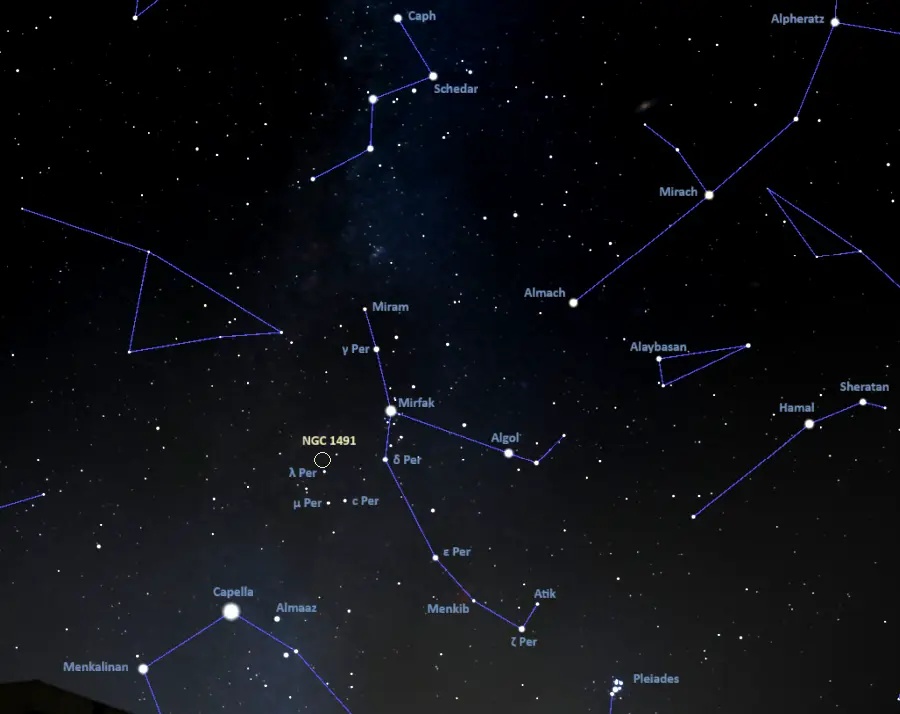
Fossil Footprint Nebula location, image: Stellarium
A faint nebula designated Outters 1 (Ou 1) appears in the field of the larger NGC 1491. It cannot be seen in amateur telescopes but is visible in long-exposure images of the Fossil Footprint. Outters 1 is most likely a planetary nebula. It was discovered by Nicolas Outters in an image of the Fossil Footprint Nebula in 2009.
The open cluster NGC 1528 appears almost directly east of the nebula. With an apparent magnitude of 6.4 and an apparent size of 23 arcminutes, the cluster can be seen in binoculars. Another open cluster, NGC 1545, appears 1.5 degrees southeast of NGC 1528. With the same apparent visual magnitude and angular size as NGC 1528, NGC 1545 can also be spotted in small binoculars.
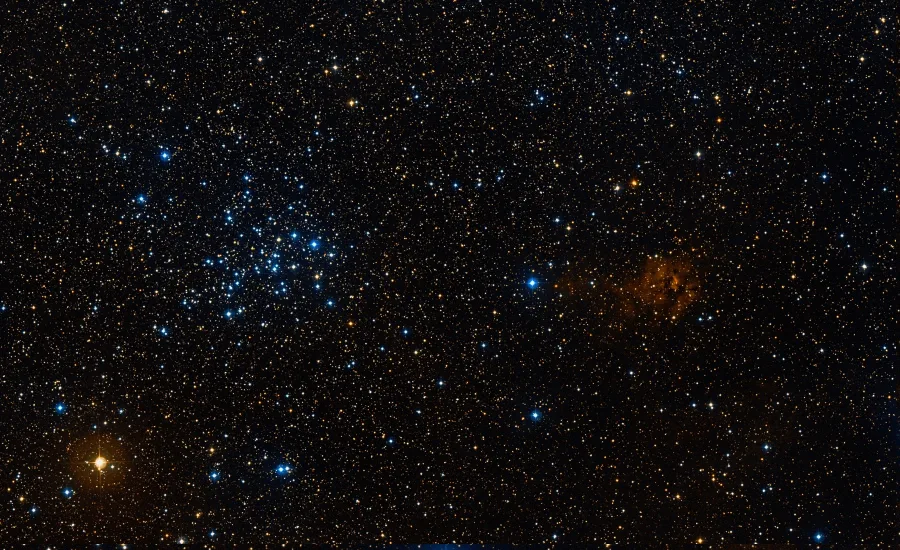
NGC 1528 and Fossil Footprint Nebula, image credit: ESO/Digitized Sky Survey 2 (CC BY 4.0)
The best time of the year to observe the Fossil Footprint Nebula and other deep sky objects in Perseus is during the month of December, when the constellation appears higher above the horizon in the early evening.
Fossil Footprint Nebula – NGC 1491
| Constellation | Perseus |
| Object type | Emission nebula (H II region) |
| Right ascension | 04h 03m 15.9s |
| Declination | +51° 18′ 54″ |
| Apparent size | 4′.8 × 4′.8 |
| Distance | 9,800 ± 2,000 light-years (3.02 ± 0.6 kiloparsecs) |
| Names and designations | Fossil Footprint Nebula, Little Pacman Nebula, NGC 1491, Sharpless 2-206, Sh2-206, LBN 704, LBN 706, LBN 150.56-00.99, LBN 150.90-01.15, Cederblad 25, Ced 25, NRAO 156, IRAS 03595+5110, BWE 0359+5110, RAFGL 5111, GAL 150.6-00.9, GAL 150.59-00.95, GRS G150.59 -00.95, MY 035935.5+511044.0, [ABB2014] WISE G150.596-00.955, [KC97c] G150.6-00.9, [L89b] 150.590-00.950, [WWB83] G150.6-0.9 |
Images
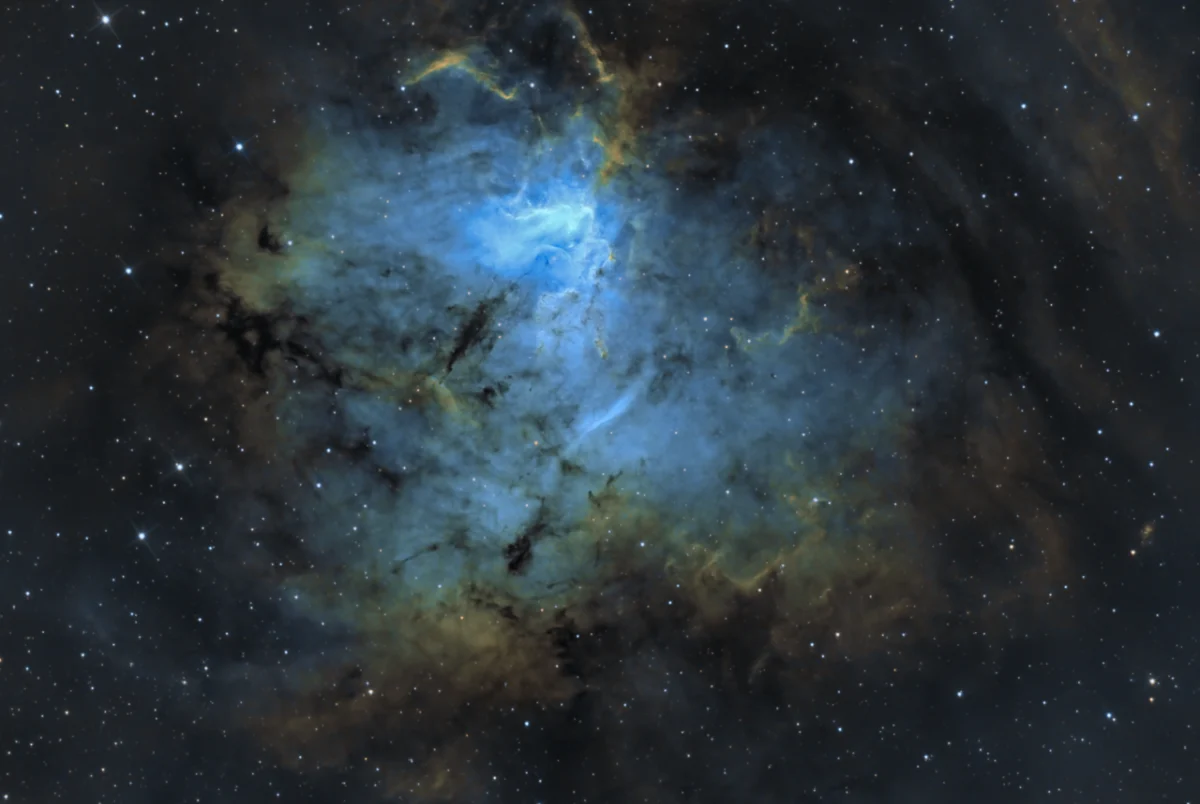
NGC 1491, image credit: Wikimedia Commons/Searchntheverse (CC BY 4.0)
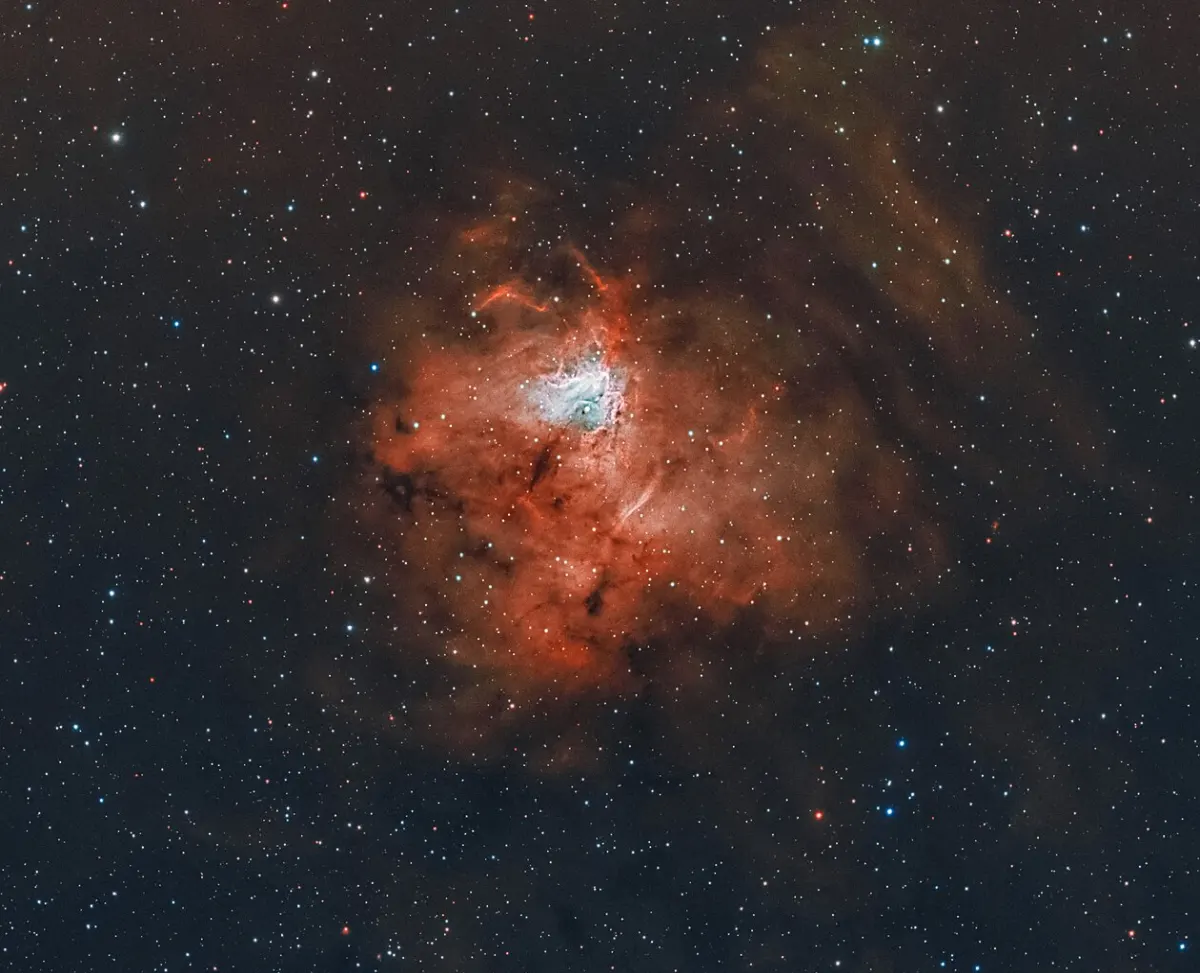
Fossil Footprint Nebula, image: Chuck Ayoub (CC BY-SA 4.0)
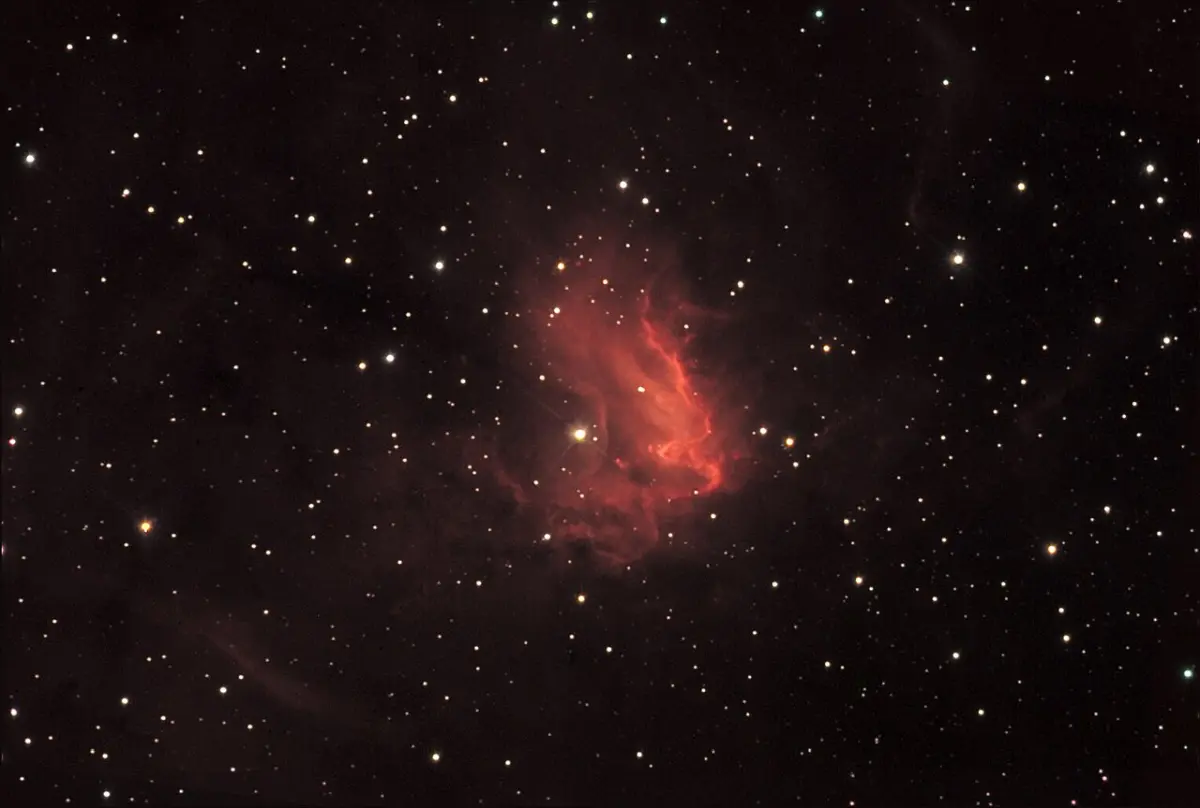
NGC 1491 is an emission nebula found in the constellation of Perseus. This particular nebula has an 11th magnitude star in its center. The “reddish” color of this object indicates that it is heavily composed of HII. Note how the central star is “blowing” a bubble in the gas that immediately surrounds it. The winds from this star are so energetic that they are breaking up the nebula to left of it in this picture.This image was taken as part of Advanced Observing Program (AOP) program at Kitt Peak Visitor Center during 2014. Image: PNO/NOIRLab/NSF/AURA/Peter Jackson and Rena Smith/Adam Block (CC BY 4.0)