NGC 1232 is an intermediate spiral galaxy located approximately 50.33 million light-years away in the constellation Eridanus (the River). It is popularly known as the Eye of God Galaxy. With an apparent magnitude of 10.9 and an angular size of 7.4 by 6.5 arcminutes, the galaxy can be seen in medium and large telescopes in good conditions.
The Eye of God Galaxy is a face-on grand design spiral galaxy. It has prominent and well-defined spiral arms that extend around it. The long spiral arms produce a number of thin arms and host numerous star formation regions. They are sprinkled with many young blue star clusters, which are separated by dark dust lanes.
NGC 1232 has a small bulge and shows hints of a bar in the nuclear region. Astronomers have identified almost a thousand H II regions – regions of ionized atomic hydrogen – in the galaxy. Observations in the radio band have shown that the galaxy is surrounded by a large envelope of neutral gas that extends far beyond the galaxy’s main body visible at optical wavelengths.
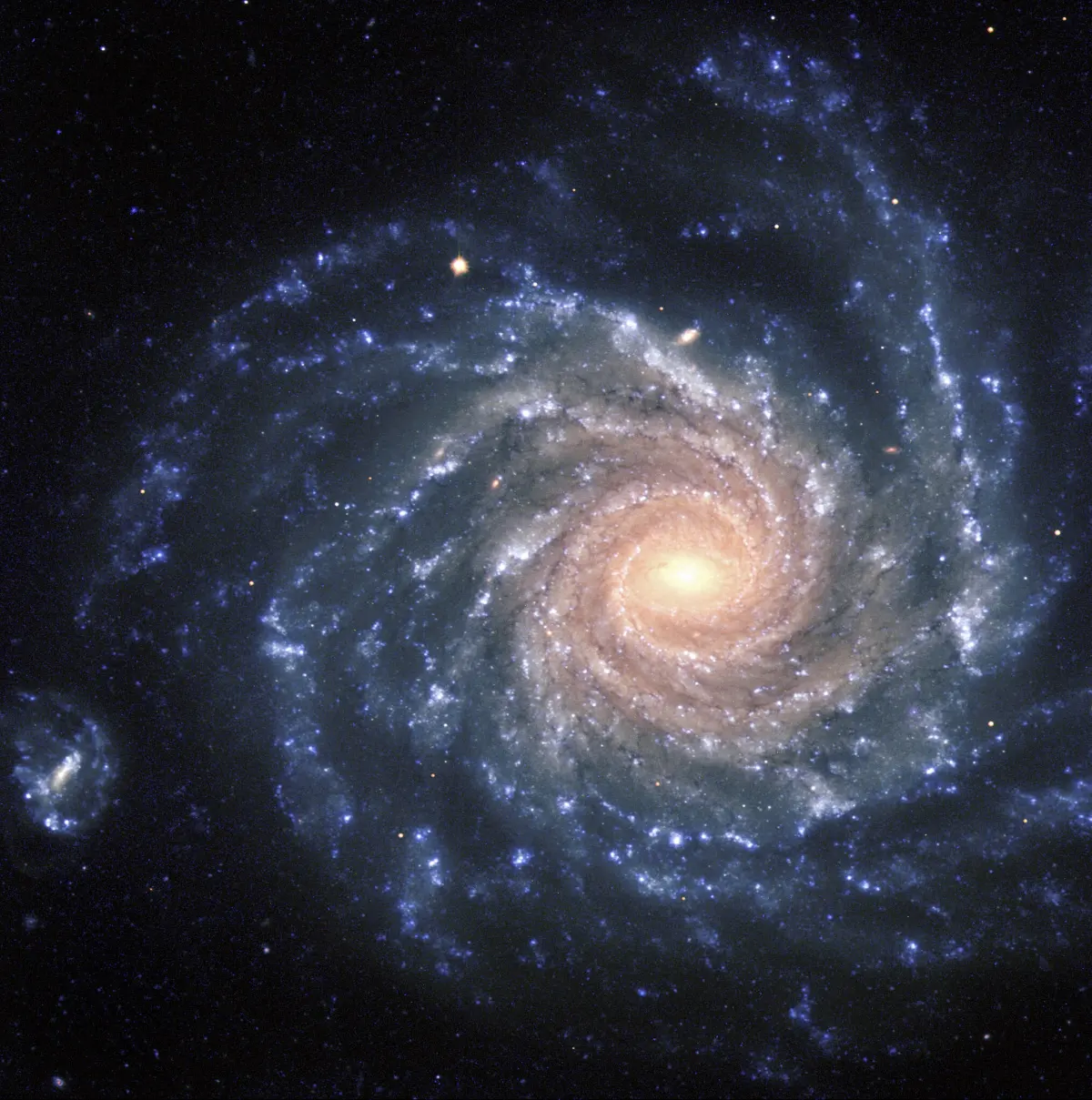
This spectacular image of the large spiral galaxy NGC 1232 was obtained on September 21, 1998, during a period of good observing conditions. It is based on three exposures in ultra-violet, blue and red light, respectively. The colours of the different regions are well visible: the central areas contain older stars of reddish colour, while the spiral arms are populated by young, blue stars and many star-forming regions. Note the distorted companion galaxy on the left side, shaped like the greek letter “theta”. Image credit: ESO (CC BY 4.0)
Observations with the Chandra X-ray Observatory in 2013 indicated that NGC 1232 suffered a collision with a smaller dwarf galaxy in the recent past. The dwarf galaxy may have crossed the disk of the larger neighbour. Astronomers detected a region of shocked gas around 7.25 kiloparsecs across. The centre of the collision is 4.3 kiloparsecs west of the galactic nucleus of NGC 1232. The collision may have triggered some star formation in the region.
High-luminosity H II regions are mainly found in the northern and eastern parts of the galaxy, where diffuse X-ray emission is weaker. A 2018 study found a lower number of H II regions where diffuse X-ray gas has a peak of emission, which indicates that the collision has quenched star formation in the area.
NGC 1232 appears to have a satellite galaxy, catalogued as NGC 1232A (PGC 11834, LEDA 11834). The smaller galaxy has a major axis of around 23 kiloparsecs (over 75,000 light-years).
The two galaxies were initially believed to have interacted in the past. A 1999 study found a separation of 2.4 megaparsecs between the galaxies, indicating that they are not physically associated at present.
Observations with the Chandra X-ray Observatory in 2021 found no evidence of previous interaction between the two galaxies. The astronomers reported three ultraluminous X-ray sources in the smaller NGC 1232A. They proposed that, in terms of morphology, mass and metallicity, NGC 1232A was analogous to the irregular spiral galaxy NGC 1313 (the Topsy Turvy Galaxy) in the constellation Reticulum.
NGC 1232 and NGC 1232A do not have matching redshifts, which means that they most likely never interacted. The galaxies are a striking example of discrepant redshifts in a galactic pair.
Chandra observations did not detect the previously reported cloud of hot gas in the larger galaxy’s disk, which had led astronomers to propose that NGC 1232 had recently interacted with a smaller galaxy.
Facts
NGC 1232 was discovered by the German-born British astronomer William Herschel on October 20, 1784.
NGC 1232 shares the nickname Eye of God with the famous Helix Nebula (NGC 7293), a bright planetary nebula in the constellation Aquarius.
NGC 1232 and NGC 1232A are listed as Arp 41 in American astronomer Halton Arp’s Atlas of Peculiar Galaxies (1966). The galactic pair is catalogued as an example of a spiral galaxy with a low surface brightness companion.
NGC 1232 and NGC 1232A may be associated with the Eridanus Cluster of galaxies, along with the barred spiral galaxy NGC 1300. However, since the galaxies are 2.2 megaparsecs away from the centre of the cluster, they are not likely to be physically bound to it.
The Eridanus Cluster hosts around 73 main galaxies and a total of 200 members. Most galaxies in the cluster (70%) are spiral or irregular, while 30% are elliptical. The cluster lies at a distance 75 million light years. The member galaxies form smaller groups that are loosely gravitationally bound to each other. Brighter members include the spiral galaxies NGC 1398, NGC 1300, NGC 1385, NGC 1367, NGC 1258 and NGC 1325, and the elliptical galaxies NGC 1395, NGC 1407, NGC 1332 and NGC 1400.
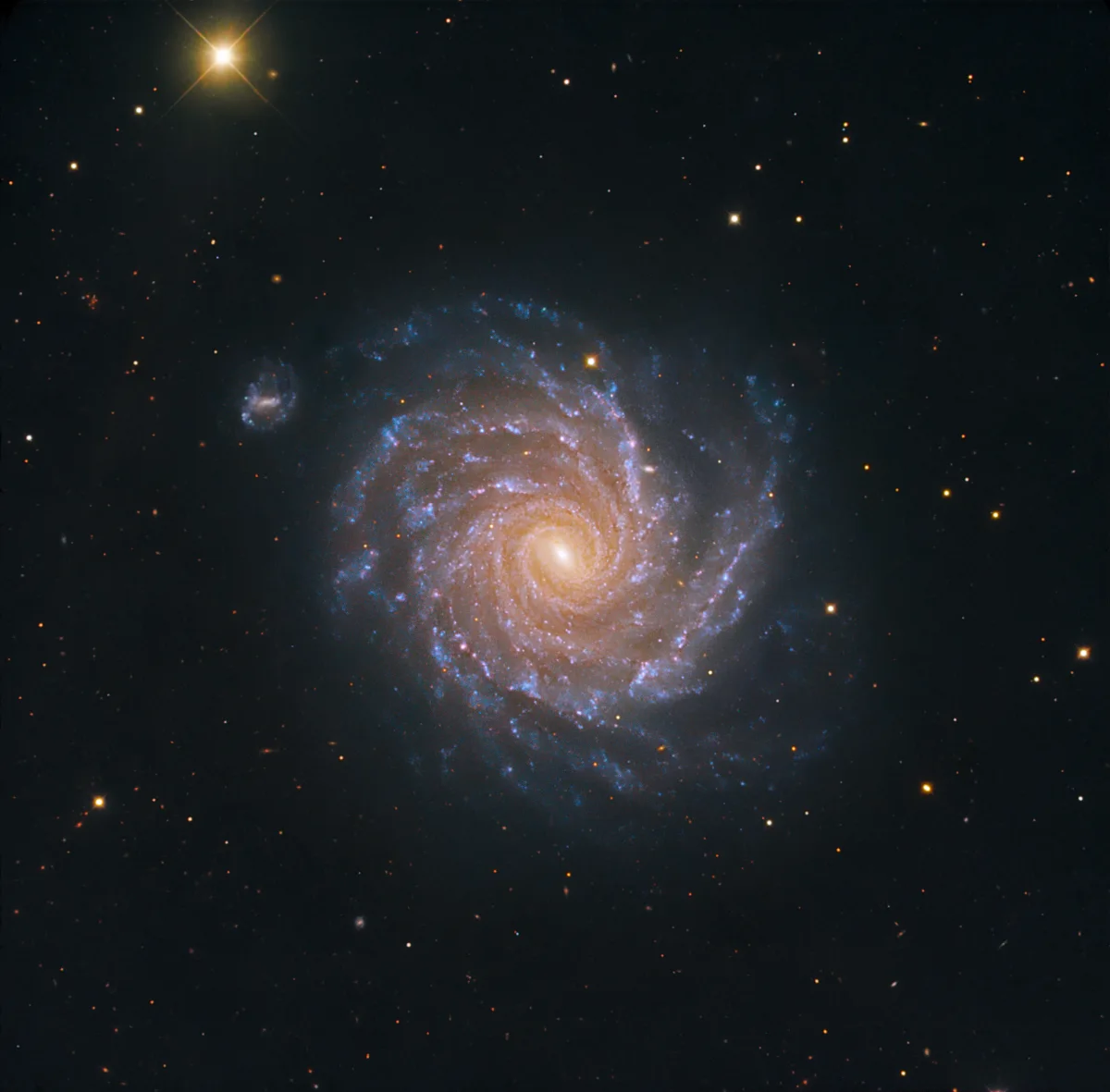
The striking, large spiral galaxy NGC 1232, and its distorted companion shaped like the greek letter “theta”. The pair is located roughly 70 million light-years away in the constellation Eridanus (The River). Billions of stars and dark dust are caught up in this beautiful gravitational swirl. The blue spiral arms with their many young stars and star-forming regions make a striking contrast with the yellow-reddish core of older stars. This image is based on data acquired with the 1.5 m Danish telescope at the ESO La Silla Observatory in Chile, through three filters (B: 900 s, V: 400 s, R: 400 s). East is up, North is to the left. Image credit: ESO/IDA/Danish 1.5 m/R.Gendler and A. Hornstrup (CC BY 4.0)
How to find NGC 1232
The Eye of God Galaxy lies in the faint central portion of Eridanus. It appears in the same area as the nine stars and star systems that share the Bayer designation Tau Eridani, about a third of the way from Tau4 Eridani to Tau1 Eridani. These star systems appear roughly halfway between Arneb in the constellation Lepus (the Hare) and Diphda in Cetus (the Sea Monster).
Located 20° 35′ south of the celestial equator, NGC 1232 is best seen from the southern hemisphere. It never rises above the horizon for observers north of the latitude 69° N.
The best time of the year to observe the Eye of God Galaxy and other deep sky objects in Eridanus is during the month of December, when the constellation appears higher in the sky in the early evening.
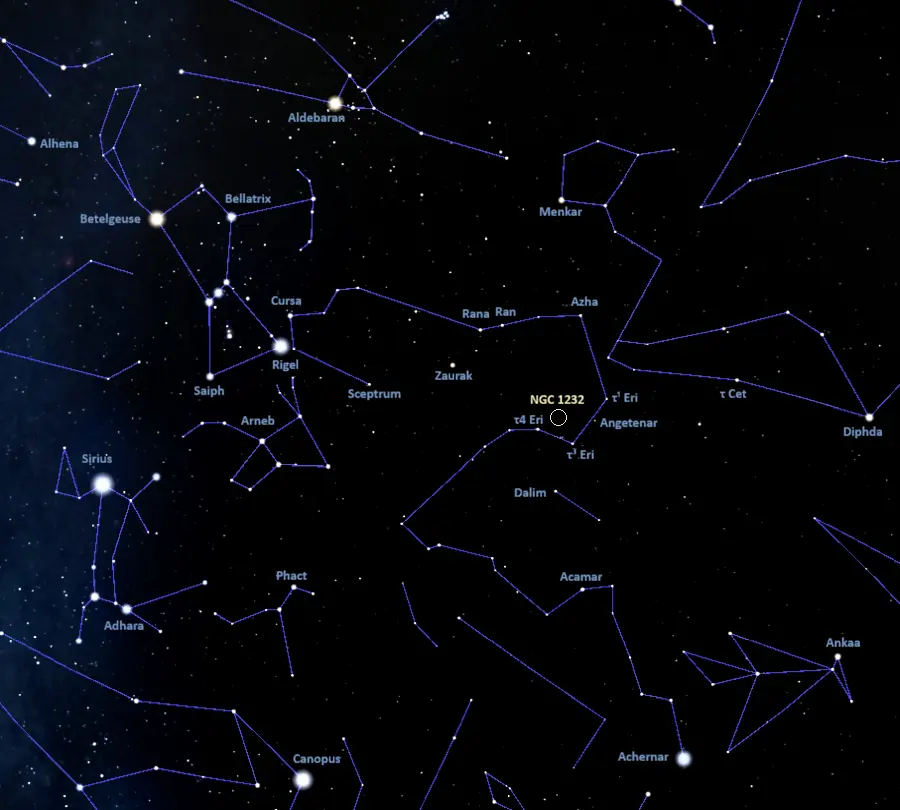
NGC 1232 location, image: Stellarium (annotated for this article)
Eye of God Galaxy – NGC 1232
| Constellation | Eridanus |
| Object type | Spiral galaxy |
| Morphological type | SAB(rs)c |
| Right ascension | 03h 09m 45.4322s |
| Declination | −20° 34′ 44.443″ |
| Apparent magnitude | 10.9 |
| Apparent size | 5′.07193 × 4′.77725 |
| Distance | 50.33 ± 2.84 million light-years (15.432 ± 0.870 megaparsecs) |
| Size | 145,300 light-years (44,570 parsecs) |
| Redshift | 0.005347 |
| Heliocentric radial velocity | 1603 ± 1 km/s |
| Names and designations | NGC 1232, LEDA 11819, PGC 11819, Arp 41, ESO 547-14, APG 41, ESO-LV 547-0140, IRAS F03075-2045, 2MASX J03094551-2034454, MCG-04-08-032, HIPASS J0309-20, SINGG HIPASS J0309-20, MBG 03075-2046, MBG 03078-2047, SGC 030730-2046.1, 6dFGS gJ030945.4-203445, [M98c] 030730.0-204613, [CHM2007] LDC 251 J030945.51-2034454 |