The D Cluster (Collinder 21) is an asterism located in the northern constellation Triangulum. It appears near Mothallah (Alpha Trianguli), one of the three bright stars that form the triangle that gives the constellation its name. With an apparent magnitude of 7.3, the star pattern can be observed in binoculars.
Like Brocchi’s Cluster (the Coathanger) in the constellation Vulpecula, the D Cluster was once believed to be an open cluster, a gravitationally bound group of stars that formed in the same stellar nursery. It was catalogued as Collinder 21 (Cr 21) in Swedish astronomer Per Collinder’s catalogue of open clusters in 1931.
However, observations in the 2000s found that the stars of Collinder 21 were unrelated. Astronomers observed the members of the presumed cluster and found that some were giants while others were still on the main sequence. These stars were discovered to lie at vastly different distances, indicating that they were not physically bound to one another.
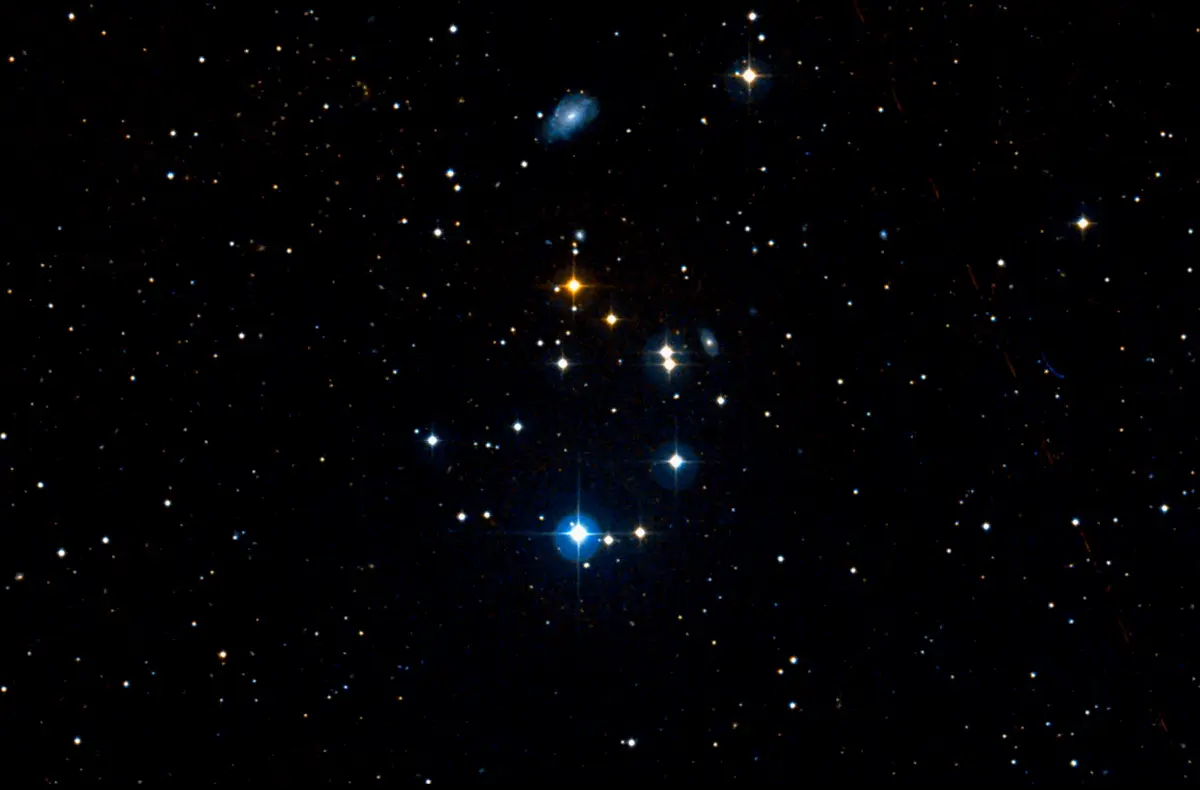
D Cluster (Collinder 21), image credit: ESO/Digitized Sky Survey 2 (CC BY 4.0)
Around 10 brighter stars in the area are distributed in a ring-like structure that looks like the letter D. These stars stand out in a poorly populated field. They include two binary systems, the visual binary BD+26 305AB and the binary star HD 11142. Both systems have the spectral type F.
HD 11142 is the brightest point of light in the D asterism. The star system has been resolved using speckle interferometry. Its two components are separated by 0.56 arcseconds. Both are classified as high proper motion stars. They have apparent visual magnitudes of 8.51 and 9.37, well below unaided eye visibility. The fainter binary BD+26 305 shines at magnitude 10.086.
A 2004 study led by S. Villanova, Department of Astronomy, University of Padua, confirmed that Collinder 21 was not in fact a star cluster. The researchers found that the 12 brightest stars in the field of view of Cr 21 did not share a common mean tangential motion. They lie at distances between 60 and 1,470 parsecs (196 and 4,795 light-years), which means that the cosmic letter D is just a chance alignment of physically unrelated field stars.
The D Cluster lies near Mothallah, the star that marks the apex of the celestial Triangle. The constellation figure of Triangulum is also formed by Alaybasan (Beta Trianguli) and Apdu (Gamma Trianguli). The elongated figure lies just below the chain of Andromeda’s three brightest stars (Alpheratz, Mirach and Almach).
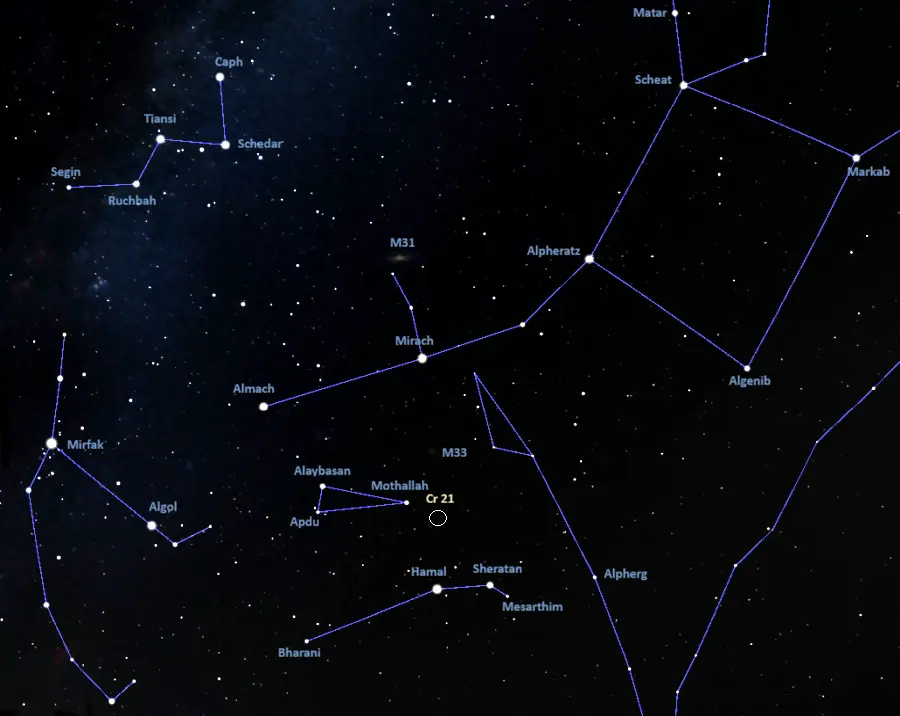
D Cluster location, image: Stellarium
Collinder 21 appears close to the imaginary line connecting Hamal in Aries and Mirach in Andromeda. The famous Triangulum Galaxy (M33) lies along the same line.
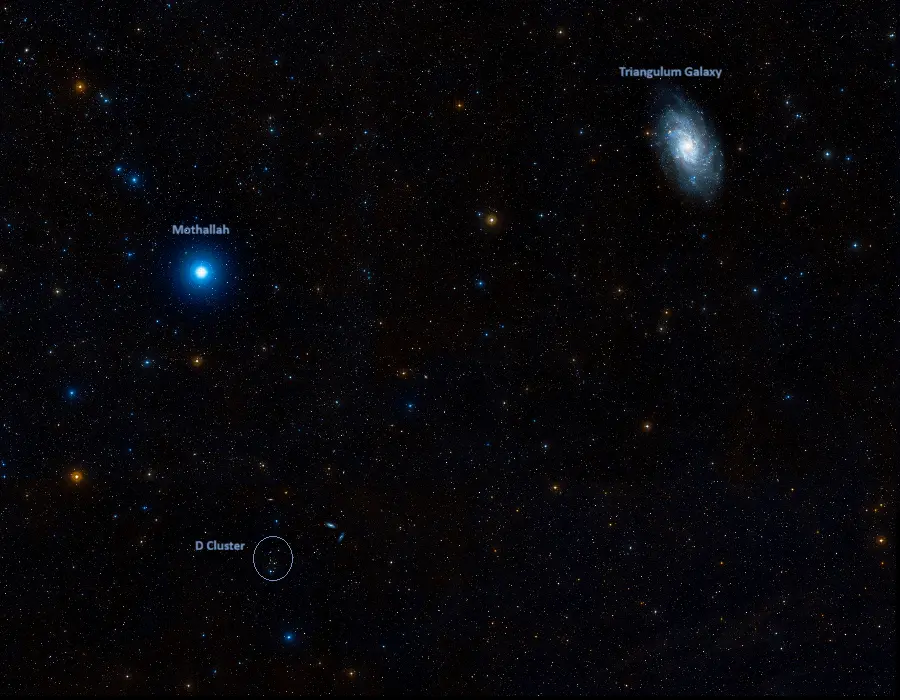
Mothallah, Triangulum Galaxy and D Cluster, image credit: ESO/Digitized Sky Survey 2 (CC BY 4.0)
The asterism lies in the same area as several fainter galaxies. The spiral galaxies IC 1731 and NGC 684 lie to the north, and the brighter NGC 672 and IC 1727 appear to the northwest.
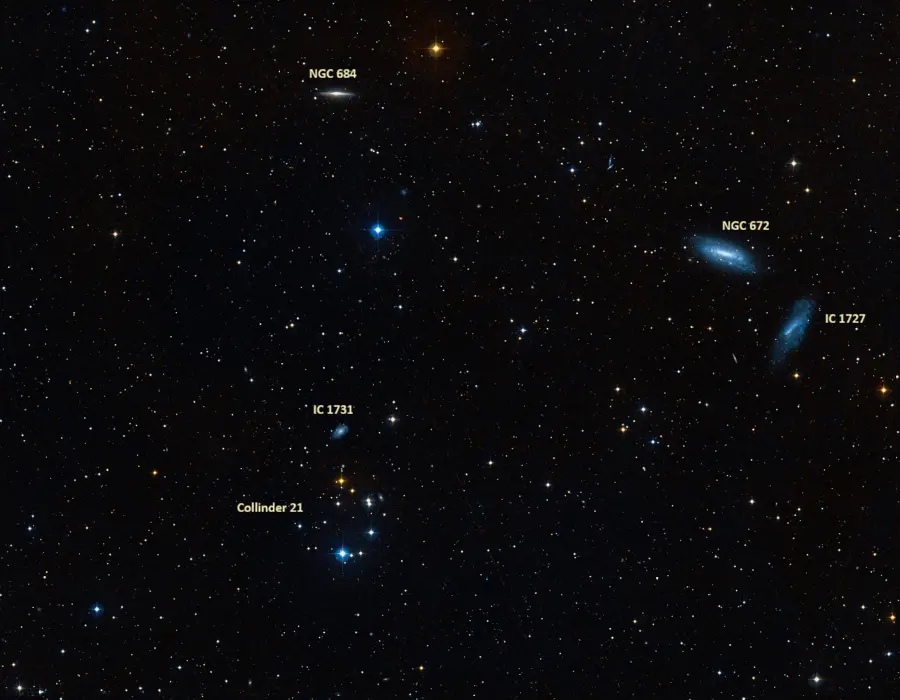
Collinder 21, NGC 672, NGC 684, IC 1731 and IC 1727, image credit: ESO/Digitized Sky Survey 2 (CC BY 4.0)
The best time of the year to observe the D Cluster and other stars and deep sky objects in Triangulum is during the month of December, when the constellation rises higher above the horizon in the early evening. The asterism can be spotted in small binoculars.
D Cluster – Collinder 21
| Constellation | Triangulum |
| Object type | Asterism |
| Right ascension | 01h 50m 09.6s |
| Declination | +27° 06′ 54″ |
| Apparent magnitude | 7.3 |
| Names and designations | D Cluster, Collinder 21, Cr 21, C 0147+270, OCl 371, [KPS2012] MWSC 0143 |