Dorado constellation lies in the southern hemisphere. Its name means “the dolphinfish” (Coryphaena hippurus) in Spanish. The constellation has also been depicted as a swordfish.
Dorado constellation was created by the Dutch astronomer Petrus Plancius from the observations of Dutch navigators Pieter Dirkszoon Keyser and Frederick de Houtman. The constellation was first depicted in Johann Bayer’s star atlas Uranometria in 1603.
Dorado contains most of the Large Magellanic Cloud, an irregular galaxy near the Milky Way. The LMC is home to WOH G64, one of the largest stars known, and to the Tarantula Nebula, the most active star-forming region in our galactic neighbourhood. The South Ecliptic Pole is also located in the direction of Dorado.
Facts, location and map
Dorado is the 72nd constellation in size, occupying an area of 179 square degrees. It is located in the first quadrant of the southern hemisphere (SQ1) and can be seen at latitudes between +20° and -90°. The neighboring constellations are Caelum, Horologium, Hydrus, Mensa, Pictor, Reticulum, and Volans.
The constellation name Dorado is pronounced /dəˈrɑːdoʊ/. In English, the constellation is known as the Swordfish. The genitive form of Dorado, used in star names, is Doradus (pronunciation: /dəˈreɪdəs/). The three-letter abbreviation, adopted by the International Astronomical Union (IAU) in 1922, is Dor.
Dorado belongs to the Johann Bayer family of constellations, along with Apus, Chamaeleon, Grus, Hydrus, Indus, Musca, Pavo, Phoenix, Tucana, and Volans.
Dorado has two stars with known planets and contains no Messier objects. The brightest star in the constellation is Alpha Doradus. There are no meteor showers associated with the constellation.
Dorado contains one formally named star. The star name approved by the International Astronomical Union (IAU) is Naledi (WASP-62).
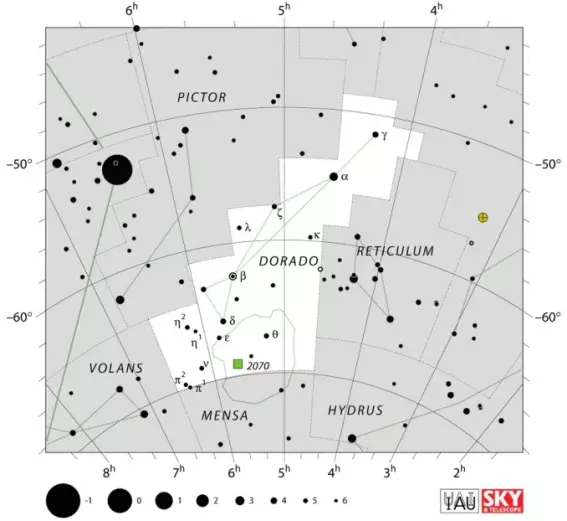
Dorado constellation map by IAU and Sky&Telescope magazine
Story
There are no myths associated with the constellation. Dorado was one of the 12 constellations created by the Dutch astronomer Petrus Plancius, who mostly named the newly created southern constellations after animals.
Dorado has also sometimes been referred to as the Swordfish constellation, or Xipias.
Dorado stars
α Doradus (Alpha Doradus)
Alpha Doradus is the brightest star in the constellation. The star’s luminosity varies from 3.26 to 3.30 magnitudes. It is approximately 169 light years distant.
Alpha Doradus is a binary star, one of the brightest ones known. The binary system is composed of the primary star, a giant belonging to the spectral class A0III, and a subgiant of the spectral type B9IV. The primary star is classified as a Si star, which means that its atmosphere exhibits an exceptionally high abundance of silicon. It has a visual magnitude of 3.8, while the companion shines at 4.3 magnitudes.
The system also has an optical companion 77 arc seconds away, but the third star is not physically associated with the main pair in any way.
β Doradus (Beta Doradus)
Beta Doradus is a Cepheid variable star. Its spectral type varies from F-type to G-type and its luminosity varies from 4.05 to 3.45 magnitudes. It is the second brightest star in the constellation. It is approximately 1,050 light years distant from Earth.
γ Doradus (Gamma Doradus)
Gamma Doradus is another variable star in Dorado. It serves as a prototype of stars known as the Gamma Doradus variables. These stars are pulsating variables whose brightness varies by less than a tenth of a magnitude as a result of non-radial gravity wave oscillations. Gamma Doradus has a visual magnitude of 4.25 and is approximately 66.2 light years distant.
δ Doradus (Delta Doradus)
Delta Doradus is a star belonging to the spectral type A7V. It has an apparent magnitude of 4.34 and is approximately 145 light years distant. Delta Doradus is notable for being the Moon’s South Pole star.
R Doradus (HD 29712)
R Doradus is a red giant star belonging to the spectral class M8 III, approximately 178 light years distant. It is classified as a Mira variable.
R Doradus is believed to be the star with the second largest apparent size when observed from Earth, second only to the Sun. The star has a mean visual magnitude of 5.40, and its brightness fluctuates between 4.8 and 6.6 magnitudes. The star’s diameter is about 370 times solar.
S Doradus
S Doradus is a hypergiant and one of the brightest stars in the Large Magellanic Cloud. It is one of the most luminous stars known, but at a distance of 169,000 light years, it cannot be seen by the unaided eye. It has a mean visual magnitude of 9.565 (its brightness varies from 8.6 to 11.5 magnitudes).
S Doradus serves as a prototype of a group of variable stars known as the S Doradus variables. It is a luminous blue variable that exhibits changes in brightness over long periods of time, with occasional outbursts. It is usually classified as spectral type A0e, but in fact has the spectrum of a F0 class star.
ζ Doradus (Zeta Doradus)
Zeta Doradus is a yellow-white main sequence star of the spectral type F7 V. It has a visual magnitude of 4.68 and is 38 light years distant from Earth. The star will move to the constellation Pictor around the year 6400.
HE 0437-5439
HE 0437-5439 is an unbound hypervelocity star in Dorado that appears to be receding from us at the speed of 723 kilometres per second. It is a main sequence star belonging to the spectral type BV, believed to be about 30 million years old. It is approximately 200,000 light years distant and has an apparent magnitude of 16.3. The star has a mass nine times that of the Sun.
HE 0437-5439 was first discovered in 2005 by observers at the European Southern Observatory. Because it is moving at such a high velocity, the star is no longer gravitationally bound to the Milky Way and will eventually leave the galaxy and move into intergalactic space.
Deep sky objects in Dorado
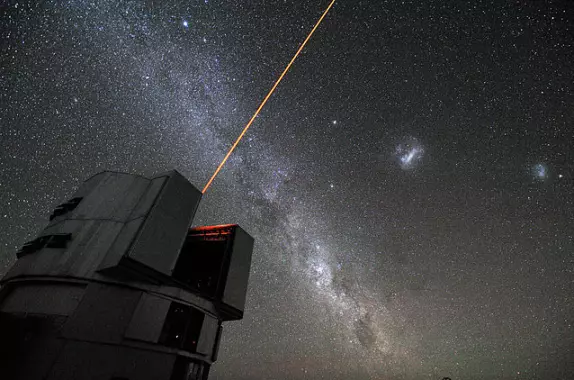
A laser beam launched from VLT´s 8.2-metre Yepun telescope crosses the majestic southern sky and creates an artificial star at 90 km altitude in the high Earth´s mesosphere. The Laser Guide Star (LGS) is part of the VLT´s Adaptive Optics system and it is used as reference to correct images from the blurring effect of the atmosphere. The picture field is crossed by an impressive Milky Way, our own galaxy seen perfectly edge-on. The most prominent objects on the Milky Way are: Sirius, the brightest star in the sky, visible at the top and the Carina nebula, seen as a bright patch besides the telescope. From the right edge of the picture to the left, the following objects are aligned: the Small Magellanic Cloud (with the globular cluster 47 Tucanae on its right), the Large Magellanic Cloud and Canopus, the second brightest star in the sky. Image: G. Hüdepohl/ESO
Large Magellanic Cloud
The Large Magellanic Cloud (LMC) is an irregular galaxy located in the constellations Dorado and Mensa. It is a satellite galaxy to the Milky Way, and the third closest galaxy to ours, after the Sagittarius Dwarf Spheroidal Galaxy in Sagittarius constellation and Canis Major Dwarf Galaxy in Canis Major. Having ten billion times the mass of the Sun, the Large Magellanic Cloud is only 1/100 as massive as the Milky Way.
The galaxy has a radius of about 14,000 light years and is about 157,000 light years distant. It has a visual magnitude of 0.9.
Its irregular appearance is believed to be a result of tidal interactions with the Milky Way and the Small Magellanic Cloud, a dwarf galaxy located in the constellation Tucana.
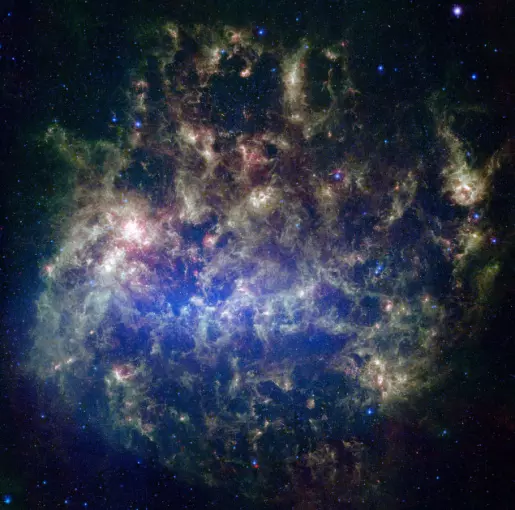
This image from NASA’s Spitzer Space Telescope shows the Large Magellanic Cloud, a satellite galaxy to our own Milky Way galaxy. The infrared image, a mosaic of 300,000 individual tiles, offers astronomers a unique chance to study the lifecycle of stars and dust in a single galaxy. Nearly one million objects are revealed for the first time in this Spitzer view, which represents about a 1,000-fold improvement in sensitivity over previous space-based missions. Most of the new objects are dusty stars of various ages populating the Large Magellanic Cloud; the rest are thought to be background galaxies. Image: NASA/JPL-Caltech/M. Meixner (STScI) & the SAGE Legacy Team
The Large Magellanic Cloud contains about 700 open clusters, 400 planetary nebulae, and 60 globular star clusters, and is home to innumerable supergiant and giant stars.
The Large Magellanic Cloud is the fourth largest galaxy in the Local Group, after the Andromeda Galaxy in Andromeda constellation, the Milky Way, and the Triangulum Galaxy in Triangulum constellation.
It is rich in gas and dust, and currently undergoing intense star forming activity. The Tarantula Nebula, the most active region of star formation in the Local Group, is located in the Large Magellanic Cloud.
The Large Magellanic Cloud was first mentioned by the Persian astronomer Abd al-Rahman al-Sufi in 964 AD in his Book of Fixed Stars. Amerigo Vespucci mentioned it in a letter in 1503-04, about his third voyage. He wrote of “three Canopes, two bright and one obscure.” The “two bright Canopes” were the two Magellanic Clouds, and the “one obscure” was the famous Coalsack Nebula in the constellation Crux.
It was, however, Ferdinand Magellan whose writings introduced the Large Magellanic Cloud to Europeans, and the galaxy has subsequently been named after him.
Tarantula Nebula – NGC 2070 (30 Doradus)
The Tarantula Nebula is an H II region located in the Large Magellanic Cloud. Originally believed to be a star, it wasn’t until 1751 that it was confirmed to be a nebula by the French astronomer Nicolas Louis de Lacaille.
The nebula has an apparent magnitude of 8 and is approximately 160,000 light years distant.
It is an exceptionally luminous non-stellar object; if it were as close as the Orion Nebula (Messier 42) in Orion constellation, NGC 2070 would appear so bright that it would cast shadows. The nebula has an absolute magnitude of -11.7.
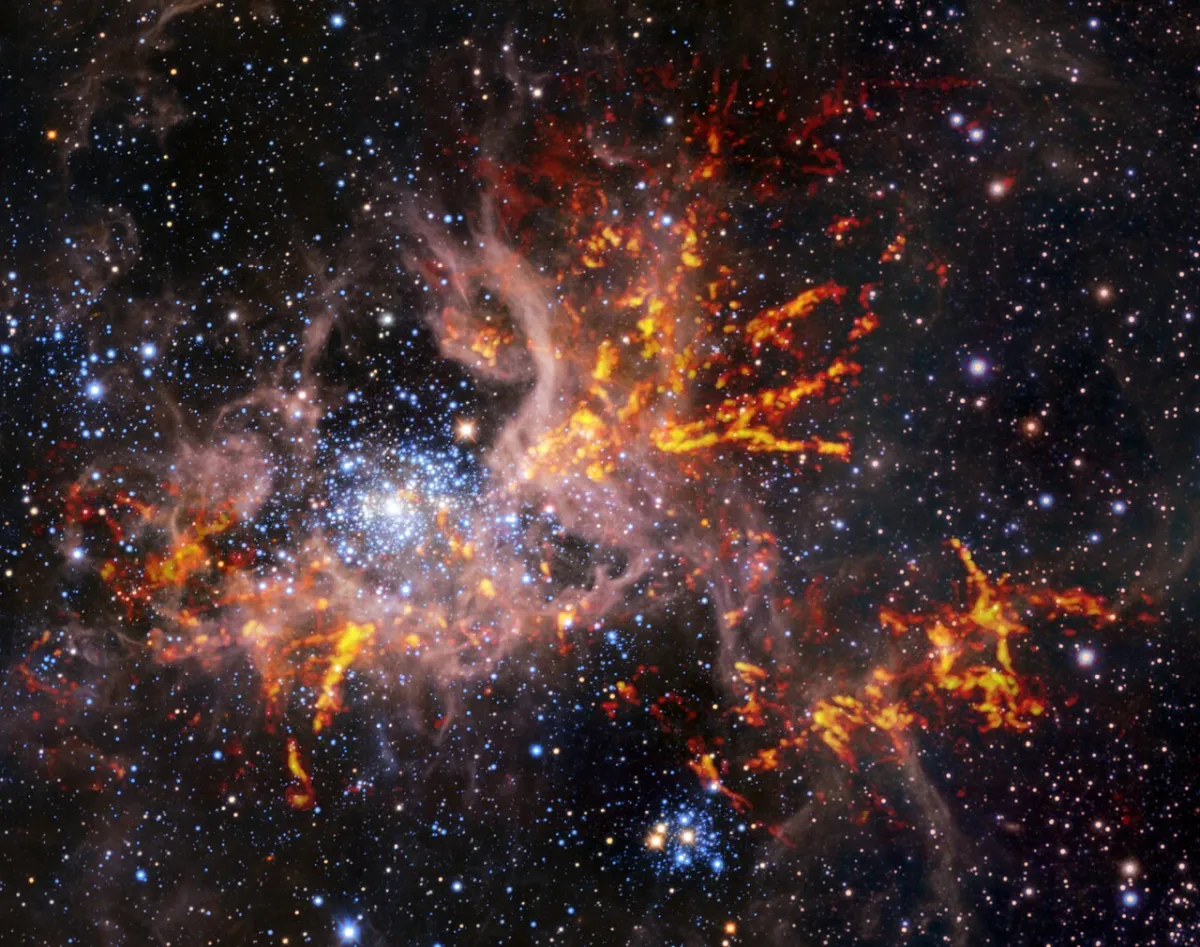
This composite image shows the star-forming region 30 Doradus, also known as the Tarantula Nebula. The background image, taken in the infrared, is itself a composite: it was captured by the HAWK-I instrument on ESO’s Very Large Telescope (VLT) and the Visible and Infrared Survey Telescope for Astronomy (VISTA), shows bright stars and light, pinkish clouds of hot gas. The bright red-yellow streaks that have been superimposed on the image come from radio observations taken by the Atacama Large Millimeter/submillimeter Array (ALMA), revealing regions of cold, dense gas which have the potential to collapse and form stars. The unique web-like structure of the gas clouds led astronomers to the nebula’s spidery nickname. Image credit: ESO, ALMA (ESO/NAOJ/NRAO)/Wong et al., ESO/M.-R. Cioni/VISTA Magellanic Cloud survey. Acknowledgment: Cambridge Astronomical Survey Unit (CC BY 4.0)
500 light years in radius, the Tarantula Nebula is the largest and most active star forming region in the Local Group of galaxies. The nebula contains the compact star cluster R136 at its centre. The cluster is responsible for producing most of the energy that makes the nebula so luminous.
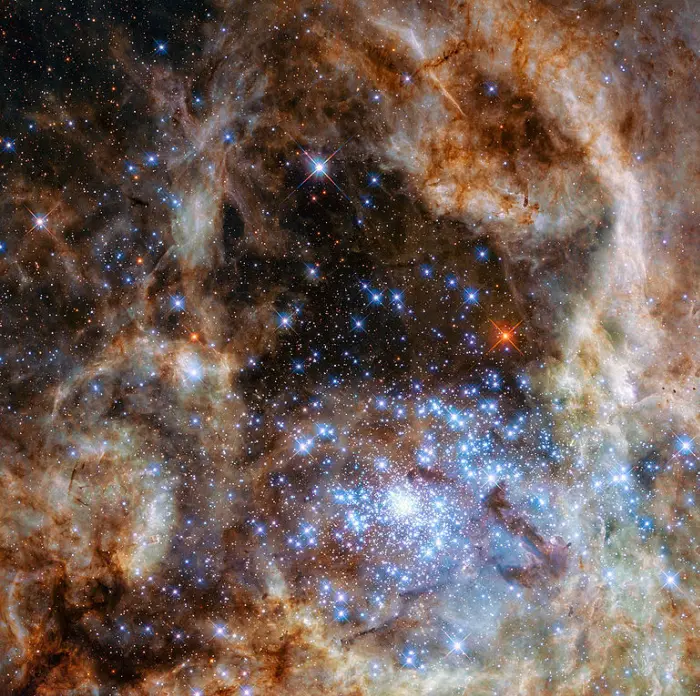
A Hubble Space Telescope image of the R136 super star cluster, near the center of the 30 Doradus Nebula, also known as the Tarantula Nebula or NGC 2070. Image credit: NASA, ESA, F. Paresce (INAF-IASF, Bologna, Italy), R. O’Connell (University of Virginia, Charlottesville), and the Wide Field Camera 3 Science Oversight Committee
Another star cluster, Hodge 301, is also located within the nebula. It is an older cluster and its most massive stars have already gone supernova.
SNR 0509-67.5
SNR 0509-67.5 is a supernova remnant located in the Large Magellanic Cloud, about 160,000 light years away. The supernova is believed to have occurred some 400 years ago and it was most likely a type 1a supernova.
SN 1987A
Supernova 1987A (SN 1987A) was a supernova that occurred in the outer region of the Tarantula Nebula about 167,885 light years from Earth. With a peak magnitude of 2.9, it could be seen without binoculars.
The light from the supernova event reached Earth on February 23, 1987. The progenitor star was identified as a blue supergiant.
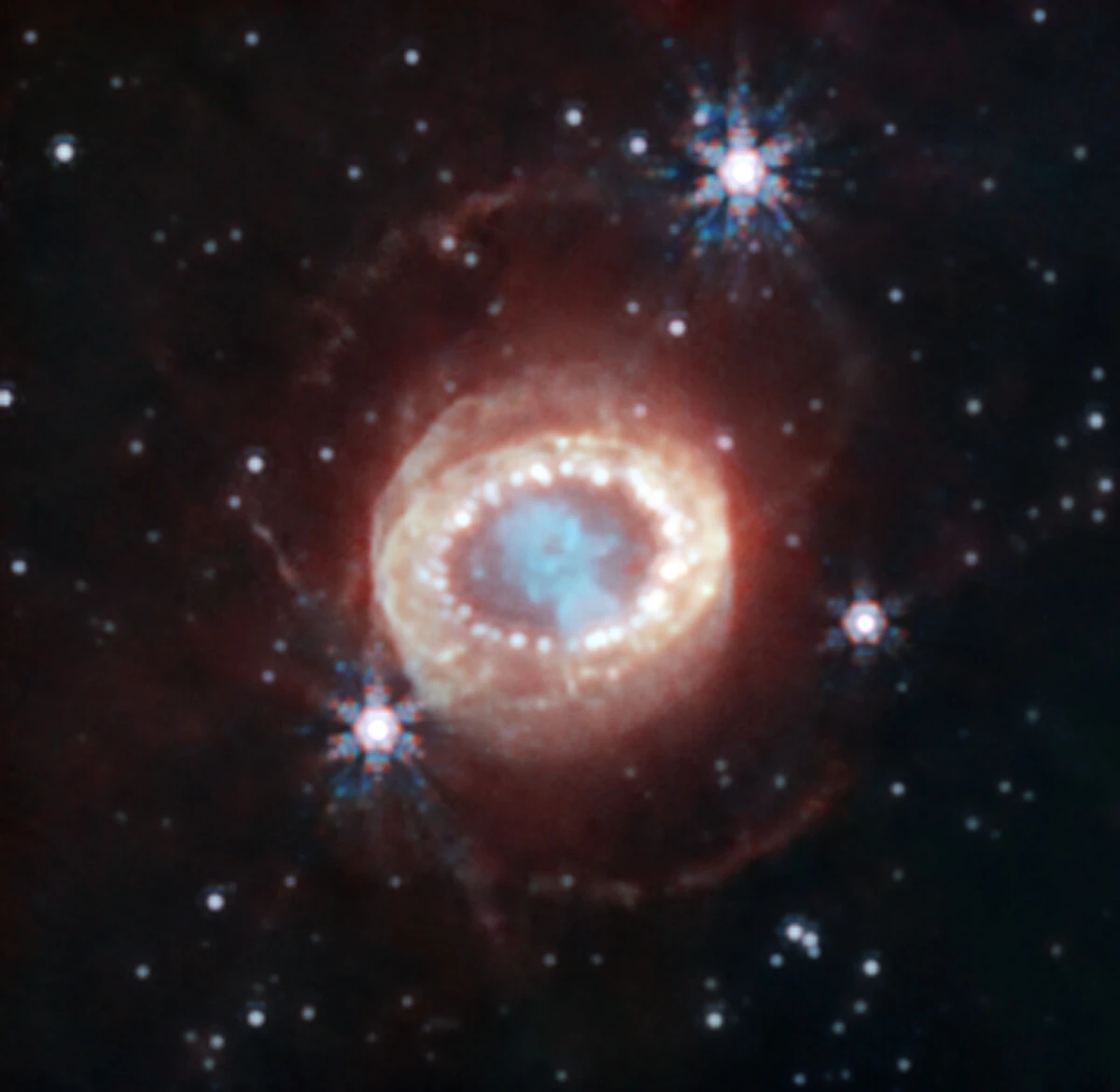
The NASA/ESA/CSA James Webb Space Telescope has begun the study of one of the most renowned supernovae, SN 1987A (Supernova 1987A). Located 168,000 light-years away in the Large Magellanic Cloud, SN 1987A has been a target of intense observations at wavelengths ranging from gamma rays to radio for nearly 40 years, since its discovery in February of 1987. New observations by Webb’s NIRCam (Near-Infrared Camera) provide a crucial clue to our understanding of how a supernova develops over time to shape its remnant. This image reveals a central structure like a keyhole. This center is packed with clumpy gas and dust ejected by the supernova event. The dust is so dense that even near-infrared light that Webb detects can’t penetrate it, shaping the dark “hole” in the keyhole. A bright, equatorial ring surrounds the inner keyhole, forming a band around the waist that connects two faint arms of hourglass-shaped outer rings. The equatorial ring, formed from material ejected tens of thousands of years before the supernova, contains bright hot spots, which appeared as the supernova’s shock wave hit the ring. Now spots are found even exterior to the ring, with diffuse emission surrounding it. These are the locations of supernova shocks hitting more exterior material. Image credit: NASA, ESA, CSA, M. Matsuura (Cardiff University), R. Arendt (NASA’s Goddard Spaceflight Center & University of Maryland, Baltimore County), C. Fransson (Stockholm University), J. Larsson (KTH Royal Institute of Technology), A. Pagan (STScI) (CC BY 4.0)
Ghost Head Nebula – NGC 2080
The Ghost Head Nebula is located to the south of the Tarantula Nebula and is another star forming region in Dorado, in the Large Magellanic Cloud. The nebula is 50 light years in diameter and about 160,000 light years distant.
The Ghost Head Nebula was first discovered by John Frederick William Herschel in 1834. It got its name because it has two very distinct white patches called “the eyes of the ghost.”
The white patch located to the west, designated A1, has a bubble at its core created by a young, massive star at the centre. The patch to the east, A2, contains a newly formed cluster of young stars.
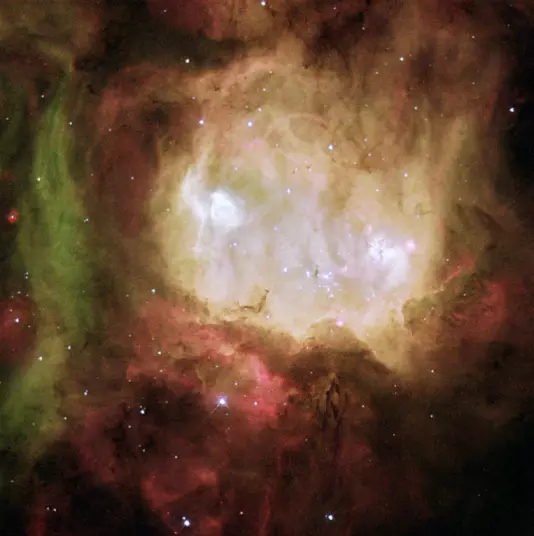
Ghost Head Nebula – NGC 2080, photo: ESA, NASA, Mohammad Heydari-Malayeri
N44
N44 is an emission nebula located in the Large Magellanic Cloud. It is about a thousand light years wide and lies approximately 160,000-170,000 light years from Earth.
The nebula has a superbubble structure, formed by the radiation pressure of a group of about 40 luminous blue-white stars located near the nebula’s centre, and it also contains a smaller bubble structure inside, designated N44F, formed in a similar manner.
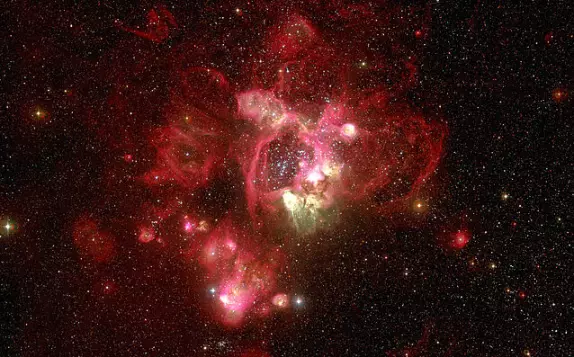
Southern part of the spectacular N44 region in the Large Magellanic Cloud. The green colour indicates areas that are particularly hot. Photo: ESO
Spanish Dancer – NGC 1566
NGC 1566 is the brightest galaxy of the Dorado Group. It is an intermediate spiral galaxy approximately 38.4 million light years distant. It has a visual magnitude of 10.3 and is the second brightest Seyfert galaxy, after NGC 1068. A supernova was observed in the galaxy in June 2010.
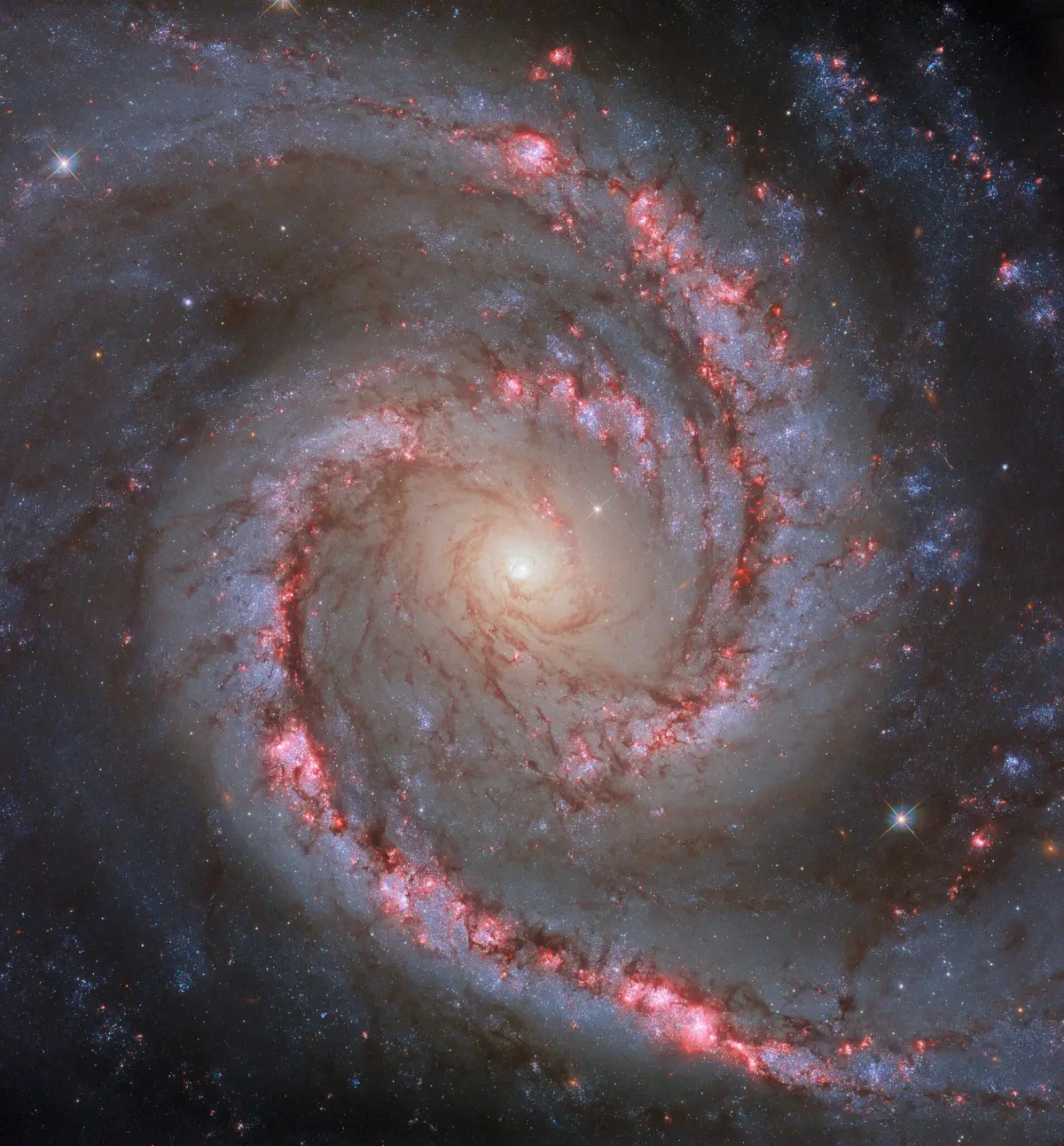
This vibrant and dynamic-looking image features the spiral galaxy NGC 1566, which is sometimes informally referred to as the ‘Spanish Dancer Galaxy’. Like the subject of another recent Hubble Picture of the Week, NGC 1566 is a weakly-barred or intermediate spiral galaxy, meaning that it does not have either a clearly present or a clearly absent bar-shaped structure at its centre. The galaxy owes its nickname to the vivid and dramatic swirling lines of its spiral arms, which could evoke the shapes and colours of a dancer’s moving form. Image credit: ESA/Hubble & NASA, D. Calzetti and the LEGUS team, R. Chandar (CC BY 4.0)
NGC 1850
NGC 1850 is an open star cluster in Dorado. It was discovered by James Dunlop in 1826. The cluster has a visual magnitude of 9.0.
NGC 1850 is notable because its stars are distributed as they would normally be in a globular cluster, but globular clusters in the Milky Way are formed of old stars, while NGC 1850 contains young ones. It is unlike any known star cluster in our galaxy.
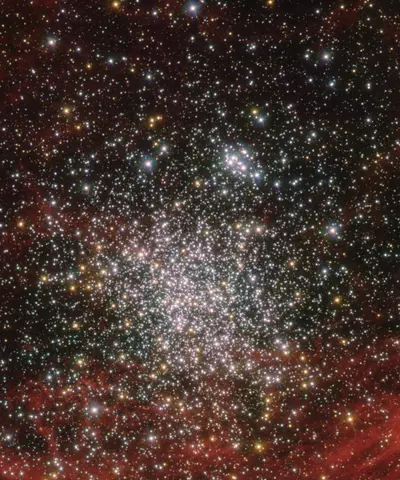
NGC 1850, image: Judy Schmidt (CC BY 2.0)