The Circlet of Pisces is a relatively faint asterism located in the western part of the constellation Pisces. The ring of seven stars represents the head of the Western Fish of Pisces. It appears in the same region of the sky as the Great Square of Pegasus and the Water Jar of Aquarius.
The Circlet is the most conspicuous star pattern in Pisces. It is formed by Theta Piscium, 7 Piscium, Gamma Piscium, Kappa Piscium, Lambda Piscium, TX Piscium (19 Psc), and Iota Piscium. The asterism can be spotted south of the Great Square of Pegasus on a clear, dark night from areas without too much light pollution.
Pisces is one of the largest and faintest constellations of the zodiac. Stretching across 889 square degrees of the northern sky, it is the 14th largest constellation in the sky and the fourth largest zodiac constellation, after Virgo, Aquarius and Leo. Despite its size, Pisces does not stand out in the sky and is best seen from locations away from city lights.

Circlet of Pisces, image credit: ESO/Digitized Sky Survey 2 (CC BY 4.0)
The constellation is depicted as two fishes connected by two cords that meet at Alrescha (Alpha Piscium). The Circlet asterism outlines the head of the Western Fish. In depictions of Pisces, it sometimes represents the whole fish. The head of the Eastern Fish is formed by Tau Piscium (mag. 4.52), Phi Piscium (mag. 4.676), and Upsilon Piscium (mag. 4.75). The three inconspicuous stars form a triangle south of the bright Mirach (Beta Andromedae) in Andromeda.
The hot blue star Fumalsamakah (Beta Piscium), which lies just west of the Circlet, marks the mouth of the Western Fish, completing the western portion of the constellation figure of Pisces. The star’s traditional name is derived from the Arabic fum al samakah, meaning “mouth of the fish.”
Polish astronomer Johannes Hevelius divided the constellation Pisces into four subdivisions: the North Fish (Piscis Boreus), the South Fish (Piscis Austrinus), the North Cord (Linum Boreum), and the South Cord (Linum Austrinum). The stars of the Circlet were part of the South Fish, along with Omega Piscium, Fumalsamakah (Beta Psc), and 5 Piscium. Omega Piscium appears just east of the Circlet, while Fumalsamakah and 5 Piscium appear west of the asterism.
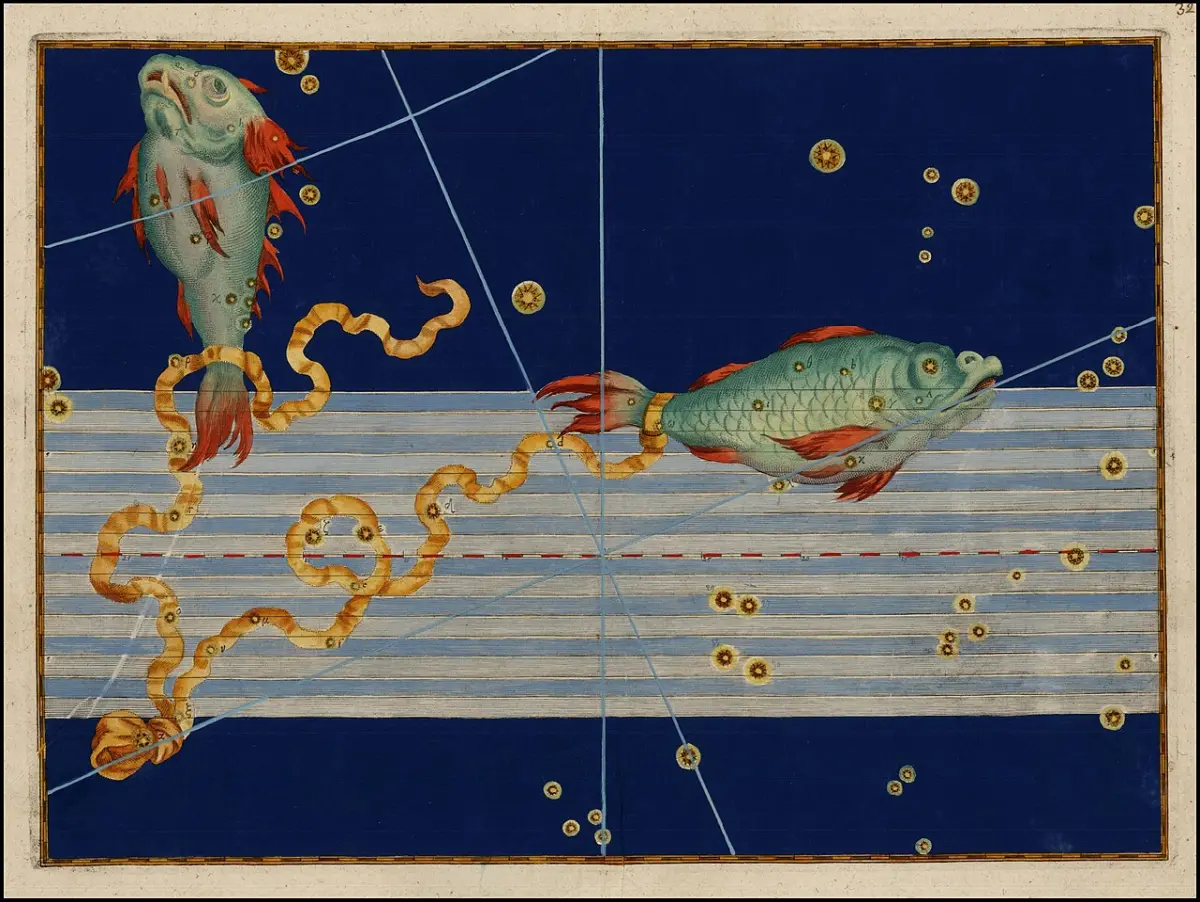
Pisces constellation, credit: Johann Bayer (1603)
The South Fish (Piscis Austrinus) should not be mistaken for the modern constellation Piscis Austrinus (the Southern Fish). The constellation that hosts Fomalhaut, one of the brightest stars in the sky, was known as Piscis Notius in Hevelius’ time. Like Pisces, it was among the Greek constellations catalogued in Ptolemy’s Almagest in the 2nd century AD. Both constellations have a Babylonian origin.
The vernal equinox, the point at which the Sun moves across the celestial equator into the northern hemisphere in March each year, lies near the Circlet of Pisces, close to the border with Aquarius. Also known as the First Point of Aries (because it was located in Aries in ancient times), the equinox will move into Aquarius around the year 2597. It has been in Pisces since 68 BC.
In traditional Chinese astronomy, the stars of the Circlet of Pisces belonged to two asterisms. Gamma, Theta, Iota and 7 Piscium formed the Thunderbolt with Fumalsamakah and Omega Piscium. The asterism was part of the Wall mansion, one of the mansions of the Black Tortoise. Lambda, Kappa and 19 Piscium were part of the Cloud and Rain asterism, along with 12 Piscium and 21 Piscium.
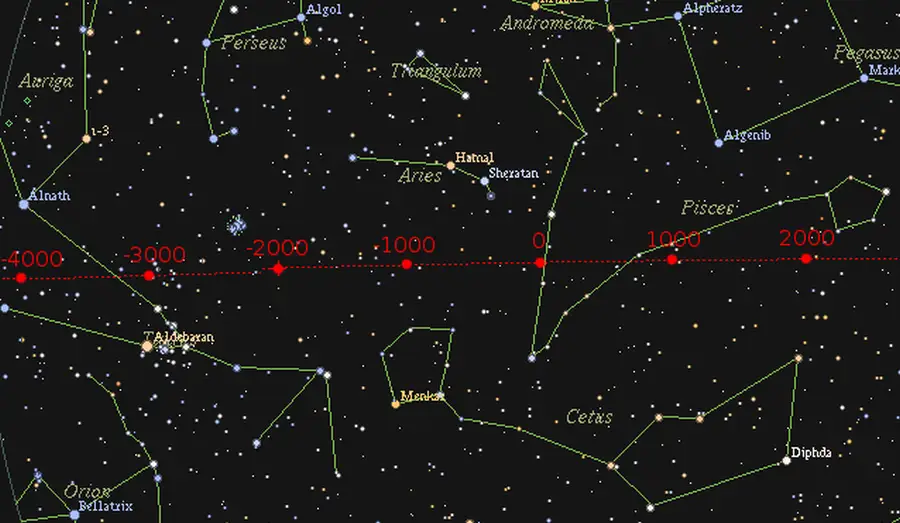
Path of the point of vernal equinox along the ecliptic over a 6000 year period. The tradition of take the point of vernal equinox as defining the “sign of Aries” dates to Babylonian astrology, ca. 600 BC. It is apparent in this image that the main star of Aries, Hamal, was closest to the point of vernal equinox in ca. the 7th century BC. Credit: Wikimedia Commons/Dbachmann (CC BY-SA 3.0)
Stars of the Circlet
The Circlet of Pisces is formed by seven stars. In the order of brightness, they are Gamma Piscium (γ Psc), Iota Piscium (ι Psc), Theta Piscium (θ Psc), Lambda Piscium (λ Psc), Kappa Piscium (κ Psc), TX Piscium (19 Psc), and 7 Piscium (7 Psc). None of the stars have proper names. All seven are visible to the unaided eye in good conditions.
Gamma Piscium
Gamma Piscium is the brightest and westernmost star of the Circlet. With an apparent magnitude of 3.699, it is the second brightest star in the constellation Pisces, after Alpherg (Eta Piscium).
The evolved yellow giant lies around 135 light-years away. It is much larger than the Sun, but slightly less massive. With a mass 97 percent that of the Sun, it is the least massive of the seven stars that form the Circlet.
Gamma Piscium is a very old star, with an estimated age of 12 billion years. A gas giant planet slightly more massive than Jupiter was detected orbiting it in 2021.
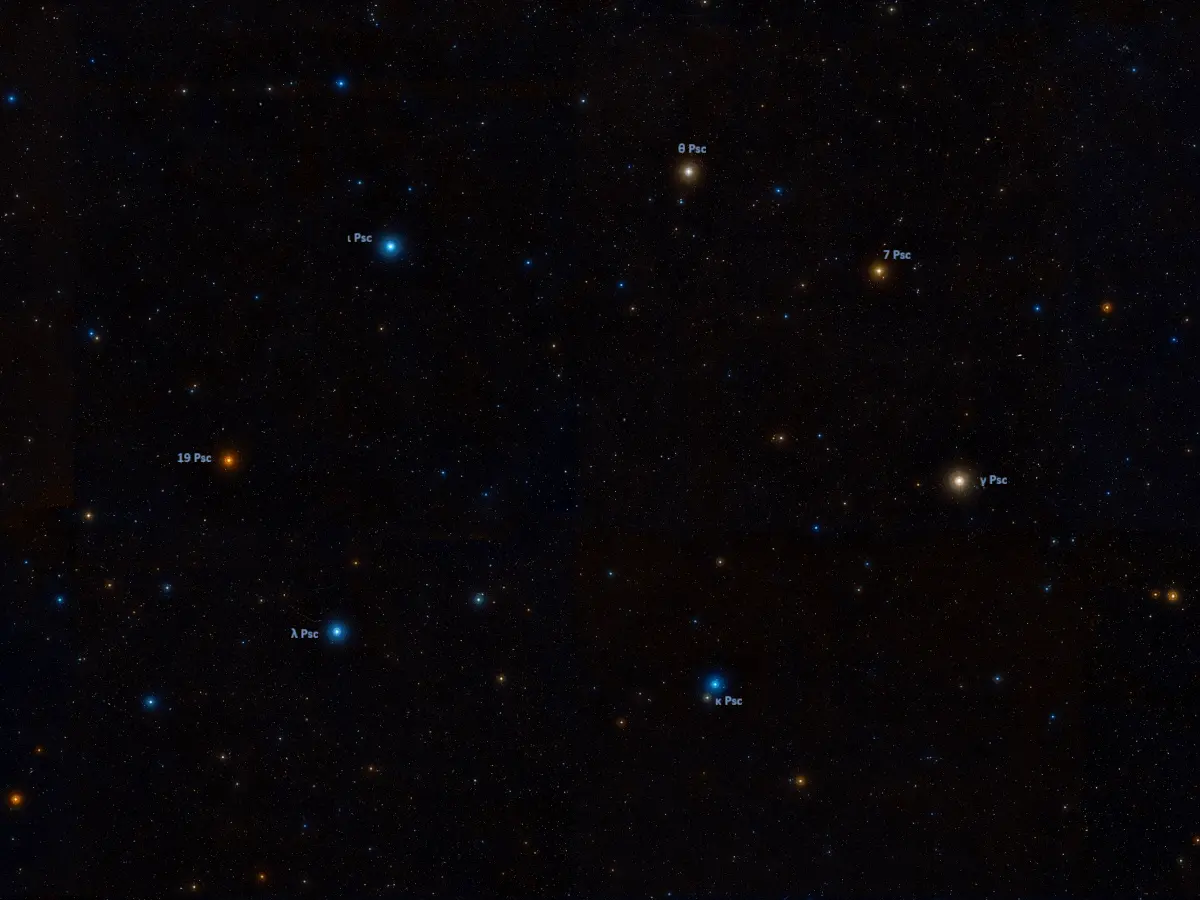
Circlet stars, image credit: ESO/Digitized Sky Survey 2 (CC BY 4.0)
Iota Piscium
Iota Piscium is a yellow-white main sequence star that shines at magnitude 4.13 from a distance of 44.73 light-years. It is the nearest of the seven Circlet stars. It has an estimated age of around 5.19 billion years.
The star is slightly larger and more massive than the Sun. It shows a far-infrared excess, indicating that it has an orbiting cold debris disk.
Theta Piscium
Theta Piscium is an orange giant located approximately 149 light years away. It has an apparent visual magnitude of 4.27. As it evolved away from the main sequence, the star has expanded to a size of 11 solar radii and is now 51.3 times more luminous than the Sun. It is much younger than the Sun, with an estimated age of 2.45 billion years.
Theta Piscium can be used to find the Pegasus I Cluster, a cluster of galaxies that appears northwest of the star. The cluster stretches across 6.3 degrees of the sky between the Circlet and the Great Square. It is dominated by the elliptical galaxies NGC 7626 and NGC 7619.

Theta Piscium and the Pegasus I Cluster, image credit: ESO/Digitized Sky Survey 2 (CC BY 4.0)
Lambda Piscium
Lambda Piscium is a white main sequence star located 106.6 light-years away. It has an apparent magnitude of 4.49. The star has 181% of the Sun’s mass and a radius double that of the Sun. It is much younger than our parent star, with an estimated age of 583 million years.
Lambda Piscium is a member of the Ursa Major moving group (the Ursa Major Stream), a stellar family whose core members include five of the seven bright stars that form the Big Dipper in Ursa Major.
Kappa Piscium
Kappa Piscium is a chemically peculiar A-type main sequence star located 153 light years away. It has an apparent magnitude of 4.94. The star has 2.62 times the Sun’s mass and shines with 30 solar luminosities. Even though it has already evolved away from the main sequence, it is still a very young star. It has an estimated age of only 157 million years.
Kappa Piscium is classified as an Alpha2 Canum Venaticorum variable. It is a candidate member of the AB Doradus moving group, a stellar association named after the young, pre-main-sequence quadruple star system AB Doradus.
TX Piscium
The variable carbon star TX Piscium is the most unusual of the Circlet stars. The pulsating evolved red giant is one of the reddest visible stars in the night sky. The star is classified as a slow irregular variable. It shines at magnitude 4.79 – 5.20 from an approximate distance of 800 light-years.
TX Piscium is by far the most distant of the seven stars of the Circlet, as well as the most luminous. It has an energy output over 7,000 times that of the Sun and a radius 295 times the Sun’s. If it replaced the Sun at the centre of our solar system, the star would engulf Earth.
7 Piscium
7 Piscium is a red clump giant of the spectral type K1 IV. It shines at magnitude of 5.069 from a distance of 343 light years.
The star is similar in age to the Sun, but it has burned through its supply of hydrogen faster due to its higher mass and evolved away from the main sequence. It is the second most distant and most luminous star of the Circlet. It shines with a luminosity of 163 Suns.

Circlet of Pisces, cropped from a photo of the constellation Pisces produced by NOIRLab in collaboration with Eckhard Slawik, a German astrophotographer. Credit: E. Slawik/NOIRLab/NSF/AURA/M. Zamani (CC BY 4.0)
Circlet of Pisces
| Star | Brightness (m) | Distance (ly) | Spectral class | Mass (M☉) | Radius (R☉) | Luminosity (L☉) | Age (Gyr) |
| γ Psc | 3.699 | 135 | G8 III | 0.97 | 11.28 | 62.7 | 12 |
| ι Psc | 4.13 | 44.73 | F7 V | 1.15 | 1.595 | 3.555 | 5.19 |
| θ Psc | 4.27 | 149 | K1 III | 1.58 | 11 | 51.3 | 2.45 |
| λ Psc | 4.49 | 106.6 | A7 V | 1.806 | 2.0403 | 13.3897 | 0.583 |
| κ Psc | 4.94 | 153 | A2 Vp SrCrSi | 2.62 | 1.71 | 30 | 0.157 |
| TX Psc | 4.79 – 5.20 | 800 | C7,2 | 1 – 3 | 295 | 7,019 – 7,876 | |
| 7 Psc | 5.069 | 343 | K1 IV | 1.37 | 22.06 | 163 | 4.58 |
Location
The Circlet of Pisces can be found using the brighter stars of the Great Square of Pegasus. The asterism appears just south of the imaginary line connecting Algenib and Markab in the Great Square. Fumalsamakah, the star marking the Fish’s mouth, can be found along the line extended from Scheat through Markab. The Circlet stars lie to the east.
The best time of the year to observe the stars and deep sky objects of Pisces is during the month of November, when the constellation appears higher above the horizon in the early evening.

Circlet of Pisces location, image: Stellarium