The Baby Eagle Nebula is a faint reflection nebula located approximately 457 light years away in the constellation Taurus (the Bull). The cloud of molecular gas and cosmic dust lies in the same area of the sky as the bright Pleiades. It is listed as LBN 777 in the Lynds’ Catalogue of Bright Nebulae. It is sometimes also called the Vulture Head Nebula.
The Baby Eagle is part of the Taurus Molecular Cloud, a large, dense giant molecular cloud in which new stars are being born. The large stellar nursery lies approximately 400 light-years away in the constellations Taurus and Auriga (the Charioteer).
The dense inner part of the Baby Eagle Nebula was catalogued as Barnard 207 (B207) by the American astronomer Edward Emerson Barnard in his catalogue of dark nebulae. It was later added to his A Photographic Atlas of Selected Regions of the Milky Way (1927). The dark core of the nebula is surrounded by a bright rim.
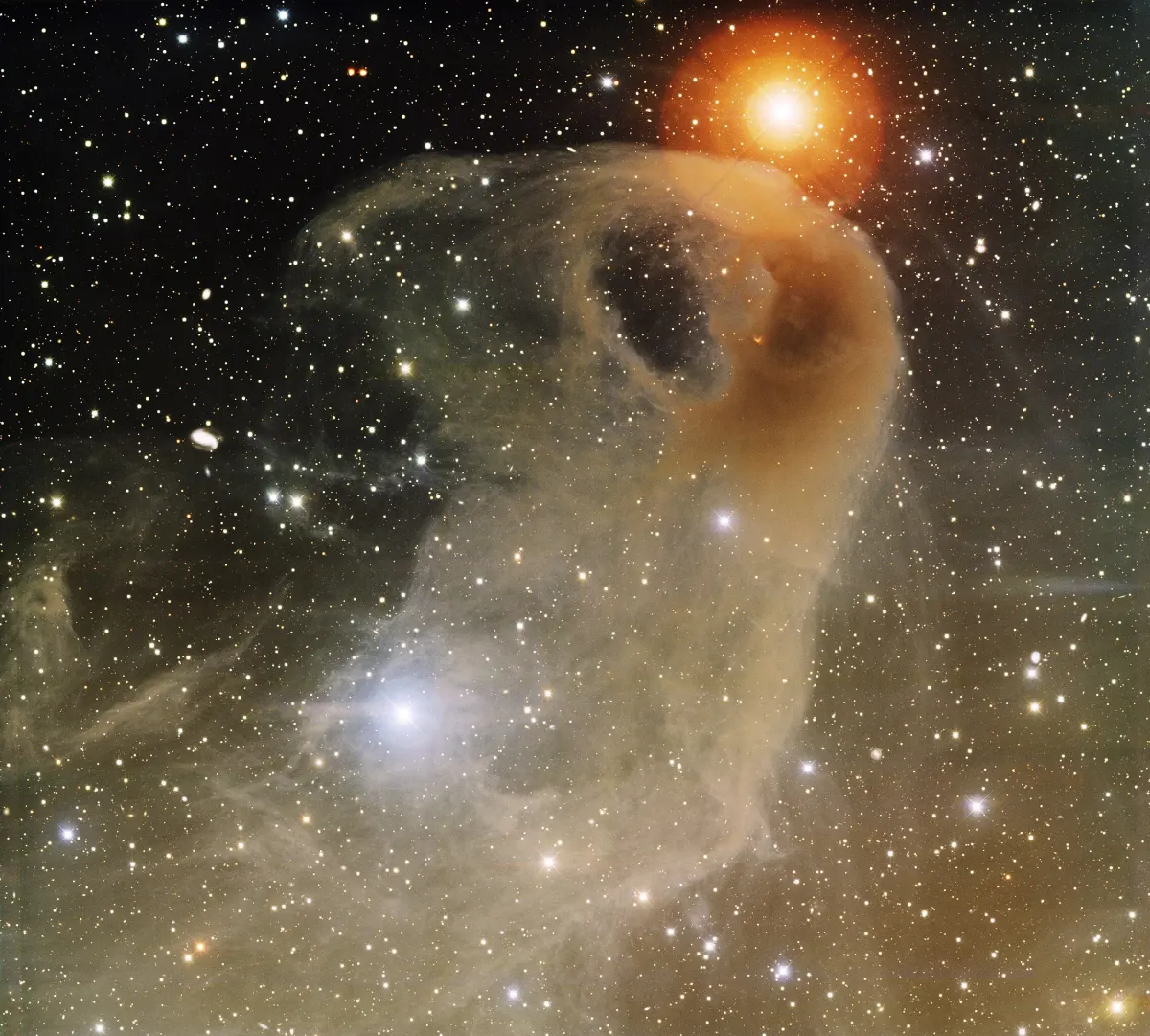
This image of the Baby Eagle Nebula was obtained with the wide-field view of the Mosaic camera on the Mayall 4-meter telescope at Kitt Peak National Observatory. LBN 777 is a portion of the large cloud of dust and gas known as the Taurus Molecular Cloud. The brownish color is caused by large dust grains embedded in the gas. The dust reflects the light of the stars inside and near the nebula. The image was generated with observations in B (blue), V (green) and I (red) filters. In this image, North is down, East is to the right. Image credit: T.A. Rector (University of Alaska Anchorage) and H. Schweiker (WIYN and NOIRLab/NSF/AURA) (CC BY 4.0)
American astronomer Beverly Turner Lynds included the dark part of the nebula as LDN 1489 in her Catalogue of Dark Nebulae of 1962. In 1965, she listed the bright portion of the Baby Eagle as LBN 777 in her Catalogue of Bright Nebulae.
The nebula contains a protostar catalogued as IRAS 04016+2610. The young stellar object has a mass of 1.6 solar masses. It is forming at the west side of the dark nebula’s core. It lies about 8,400 astronomical units (AU) from the dense core.
IRAS 04016+2610 is a Class I protostar. It is still gathering gas and dust from its surrounding birth cloud. It cannot be seen optically because it is still embedded in thick dust and gas clouds.
The presence of the young protostar gives the cloud an estimated age of only several hundred thousand years. A 2017 study found a total mass of around 17 solar masses for B207 and dust temperature of only 11 K at the core.
Barnard 207 is a Bok globule, a small dark nebula composed of dense dust and gas where young stars may form. Bok globules are commonly found in H II regions. They typically produce double and multiple star systems. If they are eroded by the intense ultraviolet light from luminous nearby stars, some of their material is stripped to produce a tail. These Bok globules are called cometary globules. The Baby Eaglet is one such globule.
Astronomers have detected three streamers – tail structures – near the protoplanetary disk of IRAS 04016+2610. Two of these are around 1,400 astronomical units long, while one stretches at least 3,000 AU in length.
The young star contains three nested disks. The inner disk has a radius of 15 AU, the intermediate one 200 AU, and the outermost disk extends to 600 astronomical units. The disks are embedded in a molecular envelope around 5,000 AU across.
The longest of the three streamers is linked with the external warped disk. It is believed to connect the young stellar object with the core of LDN 1489, which feeds material to the disk. The infall of material is believed to be responsible for the formation of the warped disk. The infant star may have migrated from the core and its disk is still being fed by it through a gas bridge.
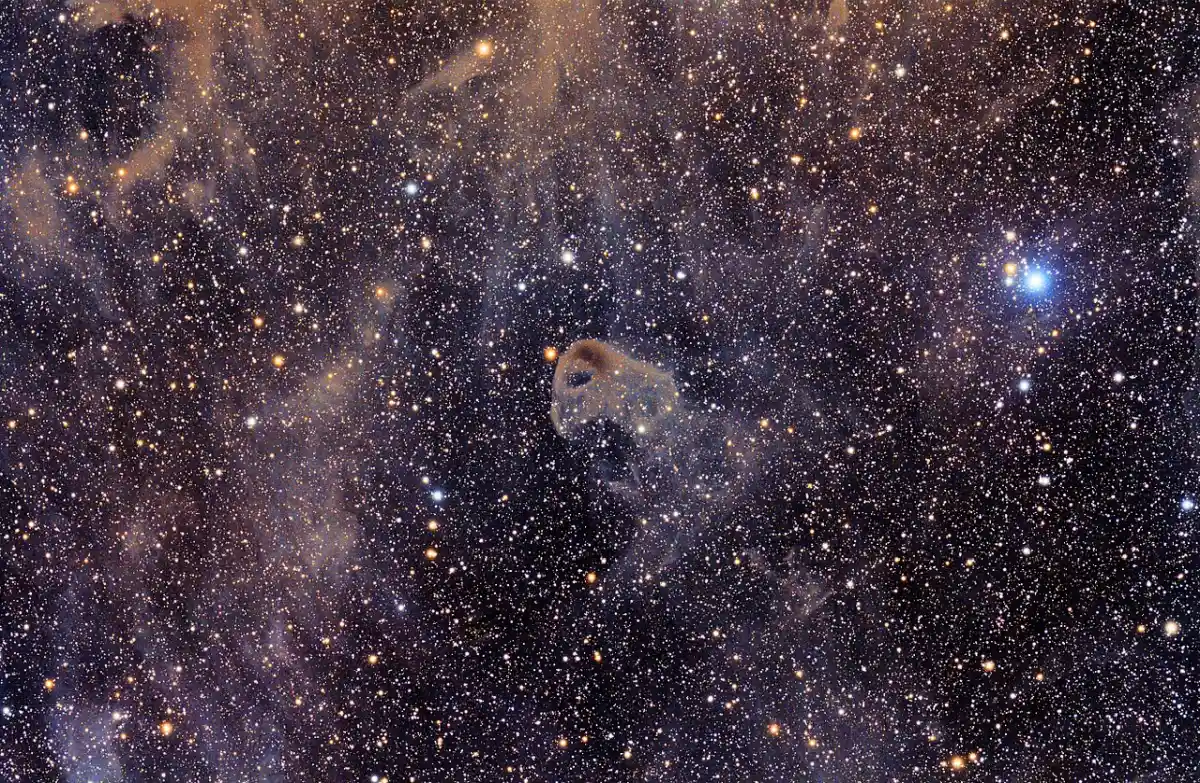
The Baby Eagle is “looking” at the Seven sisters of the Plejades (M45) just outside this field of view at the lower-left corner. The dark dusty nebulosity is enhanced by the 10 hour exposure time. Esprit 100 f5.5 APO refractor/ Canon 6Da/ Optolong L filter. 20×120 iso 400, 78×300 and 44×240 iso1600. Stacked in DSS (2 stacks) and processed in Pixinsight (with HDR composition). Image credit: Kees Scherer (CC BY-SA 4.0)
Location
The Baby Eagle Nebula appears 4.5 degrees northeast of the Pleiades cluster (Messier 45) in Taurus. The nebula is very faint and cannot be observed in a telescope. It can only be seen in long-exposure photographs.
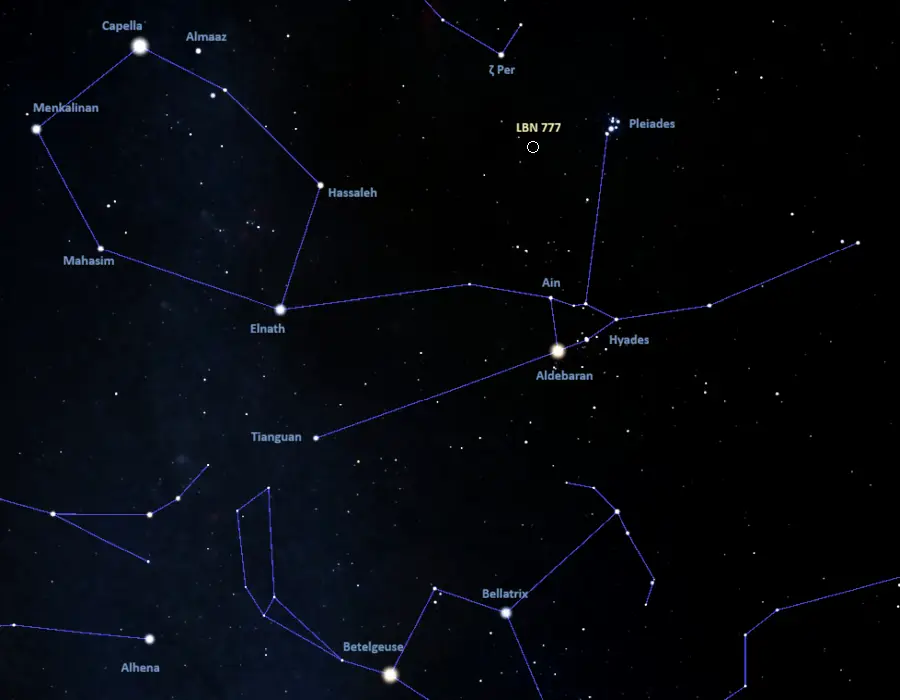
Location of the Baby Eagle Nebula (LBN 777), image: Stellarium
Baby Eagle Nebula – LBN 777
| Constellation | Taurus |
| Object type | Reflection nebula |
| Right ascension | 04h 05m 00.0s |
| Declination | +26° 24′ 00″ |
| Distance | 457 light-years (140 parsecs) |
| Names and designations | Baby Eagle Nebula, Vulture Head Nebula, LBN 777, LBN 168.10-19.04, DG 26 |