NGC 925 is a bright barred spiral galaxy located approximately 30.3 million light years away in the northern constellation Triangulum. It is popularly known as the Amatha Galaxy. With an apparent magnitude of 10.7 and an apparent size of 10.5 by 5.9 arcminutes, it can be observed in amateur telescopes.
The Amatha Galaxy is inclined 55 degrees to our line of sight, similar to the brighter and better-known Triangulum Galaxy (54°). The proximity of NGC 925 has made it possible for astronomers to resolve stars in the galaxy’s bar with deep imaging.
NGC 925 has a physical optical radius of 14.15 kiloparsecs (46,151 ly). It has the morphological type SB(s)d, indicating loosely wound spiral arms and the presence of a central bar structure. The galaxy’s southern spiral arm is longer and more prominent than the northern one, which appears flocculent and patchy.
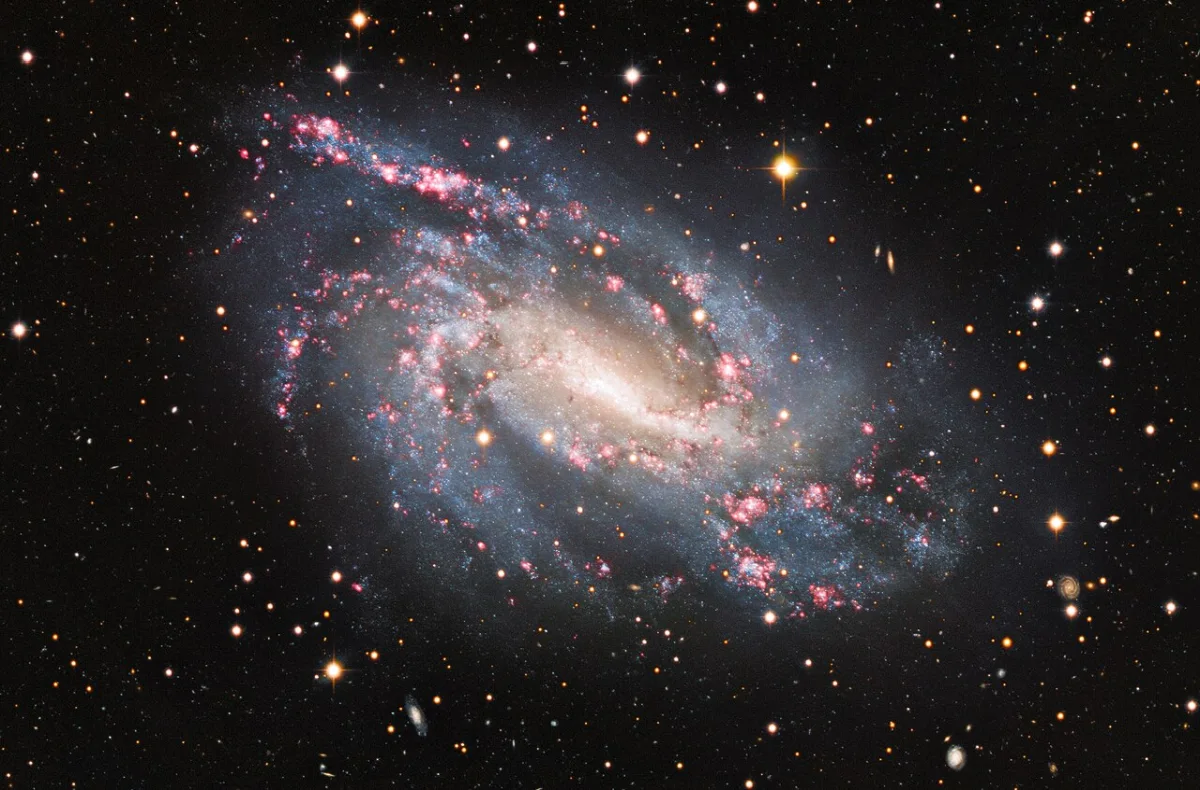
The spiral galaxy NGC 925 reveals cosmic pyrotechnics in its spiral arms where bursts of star formation are taking place in the red, glowing clouds scattered throughout it. Credit: KPNO/NOIRLab/NSF/AURA; Acknowledgements: PI: M T. Patterson (New Mexico State University); Image processing: Travis Rector (University of Alaska Anchorage), Mahdi Zamani & Davide de Martin (CC BY 4.0)
The galactic bar of NGC 925 is a site of intense star formation. It appears offset from the galaxy’s centre. The offset bar and a dominant spiral arm are typically found in Magellanic spiral galaxies.
The spiral arms and the central bar of the Amatha Galaxy host numerous H II regions. In 2025, astronomers detected a low-surface brightness clump in the southwestern portion of the galaxy and found a gas bridge linking the stellar overdensity with the main galaxy. However, they could not confirm that this was a smaller neighbouring galaxy.
In 1998, Pisano et al. reported the presence of an H I cloud linked to the galaxy by a streamer. The cloud may be tidal in origin – the result of interaction with another galaxy – or it may be composed of primordial gas. It may be debris from an encounter in the distant past or a remnant of a dwarf galaxy.
The Amatha Galaxy is a member of the NGC 1023 Group, a group of galaxies centred on the Perseus Lenticular Galaxy (NGC 1023) in the constellation Perseus. The group is located in the Local Supercluster. NGC 925 is the second brightest member of the group, after NGC 1023. Other bright members include the spiral galaxies NGC 959 in Triangulum, NGC 1058 and NGC 1003 in Perseus, and the Silver Sliver Galaxy (Caldwell 23, NGC 891) and IC 239 in Andromeda. The nearest group member lies at least 650,000 light-years from NGC 925.
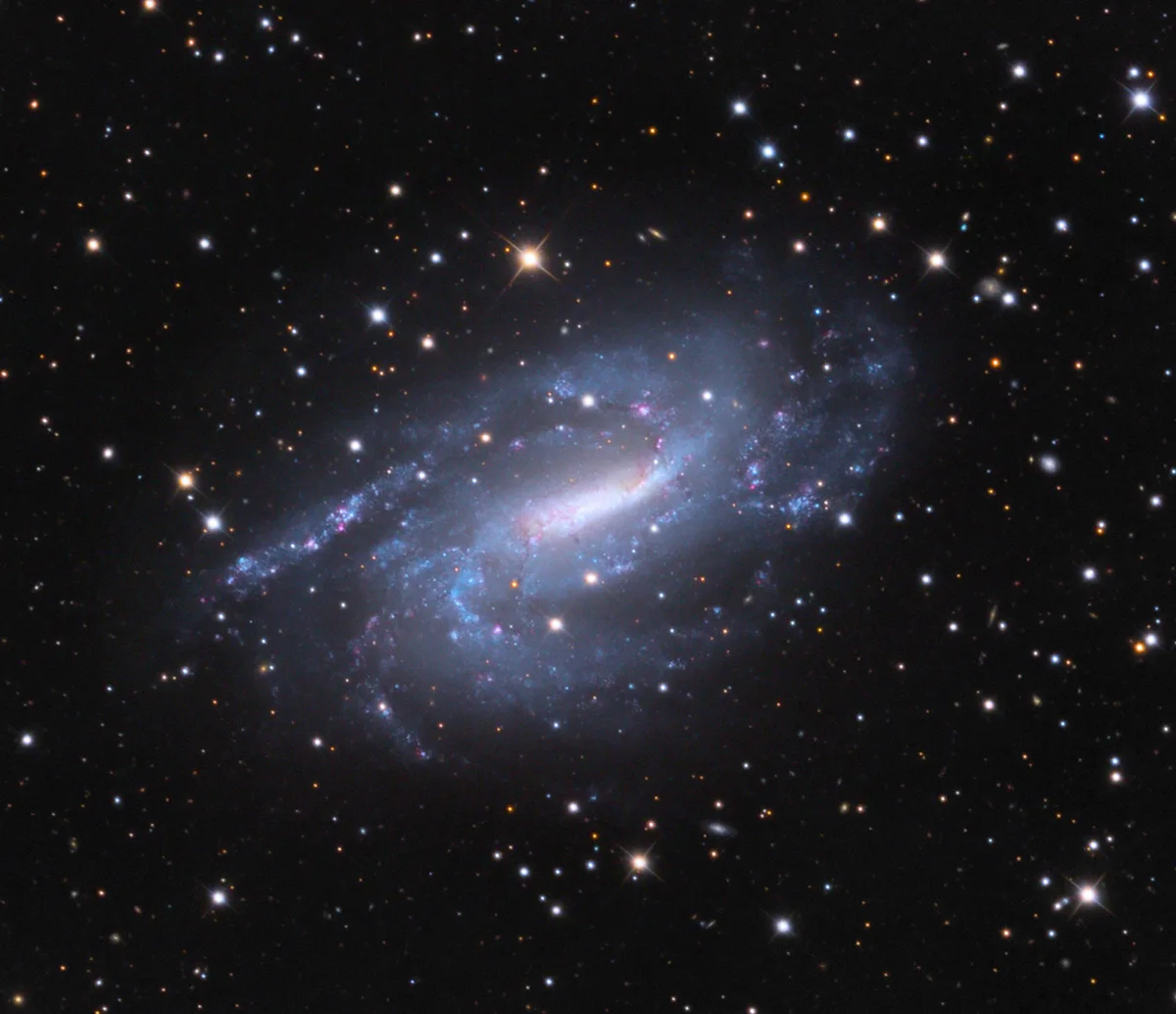
NGC 925, image credit: Adam Block/Mount Lemmon SkyCenter/University of Arizona (CC BY-SA 4.0)
Facts
NGC 925 was discovered by the German-born British astronomer William Herschel on September 13, 1784. Herschel spotted the galaxy in his 18.7-inch reflector and catalogued it as III 177. He assigned it the Class III, indicating a very faint nebula, and noted, “Very faint, considerably large, irregularly round, resolvable, 2 or 3′ in diameter.”
Danish astronomer John Louis Emil Dreyer included the object as NGC 925 in his New General Catalogue of 1888.
NGC 925 hosted a luminous red nova, AT 2023nzt, discovered on July 26, 2023. The nova shone at magnitude 19. It was detected by the Asteroid Terrestrial-impact Last Alert System (ATLAS) survey as a faint transient in the outskirts of the galaxy. It reached a peak absolute magnitude of -11.5.
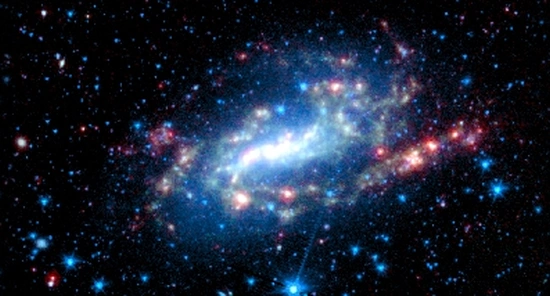
Infrared view of NGC 925 by the Spitzer telescope, image: NASA/JPL-Caltech/K. Gordon (Space Telescope Science Institute) and SINGS Team (PD)
How to find NGC 925
NGC 925 is easy to find on a clear night. It lies next to the familiar constellation figure of the Triangle (Triangulum), a little less than a third of the way from Mirfak, the brightest star in Perseus, to Hamal, the lucida of Aries.
The Amatha Galaxy appears near Gamma Trianguli (Apdu), a magnitude 4.01 star that forms Triangulum’s elongated constellation figure with the brighter Beta Trianguli (Alaybasan) and Mothallah (Alpha Trianguli).
NGC 925 has a low surface brightness, but it can be spotted in medium and larger telescopes. A 10-inch telescope will reveal an elongated patch of light, and larger instruments will show more of the galaxy’s details.
The Triangulum constellation lies between the bright Mirach and Almach in Andromeda and the flat triangle formed by Hamal, Sheratan and Mesarthim in Aries. Gamma Trianguli is the southern of the two stars that form the base of the triangle asterism that makes the constellation recognizable.
At declination +33° 35′, NGC 925 is best seen from the northern hemisphere. It never rises above the horizon for observers south of the latitude 56° S.
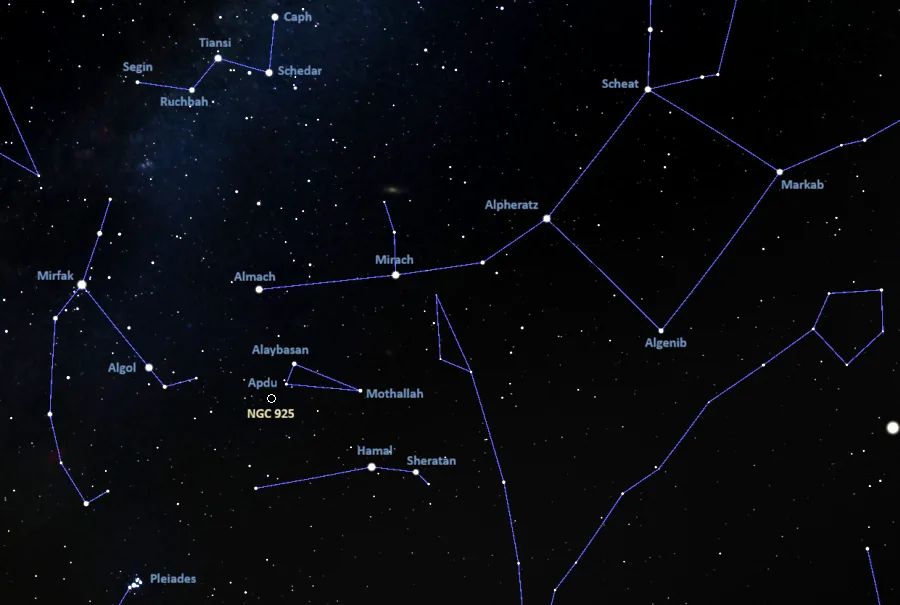
NGC 925 location, image: Stellarium
Amatha Galaxy – NGC 925
| Constellation | Triangulum |
| Object type | Barred spiral galaxy |
| Morphological type | SB(s)d |
| Right ascension | 02h 27m 16.913s |
| Declination | +33° 34′ 43.97″ |
| Apparent magnitude | 10.7 |
| Apparent size | 10′.5 × 5′.9 |
| Distance | 30.3 ± 2.3 million light years (9.29 ± 0.69 megaparsecs) |
| Redshift | 0.001846 ± 0.000010 |
| Heliocentric radial velocity | 553 ± 3 km/s |
| Names and designations | Amatha Galaxy, NGC 925, LEDA 9332, PGC 9332, UGC 1913, MCG +05-06-045, CGCG 504-085, TC 650, IRAS 02243+3321, IRAS F02242+3321, 2MASX J02271691+3334439, K73 105, KUG 0224+333, PSCz Q02243+3321, QDOT B0224203+332106, RX J0227.4+3334, UZC J022717.0+333443, [TT2009] 3, [VDD93] 16, [BTW2003] J0227+3334, Z 504-85, Z 0224.3+3321, [CHM2007] HDC 155 J022716.91+3334439, [CHM2007] LDC 160 J022716.91+3334439, [M98c] 022416.8+332115 |