NGC 1365 is a barred spiral galaxy located in Fornax constellation. It has an apparent visual magnitude of 10.3 and is approximately 56.2 million light years distant from the Sun.
The giant Seyfert-type galaxy is also known as PGC 13179, or the Great Barred Spiral Galaxy. It is the largest spiral galaxy in Fornax and may be the most prominent barred spiral galaxy in the night sky. Continue reading “NGC 1365: The Great Barred Spiral Galaxy”
NGC 6872 is a massive barred spiral galaxy in Pavo constellation. It has an apparent visual magnitude of 12.7 and is approximately 220 million light years distant from Earth.
The galaxy is currently in the process of interacting with a lenticular galaxy, IC 4970. The smaller IC 4970 – only a fifth the size of its larger neighbour – has an apparent magnitude of 14.7. It is located 1.1 arcminutes to the north of NGC 6872. Continue reading “NGC 6872: Spiral Galaxy in Pavo”
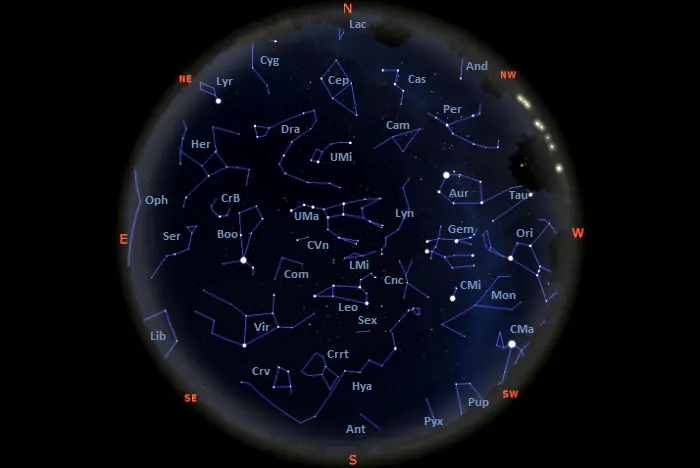
Here are some of the highlights of the sky in May:
9 PM – Jupiter rises in the western sky
9 PM – Mercury, Jupiter and Venus in the western sky toward the end of the month
9:30 PM – Saturn rising in the southeastern sky just after sunset and moving to the west before sunrise
10 PM – Virgo constellation in the southern sky in the late evening – notable deep sky objects include the Virgo Cluster of galaxies and the famous Sombrero Galaxy (Messier 104)
10 PM – constellations Coma Berenices with the spiral galaxy Messier 64 in the southern sky above Virgo and Canes Venatici in the southeastern sky, with the bright star Cor Caroli and the famous face-on spiral galaxy Messier 51 (the Whirlpool Galaxy)
3 AM – the Eta Aquarid meteor show in the direction of Aquarius constellation, peaking on the night of May 5-6 with up to 10 meteors per hour shooting from the east after midnight
May 10 – an annular solar eclipse visible in Northern Australia and the central Pacific Ocean
May 24 – a penumbral lunar eclipse visible in most of North & South America, western Europe, and western Africa
Here are the highlights of the night sky in April:
9 PM, western sky – Jupiter rising over the western horizon
10 PM, eastern sky – Saturn rises in the eastern sky and stays visible in the south-east throughout the night
10 PM, northern sky – Ursa Major constellation and the Big Dipper asterism are visible, with the pointer stars showing the way to Polaris, the North Star in Ursa Minor
the double stars Mizar and Alcor in Ursa Major that can be seen without binoculars
the spiral galaxy Messier 81 (Bode’s Galaxy) and starburst galaxy Messier 82 (Cigar Galaxy) in Ursa Major
10 PM, southern sky – Leo constellation with the bright stars Denebola and Regulus and the Leo Triplet of galaxies (Messier 65, Messier 66 and NGC 3628), easily visible in a telescope
the pair of large spiral galaxies Messier 95 and Messier 96 in Leo
three pairs of bright stars between Leo and Ursa Major known as the Three Leaps of the Gazelle, also representing the bear’s paws
2 AM, eastern sky – Lyrid meteor shower in the direction of Lyra constellation, with up to 20 meteors per hour, best seen on April 22
April 25 – partial lunar eclipse visible in most of Africa, Europe, Asia and Australia