NGC 2207 and IC 2163 are a pair of interacting galaxies located approximately 114 million light years away in the southern constellation Canis Major (the Great Dog). Popularly known as the Cosmic Owl, the two face-on spiral galaxies are in an early stage of a merger. They will eventually come together to form a single larger galaxy.
The interacting pair is beginning to show higher rates of star formation as the galaxies move closer to each other. Young starburst regions appear as bright dots in long-exposure images. As the galaxies continue to pass close to each and eventually collide, tidal interactions will completely reshape their disks.
NGC 2207 and IC 2163 are still two separate spiral galaxies. The larger NGC 2207 is classified as an intermediate spiral galaxy and its smaller companion IC 2163 as a barred spiral. They are gravitationally disrupting each other but have not fully collided yet.
NGC 2207 was discovered by John Herschel on January 24, 1835. The English astronomer described the galaxy as pretty bright and large, elongated and brightening towards the centre. He did not record its smaller companion. IC 2163 was discovered half a century later. American astronomer Herbert Howe spotted it on February 11, 1898.
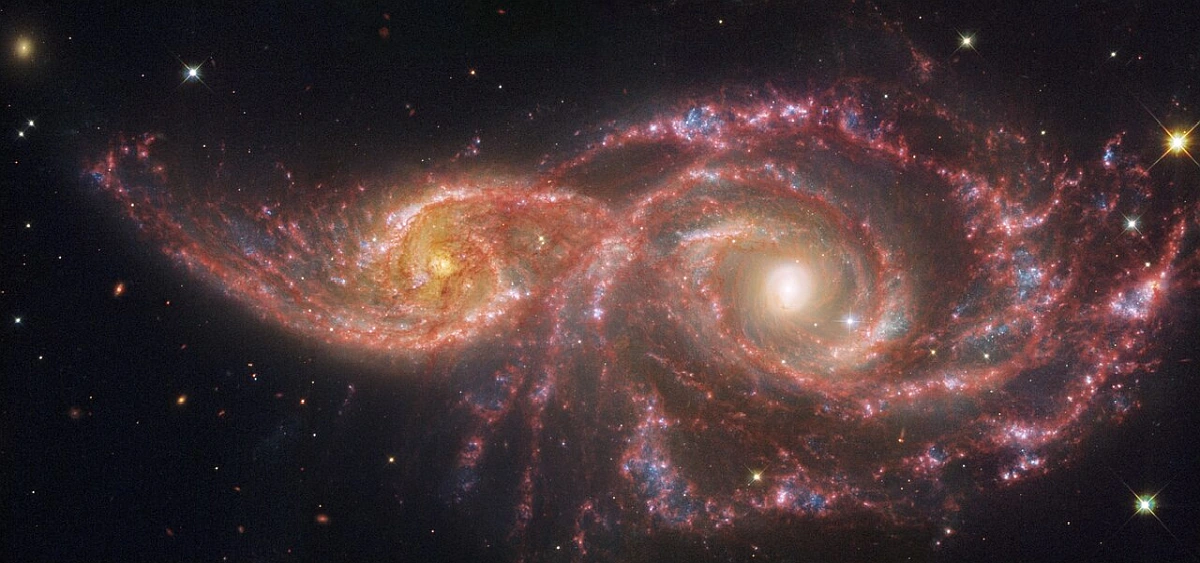
The gruesome palette of these galaxies is owed to a mix of mid-infrared light from the NASA/ESA/CSA James Webb Space Telescope, and visible and ultraviolet light from the NASA/ESA Hubble Space Telescope. The pair grazed one another millions of years ago. The smaller spiral on the left, catalogued as IC 2163, passed behind NGC 2207, the larger spiral galaxy at right. Both have increased star formation rates. Combined, they are estimated to form the equivalent of two dozen new stars that are the size of the Sun annually. Our Milky Way galaxy forms the equivalent of two or three new Sun-like stars per year. Both galaxies have hosted seven known supernovae, each of which may have cleared space in their arms, rearranging gas and dust that later cooled, and allowed many new stars to form. Find these areas by looking for the bluest regions. Image credit: NASA, ESA, CSA, STScI (CC BY-SA 3.0 IGO)
Structure and physical properties
NGC 2207 is the larger of the two galaxies. It is about 123,400 light-years across and has an angular size of 4.3 by 2.8 arcminutes. Shining at magnitude 12.2, it is fainter than its smaller neighbour. The morphological type SAB(rs)bc pec indicates a peculiar galaxy with a weak ring structure around the central bar.
IC 2163 has a diameter of 87,650 light-years and an apparent size of 3 by 1.2 arcminutes. It has an apparent visual magnitude of 11.6. The smaller barred spiral galaxy was given the morphological type SB(rs)c. It has an elongated spiral arm that has been stretched out by the strong tidal forces as a result of the close encounter with the larger NGC 2207. Like its companion, it has a weak inner ring.
Both galaxies are listed as active galaxy nucleus (AGN) candidates in the Sumbad database. They have vast reservoirs of gas and dust. The strong emissions from their bright cores are powered by the accretion of this material onto the galaxies’ central massive black holes.
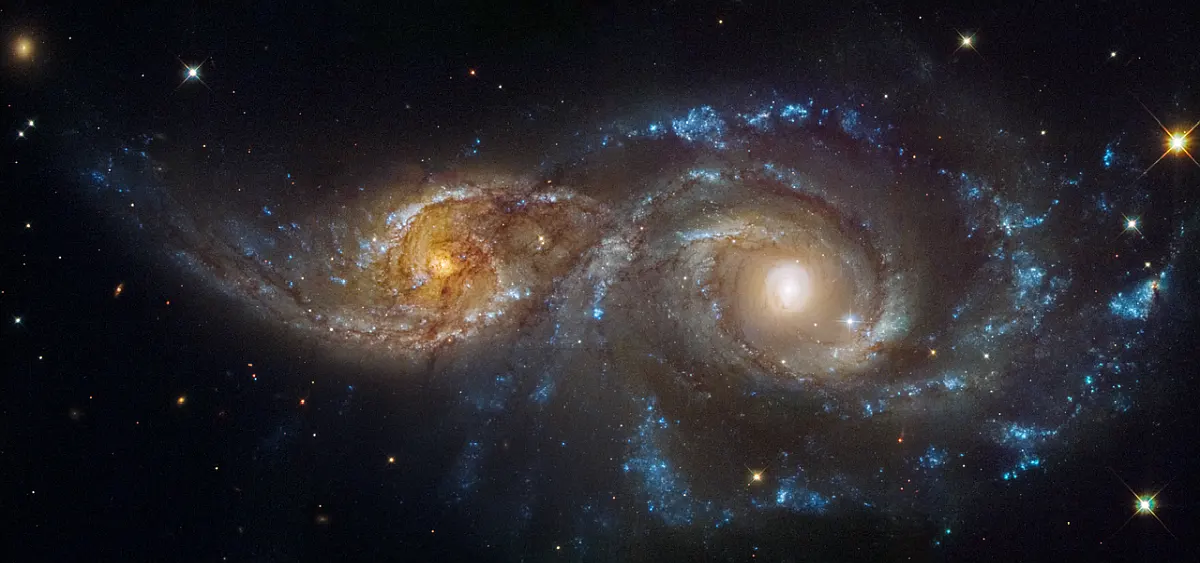
View of two overlapping spiral galaxies, IC 2163 and NGC 2207, seen by Hubble. Image credit: NASA, ESA, CSA, STScI (PD)
Galactic collision
Galactic collisions like the Cosmic Owl make fertile ground for new star formation. The gravitational forces and interaction of gas clouds in the two galaxies result in gas being compressed and material collapsing to form protostars.
Unlike the more famous colliding pairs known as the Antennae Galaxies (NGC 4038 and NGC 4039) in Corvus and the Mice Galaxies (NGC 4676) in Coma Berenices, NGC 2207 and IC 2163 have not yet merged. They are gravitationally bound to each other but will have to make several more close passes before they merge into a single larger elliptical galaxy.
The larger NGC 2207 is tidally stripping its smaller companion. It is pulling stars, gas and dark matter from IC 2163. The process will ultimately transform the smaller galaxy’s morphology, creating tidal tails and diffuse light around the galaxies.
The gravitational interaction from the first grazing passage of the smaller galaxy near the larger one has drawn out stellar streams and triggered bursts of star formation in both galaxies. The rate of star formation in the galactic pair is about a dozen times greater than that in our own Milky Way. The smaller IC 2163 will eventually be pulled back towards NGC 2207, and the galaxies will continue to disrupt each other as their mutual orbit gets smaller.
As a result of the encounter, the larger NGC 2207 has several extended tidal structures and a mini-starburst in its western spiral arm, while IC 2163 has long tidal arms and a large “eyelid” structure that formed when a tidal wave sent its gas and stars crashing through the galactic disk. The gravitational forces of NGC 2207 pulled the material outward into two tidal tails a hundred thousand light years long. At the same time, material from the smaller galaxy’s outer disk rushed inwards toward the centre at velocities of around 100 km/s.
The two bright curves of material that form the “eye” of IC 2163 are waves of stars and gas moving through the galaxy’s disk. The structure will only last for several tens of millions of years, and the two galaxies are expected to merge in about a billion years.
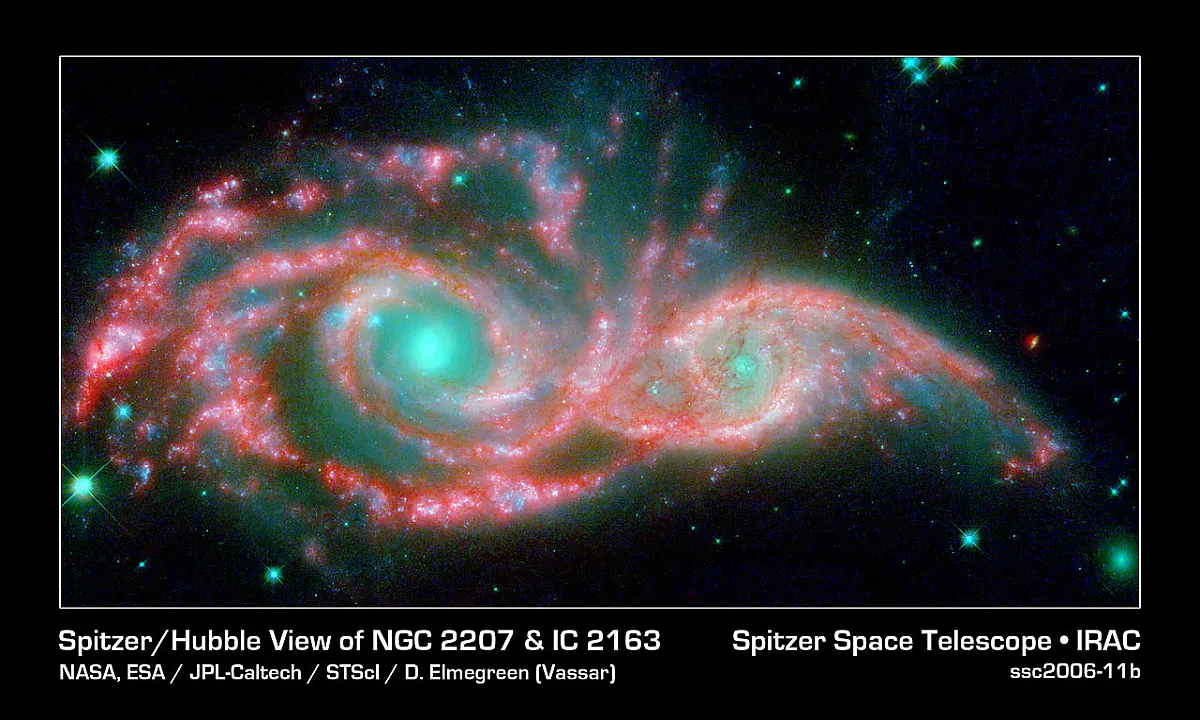
These shape-shifting galaxies have taken on the form of a giant mask. The icy blue eyes are actually the cores of two merging galaxies, called NGC 2207 and IC 2163, and the mask is their spiral arms. The false-colored image consists of infrared data from NASA’s Spitzer Space Telescope (red) and visible data from NASA’s Hubble Space Telescope (blue/green). The two galaxies are tugging at each other, stimulating new stars to form. Eventually, this cosmic ball will come to an end, when the galaxies meld into one. The infrared data from Spitzer highlight the galaxies’ dusty regions, while the visible data from Hubble indicates starlight. Image credit: NASA, ESA/JPL-Caltech/STScI/D. Elmegreen (Vassar) (PD)
Observations with space telescopes
Hubble famously photographed the Cosmic Owl in 1999. Released in 2000, the Hubble image of the colliding pair showed star formation regions, dust structures, and other evidence of the close encounter between the galaxies. It revealed the bright oval starburst ridge along the regions where the gas moving inwards rebounded, and the outflowing gas and dust filaments that become increasingly thicker in the region where the gas meets the tidal arm.
The observations showed the pair in a near-encounter that has left both galaxies warped or compressed. Astronomers proposed that the galaxies started interacting around 40 million years ago, which would explain why their spiral arms were not more visibly affected, but only distorted. More recent models show that the closest interaction occurred around 240 million years ago.
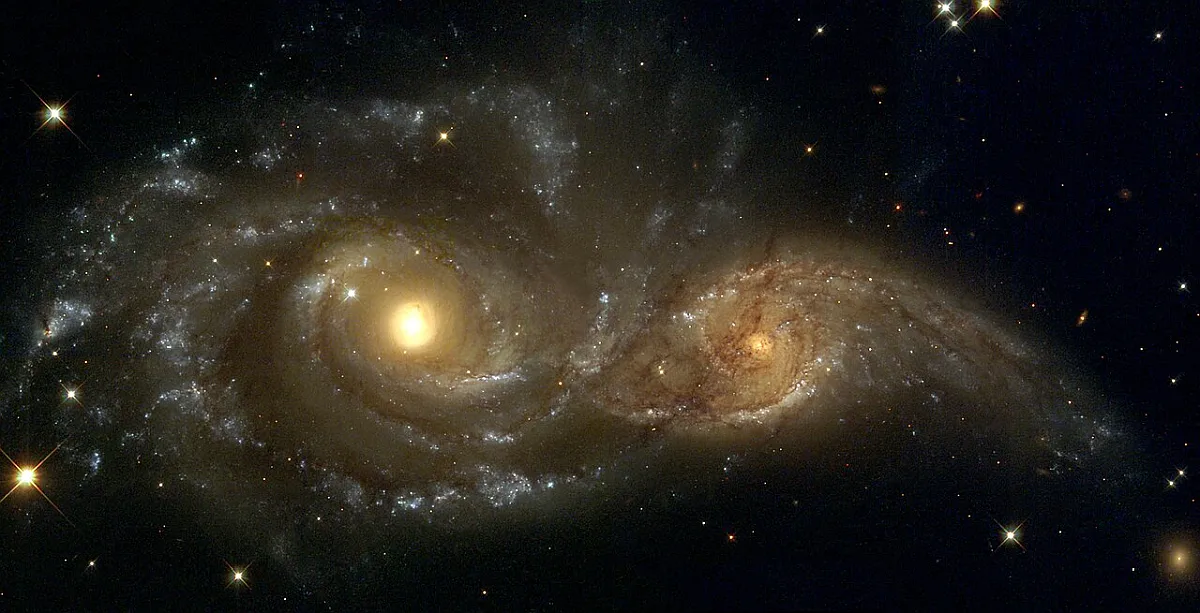
Near colliding NGC 2207 and IC 2163 as seen by the NASA/ESA Hubble Space Telescope. Credit: NASA/ESA and The Hubble Heritage Team (STScI) (PD)
Data obtained with the Spitzer Space Telescope in 2006 showed the dusty regions in the galaxies, glowing bright in infrared.
The Chandra X-ray Observatory detected many ultraluminous X-ray sources (ULXs) in NGC 2207 and IC 2163. Appearing as bright lights to Chandra’s X-ray eye, these sources are believed to be X-ray binary systems. An X-ray binary is composed of a star in a close orbit around a neutron star or black hole.
Neutron stars and stellar-mass black holes are remnants of massive stars that ended their lives as supernovae. These dense, massive objects continually pull material from their orbiting companions. As the material falls toward the remnant, it is heated to millions of degrees and produces X-rays. In 2014, researchers identified 28 ULXs using Chandra.
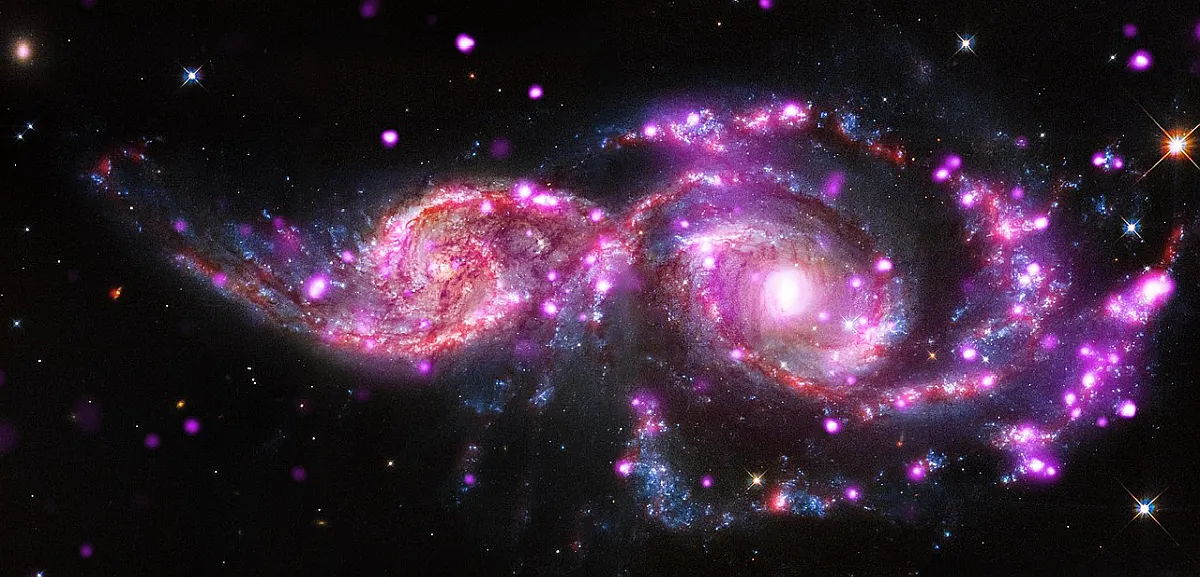
As in our Milky Way galaxy, NGC 2207 and IC 2163 are sprinkled with many star systems known as X-ray binaries, which consist of a star in a tight orbit around either a neutron star or a “stellar-mass” black hole. The strong gravity of the neutron star or black hole pulls matter from the companion star. As this matter falls toward the neutron star or black hole, it is heated to millions of degrees and generates X-rays. ULXs have far brighter X-rays than most “normal” X-ray binaries. The true nature of ULXs is still debated, but they are likely a peculiar type of X-ray binary. The black holes in some ULXs may be heavier than stellar mass black holes and could represent a hypothesized, but as yet unconfirmed, intermediate-mass category of black holes. This composite image of NGC 2207 and IC 2163 contains Chandra data in pink, optical light data from the Hubble Space Telescope in red, green, and blue (appearing as blue, white, orange, and brown), and infrared data from the Spitzer Space Telescope in red. Image credit – X-ray: NASA/CXC/SAO/S.Mineo et al, Optical: NASA/STScI, Infrared: NASA/JPL-Caltech (PD)
In 2017, observations with the Atacama Large Millimeter Array (ALMA) found the maximum age of new star complexes in the shock front region of IC 2163 to be about 200 million years. The estimate corresponds to the time of the closest approach between the two galaxies. Star clusters in other parts of the galactic pair were found to have ages from less than 1 million years to almost 10 billion years.
Using ALMA, astronomers found more than 300 molecular clouds with masses of a million solar masses. The most massive of these were detected in the eyelid regions. Some of these regions later turned out to be false detections.
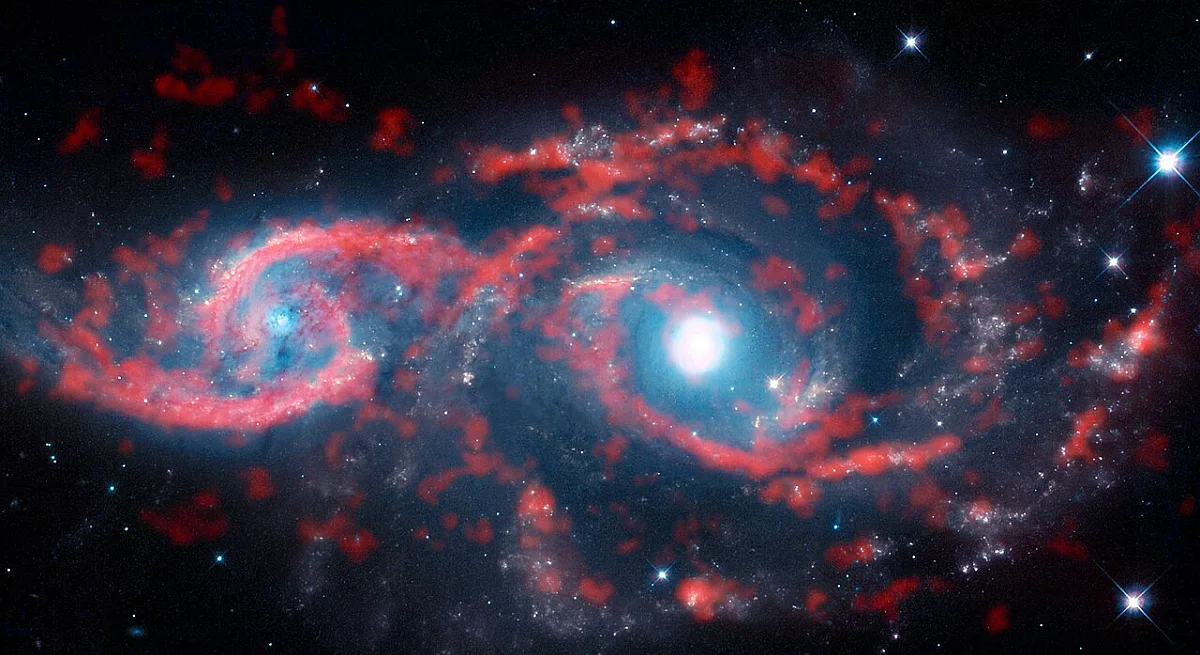
Astronomers spend their time gazing out into the Universe — and occasionally the Universe seems to peer right back! This image, a composite of data from the Atacama Large Millimeter/submillimeter Array (ALMA) and the NASA/ESA Hubble Space Telescope, shows a very rare cosmic sight: a pair of interacting galaxies that have taken on an ocular structure. As the name suggests, some types of grazing encounters between galaxies create shapes that resemble the human eye. While galaxy collisions of this type are not uncommon, only a few galaxies with eye-like, or ocular, structures have been observed. The paucity of these features is likely due to their very ephemeral nature — ocular structures like these tend to only last for several tens of millions of years, which is merely the blink of an eye in a galactic lifetime. These two galaxies are named IC 2163 (left) and NGC 2207 (right) — IC 2163 displays the ocular structure in this image. The duo lies approximately 114 million light-years from Earth in the direction of the constellation of Canis Major (The Greater Dog). The galaxies have brushed past each other — scraping the outer edges of their spiral arms —with IC 2163 passing behind NGC 2207. This glancing collision triggered a tsunami of stars and gas in IC 2163, with material in the outer portions of the disc of the galaxy travelling inwards. This colossal wave of material decelerated rapidly moving from the outer to the inner edge of the eyelids and crashed midway through the galaxy’s disc, producing dazzling ribbons of intense star formation and compressed ridges of gas and dust that resemble a pair of cosmic “eyelids”. Image credit: ALMA (ESO/NAOJ/NRAO)/M. Kaufman (CC BY 4.0)
In 2025, the number of detected H II region complexes grew to a total of 1,152 when a team of researchers analyzed imaging data obtained with the Fourier Transform Spectrometer SITELLE on the Canada-France-Hawaii Telescope. 240 of these star formation complexes were found in the overlap zone, where NGC 2207 intersects IC 2163’s eyelids.
The astronomers also identified two dwarf elliptical galaxies involved in the interaction: one at the tip of IC 2163’s tidal tail and another about 45 kpc from the centre of NGC 2207. The dwarf galaxies were found to have similar systemic velocities as the larger galaxies.
NGC 2207 and IC 2163 were photographed by the James Webb Space Telescope (JWST) in 2024. Webb’s MIRI (Mid-Infrared Camera) captured regions of cold dust in both galaxies and peered through the dust to show the embedded young star clusters. Webb also caught the bright starburst region in NGC 2207, as well as many distant quasars that appear as pink dots in the MIRI image.
The high starburst activity in NGC 2207 and IC 2163 has led to an increased rate of supernovae observed in the system. Astronomers reported seven supernovae in the galaxies. Five of these – SN 1975A, SN 1999ec, SN 2003H, SN 2013ai, and AT 2019eez (ASASSN-19kz) – were discovered in NGC 2207. One (SN 2018lab) was detected in IC 2163, and one (SN 2010jp) was observed on the outskirts of the galaxies.
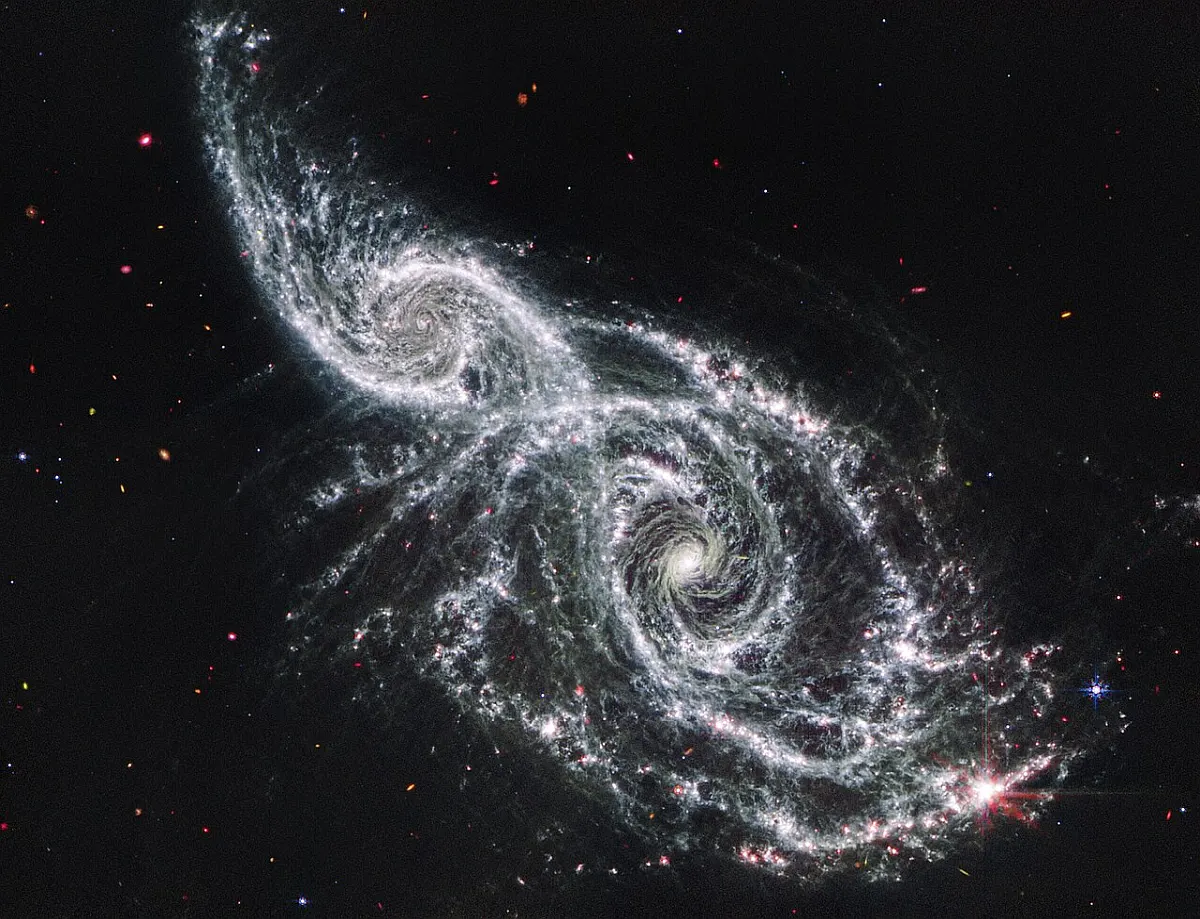
The James Webb Space Telescope’s mid-infrared image of galaxies IC 2163 and NGC 2207 recalls the iciness of long-dead bones mixed with eerie vapours. Two large luminous ‘eyes’ lie at the galaxies’ cores, and gauzy spiral arms reach out into the vast distances of space.Webb’s mid-infrared image excels at showing where the cold dust glows throughout these galaxies — and helps pinpoint where stars and star clusters are buried within the dust. Find these regions by looking for the pink dots along the spiral arms. Many of these areas are home to actively forming stars that are still encased in the gas and dust that feeds their growth. Other pink dots may be objects that lie well behind these galaxies, including extremely distant active supermassive black holes known as quasars.The largest, brightest pink region that glimmers with eight prominent diffraction spikes at the bottom right is a mini starburst — a location where many stars are forming in quick succession. Find the lace-like holes in the spiral arms. These areas are brimming with star formation.Finally, scan the black background of space, where objects shine brightly in a rainbow of colours. Blue circles with tiny diffraction spikes are foreground stars. Objects without spikes are very distant galaxies. Image credit: NASA, ESA, CSA, STScI (CC BY 4.0)
How to Find NGC 2207 and IC 2163
NGC 2207 and IC 2163 lie in the western part of Canis Major, near the border with Lepus (the Hare). The galaxies appear under the Great Dog’s front leg, marked by Mirzam. They can be found roughly a third of the way from Adhara in Canis Major to Rigel in Orion, close to the midpoint of the imaginary line connecting Wezen and Arneb, the brightest star in Lepus.
The open cluster NGC 2204 appears about 3 degrees north of the galaxies.
At declination −21° 23′, NGC 2207 and IC 2163 can be observed from locations south of the latitude 68° N. The galaxies never rise above the horizon for observers in the far-northern latitudes.
The best time of the year to observe the Cosmic Owl is during the month of February, when the constellation Canis Major appears higher in the sky around 9 pm.
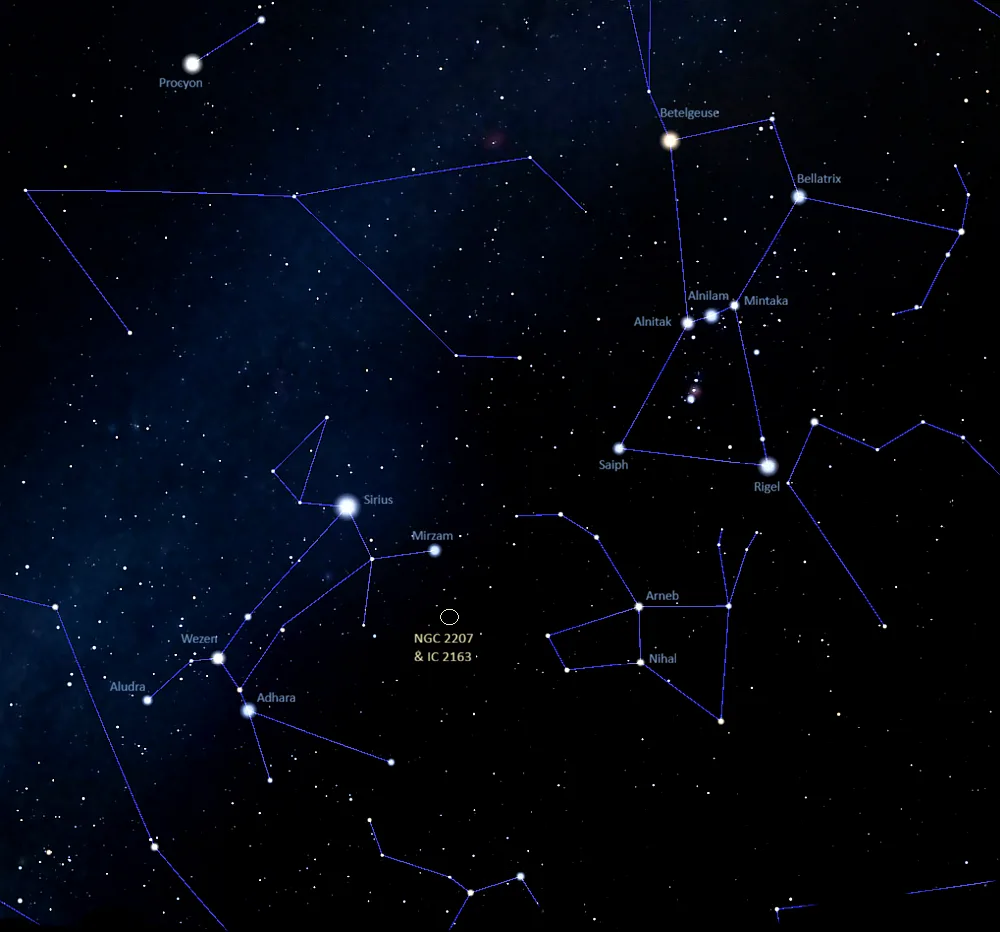
Location of the Cosmic Owl (NGC 2207 & IC 2163), image: Stellarium (annotated for this article)
Explore other deep sky objects in the Great Dog:
- Dolphin Head Nebula (Sh2-308)
- Tau Canis Majoris Cluster (NGC 2362)
- Seagull Nebula (IC 2177)
- Thor’s Helmet Nebula (NGC 2359)
NGC 2207
| Constellation | Canis Major |
| Object type | Intermediate spiral galaxy |
| Morphological type | SAB(rs)bc pec |
| Right ascension | 06h 16m 22.0336889136s |
| Declination | −21° 22′ 21.759218400″ |
| Apparent magnitude | 12.2 |
| Apparent size | 4.3′ × 2.8′ |
| Distance | 114 million light-years (35 megaparsecs) |
| Size | 123,400 light-years |
| Redshift | 0.009292 |
| Heliocentric radial velocity | 2772.8 km/s |
| Names and designations | NGC 2207, ESO 556-8, ESO-LV 556-0080, LEDA 18749, PGC 18749, UGCA 124, NVSS J061625-212213, AGC 24971, MCG-04-15-020, MRC 0614-213, RR95 132a, Cul 0614-213, GLEAM J061622-212208, WISH B0614.2-2121a, WISH B0614.2-2121b, WISH B0614.2-2121Bb, WISH B0614.2-2121Ba, PMN J0616-2122, HIPASS J0616-21, SGC 061414-2121.2, TGSSADR J061622.4-212213, 6dFGS gJ061622.0-212222, IRAS F06142-2121, 2MASX J06162209-2122217, Gaia DR3 2937977949402760704 |
IC 2163
| Object type | Barred spiral galaxy |
| Morphological type | SB(rs)c pec |
| Right ascension | 06h 16m 27.9671433048s |
| Declination | −21° 22′ 33.133211832″ |
| Apparent magnitude | 11.6 |
| Apparent size | 3.0′ × 1.2′ |
| Size | 87,650 light-years |
| Redshift | 0.009266 |
| Heliocentric radial velocity | 2765 ± 9 km/s |
| Names and designations | IC 2163, ESO 556-9, ESO-LV 556-0090, LEDA 18751, PGC 18751, UGCA 125, MCG-04-15-021, RR95 132b, SGC 061420-2121.4, Gaia DR2 2937977704590652416, Gaia DR3 2937977708884534528 |